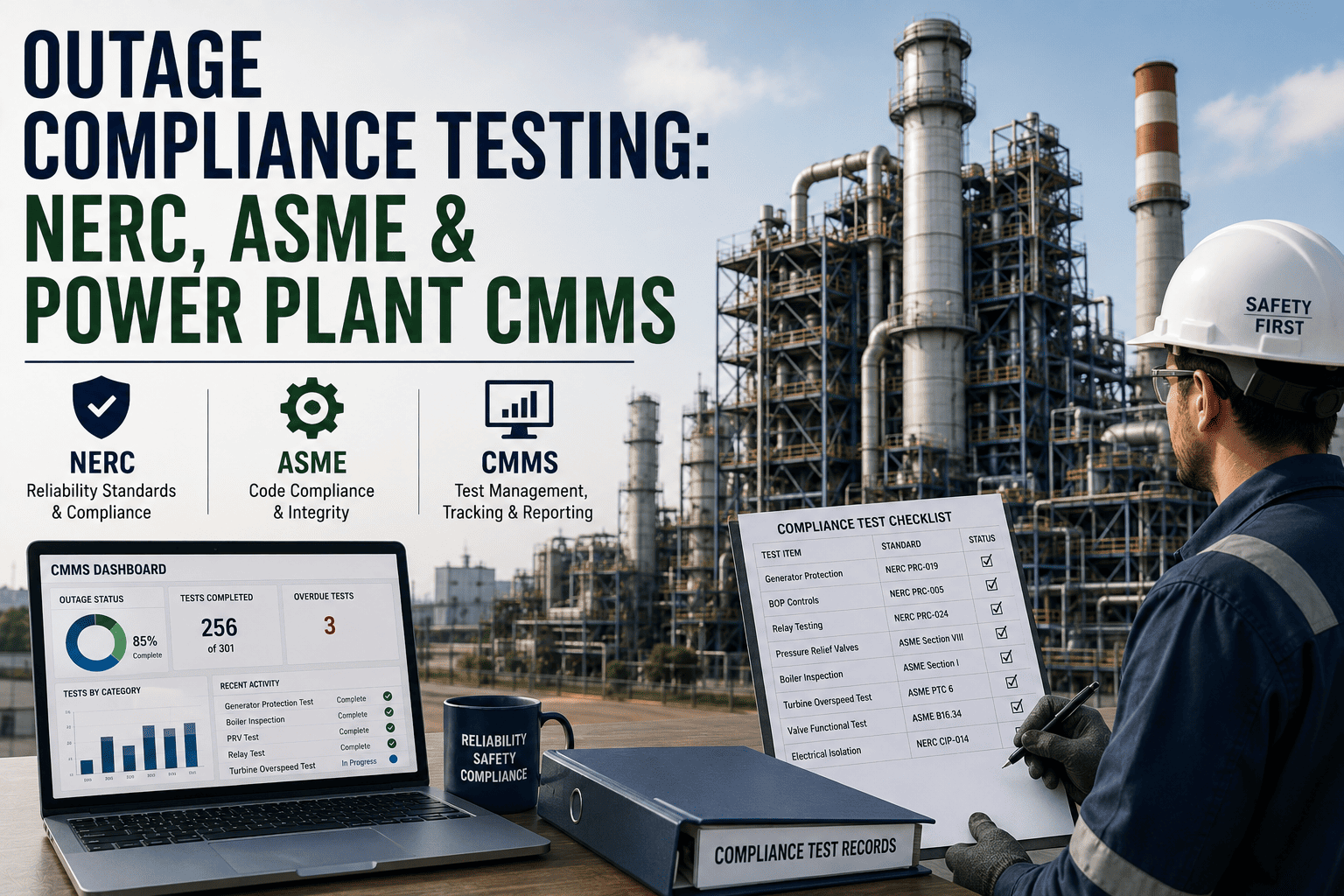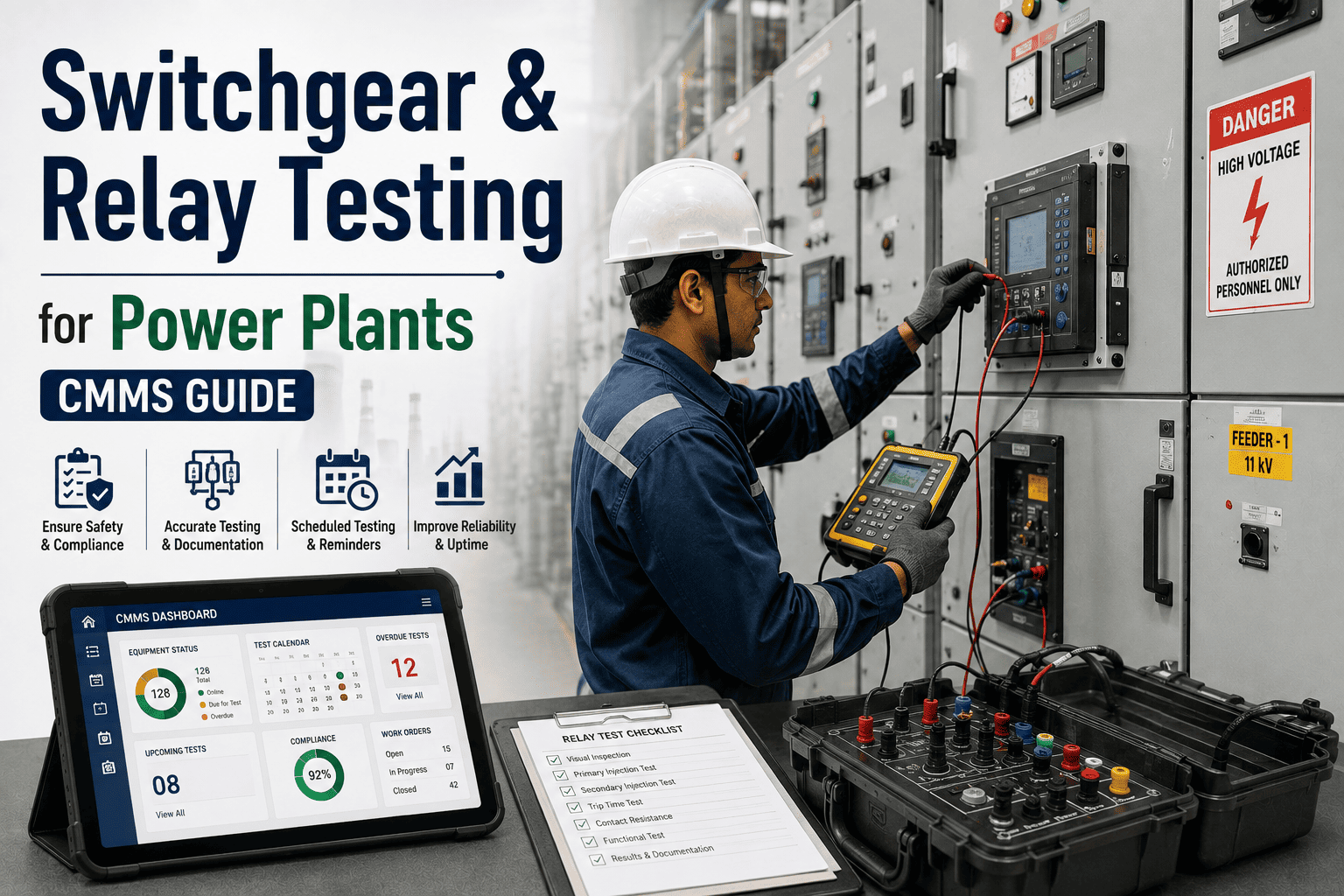
Protection relays are the last line of defense between an electrical fault and catastrophic plant damage — but they are also hidden failures by definition. A backup protection relay that has not been tested in 18 months may be non-functional today, and no operator will know until the fault it was designed to clear actually occurs. NERC PRC-005 and equivalent national standards set mandatory relay testing intervals for transmission and generation protection systems, yet compliance failures in this area remain common because most plants manage relay test schedules through spreadsheets, paper logs, and engineer memory — with no automated tracking, no due-date alerts, and no system that captures calibration evidence against each relay asset record. A single relay testing compliance gap can result in regulatory penalties exceeding $150,000 for documentation failures alone. OxMaint's CMMS converts relay testing obligations into automated workflows — asset registers, due-date scheduling, technician assignment, calibration evidence capture, and audit-ready reports — so no relay test falls through the scheduling gap and no audit arrives without complete documentation. Start your free OxMaint trial — no credit card required.
Electrical Maintenance · Compliance Tracking · CMMS
Relay Testing Schedule Management for Power Plants
Asset registers, due dates, technician assignments, calibration evidence, and audit reports — every protection relay tested on schedule, every test documented for compliance.
Relay Test Compliance — This Quarter
Differential Relays
92%
Distance Protection
87%
Buchholz Relays
68%
Overcurrent Protection
95%
Earth Fault Relays
44%
3 relays overdue — compliance window closing
$150K+
NERC penalty per documentation failure — not per operational failure — in 2024
20%
Year-over-year increase in NERC penalties in 2024 — compliance stakes are rising
PRC-005
NERC standard mandating protection system maintenance intervals — each relay has its own testing window
Hidden
Relay failures are hidden by definition — non-functional protection only reveals itself when the fault it should clear actually occurs
The Relay Types OxMaint Tracks — And What Each Test Must Verify
Differential Protection
Generator, transformer, busbar
Inject secondary currents at multiple points — verify characteristic curve matches settings and trips for internal faults while remaining stable during external faults and inrush. Test: Annual.
OxMaint captures: injection currents, trip timing, characteristic curve match, technician sign-off, test equipment ID.
Buchholz Gas Relay
Power and auxiliary transformers
Simulate gas accumulation — verify alarm and trip contacts operate at correct gas volumes per manufacturer settings. Verify sudden pressure relay trips circuit breaker within design time. Test: Annual.
OxMaint captures: gas volume at alarm and trip, response time, trip breaker confirmation, photo evidence.
Distance Protection
Transmission lines, feeders
Apply test impedances at each zone boundary — verify trip time and reach for each zone. Check power swing blocking and out-of-step logic where applicable. Test: 3 to 6 years per PRC-005.
OxMaint captures: zone reach measurements, trip times, impedance test values, settings verification.
Overcurrent and Earth Fault
MV/LV feeders, motor protection
Verify pickup current, time-current characteristic, and definite-time elements. Check directional element polarization where present. Test: Annual for critical feeders, per PRC-005 for transmission.
OxMaint captures: measured pickup vs. set pickup, time-current results, directional element test, calibration report.
Relay Tests That Are Not Documented Did Not Happen — for Audit Purposes
OxMaint assigns every relay test a due date, a technician, and a digital evidence form — so every test that happens is captured, and every test that is overdue is visible before the compliance window closes, not after the audit arrives.
From Asset Register to Audit Report — The OxMaint Relay Compliance Workflow
Step 1
Build the Relay Asset Register
Every protection relay registered in OxMaint as an individual asset — relay type, manufacturer, model, installation date, protected element, and applicable PRC-005 or national standard interval. The register is the foundation that makes everything else automatic.
→
Step 2
Auto-Schedule Test Work Orders
OxMaint generates relay test WOs on configurable intervals per relay type and protection scheme. Due-date alerts surface in the maintenance queue with the required lead time for test equipment booking and crew assignment — before the compliance window, not inside it.
→
Step 3
Capture Calibration Evidence On-Device
Technicians complete relay test checklists on mobile — injection values, trip times, settings match, calibration certificate reference, and test equipment serial number. Everything syncs to the relay asset record in real time with photo attachment support.
→
Step 4
Generate Audit-Ready Compliance Reports
OxMaint generates per-relay compliance reports — test completion rate, overdue relay count, evidence completeness, and open corrective WO aging — formatted for regulatory submission and internal compliance review without manual document compilation.
Frequently Asked Questions
How does OxMaint handle PRC-005 test interval tracking for different relay types?
Each relay is registered with its own test interval in OxMaint — reflecting its specific PRC-005 or equivalent national standard requirement. Differential relays, distance protection, and Buchholz relays can have different intervals within the same substation and OxMaint tracks them independently. Build your relay asset register in OxMaint.
Can OxMaint flag relays approaching their compliance window before the deadline?
OxMaint surfaces upcoming relay test WOs in the maintenance queue with configurable lead-time alerts — giving the team enough advance notice to book test equipment, schedule outage coordination, and assign a qualified technician before the compliance window begins to close. See the compliance alert workflow in a live demo.
What evidence does OxMaint capture to satisfy a NERC PRC-005 audit?
OxMaint captures technician name, test date, injection values, trip times, settings verification results, test equipment ID, and photo attachments against each relay test WO — all timestamped and linked to the relay asset record. Evidence packages are extractable by relay, protection system, or date range without manual compilation.
How does OxMaint handle relay setting changes that affect compliance records?
Setting changes are documented as corrective work orders in OxMaint linked to the relay asset record — creating a permanent changelog that connects every setting modification to the originating review, the authorizing engineer, and the post-change functional test that confirms correct operation. Auditors see a complete, unbroken history.
Can OxMaint manage relay testing across multiple substations or plant units?
OxMaint supports multi-site and multi-unit asset registers — relay assets are organized by substation, unit, or voltage level. Compliance dashboards can be viewed plant-wide or filtered by site, giving the electrical maintenance manager a single view of relay test status across the entire protection system portfolio. Set up your multi-unit relay register today.
Every Missed Relay Test Is an Open Compliance Finding Waiting to Be Discovered
OxMaint gives your protection engineering team a complete relay testing schedule management system — asset registers, auto-scheduled test WOs, mobile calibration evidence capture, and audit-ready compliance reports — so no relay test falls through the scheduling gap.