The turbine tripped again last Tuesday. Same unit, same symptoms, same $125,000-per-hour losses. Your maintenance team fixed it—again—and everyone moved on. But here's the uncomfortable truth: without understanding why that turbine keeps failing, you're not solving a problem. You're renting a temporary solution. Root Cause Analysis is the discipline that breaks this cycle, transforming every failure into permanent improvement. Plants that master RCA don't just fix equipment—they eliminate the conditions that cause failures in the first place. The data proves it: systematic RCA programs reduce recurring failures by up to 70% and cut unplanned downtime in half.
The Costly Fix-Fail-Repeat Cycle
Why treating symptoms keeps you trapped
Equipment Fails
Emergency Repair
"Fixed" - Back Online
$1M+annual cost of recurring failures
Break the Cycle with RCAFind the root cause → Fix it once → Never repeat
Where Forced Outages Actually Come From
Before you can fix root causes, you need to know where to look. NERC's Generating Availability Data System—tracking over 5,800 units across North America—reveals that more than half of forced outages at thermal plants trace back to a single source: boiler tube failures. Understanding this distribution helps prioritize where RCA efforts will deliver the greatest returns. Plants ready to start tracking their own failure patterns can create a free OXmaint account and begin building the data foundation for systematic improvement.
85% of human error-related outages stem from staff failing to follow procedures or flawed processes themselves
The 5 Whys: Drilling to the Real Problem
The 5 Whys technique is deceptively simple: keep asking "why" until you reach a cause that, if addressed, prevents recurrence. But simplicity doesn't mean easy. The discipline lies in following evidence at each step, resisting the urge to blame people, and stopping only when you've reached a systemic fix. Here's how it works in practice—and why the fifth "why" often reveals something very different from what you expected at the start.
5 Whys Analysis: Turbine Bearing Failure
1
Why did the turbine trip?
Bearing temperature exceeded 180°F alarm threshold
2
Why did bearing temperature exceed threshold?
Insufficient oil reaching the bearing surface
3
Why was oil flow insufficient?
Oil filter was 80% blocked, restricting flow rate
4
Why was the filter blocked?
Filter replacement was 60 days overdue
5
Why was replacement overdue?
PM schedule wasn't updated when vendor changed filter specification from 90-day to 45-day interval
ROOT CAUSE IDENTIFIED
Corrective Actions
Update PM task to 45-day filter interval
Create vendor change notification procedure
Audit all PM schedules against current vendor specs
Fishbone Diagram: Mapping All Contributing Factors
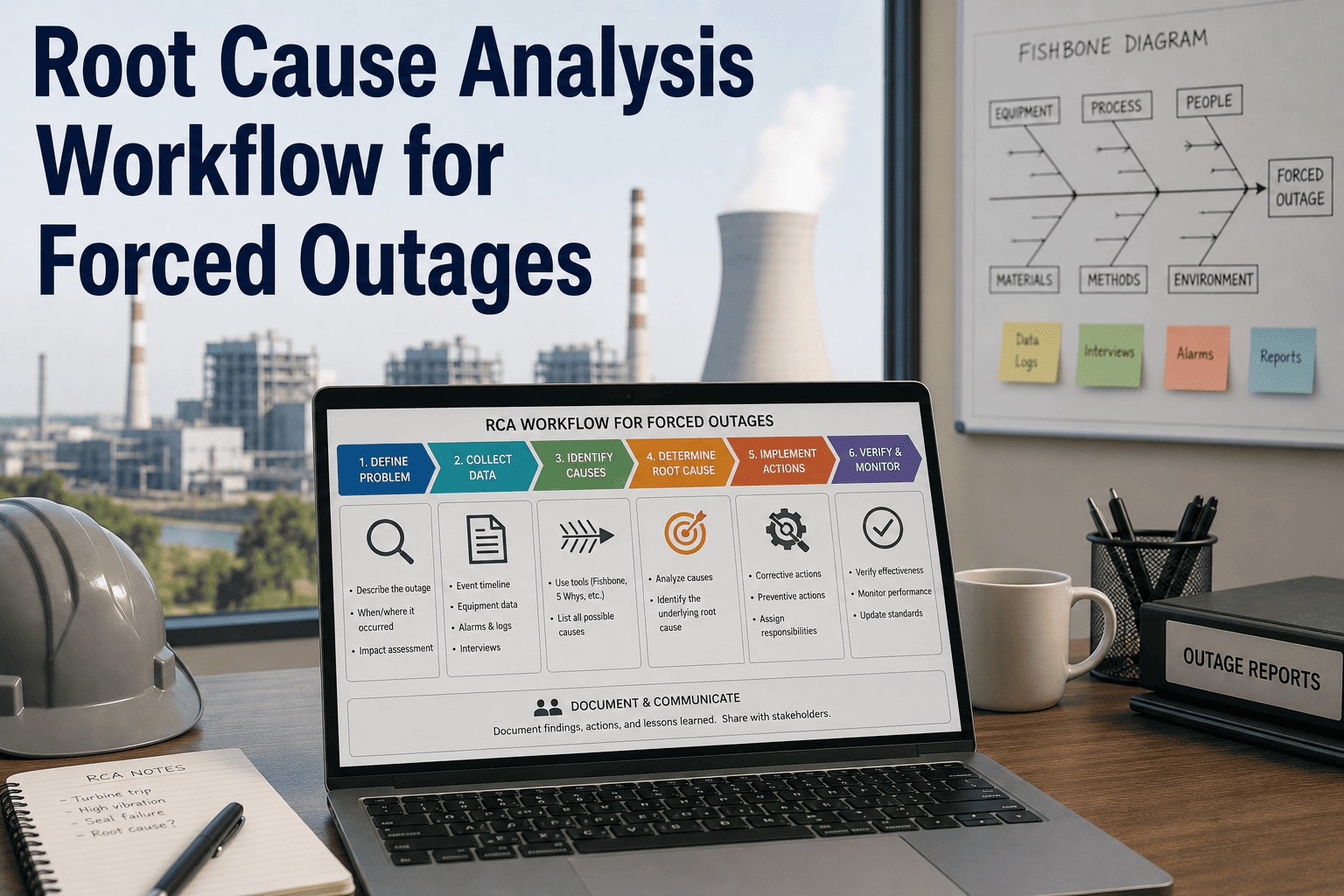
When failures have multiple interacting causes—as most serious ones do—the Fishbone diagram prevents tunnel vision. By systematically exploring six categories (People, Machine, Method, Material, Measurement, Environment), teams uncover factors that linear analysis might miss. The visual format also makes it easier to communicate findings to stakeholders and build consensus around corrective actions. To see how this integrates with automated work order generation, book a demo of OXmaint's RCA workflow.
Problem:Recurring Boiler Tube Failures
People
Insufficient inspector trainingStaff shortages during outagesProcedure shortcuts under pressure
Machine
Aging tube material (25+ years)Worn sootblower alignmentInadequate circulation design
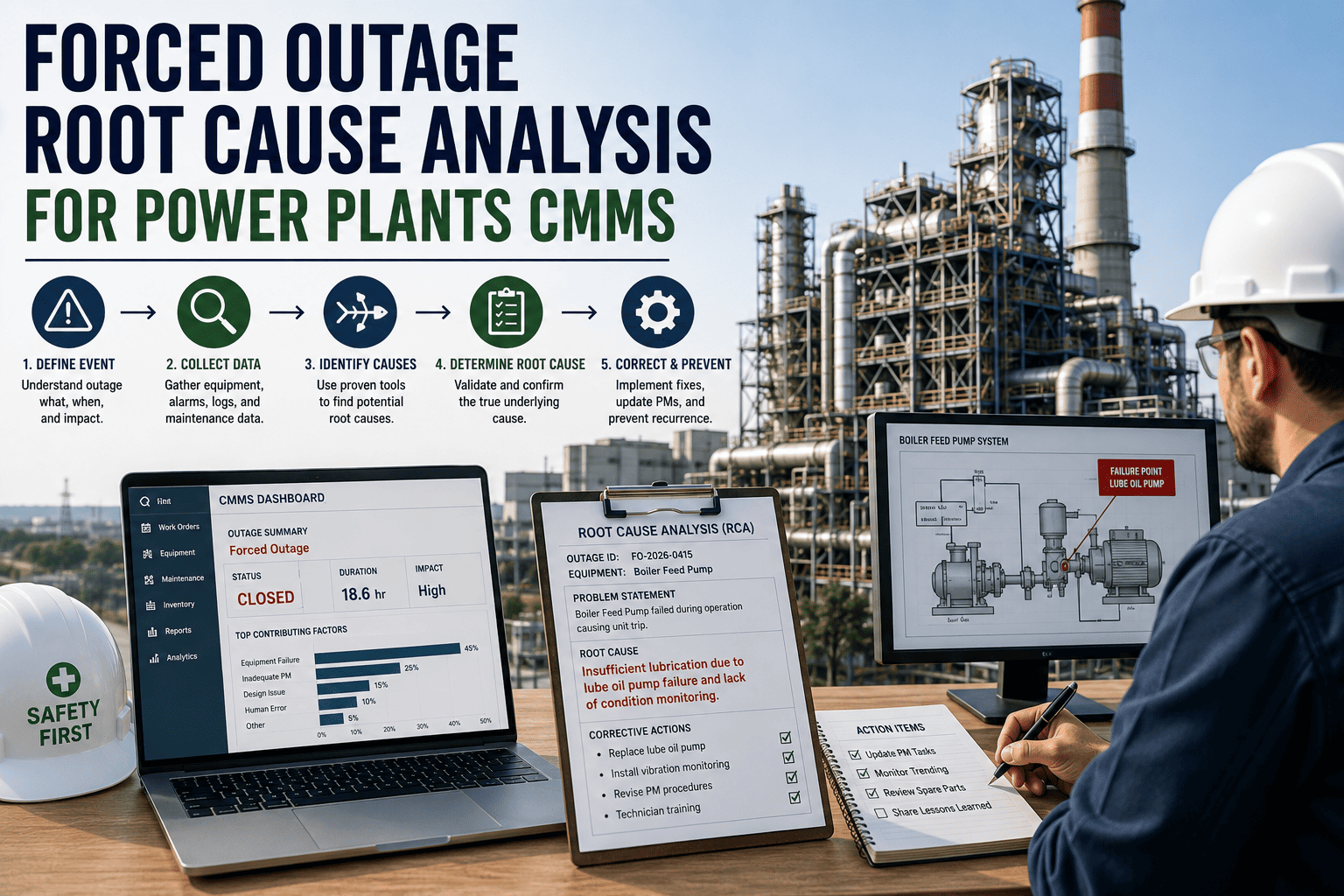
Root Cause Analysis creates value only when findings translate into permanent changes. A CMMS serves as the connective tissue between investigation and execution: it stores the historical data needed for analysis, documents RCA findings, generates corrective work orders, updates PM schedules, and tracks whether solutions actually prevent recurrence. Without this closed loop, even the best RCA reports become forgotten documents. Plants that start tracking failures systematically with OXmaint build the foundation for continuous reliability improvement.
Generate work orders, update PMs, revise procedures
04
Verify
Monitor MTBF, confirm no recurrence, close RCA
Expert Perspective: Building an RCA Culture
"The most successful plants view RCA as a continuous learning loop, not a one-time project. Every chronic machine failure has a human story behind it—production pressure, rushed startups, inadequate training. Effective root cause analysis blends technical evidence with cultural awareness. It requires leaders who create psychological safety where technicians can discuss errors without fear."
Focus on systems, not people. Ask what process allowed this failure—not who made a mistake.
Verify corrective actions work. An RCA that ends with a new procedure but no behavioral change is only half done.
Document for the future. Create searchable knowledge so lessons apply fleet-wide, not just to one unit.
The plants that achieve world-class availability don't have better equipment—they have better learning systems. Every failure becomes organizational intelligence. Every RCA feeds a growing knowledge base that prevents the same mistakes across the entire fleet. When your CMMS automatically flags assets with three failures in 60 days and generates an RCA task, you've built reliability into your culture, not just your maintenance schedule. Schedule a demo to see how OXmaint enables this systematic approach.
Transform Every Failure Into Improvement
OXmaint gives your team the tools to investigate systematically, document thoroughly, and prevent recurrence permanently.
Conduct RCA for any failure causing significant downtime, recurring failures on the same equipment, safety incidents, near-misses with high-consequence potential, or quality issues affecting output. Many organizations set automatic triggers—such as three corrective work orders within 60 days—to ensure RCA happens systematically rather than only after catastrophic events.
What's the difference between the 5 Whys and Fishbone diagram?
The 5 Whys drills down a single causal chain by repeatedly asking "why" until reaching a root cause—ideal for straightforward problems with linear cause-and-effect. The Fishbone diagram maps all potential contributing factors across multiple categories simultaneously, making it better for complex failures with multiple interacting causes. Most effective programs use both: Fishbone to brainstorm possibilities, then 5 Whys to drill into the most likely contributors.
How does CMMS software support Root Cause Analysis?
CMMS provides the data foundation for effective RCA: maintenance history, failure patterns, work order details, and equipment performance trends. It documents RCA findings in a searchable format, generates corrective work orders, updates PM schedules based on findings, and tracks whether corrective actions actually reduce recurrence. This closed-loop system ensures investigations lead to lasting improvements.
How long does a proper Root Cause Analysis take?
Timeline varies with complexity. Simple failures with obvious causes might take a few hours using the 5 Whys. Complex multi-factor failures requiring cross-functional teams, data analysis, and hypothesis testing can take days to weeks. The key is not rushing to conclusions—a quick "root cause" that doesn't address the actual problem wastes resources and allows failures to continue.
What are the most common mistakes in RCA?
Common pitfalls include stopping too early (accepting symptoms as root causes), focusing on people rather than systems, failing to verify that corrective actions work, not documenting findings for future reference, and treating RCA as a one-time project rather than ongoing discipline. The biggest mistake: conducting investigations without follow-through. An RCA report that sits in a drawer prevents nothing.



-root-cause-analysis-and-prevention-programs.png)

