In a substation, the difference between a caught fault and a catastrophic one is often a single inspection line that got skipped — a breather gone saturated, a bolted joint running hot, a breaker's gas pressure drifting low. The trouble is that when every engineer inspects to their own mental list, the same asset gets checked differently each visit, and the gaps move around. A standard, equipment-grouped checklist fixes that: the same points, every transformer, every round. This guide lays out that checklist across transformers, breakers, disconnectors, busbars and instrument transformers. OXMAINT AI — the AI-powered maintenance management software — puts this checklist on a schedule per asset and captures every result.
Power Generation · Substation & Switchyard · Inspection Checklist · 2026
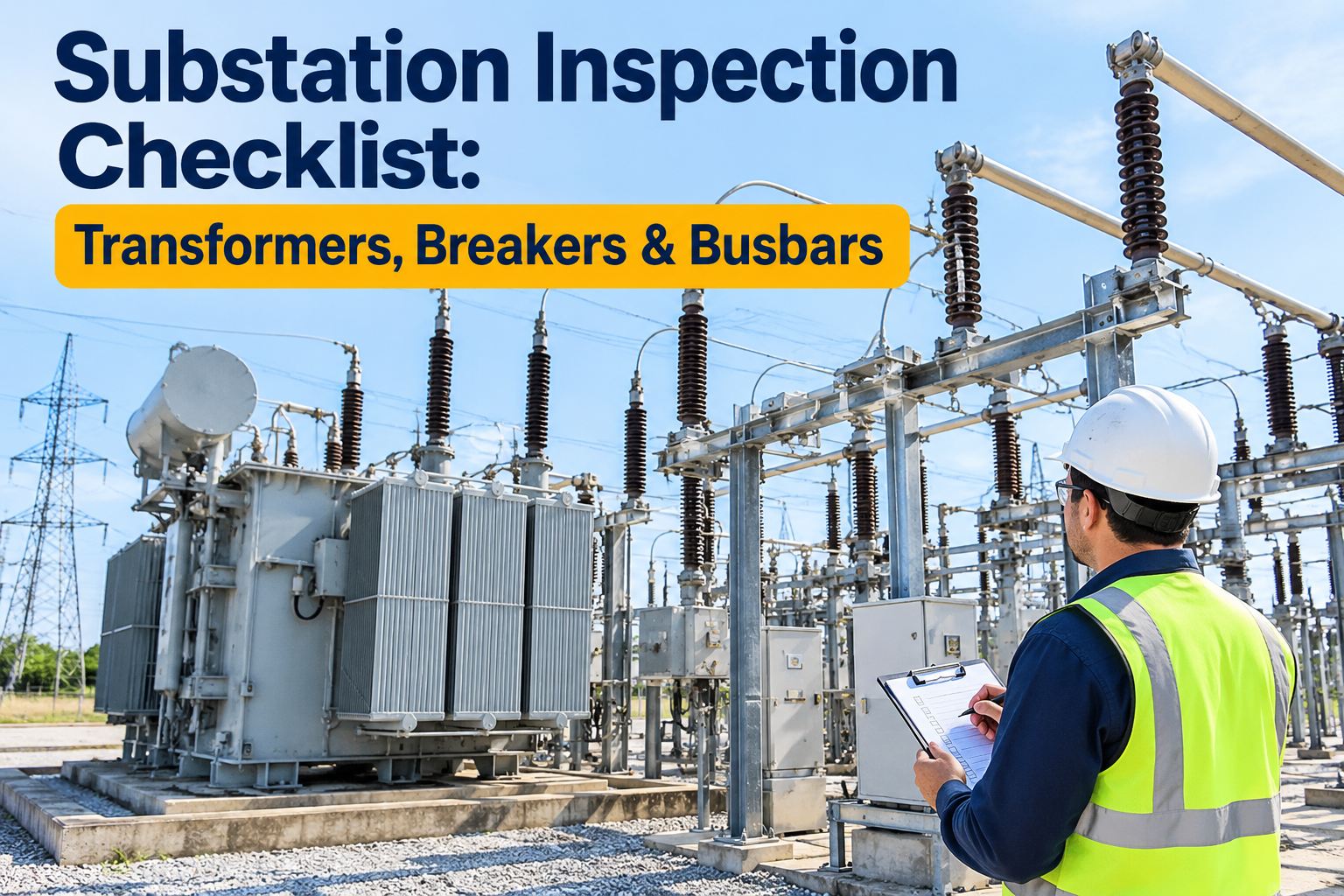
Substation Inspection Checklist
One standard checklist across the switchyard — transformers, breakers, disconnectors, busbars and instrument transformers — so the same points get checked on every asset, every round. The OXMAINT AI maintenance management software holds the schedule and the record.
Transformers
Breakers
Busbars
CT / VT
One standard
the same points on every asset, so gaps don't move round to round
By equipment
grouped the way the switchyard is built — nothing falls between roles
On a schedule
monthly rounds through annual tests, each on its own cadence
Recorded
every reading logged per asset, so drift and trends are visible
Why One Standard Checklist Across the Switchyard
Inconsistent inspection is the quiet risk in substation maintenance — when the procedure lives in each engineer's head, coverage varies and findings slip. A single standard checklist makes every round consistent and comparable; book a demo to see standard rounds in OXMAINT AI.
Consistent coverage
The same points on every asset every time, so nothing depends on which engineer walked the round.
Comparable trends
When readings are taken the same way each round, a slow drift in temperature or gas actually shows up.
Fewer missed faults
A fixed list catches the breather, the hot joint and the low gas pressure that an ad-hoc walk would pass.
Audit-ready record
Each round logged against the asset gives a defensible history for regulators, insurers and root-cause work.
Inspect safely. Many of these checks are visual and can be done from a safe distance with the equipment live; anything requiring contact or close access needs the asset de-energized, isolated and earthed under a permit-to-work and lockout procedure. Always follow your site's safety rules and clearance distances — treat every conductor as live until proven dead.
The Substation Inspection Checklist
Six equipment groups, each with its checks and interval. The chip on each line shows how often it's due. Work them per asset on their cadence; start free and put every point on a schedule in OXMAINT AI.
Frequency
MMonthly
QQuarterly
SASemi-annual
AAnnual
A Reading Taken the Same Way Every Round Is a Trend. One That Isn't Is Noise.
The value of a substation round is the trend — oil temperature, gas pressure, a joint's thermal signature over time. The OXMAINT AI maintenance management software captures each reading against the asset on a standard form, so drift surfaces as a signal instead of hiding in scattered paper logs.
How OXMAINT AI Runs Substation Inspections
A standard checklist only holds when the rounds actually run and the results land somewhere they can be compared. Here's what the OXMAINT AI maintenance management software brings; start free and run your switchyard on a plan in OXMAINT AI.
Scheduled rounds per asset
Monthly through annual checks on their own cadence for every transformer, breaker and bay, so none lapses.
One standard form
The same checklist on every engineer's device, so coverage doesn't depend on who walked the round.
Reading trends
Oil temperature, gas pressure and thermal readings trended per asset, so slow drift becomes visible.
Auto work orders
A failed check or out-of-range reading raises a work order with the asset, finding and parts attached.
Thermography logging
Thermal scans attached to the joint or bay, so hot-spot history is tracked over time, not lost on a camera.
Audit-ready history
Every round, reading and repair on record per asset, so the inspection trail stands up to any review.
“
Every engineer had their own way of walking the substation, so our records were a patchwork — some bays checked thoroughly, others barely noted. Moving everyone onto one standard checklist per asset closed that overnight. Now a rising oil temperature on a transformer shows up as a trend because it's logged the same way every month, and a hot busbar joint from a thermal scan turns straight into a work order. The rounds finally give us data we can act on instead of a stack of inconsistent sheets.
Substation Maintenance Engineer · Transmission Utility
Frequently Asked Questions
What should a substation inspection checklist cover?
Every major equipment group: power transformers (oil, temperature, breather, bushings, cooling, Buchholz), circuit breakers (gas or oil, mechanism, coils, timing), disconnectors and isolators (contacts, interlocks, earth switch), busbars and connections (thermography, joints, insulators), instrument transformers (oil, terminals, earthing), and the general systems — earthing, arresters, DC battery, fencing and fire protection.
Start free and schedule the full checklist.
How often should a substation be inspected?
On mixed intervals: visual rounds and key readings monthly, most equipment checks quarterly, mechanism and connection work semi-annually, and the deeper tests — transformer oil dissolved-gas analysis, breaker timing and contact-resistance — annually. The exact cadence depends on voltage level, asset age, criticality and your regulator's requirements.
Why is thermography important in substation inspection?
A loose or corroded busbar joint or connection heats up under load long before it fails, and a thermal scan catches that hot spot while the equipment is still live and the fix is simple. Tracking the thermal signature of each joint over time turns a one-off scan into a trend that predicts failures.
Book a demo to see thermography logging.
Which checks can be done while equipment is live?
Many visual and instrument checks — oil levels, gauges, gas pressure, breather colour, thermography, fencing and vegetation — are done from a safe distance with equipment energized. Anything needing contact or close access requires the asset de-energized, isolated and earthed under a permit-to-work. Always follow site safety rules and treat every conductor as live until proven dead.
How does a CMMS help with substation maintenance?
It puts one standard checklist on every engineer's device, schedules each check on its own interval per asset, captures readings digitally so they trend over time, turns a failed check or out-of-range value into a work order automatically, logs thermography against the joint, and keeps an audit-ready history — so inspections are consistent and the data is actually usable.
Inspect Every Asset the Same Way — and Catch Faults Before They Trip.
Standardize your switchyard rounds with the OXMAINT AI maintenance management software — one checklist per asset, scheduled intervals, trended readings, thermography logging, automatic work orders and an audit-ready record. Turn inconsistent inspections into data you can act on.