The building envelope is your property's first and most critical line of defence against the elements — yet it remains one of the most neglected areas of commercial and residential asset management. From roofs and façades to windows, foundations, and waterproofing membranes, every component of the exterior shell works together to preserve structural integrity, control energy loss, and protect everything inside. Without a structured building envelope maintenance programme, minor defects silently escalate into six-figure repair liabilities.
Smarter Building Envelope Maintenance Starts Here
Schedule inspections, track defects, and protect your property's structural integrity — all from one preventive maintenance platform.
What Is the Building Envelope and Why Does It Matter?
The building envelope — also called the building shell or building skin — refers to the physical boundary separating a structure's conditioned interior from the external environment. It encompasses every element that controls the flow of heat, air, moisture, and light between inside and outside.
Its primary functions are structural load-bearing, weatherproofing, thermal regulation, and acoustic management. When even one component fails — a cracked caulk joint, a failed window seal, a section of compromised waterproofing — the consequences cascade rapidly through connected systems.
Facilities managers across the UK, Canada, Germany, and the UAE are increasingly recognising that a proactive exterior maintenance strategy is not a cost centre — it is a capital preservation tool that directly protects asset valuation and reduces lifecycle operating expenditure.
Core Components of the Building Envelope
Effective exterior maintenance begins with understanding the interconnected components that collectively form the building shell. Each element has its own inspection cadence, degradation mechanism, and failure signature.
Roofing Systems
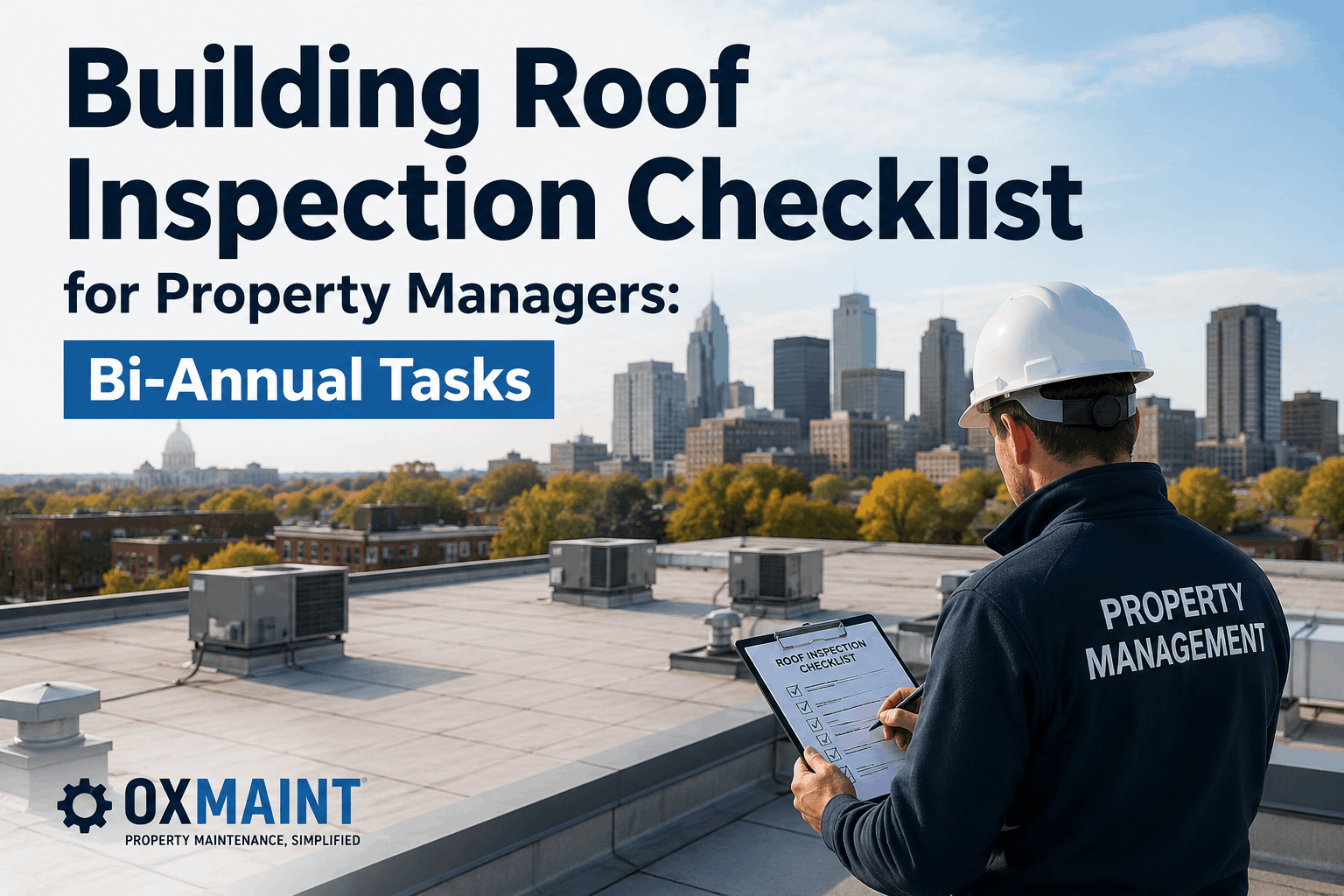
The roof is the envelope's primary weatherproofing layer. Membrane blistering, flashing separation, drainage blockage, and UV-induced degradation are the most common failure modes — all preventable with twice-yearly inspection.
Exterior Walls & Façades
Masonry, cladding, render, and curtain walling are all vulnerable to water ingress through cracked joints. Freeze-thaw cycling in Canada and Germany, and UV exposure in the UAE demand structured annual inspection.
Windows, Glazing & Curtain Walls
Failed glazing seals cause cold bridging, condensation, and hidden moisture damage to surrounding wall assemblies. Curtain wall anchor fixings, gaskets, and movement joints require verified inspection on a documented cycle.
Foundations & Below-Grade Waterproofing
Water ingress through basement walls and slab joints signals membrane failure that — if unaddressed — causes structural deterioration and mould. Tanking, cavity drain, and crystalline systems each require tracked maintenance records.
Caulking, Sealants & Expansion Joints
Sealant joints at window perimeters, movement joints, and façade panel interfaces reach end-of-life within 7–12 years. Proactive recaulking is the single highest-value, lowest-cost envelope maintenance activity available — preventing the majority of water ingress escalations. Sign up free to schedule sealant inspections automatically.
Building Envelope Inspection: A Structured Approach
Unstructured walk-around inspections generate inconsistent results and miss latent defects. Professional building envelope inspection programmes use condition grading systems, photographic documentation, and defect trending to turn raw inspection data into prioritised maintenance schedules. Book a demo to see how OxMaint structures this process.
Desktop Review and Documentation Audit
Before any site activity, review existing maintenance records, previous inspection reports, warranty documentation, and as-built drawings. Identify components approaching end-of-warranty or design life that warrant elevated inspection attention.
Visual Condition Assessment
Systematic visual inspection of all accessible envelope surfaces using standardised condition grading (1–5 scale). Photograph all defects with geo-referenced location data to enable trend comparison across inspection cycles.
Invasive and Diagnostic Testing
Where visual inspection identifies suspected latent defects, deploy targeted diagnostic tools — thermographic surveys for insulation voids, water testing for waterproofing integrity, and borescope investigation for concealed cavity conditions.
Defect Prioritisation and Cost Planning
Categorise defects by urgency: immediate safety or water ingress risk, short-term intervention within three to twelve months, and planned renewal within the capital expenditure cycle. Generate cost estimates for each priority tier.
Scheduled Maintenance Programme Integration
Upload inspection findings into a preventive maintenance scheduling platform to generate automated work orders, inspection reminders, and asset condition history trails that satisfy insurer, lender, and compliance audit requirements.
How AI Vision Enhances Building Envelope Maintenance
Artificial intelligence — specifically computer vision — is transforming how facilities professionals inspect, monitor, and maintain building exteriors. What once required scaffolding, rope access, and weeks of manual survey work can now be completed faster, more safely, and with significantly greater accuracy using AI-powered inspection tools.
Automated Defect Detection
AI vision systems analyse high-resolution imagery to automatically identify cracks, spalling, sealant failure, and coating degradation across façades, roofs, and cladding panels — flagging anomalies without requiring physical access at height.
Hidden Moisture & Insulation Faults
AI-powered thermal analysis interprets infrared imagery to locate moisture infiltration behind cladding, insulation voids within cavity walls, and air leakage pathways — defects completely invisible to conventional visual inspection.
Continuous Structural Monitoring
Fixed AI vision sensors monitor structural movement, crack propagation, and surface change continuously — alerting facilities managers when indicators exceed thresholds, before defects become structural concerns. Critical in Germany and Canada.
Predictive Maintenance Scheduling
When AI vision data integrates with a building maintenance platform, the system identifies degradation trajectories and predicts when components require intervention — converting reactive budgets into planned capital programmes.
Weatherproofing and Waterproofing: The Technical Core of Envelope Performance
Weatherproofing is not a single product or system — it is a performance outcome achieved through the coordinated performance of multiple overlapping components. Waterproofing membranes, drainage planes, flashings, sealants, and surface treatments must all function correctly and in sequence to prevent water from reaching structural elements. Sign up free and track every component in one place.
Roof Waterproofing Systems
Built-up roofing, single-ply membranes (TPO, EPDM, PVC), liquid-applied systems, and green roof assemblies each have distinct inspection criteria and maintenance requirements. Annual inspection should verify membrane integrity at seams and terminations, drainage outlet condition, upstand height adequacy, and ballast or overburden stability.
Below-Grade and Podium Waterproofing
Basement and podium waterproofing systems are under permanent hydrostatic pressure and cannot be accessed for inspection without significant disruption once construction is complete. Maintaining accurate records of original waterproofing specification and installation is critical — monitor internal spaces for early ingress indicators such as moisture readings, salt efflorescence, and humidity trends.
Façade Weatherproofing and Drainage Management
Modern façade systems rely on a pressure-equalised drainage plane rather than a single external barrier. When drainage channels within the cavity become blocked by debris, retained water causes accelerated corrosion of fixings and structural damage to load-bearing substrates. Annual cavity flushing and drainage inspection is a low-cost activity that prevents high-consequence failure.
Building Envelope Maintenance Software and Platform Comparison
Selecting the right maintenance management platform for building envelope programmes requires evaluating scheduling capability, mobile inspection tools, asset tracking, and reporting depth. The table below compares the primary system categories available to facilities teams.
| Platform Type | Key Capabilities | Best For | Limitation | OxMaint Advantage |
|---|---|---|---|---|
| Spreadsheet-Based Tracking | Manual log of inspections and work orders | Single-asset owner-operators | No automation, audit trail gaps, version control issues | Automated scheduling eliminates manual tracking |
| Generic CMMS Software | Work order management, asset registers | Multi-trade facilities teams | Not configured for envelope-specific inspection workflows | Built-in envelope inspection templates and checklist library |
| BIM-Integrated Platforms | 3D model-linked defect recording | Large new-build commercial assets | High implementation cost, requires BIM model as prerequisite | No BIM prerequisite — works on existing assets from day one |
| AI-Powered Maintenance Platforms | Predictive scheduling, condition trending, mobile inspection, automated alerts | Portfolio managers, FM contractors, asset owners | Requires structured data input for maximum predictive accuracy | OxMaint combines preventive scheduling with AI-powered condition tracking in one system |
| Drone Inspection Software | Automated flight planning, imagery analysis, defect mapping | High-rise and large portfolio surveys | Inspection data siloed from maintenance workflow | OxMaint integrates external inspection data into the maintenance scheduling workflow |
Key Benefits of a Structured Exterior Maintenance Programme
The business case for preventive building envelope maintenance is straightforward — but it must be articulated in terms that resonate with asset owners, boards, and finance committees who control capital allocation decisions. Book a demo and let us walk you through the numbers for your asset.
Protected Property Valuation
A documented maintenance history is a tangible asset at sale, refinancing, and insurance renewal. Lenders discount assets with deferred liabilities — structured programmes eliminate that risk.
Reduced Energy Costs
Failed seals and degraded insulation account for 15–25% of heating and cooling spend. Restoring envelope airtightness delivers measurable, immediate energy savings.
Regulatory & Insurance Compliance
UK, Canada, Germany, and UAE building owners face stringent obligations on structural safety and energy efficiency. A maintenance audit trail satisfies regulators and insurers alike.
Lower Whole-Life Expenditure
Every £1 in preventive maintenance eliminates £3–£5 in future reactive repair. Planned intervention at low unit cost consistently outperforms emergency response spending.
Better Internal Environment
Water ingress, mould, cold bridging, and noise — all consequences of envelope failure — harm occupant health and productivity. Prevention protects lease renewals and tenant scores.
ESG and Net-Zero Alignment
Envelope performance is directly linked to operational carbon. Upgrading insulation and air barriers is one of the most effective paths to reducing carbon intensity under ESG obligations.
Common Challenges in Envelope Maintenance — and How to Solve Them
Most building envelope failures are not sudden — they are predictable problems that go unaddressed due to reactive habits, poor recordkeeping, or inconsistent contractor standards.
Inspections Too Infrequent
Owners only inspect after complaints — by then water ingress has already caused internal damage and repair costs have multiplied.
Use a risk-based schedule: roofs and expansion joints annually, cladding every two years, coatings every three to five years.
No Centralised Records
PDFs scattered across inboxes make it impossible to track degradation trends or prove compliance to auditors and insurers.
Store all inspection data, photos, and work orders in a central maintenance platform with a permanent, searchable history.
Reactive Budget Planning
Without defect tracking, major spend — roof replacement, façade re-sealing — hits as an emergency rather than a planned capital line.
Build 5–10 year capex plans from condition data so budget is secured ahead of component end-of-life at planned rates, not crisis premiums.
Contractor Inconsistency
Without standard checklists, maintenance quality varies visit to visit — leaving defects undetected between inspections.
Embed standardised scope, acceptance criteria, and reporting specs into the maintenance system so every contractor visit is consistent and auditable.
Best Practices for Long-Term Building Envelope Performance
The most resilient building envelope maintenance programmes share a set of operating principles that distinguish them from reactive, complaint-driven approaches. These practices are applicable across all asset classes and all geographies, from the UAE's extreme heat to Canada's harsh winter cycling. Get started free and put these principles into a working maintenance plan.
Maintain a Complete Component Register with Condition Baselines
Document every envelope component — roof system, façade zone, window type, waterproofing membrane, sealant line — with installation date, specification, warranty status, and initial condition grade. This register is the foundation of all subsequent inspection and capital planning activity.
Inspect After Extreme Weather Events, Not Only on Fixed Schedules
Storm events, prolonged frost, hail, and high-wind episodes can cause acute damage that does not align with annual inspection cycles. Programme targeted post-event inspections of high-risk components — flat roofs, rooflights, exposed cladding panels — as a standing protocol.
Prioritise Sealant and Caulking Maintenance Above All Cosmetic Work
Sealant failure is the single most common entry point for water ingress in modern building envelopes. Recaulking aged or failed sealant joints should always take budget priority over cosmetic exterior painting or surface cleaning — the structural consequences of ignoring sealant failure far exceed the cost of the work itself.
Integrate Envelope Maintenance with Energy Performance Monitoring
Use energy consumption data as a secondary indicator of envelope performance. Unexplained increases in heating or cooling demand often signal insulation degradation or airtightness failure months before visible symptoms appear — allowing targeted investigation before significant heat loss occurs.
Use Automation to Eliminate Inspection Scheduling Gaps
Manual scheduling of recurring inspections is consistently unreliable — reminders are missed, staff changes disrupt continuity, and inspection frequency drifts. Deploy a preventive maintenance automation platform that generates inspection work orders automatically, assigns them to the correct contractor or in-house technician, and escalates overdue tasks without manual follow-up.
Frequently Asked Questions
How often should a building envelope be inspected?
A minimum annual inspection of high-risk components — flat roofs, expansion joints, below-grade waterproofing, and window perimeter seals — is the industry-standard baseline. Lower-risk components such as exterior cladding and rendered surfaces should be inspected every two years. After significant storm or frost events, targeted post-event inspections should be conducted outside the normal schedule.
What is the most common cause of building envelope failure?
Sealant and caulking degradation is the single most common cause of water ingress through modern building envelopes. Sealant joints at window perimeters, movement joints, and façade panel interfaces have a typical service life of seven to twelve years — well within the operational life of buildings that often go decades without a systematic recaulking programme.
What does building envelope maintenance include?
Building envelope maintenance covers inspection and remediation of roofing systems, exterior walls, façade cladding, windows, doors, glazing systems, foundation and below-grade waterproofing, expansion joints, drainage systems, insulation layers, exterior coatings, and all associated sealants and flashings. It also encompasses monitoring of structural movement, cold chain thermal performance, and air permeability.
How does preventive maintenance reduce building envelope costs?
Preventive maintenance identifies defects at their earliest stage — when remediation scope is smallest and unit cost is lowest. Industry data indicates a consistent 3:1 to 5:1 ratio between reactive repair cost and the equivalent preventive maintenance investment. Structured programmes also enable planned capital expenditure that avoids emergency contractor premiums and minimises disruption to building occupants.
Can AI tools be used for building envelope inspection?
Yes. AI vision systems integrated with drone imagery, fixed cameras, and thermal sensors can automatically detect façade cracks, coating degradation, moisture infiltration, and insulation voids across entire building exteriors. When connected to a maintenance management platform, these systems generate automated defect reports and maintenance work orders — significantly reducing inspection cost and improving defect detection accuracy compared to manual survey methods.
Protect Your Property Investment with Structured Envelope Maintenance
OxMaint's preventive maintenance scheduling platform automates building envelope inspection cycles, tracks component condition over time, and generates the documented maintenance history your insurers, lenders, and regulators require.