Commercial properties lose an average of $12,800 per unplanned HVAC shutdown — factoring in emergency contractor
premiums, tenant disruption costs, and temporary cooling or heating rentals. For property managers overseeing
multi-tenant buildings, retail centers, or office complexes, a structured HVAC maintenance checklist is not optional
— it is the single most effective tool for preventing tenant complaints, protecting lease renewals, and controlling
operating expenses. Properties following a disciplined maintenance checklist reduce HVAC emergency calls by 71% and
extend equipment life by 25–40%. Start your free trial
today and digitize your HVAC maintenance checklist so nothing falls through the cracks. Schedule a 30-minute demo with our
commercial property specialists to see checklist automation in action.
Reactive / Ad-Hoc
HVAC Failure Detection
After Tenant Complaints
Average Emergency Repair Cost
4.2x Standard Rate
Annual HVAC Downtime
120–280 Hours Per Building
Tenant Satisfaction Impact
18–32 Complaints Per Year
Checklist-Driven / Preventive
HVAC Failure Detection
Caught During Scheduled Inspections
Average Repair Cost
1x Planned Rate
Annual HVAC Downtime
25–60 Hours (71% Reduction)
Tenant Satisfaction Impact
2–5 Complaints Per Year
Average Annual Savings for a 200K SF Property:
$48,000–$92,000
Seasonal HVAC Maintenance Checklist Breakdown
Commercial HVAC systems demand different attention at different times of year. Missing seasonal tasks creates
compounding failures — a skipped spring coil cleaning leads to a midsummer compressor burnout that costs 8x what the
cleaning would have. Property managers using Oxmaint
automate seasonal checklist scheduling so every task triggers at the right time with the right technician
assignment.
01
Spring Prep
Clean condenser and evaporator coils
Check refrigerant levels and test for leaks
Inspect and replace air filters
Test thermostat calibration accuracy
Focus: Cooling Readiness
02
Summer Monitoring
Monitor compressor amperage weekly
Clear condensate drain lines monthly
Inspect belt tension and alignment
Verify economizer operation and dampers
Focus: Peak Performance
03
Fall Transition
Test heating system ignition and burners
Inspect heat exchangers for cracks
Flush and treat cooling towers
Check gas connections and safety valves
Focus: Heating Readiness
04
Winter Operations
Monitor boiler pressure and safety relief
Inspect pipe insulation for damage
Test freeze protection controls
Verify exhaust fan and ventilation rates
Focus: Reliability & Safety
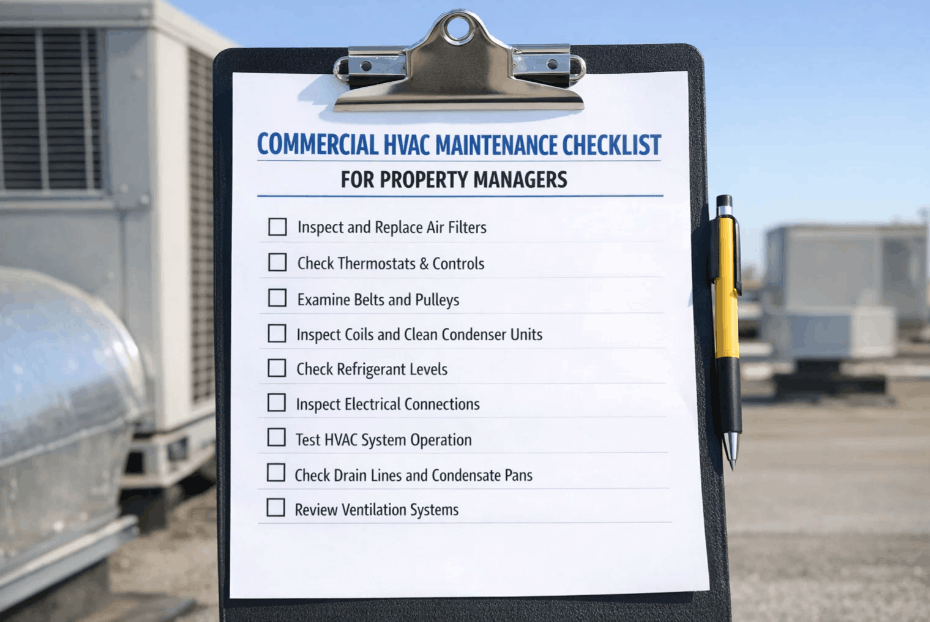
Monthly HVAC Maintenance Checklist
These tasks must be completed every month without exception. Each item takes 5–15 minutes per unit and prevents the
compounding failures that lead to emergency breakdowns. Property managers using Oxmaint track every item digitally with photo verification and timestamped completion
records.
Critical HVAC Components Every Property Manager Must Inspect
Not every HVAC component carries equal risk. These six systems account for 88% of commercial HVAC failures and 91% of
emergency repair spending. Prioritizing checklist coverage on these components delivers the highest protection per
inspection hour invested.
Rooftop Units (RTUs)
38%
Of all commercial HVAC failures — compressors, economizers,
contactors, capacitors
Air Handling Units
22%
Fan motors, belt drives, coils, filters, and damper actuators require
quarterly checks
Controls & Thermostats
15%
Sensor drift, calibration errors, and programming issues waste energy
silently
Ductwork & Insulation
12%
Leaks waste 20–30% of conditioned air — inspect joints, seals, and
insulation integrity
Refrigerant Systems
$8K+
Average cost per refrigerant leak repair — EPA compliance and
environmental liability
Electrical Components
Fire Risk
Contactors, capacitors, wiring connections — thermal scanning
prevents arc flash hazards
Monthly, Quarterly & Annual Checklist Tasks
Effective commercial HVAC maintenance follows a tiered frequency model. Monthly tasks catch fast-developing issues.
Quarterly inspections address wear-based degradation. Annual tasks cover deep-cleaning and component testing that
prevents seasonal failures. This structured approach ensures no critical task is missed regardless of staff turnover
or workload fluctuations.
Filter Replacement
Check condition monthly, replace every 30–90 days based on MERV rating
and occupancy load
Monthly
Belt Inspection
Check tension, alignment, and wear on all fan belts — cracked belts fail
without warning
Monthly
Coil Cleaning
Clean condenser and evaporator coils — dirty coils increase energy
consumption 30–40%
Quarterly
Refrigerant Check
Verify charge levels, inspect for leaks at joints, valve stems, and
Schrader cores
Quarterly
Electrical Inspection
Thermal scan contactors, tighten connections, test capacitors, verify amp
draw vs nameplate
Semi-Annual
Full System Audit
Complete mechanical, electrical, controls, and efficiency assessment with
documented findings
Annual
Total Checklist Items Per Unit Per Year
86+
Missing even 10% of scheduled checklist tasks increases emergency failure probability
by 34%. Automated checklist platforms ensure 100% task completion with photo documentation and compliance
records.
Automate Your HVAC Maintenance Checklists Today
Oxmaint digitizes every seasonal, monthly, and quarterly HVAC checklist task —
auto-scheduling inspections, assigning technicians, capturing photo verification, and generating compliance
reports so your property never misses a critical maintenance window again.
Cost of Neglecting HVAC Maintenance Checklists
The financial consequences of skipping checklist tasks compound exponentially. A $45 filter replacement skipped today
becomes a $1,200 coil cleaning next quarter, which becomes a $6,800 compressor replacement next year. Property
managers who document and follow structured checklists avoid this cost cascade entirely.
Emergency Repairs Avoided
6 prevented emergencies × $8,400 avg cost (4.2x multiplier eliminated)
$50,400
Energy Waste Eliminated
Clean coils + calibrated controls reduce HVAC energy use 18–25%
$22,800
Equipment Life Extension
Proper maintenance extends RTU life from 15 to 22 years, deferring $180K
replacement
$14,400
Tenant Retention Value
Comfort reliability protects lease renewals — each lost tenant costs
$18K–$45K in turnover
$36,000
Total Annual Value of Checklist Compliance
$123,600
Checklist platform investment: $3,600–$8,400/year. Net ROI: $115K–$120K. Return:
14–34x. The cost of NOT maintaining a checklist far exceeds the cost of any maintenance software on the market.
Implementation: Building Your Digital HVAC Checklist Program
Transitioning from paper-based or ad-hoc HVAC maintenance to a digital checklist system follows a clear path. Start
with your highest-risk equipment, prove value fast, and expand with documented results that justify the investment
to ownership and asset managers.
01
Week 1–2: Inventory
Catalog all HVAC units with model and age
Document current maintenance gaps
Prioritize units by failure risk and cost
Output: Asset Register
02
Week 3–4: Configure
Build checklists per equipment type
Set seasonal and frequency schedules
Assign technicians and notification rules
Output: Live Checklists
03
Month 2–3: Execute
Technicians complete mobile checklists
Photo verification on critical items
Track completion rates and findings
Output: 100% Compliance
04
Month 4+: Optimize
Analyze trends to refine task frequency
Generate owner reports with ROI data
Expand to all properties in portfolio
Output: 14–34x ROI
Quarterly Deep-Inspection Checklist
Quarterly tasks address degradation that monthly checks cannot catch. These require 30–60 minutes per unit and often
need a licensed HVAC technician with refrigerant certification and electrical testing equipment.
Common HVAC Checklist Mistakes Property Managers Make
Even property managers who maintain checklists often make critical errors that undermine their effectiveness.
Recognizing and correcting these mistakes is as important as having the checklist itself.
Paper-Only Records
Fix It
Paper checklists get lost, lack timestamps, and provide zero trend
analysis capability
Skipping Off-Season
Fix It
Winter HVAC neglect causes 42% of spring cooling failures — maintain
year-round
Generic Checklists
Fix It
Each unit type needs specific tasks — a 20-ton RTU checklist differs
from a split system
No Photo Evidence
Fix It
Without photos, you cannot verify work quality or track degradation
over time
Ignoring Amp Readings
Fix It
Recording motor amperage each visit reveals trending failures weeks
before breakdown
No Owner Reporting
Fix It
Document maintenance value to justify budgets — show cost avoidance,
not just expenses
Frequently Asked Questions
How often should commercial HVAC systems receive maintenance?
Commercial HVAC systems require tiered maintenance frequencies. Filters should be
checked monthly and replaced every 30–90 days depending on MERV rating and building occupancy. Belt
inspections, condensate drain checks, and basic operational verification should occur monthly. Coil
cleaning, refrigerant checks, and control calibration should happen quarterly. Full electrical inspections,
including thermal scanning and amp draw verification, should occur semi-annually. A comprehensive system
audit covering mechanical, electrical, controls, and efficiency performance should be completed annually.
Properties with high-occupancy or 24/7 operations may need more frequent attention.
Sign up free to auto-schedule every maintenance
task at the right frequency.
What are the most commonly missed items on HVAC maintenance checklists?
The five most frequently missed checklist items are condensate drain line clearing
(causes water damage and mold), economizer damper testing (wastes 15–25% energy when stuck), electrical
connection tightening (causes arc flash risk), thermostat calibration verification (leads to simultaneous
heating and cooling), and cooling tower water treatment (causes Legionella risk and heat exchange fouling).
These items are missed because they are less visible than filter changes or belt replacements — but their
failure consequences are far more expensive. Digital checklists with mandatory completion fields and photo
verification eliminate these gaps entirely.
Should property managers handle HVAC maintenance in-house or outsource it?
The optimal approach for most commercial properties is a hybrid model. In-house
staff handle monthly tasks — filter checks, visual inspections, condensate drain clearing, and basic
operational verification. These tasks require minimal training and catch fast-developing issues between
professional visits. Quarterly and annual tasks — coil cleaning, refrigerant work, electrical inspections,
and full system audits — should be performed by licensed HVAC contractors with proper certifications and
equipment. The critical factor is that both in-house and outsourced work follow the same digital checklist
system so nothing falls through the cracks between service providers.
How does a digital checklist platform differ from a spreadsheet?
Spreadsheets track what should happen. Digital checklist platforms ensure it
actually happens. The key differences include automated scheduling that triggers tasks at the right time
without manual calendar management, mobile completion with GPS-verified timestamps proving technicians were
on-site, mandatory photo fields that document equipment condition for trend analysis, automatic escalation
when tasks are overdue, integrated work order generation when checklist findings require repairs, and
compliance reporting that satisfies lease obligations, insurance requirements, and regulatory inspections.
Most property managers who switch from spreadsheets to digital platforms report catching 3–5 critical issues
in the first quarter that their spreadsheet-based system had been missing for months.
Stop Losing Money to Missed HVAC Maintenance Tasks
Every skipped filter check, missed coil cleaning, and overlooked amp reading
pushes your HVAC equipment closer to emergency failure. Oxmaint automates your entire commercial HVAC
checklist — scheduling tasks, assigning technicians, requiring photo verification, and generating compliance
reports that prove maintenance value to property owners and protect your management reputation.
.png)