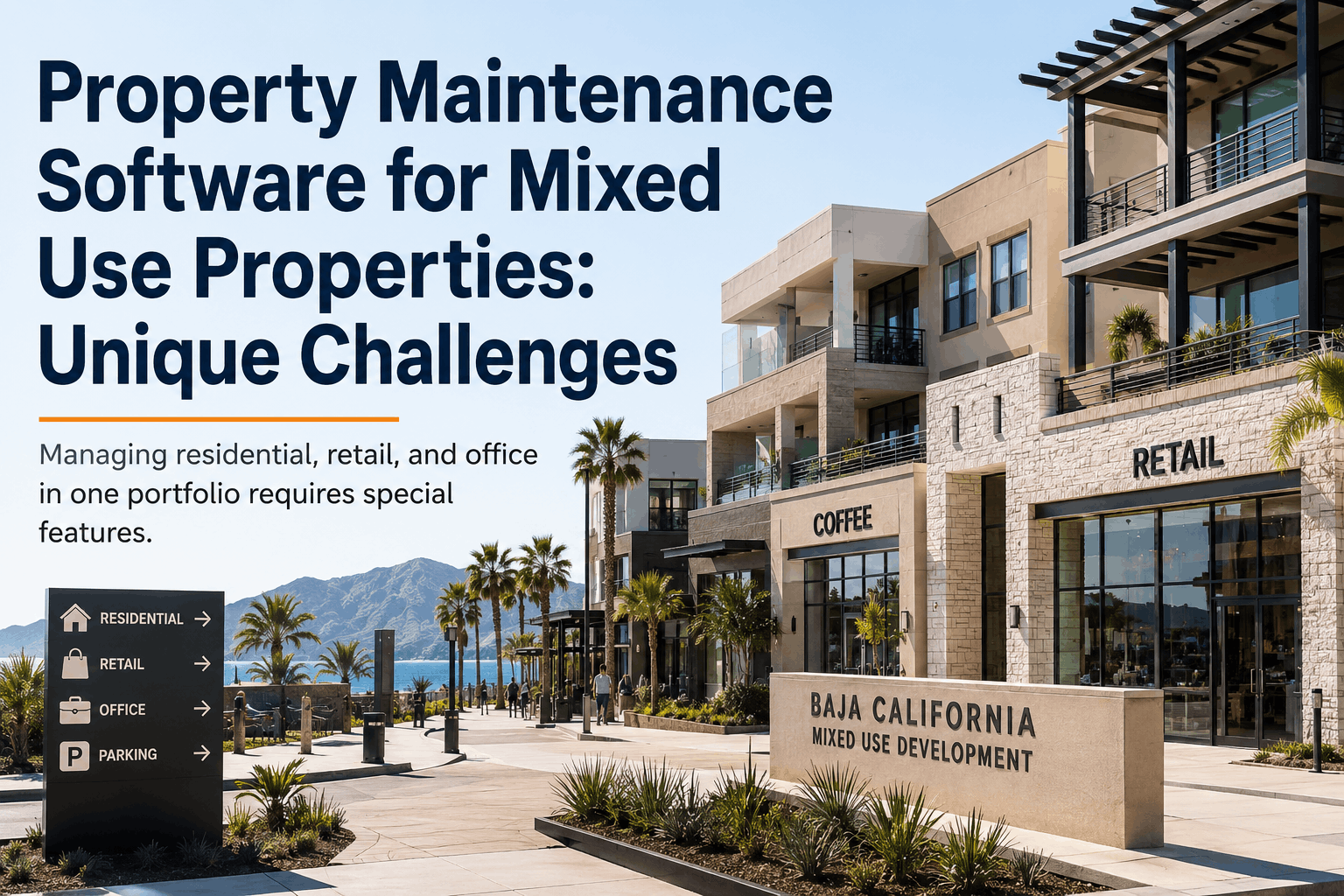
The lobby fountain stopped working three days ago. Retail tenants are complaining about the HVAC—again. A resident just posted a photo of the flickering hallway lights tagging your building. Meanwhile, your maintenance tech is hunting through a filing cabinet for the warranty information on the parking garage gate that jammed this morning. Welcome to Tuesday at a mixed-use property.
Mixed-use properties create unique maintenance challenges that single-use buildings never face. When retail, residential, office, and parking share walls, systems, and common areas, a single equipment failure cascades across occupancy types—damaging tenant relationships, triggering lease penalties and creating liability exposure that reactive approaches can't prevent.
This guide provides the framework for tracking and maintaining common area assets across mixed-use properties—from barcode/QR identification to IoT sensors and predictive maintenance property management strategies. Properties implementing structured asset tracking property management programs report 40-60% reduction in emergency repairs and 25-35% improvement in tenant satisfaction scores. Ready to take control of your common areas? Sign up free to start tracking assets with Oxmaint CMMS.
What if every common area asset had a digital identity—trackable, maintainable, and never lost in a filing cabinet?
Common Area Asset Tracking and Care: The Ultimate Guide for Mixed-Use Properties
The Mixed-Use Maintenance Challenge
A mixed-use property isn't just multiple building types sharing an address—it's competing priorities, overlapping systems and tenant expectations that vary by the hour. Understanding these dynamics is the foundation of effective asset tracking property management.
| Tenant Type | Peak Hours | Critical Systems | Common Complaint | SLA Expectation |
|---|---|---|---|---|
| Office | 8 AM - 6 PM | Elevators, HVAC, Parking | "Elevator wait time is killing productivity" | Response within 2 hours |
| Residential | 6 PM - 10 PM, Weekends | Entry systems, Amenities, HVAC | "The gym equipment has been broken for weeks" | Response within 24 hours |
| Retail | 10 AM - 9 PM | Storefront lighting, HVAC, Loading dock | "Poor lighting makes my store look closed" | Response within 4 hours |
| Parking | 7 AM - 9 AM, 5 PM - 7 PM | Gates, Lighting, Payment systems | "I was stuck behind a broken gate" | Immediate response |
Common Area Asset Inventory
Effective asset tracking starts with knowing what you're tracking. Mixed-use properties typically manage 200-500+ distinct common area assets. Here's what a complete inventory looks like:
| Category | Typical Assets | Qty | Criticality | PM Cycle | Failure Cost |
|---|---|---|---|---|---|
| Vertical Transport | Elevators, escalators, wheelchair lifts | 4-12 | Critical | Monthly | $8,000-15,000 |
| HVAC Systems | RTUs, chillers, boilers, AHUs, VAV boxes | 15-50 | Critical | Quarterly | $3,000-12,000 |
| Life Safety | Fire panels, sprinklers, emergency lights, AEDs | 50-200 | Critical | Monthly | $500-5,000 + liability |
| Access Control | Gates, automatic doors, FOB readers, intercoms | 20-80 | High | Quarterly | $1,500-4,000 |
| Lighting | Parking fixtures, lobby, corridors, exterior | 100-500 | Medium | Semi-Annual | $200-800/fixture |
| Amenities | Pool pumps, gym equipment, grills, fountains | 20-60 | Medium | Weekly-Monthly | $500-3,000 |
| Plumbing | Pumps, water heaters, backflow preventers | 10-30 | High | Quarterly | $2,000-8,000 |
| Exterior | Irrigation, hardscape, signage, canopies | Varies | Low | Seasonal | $300-2,000 |
Boost Property Management Uptime with Connected Sensors
IoT sensors transform common area maintenance from reactive firefighting to predictive prevention. Instead of waiting for tenant complaints, you know about equipment degradation weeks before failure—giving you time to schedule repairs during off-peak hours.
| Equipment | What Sensors Track | Warning Lead Time | Prevented Failure Cost |
|---|---|---|---|
| Elevator Motors | Temperature, vibration, current draw | 3-6 weeks | $8,000-15,000 |
| HVAC Units | Filter pressure, refrigerant levels, runtime hours | 2-4 weeks | $3,000-12,000 |
| Parking Gates | Cycle count, motor load, response time | 4-8 weeks | $1,500-4,000 |
| Pool Pumps | Vibration, flow rate, motor temperature | 2-4 weeks | $500-3,000 |
| Boilers | Combustion efficiency, pressure, temperature | 3-5 weeks | $4,000-10,000 |
Reactive vs. Predictive Maintenance Comparison
| Metric | Reactive Approach | Predictive with IoT | Improvement |
|---|---|---|---|
| Response Time | 4-8 hours after failure | Scheduled in advance | 100% planned |
| Average Repair Cost | $2,400 | $800-1,200 | 50-65% lower |
| Tenant Impact | High — complaints filed | Minimal — planned work | Satisfaction up 25-35% |
| Equipment Lifespan | Shortened 20-30% | Extended 25-40% | 45-70% longer |
| Annual Emergency Calls | 45-60 per property | 12-18 per property | 60-75% reduction |
| Maintenance Budget | Unpredictable spikes | Consistent, plannable | Budget variance ±5% |
Barcode/QR Asset Identification System
Every asset needs a digital identity. Barcode/QR tags eliminate the "which unit is this?" problem and give technicians instant access to maintenance history, OEM documentation, and spare parts planning information with a single scan.
Technician scans barcode/QR using mobile app—works on any smartphone
Maintenance history, open work orders, warranty status, OEM manuals load instantly
Complete work, add photos, log parts used, capture digital signature
Asset history updates in real-time, compliance logs populated automatically
Ready to give every asset a digital identity?
Building a Resilient Backbone — A Property Management Roadmap with KPIs
Moving from reactive to proactive maintenance requires systematic implementation. This roadmap provides the milestones and KPIs for building a predictive maintenance property management program.
- Complete physical inventory of all common area assets
- Apply barcode/QR tags to every trackable asset
- Document current condition with photos
- Import data into maintenance software property management platform
- Define PM frequencies based on OEM specifications
- Configure work order automation triggers
- Set up spare parts planning and minimum inventory levels
- Assign technician responsibilities by asset type
- Install IoT sensors on critical equipment
- Configure alert thresholds based on baseline data
- Integrate sensor data with CMMS for automated work orders
- Train team on condition monitoring dashboards
- Refine alert thresholds based on performance data
- Implement SLA reporting for stakeholders
- Expand to secondary assets and additional properties
- Benchmark performance across portfolio
Mobile Inspections Property Management
Paper inspection forms create gaps—illegible entries, lost forms, delayed data entry. Mobile inspections property management tools ensure consistent data capture while giving technicians everything they need in their pocket.
| Feature | What It Does | Problem It Solves |
|---|---|---|
| Guided Checklists | Step-by-step inspection procedures with required fields | Ensures consistency regardless of who performs inspection |
| Photo Documentation | Timestamped images attached directly to work orders | Creates visual audit trail for property management compliance |
| Offline Mode | Works without connectivity, syncs when connected | Functions in basements, garages, and mechanical rooms |
| Instant Work Orders | Create follow-up work orders on the spot | Issues get logged immediately, not forgotten |
| Digital Signatures | Capture technician and supervisor sign-off | Compliance logs with tamper-proof completion records |
| Parts Lookup | Check spare parts availability from the field | No wasted trips—know if parts are in stock before starting |
SLA Reporting Framework
Different stakeholders need different views. SLA reporting transforms raw maintenance data into actionable intelligence tailored for each audience.
| Stakeholder | Key Metrics | Report Focus | Frequency |
|---|---|---|---|
| Property Owners | Equipment Availability, Cost Avoidance, Budget Variance | ROI metrics, asset value preservation, capital planning | Monthly |
| Property Managers | PM Compliance, Response Time, Tenant Satisfaction | Compliance logs, work order aging, vendor performance | Weekly |
| Maintenance Teams | Open Work Orders, Due Today, Parts Availability | Daily priorities, equipment alerts, PM schedule | Daily |
Multi-Site Rollouts
Managing multiple properties multiplies complexity—but also opportunity. Multi-site rollouts with standardized processes enable benchmarking, resource sharing, and best practice replication across your portfolio.
| Standardize | Centralize | Optimize |
|---|---|---|
| Common asset naming conventions | Portfolio-wide dashboards | Benchmark performance between properties |
| Unified PM templates by equipment type | Cross-property reporting and analytics | Identify and replicate best practices |
| Standard inspection checklists | Shared spare parts planning inventory | Share maintenance resources across sites |
| Consistent criticality ratings | Unified vendor management | Negotiate volume contracts with vendors |
Property Management CMMS Best Practices
If it can break and affect tenants, it needs a barcode/QR tag and a record in your CMMS. No exceptions.
Link OEM manuals, warranty info, and vendor contacts directly to asset records. Accessible in the field.
Let the system generate and assign work orders automatically. Never miss a preventive task.
Connect complaints to specific equipment to identify patterns and systemic problems.
Automatically document inspections, certifications, and regulatory requirements. Audit-ready always.
What gets measured gets managed. Track PM compliance, response time, and equipment uptime.
Conclusion
Common area assets are the shared infrastructure that makes mixed-use properties work. When they fail, everyone notices—retail, residential, office, and parking tenants alike. The difference between properties that struggle with constant complaints and those that operate smoothly comes down to systematic asset tracking and proactive maintenance.
Start with barcode/QR tags on critical equipment. Add IoT sensors where failure costs are highest. Build from there. The ROI follows.