
Commercial heat pump maintenance is no longer a seasonal checkbox — it is a year-round operational discipline that directly determines energy costs, tenant comfort, and equipment lifespan. Facilities managers across the US, UK, Canada, Germany, and UAE are under increasing pressure to prove HVAC system reliability through documented inspection programs, preventive service records, and measurable efficiency outcomes. This guide covers every critical element of a commercial heat pump maintenance program — from defrost cycle management and reversing valve inspection to auxiliary heat control and seasonal changeover procedures. Sign up free to digitize your heat pump PM program and track every inspection from a single platform.
Streamline Your Heat Pump PM Program
Connect your commercial heat pump maintenance schedules with automated work orders, technician assignments, and compliance records — all in one platform built for facilities teams.
Why Commercial Heat Pump Maintenance Demands a Structured Approach
Commercial heat pump systems operate under fundamentally different conditions than residential units. A rooftop heat pump serving a multi-tenant office building in Toronto or a retail complex in Dubai runs continuously through extreme seasonal swings, accumulates wear across compressors, reversing valves, and defrost controls far faster than any residential counterpart, and carries financial consequences for failure that are orders of magnitude higher.
Unplanned heat pump failure in a commercial property means tenant complaints, lease penalties, emergency service call premiums, and in cold climates, potential liability for inadequate heating. In Germany and the UK, where energy efficiency regulations tie building compliance ratings to HVAC performance data, a poorly maintained heat pump is a regulatory risk as much as an operational one.
A structured commercial heat pump maintenance program eliminates guesswork by replacing reactive repair with scheduled inspection, documented system monitoring, and AI-powered predictive alerts — keeping systems reliable across heating and cooling seasons without costly emergency interventions.
Core Components of a Commercial Heat Pump Inspection Checklist
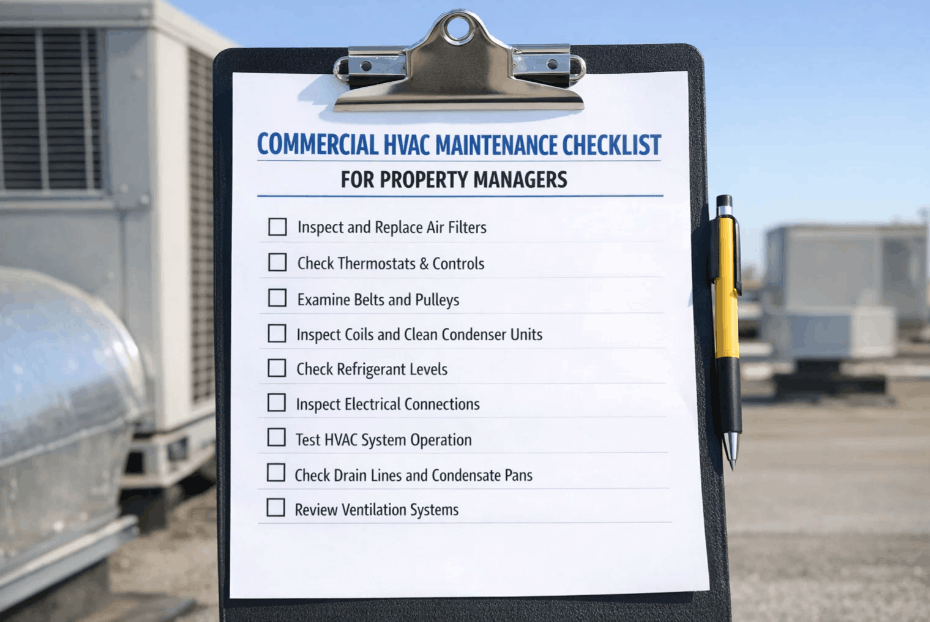
An effective heat pump inspection checklist covers mechanical, electrical, refrigerant, and controls systems in a defined sequence. Ad hoc inspections miss critical interdependencies — a marginal reversing valve failure, for example, produces symptoms that look identical to refrigerant undercharge unless both are checked in parallel. The following components form the minimum inspection scope for any commercial heat pump PM program.
Defrost Cycle Verification
The defrost cycle is the most failure-prone function in air-source heat pumps operating in cold climates. When defrost controls malfunction, frost accumulates on the outdoor coil and chokes airflow — driving up compressor head pressure, reducing heating capacity, and in severe cases tripping high-pressure safeties that lock out the system entirely.
Technicians should verify defrost initiation and termination logic at every scheduled PM visit, confirm that the defrost timer or demand-defrost sensor is calibrated correctly, and check that the reversing valve shifts cleanly into defrost mode without sticking. Facilities in Canada and northern Germany should schedule defrost system verification at the start of every heating season — not just annually.
Reversing Valve Inspection
The reversing valve directs refrigerant flow between heating and cooling modes. A valve that sticks in an intermediate position causes a characteristic symptom: the system appears to run but delivers neither adequate heating nor cooling, with suction and discharge pressures collapsing toward equilibrium. This is one of the most misdiagnosed heat pump faults in commercial facilities.
Inspection should include solenoid coil resistance testing, pilot valve function verification, and a full heating-to-cooling mode shift under controlled conditions. Book a demo to see how OxMaint captures reversing valve inspection data and flags trending fault signatures before full valve failure occurs.
Refrigerant Circuit and Pressure Analysis
Refrigerant charge affects every performance metric a commercial heat pump produces — capacity, efficiency, compressor operating temperature, and defrost behavior. Even a 10% undercharge drops system COP by a measurable margin and accelerates compressor wear by raising operating temperatures.
Every PM visit should include suction and discharge pressure logging, superheat and subcooling calculations, and a leak check across all accessible joints and service valves. In UAE facilities where systems operate near maximum load continuously, refrigerant circuit checks should occur quarterly rather than bi-annually.
Auxiliary and Backup Heat Management
Commercial heat pump systems with electric resistance auxiliary heat are particularly vulnerable to auxiliary heat over-reliance — a condition where the control system activates backup heating strips at temperatures where the heat pump should still be the primary source. This single fault can increase heating energy consumption by 30–50% without triggering any system alarm.
Inspection should verify auxiliary heat lockout setpoints, confirm that the auxiliary stage is only activating at the correct outdoor temperature threshold, and validate that emergency heat mode is not engaged unintentionally. Facilities managers in the UK operating hybrid heat pump systems should cross-reference auxiliary heat runtime data against degree-day records to identify control anomalies.
Coil Cleaning and Airflow Verification
Both indoor and outdoor coils accumulate fouling that degrades heat transfer efficiency and forces the refrigerant circuit to operate at abnormal pressures. In commercial facilities near urban construction sites or high-traffic areas — common in UAE and Germany's industrial zones — outdoor coil fouling can become critical within a single season.
Coil cleaning frequency should be determined by measured airflow performance, not calendar schedule alone. Static pressure measurements across the coil before and after cleaning provide objective data on fouling severity and cleaning effectiveness — data that should be logged in the CMMS for trend analysis over time.
Seasonal Changeover Procedures for Commercial Heat Pumps
Seasonal changeover is one of the highest-risk operational events for a commercial heat pump. Transitioning a system that has operated in heating mode for months into summer cooling without a structured verification procedure frequently reveals dormant faults — refrigerant migration, reversing valve hesitation, economizer damper failures — that were masked during single-mode operation.
Pre-Changeover System Documentation
Before switching operating modes, record baseline performance data — supply and return temperatures, refrigerant pressures, amperage draw, and airflow readings — for direct comparison against post-changeover measurements. Deviations larger than 10% warrant investigation before the new season begins.
Controls and Thermostat Verification
Confirm that building automation system (BAS) setpoints, scheduling, and mode logic are correctly configured for the incoming season. Verify that auxiliary heat lockout temperatures, economizer enable conditions, and night setback schedules are updated to reflect seasonal requirements.
Reversing Valve Mode Shift Test
Deliberately cycle the system through at least two full heating-to-cooling transitions under load, monitoring suction and discharge pressure behavior during each shift. A slow or incomplete pressure equalization during transition indicates a reversing valve or pilot tube issue requiring intervention before the season begins.
Filter, Coil, and Drain Pan Service
Replace or clean all air filters, inspect indoor and outdoor coils for fouling, and verify that condensate drain pans and trap assemblies are clear before cooling season begins. Blocked drains are among the most common sources of water damage claims in commercial HVAC systems during the first weeks of cooling operation.
Post-Changeover Performance Logging
Log post-changeover performance data within the first 72 hours of new-season operation and compare against pre-changeover baseline. Flag anomalies immediately rather than waiting for the next scheduled PM cycle. Sign up free to automate post-changeover data collection and comparison in OxMaint.
How AI Vision Enhances Commercial Heat Pump Maintenance
AI vision technology — computer vision systems that analyze visual data from cameras in real time — is becoming a practical tool for commercial HVAC maintenance programs that need higher inspection coverage than technician visits alone can provide. The application in heat pump maintenance is straightforward: cameras positioned at outdoor units, AHUs, and mechanical rooms continuously monitor conditions that indicate developing faults.
In practical terms, an AI vision system installed at a commercial rooftop unit can detect excessive frost accumulation on outdoor coils between scheduled PM visits — flagging defrost cycle underperformance days before it triggers a system fault. The same system monitors condensate drainage from drain pans, identifies ice formation at indoor units during cooling season, and flags abnormal vibration signatures through motion analysis that correlates with compressor or fan bearing wear. Book a demo to see how AI vision inspection data connects directly with OxMaint CMMS work orders for heat pump assets.
Coil Frost Pattern Detection
AI vision cameras analyze outdoor coil frost accumulation patterns continuously, identifying abnormal ice buildup that signals defrost cycle failure — enabling intervention before compressor safeties trip.
Refrigerant Oil Stain Identification
Computer vision models trained on refrigerant oil stain signatures detect refrigerant leak indicators at service ports, line set connections, and coil surfaces — reducing the time between leak onset and technician response.
Fan and Discharge Airflow Monitoring
AI vision systems analyze outdoor fan discharge airflow patterns, detecting blade damage, motor degradation, and recirculation conditions that reduce heat pump capacity during peak load periods.
Drain Pan Overflow Detection
Camera-based monitoring at indoor unit drain pans detects standing water conditions in real time — triggering immediate alerts before overflow damage occurs in commercial ceiling spaces.
Compressor and Fan Bearing Monitoring
Motion analysis via AI vision identifies abnormal vibration signatures at compressor housings and fan assemblies, providing early warning of bearing wear between physical PM inspections.
Coil Cleanliness Assessment
AI vision systems assess outdoor coil fouling levels continuously, replacing calendar-based cleaning schedules with condition-based triggers — reducing unnecessary service visits while preventing efficiency degradation.
Commercial Heat Pump Maintenance Software and Platform Comparison
Selecting the right maintenance management platform for a commercial heat pump program depends on the scale of your portfolio, the need for mobile technician tools, and the depth of integration required with BAS or energy management systems. The table below compares the leading platform categories across dimensions most relevant to facilities managers in the US, UK, Canada, Germany, and UAE markets.
| Platform Capability | Basic CMMS | Mid-Tier CMMS | AI-Powered CMMS (OxMaint) |
|---|---|---|---|
| PM schedule automation | Manual calendar only | Template-based scheduling | Condition-based + calendar hybrid |
| Heat pump inspection checklists | Generic forms | Customizable checklists | Asset-specific dynamic checklists |
| Defrost and performance data logging | None | Manual entry | Automated sensor + manual entry |
| AI vision integration | None | None | Native alert-to-work-order integration |
| Compliance documentation | Manual export | Basic report generation | Automated audit-ready records |
| Mobile technician tools | Limited | Yes | Full offline-capable mobile app |
| Multi-site portfolio management | Single site only | Limited multi-site | Unlimited sites with unified dashboard |
| BAS / IoT integration | None | Limited API | Full API + sensor integration |
Heat Pump Troubleshooting: Most Common Commercial Faults and Resolutions
Commercial heat pump troubleshooting requires a systematic approach that distinguishes between refrigerant system faults, electrical control failures, and mechanical degradation. The following fault categories account for the majority of commercial heat pump service calls across all climate zones.
Most common causes are refrigerant undercharge, fouled outdoor coil, reversing valve partial failure, or auxiliary heat lockout set too low. Diagnosis requires pressure analysis, mode shift testing, and auxiliary heat control verification in sequence.
Indicates defrost termination sensor failure, pilot tube contamination in the reversing valve, or outdoor airflow restriction from coil fouling or equipment placement obstruction. Verify defrost board logic and sensor calibration before replacing components.
Often caused by auxiliary heat over-reliance, refrigerant overcharge or undercharge, dirty coils reducing heat transfer efficiency, or compressor valve wear reducing volumetric efficiency. Energy billing data correlated with degree-day records identifies the fault pattern.
Short-cycling is typically caused by refrigerant overcharge, low-pressure safety trips from restricted airflow, or thermostat location issues. In commercial multi-zone systems, zone valve failures that cause excess system pressure drop are also a frequent cause.
ROI of a Documented Commercial Heat Pump Maintenance Program
The financial case for structured heat pump maintenance investment is strongest when measured against documented avoided costs — not just energy savings alone. Facilities managers in Canada, the UK, and Germany who have implemented scheduled PM programs report consistent outcomes across three categories: reduced emergency service expenditure, lower energy consumption, and extended capital equipment replacement intervals.
Best Practices for Commercial Heat Pump Maintenance Programs
Facilities teams that achieve the best outcomes from commercial heat pump maintenance programs share a common set of operating practices — most of which center on consistency, documentation quality, and data-driven scheduling rather than inspection frequency alone.
Establish Asset-Level Maintenance Histories
Every heat pump unit in a commercial portfolio should have an individual maintenance history linked to its asset record in the CMMS — capturing not just PM completion dates but measured performance data at each visit. This history is the foundation for trend analysis that predicts failure before it occurs.
Define Condition-Based Inspection Triggers
Supplement calendar-based PM schedules with condition-based triggers — refrigerant pressure deviation thresholds, auxiliary heat runtime ratios, coil static pressure increases — that initiate inspection outside the scheduled cycle when system data indicates developing fault conditions.
Standardize Technician Inspection Protocols
Inspection quality variance between technicians is one of the most common causes of missed fault detection in commercial heat pump programs. Standardized digital checklists with mandatory measurement fields — not free-text notes — ensure consistent data quality across all technicians and visits. Sign up free to deploy standardized heat pump inspection checklists to your entire technician team through OxMaint.
Align PM Frequency to Climate Zone and Load Profile
Heat pump PM frequency should reflect actual operating conditions, not a one-size-fits-all annual schedule. High-load facilities in UAE climates where systems run near maximum capacity year-round require quarterly comprehensive inspections. Low-load applications in moderate UK climates may perform adequately on bi-annual schedules with monthly monitoring data reviews.
Integrate Maintenance Data with Energy Management
Cross-referencing CMMS maintenance records with building energy management system (BEMS) data identifies the energy impact of individual maintenance interventions — quantifying ROI at the asset level and prioritizing maintenance investment in the highest-impact units across a portfolio.
Challenges in Commercial Heat Pump Maintenance — and How to Overcome Them
Even well-resourced facilities teams face consistent challenges when building and sustaining commercial heat pump maintenance programs. Understanding these challenges in advance allows program designers to build structural solutions rather than relying on heroic individual effort.
Solution: Replace paper-based or unstructured digital checklists with asset-specific inspection protocols that require measured data entry at each step. Mandatory fields for pressure readings, temperature differentials, and amperage draw eliminate the subjective "visually inspected — OK" records that provide no trend analysis value.
Solution: Implement a priority-tiered work order system that distinguishes between deferred cosmetic maintenance and deferred safety-critical or efficiency-critical maintenance. Real-time dashboards showing deferred maintenance aging by asset make the risk visible to facilities leadership before deferred items accumulate into failure events.
Solution: Centralized CMMS platforms with multi-site visibility allow regional facilities managers in Canada, Germany, or the UAE to monitor inspection completion rates, PM compliance, and open work order aging across all properties from a single dashboard — without requiring site-by-site report consolidation.
Solution: Embed heat pump-specific diagnostic guidance directly into digital inspection checklists — providing technicians with decision-tree troubleshooting support at the point of inspection rather than relying on recalled training. This closes the knowledge gap between generalist technicians and heat pump specialists without requiring additional headcount.
Frequently Asked Questions
How often should commercial heat pumps be serviced?
Commercial heat pumps in moderate climates (UK, Canada, Germany) should receive comprehensive PM service at minimum twice per year — once before heating season and once before cooling season. High-load applications in hot climates like UAE, or systems serving critical environments, benefit from quarterly inspections supplemented by monthly performance data monitoring between visits.
What does a commercial heat pump PM checklist include?
A comprehensive commercial heat pump PM checklist covers refrigerant pressure and charge verification, defrost cycle initiation and termination testing, reversing valve mode shift testing, coil inspection and cleaning, filter replacement, condensate drain verification, electrical connection tightening, contactor and capacitor inspection, auxiliary heat lockout setpoint verification, and complete performance data logging including supply/return temperatures and amperage draw.
What causes a commercial heat pump to lose efficiency over time?
The most common causes of commercial heat pump efficiency degradation are refrigerant charge drift from slow leaks, coil fouling that reduces heat transfer performance, compressor valve wear that reduces volumetric efficiency, auxiliary heat control drift that causes over-reliance on electric resistance heating, and defrost system degradation that allows coil icing during heating season. Each of these causes is detectable through documented performance data trends before it produces a noticeable comfort complaint.
How does a CMMS improve heat pump maintenance outcomes?
A CMMS improves commercial heat pump maintenance outcomes by ensuring PM visits are never missed, capturing measured performance data at every inspection for trend analysis, generating work orders automatically when monitoring data indicates fault conditions, and creating the audit-ready maintenance records required by UK, German, and US regulatory frameworks. CMMS-managed programs consistently outperform spreadsheet or paper-based programs on both inspection completion rates and fault detection lead time.
Can AI tools help predict heat pump failures before they occur?
Yes. AI-powered maintenance platforms analyze performance data trends across heat pump assets to identify deviation patterns that precede specific failure modes — refrigerant loss trajectories, compressor efficiency trends, and defrost cycle degradation signatures — weeks before the fault produces a system alarm or comfort complaint. When combined with AI vision monitoring of physical equipment conditions, predictive maintenance systems can extend mean time between failures significantly and reduce total maintenance cost per asset over the equipment lifecycle.
Ready to Protect Your Heat Pump Assets?
OxMaint gives commercial facilities teams a single platform for heat pump inspection checklists, seasonal PM scheduling, performance data logging, and compliance documentation — built for portfolios of any size. Get your first heat pump maintenance schedule running today.




.png)

