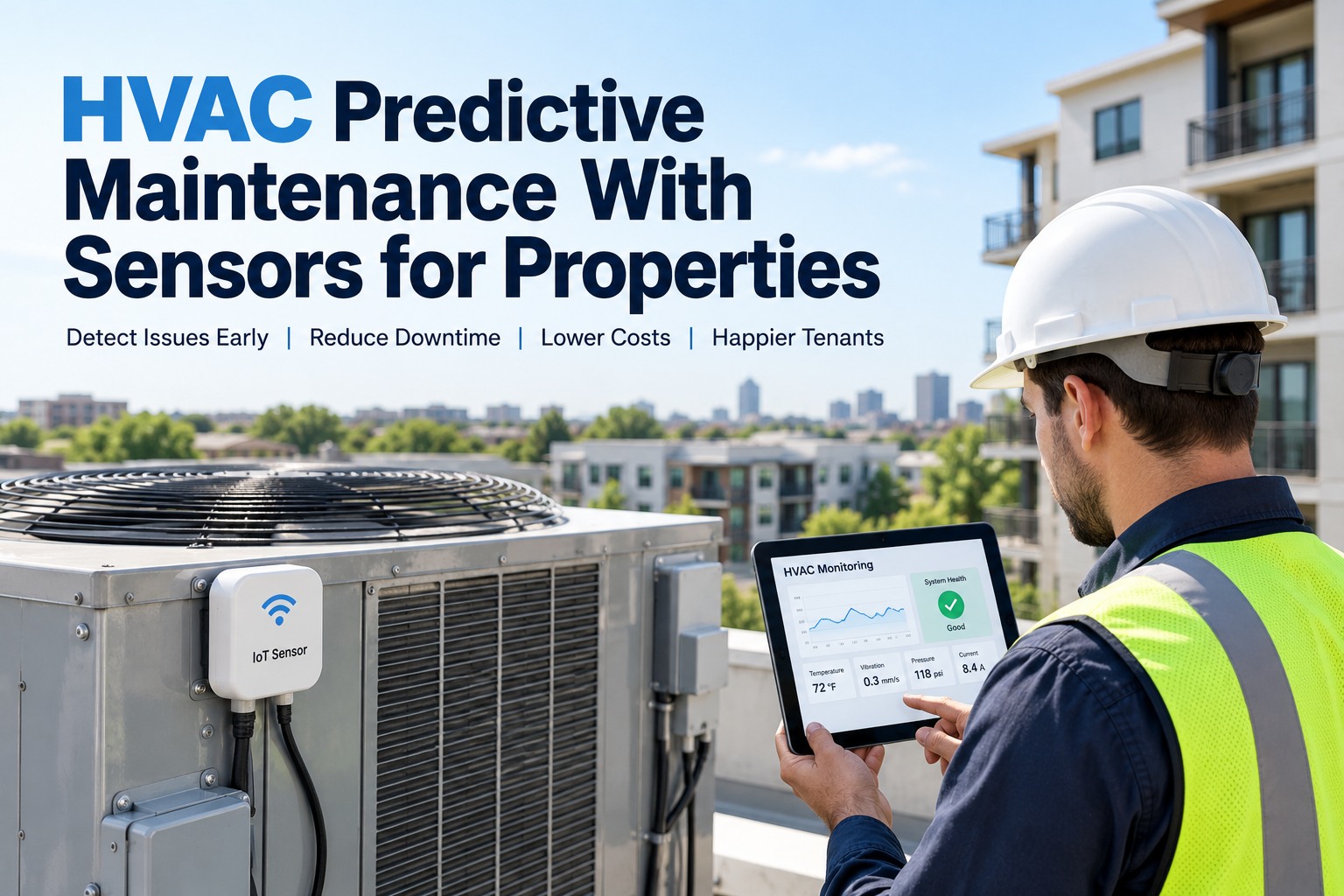
It's July 15th, the hottest day of the year. Building 7 of your industrial park loses its 500-ton chiller at 2:47 PM—three pharmaceutical tenants watch their cold storage temperatures climb, a data center operator scrambles to activate backup cooling, and your property management team fields 34 emergency calls in under an hour. The backup unit, serviced on schedule six months ago, fails under emergency load. By evening, you're facing $180,000 in spoiled inventory claims, two lease termination threats, and a $45,000 emergency repair bill. The chiller's compressor had been drawing 12% excess current for eight weeks. The condenser coils showed a 15°F temperature differential trending upward. Your maintenance logs showed "inspected—OK" because calendar-based maintenance couldn't see what condition monitoring would have made obvious.
Industrial parks create the most complex HVAC and chiller management challenges in commercial property management. Multiple buildings with diverse tenant operations—manufacturing heat loads, warehouse ventilation requirements, laboratory environmental controls, and office comfort needs—all compete for cooling capacity from shared infrastructure. A single central plant failure doesn't affect one tenant; it cascades across every business depending on that cooling capacity, triggering lease penalties, damaging tenant relationships, and creating liability exposure that reactive maintenance strategies cannot prevent.
This change management framework establishes AI-driven predictive maintenance strategies for HVAC and chiller systems across multi-site industrial park environments, transforming condition monitoring data into actionable maintenance decisions before failures impact tenant operations. Property managers implementing predictive maintenance property management for central plant equipment achieve 60-80% reduction in emergency repairs while cutting energy costs by 25-40%. Teams ready to modernize their approach can get started with proper HVAC maintenance management.
What if your chillers could alert you to compressor stress weeks before failure—protecting tenant operations and eliminating emergency repair chaos?
Why Industrial Park HVAC Systems Fail More Often
Industrial parks create stress patterns that single-tenant buildings never experience. Understanding these failure drivers is essential before implementing any predictive maintenance property management strategy. Property managers who sign up free to track equipment stress patterns identify problems 6-10 weeks before failures occur.
Mixed tenant operations create demand swings that exceed equipment design parameters daily
Manufacturing and cold storage operations eliminate traditional maintenance scheduling options
Shared infrastructure means single failures impact multiple tenants simultaneously
Pharmaceutical and data center tenants contractually require near-perfect uptime
IoT Sensor Architecture for Condition Monitoring
AI analytics transform raw sensor data into failure predictions—but only when sensors are deployed on the right components measuring the right parameters. This IoT sensors deployment map shows where condition monitoring delivers maximum predictive value for industrial park HVAC systems. Teams ready to implement sensor-based monitoring can create a free account to configure automated alerts based on equipment thresholds.
AI-Powered Risk Scoring Framework
Risk scoring transforms continuous sensor streams into prioritized maintenance decisions. AI analytics evaluate equipment health against baseline performance, OEM manuals specifications, and historical failure patterns—generating scores that direct limited resources to highest-impact interventions. Property managers using Oxmaint's free trial for AI-powered risk scoring reduce emergency calls by 70-85%.
Indicators: Compressor bearing failure signatures, refrigerant leak detection, safety system anomalies
Action: Immediate isolation, emergency dispatch within 2 hours, tenant notification
Indicators: Component degradation trending toward failure within 2 weeks
Action: Priority service within 48-72 hours, pre-order parts, verify backup capacity
Indicators: Early warning patterns suggesting 4-8 weeks to potential issues
Action: Schedule for next PM cycle, monitor trend acceleration closely
Indicators: All parameters within normal ranges per OEM specifications
Action: Continue standard monitoring, execute scheduled PM only
The Maintenance Transformation: Before and After AI Analytics
The shift from reactive to predictive maintenance property management delivers measurable improvements across every operational metric. These results represent documented outcomes from industrial parks that completed full predictive maintenance implementation.
Ready to see these results at your industrial park? Sign up free to start tracking your baseline metrics and measure your improvement over time.
Multi-Site Rollout Roadmap
Successful multi-site rollouts require phased implementation that builds organizational capability while demonstrating measurable value. This roadmap guides property managers through pilot-to-portfolio expansion. Organizations following this approach and signing up for centralized asset tracking achieve faster adoption with lower risk.
Inventory all HVAC equipment across buildings. Document failure history, maintenance costs, and establish performance baselines.
Choose highest-criticality building with cooperative tenants. Focus on central plant where failure impact is greatest.
Install IoT monitoring on compressors, condensers, cooling towers, and controls. Validate data accuracy against manual readings.
Connect sensor data to maintenance software property management platform. Configure alerts and automated work order generation.
Roll out to adjacent buildings sharing infrastructure. Standardize procedures and train staff on condition-based workflows.
Complete deployment across all buildings. Refine AI models with operational data and benchmark against industry standards.
Compliance Logs and Audit Documentation
Industrial park HVAC systems face rigorous property management compliance requirements across multiple regulatory frameworks. Automated compliance logs eliminate manual documentation burden while ensuring audit-ready records. Facilities using Oxmaint's free compliance tracking tools pass audits faster with zero findings.
Mobile Inspection Process Flow
Field technicians capture inspection data consistently while creating audit-ready documentation automatically. This mobile workflow eliminates paper processes and ensures property management CMMS best practices compliance. Teams implementing Oxmaint's free mobile inspection checklists achieve 98%+ data consistency across all technicians.
QR/barcode scan loads asset history, open work orders, and inspection checklist
Mobile checklist prompts consistent data capture with required field validation
Timestamped images attach to work orders for visual audit trail
Technician and supervisor signatures create tamper-proof records
Performance KPI Benchmarks
Effective property management requires continuous measurement against defined targets. These KPIs enable property managers to demonstrate value, justify investments, and benchmark against industry standards. Organizations tracking metrics with Oxmaint's free performance dashboards identify degradation before tenant impact.
Stop reacting to chiller failures. Start predicting problems before they impact your tenants and your bottom line.