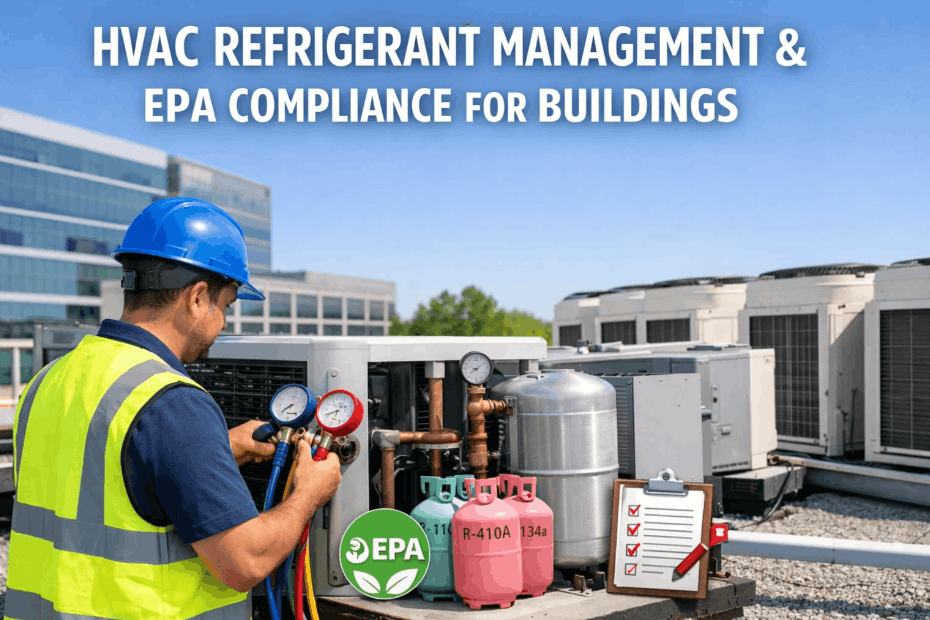
Refrigerant management is no longer just a technical task for HVAC technicians — it is a compliance obligation, a cost-control lever, and an environmental responsibility that building owners, facilities managers, and operations directors across the US, UK, Canada, and Germany cannot afford to overlook. EPA Section 608 regulations, the AIM Act phase-down schedule, and the rising cost of refrigerants have transformed how commercial buildings must track, recover, and report refrigerant use. This guide delivers a complete roadmap: from understanding your compliance obligations to implementing the systems and software platforms that make refrigerant management audit-ready and operationally efficient. Sign Up Free to start managing refrigerant compliance across your building portfolio today.
Why Refrigerant Compliance Has Become a Business-Critical Issue
The Regulatory, Financial, and Environmental Stakes of Modern Refrigerant Management
The regulatory landscape governing commercial HVAC refrigerants has shifted dramatically over the past decade. The American Innovation and Manufacturing (AIM) Act, signed into law in 2020, handed the EPA authority to phase down hydrofluorocarbons (HFCs) — including R-410A, the most widely used refrigerant in commercial cooling equipment today — by 85% over the next 15 years. The phase-down is already underway, and its effects are being felt in refrigerant pricing, equipment availability, and compliance scrutiny across every market.
For building operators in the US and Canada, EPA Section 608 compliance is not optional — it is a legal obligation with per-violation penalties that now exceed $44,000 per day. For facilities teams in Germany and the UK, equivalent F-Gas regulatory frameworks impose refrigerant logging, certified technician requirements, and leak detection obligations that mirror the US system in both scope and enforcement seriousness. In the UAE, rapidly tightening environmental standards are bringing the region in line with global best practice.
The commercial consequence is direct: facilities teams that rely on informal refrigerant tracking — paper records, technician memory, or disconnected spreadsheets — face audit exposure, regulatory fines, compressor failures caused by undetected leaks, and accelerating refrigerant costs as HFC prices rise under phase-down pressure. A structured refrigerant management platform is no longer a convenience — it is a compliance necessity.
Understanding the AIM Act and R-410A Phase-Down Schedule
What the HFC Phase-Down Means for Your Commercial HVAC Equipment Strategy
The AIM Act phase-down operates through an allowance-based system that reduces the total quantity of HFCs permitted to be produced or imported into the US each year. The phased reduction began in 2022 and follows a step-down schedule ending in 2036 at 15% of the 2011–2013 baseline. The practical consequence for commercial building operators is not an immediate ban — existing equipment continues to operate legally — but a progressive tightening of refrigerant supply that drives price increases and makes proactive equipment transition planning essential.
R-410A, the refrigerant in the majority of commercial HVAC equipment installed between 2000 and 2024, has a Global Warming Potential (GWP) of 2,088 — placing it firmly in the HFC category targeted for phase-down. New equipment using R-410A is no longer being manufactured for sale in the US from 2025. Systems containing R-410A already in the field will continue to operate and can still be serviced with reclaimed refrigerant, but new production supply is being phased out, and prices will reflect this constraint.
The replacement refrigerant generation — primarily A2L class refrigerants including R-32, R-454B, and R-466A — offer lower GWP profiles but introduce mild flammability classifications that require updated technician training, revised safety procedures, and in some cases, modified service equipment. Facilities teams managing large commercial portfolios in Toronto, London, or Frankfurt need to begin auditing equipment age, charge size, and replacement timelines now — not when refrigerant costs make retrofits financially forced.
| Refrigerant | GWP | Status | Replacement | Key Compliance Note |
|---|---|---|---|---|
| R-410A | 2,088 | Phased Down | R-32, R-454B, R-466A | No new equipment from 2025; reclaimed supply only |
| R-22 | 1,810 | Phased Out | R-407C, R-422D | Fully phased out; reclaimed only; equipment age risk |
| R-134a | 1,430 | Phase-Down Underway | R-1234yf, R-513A | Restricted in new equipment; chiller transition planning required |
| R-407C | 1,774 | Phase-Down Underway | R-32, R-454B | Common R-22 retrofit fluid; subject to same HFC restrictions |
| R-32 | 675 | Approved | — | A2L (mildly flammable); requires updated technician protocols |
| R-454B | 466 | Approved | — | Primary R-410A replacement; A2L classification |
EPA Section 608 Compliance: Core Obligations for Commercial Buildings
What Facilities Managers and Building Operators Must Know and Document
EPA Section 608 of the Clean Air Act establishes the foundational regulatory framework for refrigerant management in the United States. For commercial building operators, the key obligations fall into four categories: technician certification, leak detection and repair, refrigerant recovery, and record-keeping. Each category carries specific requirements, documentation standards, and enforcement consequences that all facilities teams managing refrigerant-containing equipment must understand.
Technician Certification: Any technician who purchases refrigerant in containers over two pounds or services refrigerant-containing equipment must hold an EPA Section 608 certification from an EPA-approved organisation. Type II certification covers high-pressure appliances — the category covering most commercial HVAC equipment. Type III covers low-pressure equipment. Universal certification covers all categories and is the standard for commercial HVAC engineers. Facilities managers are responsible for verifying that all contractors servicing their equipment hold current certifications before work begins.
Leak Detection and Repair Requirements: Commercial HVAC systems containing 50 or more pounds of refrigerant are classified as comfort cooling appliances under Section 608. If annual leak rate reaches or exceeds 20% of total charge, the system owner is required to either repair the leak within 30 days or develop a retrofit or retirement plan and submit it to the EPA within 30 days. Systems with chronic leak histories that cannot be economically repaired trigger mandatory equipment retirement timelines. Tracking cumulative refrigerant additions in a digital refrigerant management system is the only reliable way to calculate annual leak rate accurately across a building portfolio.
Refrigerant Recovery: All refrigerant must be recovered from systems before service, maintenance, or disposal work that involves opening the refrigerant circuit. Recovery must be performed using certified recovery equipment. Venting refrigerant — releasing it to atmosphere — is illegal under Section 608 and carries the highest per-violation penalties. Recovery contractors and in-house technicians must maintain recovery equipment certification records and log all recovery activities by equipment unit and date.
Record-Keeping: Owners of appliances containing 50 or more pounds of refrigerant must retain records of the amount of refrigerant added to each appliance during each service visit. These records must be kept for at least three years and be available for EPA inspection on request. A pattern of refrigerant additions that implies a persistent leak — without corresponding repair records — is precisely the evidence an EPA inspector will look for during an audit.
Refrigerant Leak Detection: Technologies, Thresholds, and Response Protocols
Choosing the Right Detection Approach for Your Building Type and Equipment Portfolio
Effective refrigerant leak detection is the cornerstone of both regulatory compliance and cost control in commercial buildings. Choosing the right approach depends on your system charge sizes, facility type, and management infrastructure. Sign Up Free to start tracking leak detection records across your entire building portfolio.
- Heated diode and infrared sensing for HFCs including R-410A and R-454B
- Best for locating suspected leak points during planned service visits
- Low capital cost — suitable for all building sizes
- Requires calibration; complements but does not replace fixed monitoring
- 24/7 air sampling in plant rooms and rooftop equipment areas
- Triggers alarms before leak rates reach EPA regulatory thresholds
- Integrates with BAS and CMMS for automated work order generation
- Required for BREEAM, LEED, and insurance compliance in UK, Germany, and Canada
- Injected once — remains in circuit permanently for ongoing traceability
- Ideal for slow or intermittent leaks that evade electronic detection
- Verify manufacturer warranty compatibility before injection
- Document dye type and date in your CMMS equipment record
- Confirms circuit integrity before refrigerant recharge after any repair
- Test pressure, hold time, and result must all be formally documented
- Strongest compliance evidence for EPA Section 608 and F-Gas audits
- Cannot be substituted by refrigerant operating pressure checks alone
How AI Vision Enhances HVAC Refrigerant Management
Computer Vision Applications That Transform Leak Detection and Compliance Monitoring
AI Vision technology gives facilities managers a continuous visual monitoring layer that sensor networks and service schedules alone cannot deliver. For building portfolios in the US, UK, Canada, and UAE, it provides early intelligence to act before refrigerant issues become regulatory events. Book a Demo to see how AI Vision works inside a live refrigerant compliance programme.
- Identifies refrigerant oil staining around joints and valve stems weeks before pressure alarms trigger
- Detects visual leak indicators invisible to conventional sensor networks
- Auto-creates inspection work orders when visual anomalies are flagged
- Identifies abnormal temperature patterns on suction and discharge lines indicating charge loss
- Detects condenser coil hot spots linked to refrigerant maldistribution
- Supports proactive decisions before efficiency loss or compressor damage occurs
- Generates timestamped visual inspection records automatically between service visits
- Creates a continuous, date-stamped audit trail for EPA and F-Gas inspections
- Links visual records to equipment service history inside your CMMS
- Confirms recovery equipment is connected before technicians open refrigerant circuits
- Creates video evidence of compliant refrigerant handling at each service event
- Protects building operators against contractor compliance failures during unannounced visits
Facilities teams across the UK and UAE that have integrated AI Vision with their CMMS-backed refrigerant management platform report catching developing leaks earlier, reducing refrigerant consumption, and entering EPA and F-Gas audits with documentation most building operators simply cannot produce from paper records. Book a Demo to see how AI Vision integrates with digital refrigerant compliance management for commercial buildings.
Refrigerant Tracking Software and CMMS Platforms for Commercial Buildings
Choosing the Right Digital Tools for Refrigerant Compliance and Asset Management
A purpose-built refrigerant tracking system — ideally integrated within a full Computerised Maintenance Management System (CMMS) — transforms refrigerant compliance from a documentation burden into a managed, automated programme. The right platform captures every refrigerant addition, calculates annual leak rates automatically, triggers leak investigation work orders when thresholds approach, and generates audit-ready reports for EPA, F-Gas, and environmental certification requirements.
| Compliance Capability | OxMaint CMMS | Generic CMMS | Spreadsheet / Paper | Standalone Refrigerant Logger |
|---|---|---|---|---|
| Refrigerant Addition Logging by Equipment Unit | Automated | Manual | Manual | Yes |
| Annual Leak Rate Calculation | Automated | No | Manual | Limited |
| EPA Section 608 Threshold Alerts | Yes | No | No | Basic |
| F-Gas and AIM Act Compliance Reports | Audit-Ready | No | Manual | Limited |
| Technician Certification Tracking | Yes | No | Manual | No |
| Leak Repair Work Order Automation | Yes | Manual | No | No |
| AI Vision Integration | Yes | No | No | No |
| Multi-Building Portfolio Dashboard | Yes | Limited | No | No |
| Mobile Work Orders for Field Technicians | Mobile-Ready | Partial | No | No |
The ROI of Structured Refrigerant Management in Commercial Buildings
Quantifying the Financial and Compliance Value of Proactive Refrigerant Tracking
The financial case for structured refrigerant management is straightforward — and it compounds across a multi-building portfolio. A single commercial rooftop unit with a slow, undetected refrigerant leak may consume an additional 20 to 40 pounds of R-410A per year across multiple service top-ups before the leak is formally identified and repaired. At current and projected R-410A pricing under phase-down supply constraints, this represents a direct materials cost that dwarfs the annual cost of a CMMS subscription.
The compliance exposure is more significant still. A single EPA Section 608 violation for improper refrigerant handling or inadequate record-keeping carries per-day penalties that can accumulate rapidly during an extended inspection process. For a building operator managing 20 or more rooftop units in Toronto, Chicago, or London, the regulatory risk of informal refrigerant tracking is not a theoretical concern — it is a quantifiable liability. Sign Up Free and start reducing that liability from day one.
Common Refrigerant Compliance Challenges and How to Solve Them
Practical Solutions for the Obstacles Facilities Teams Face Most Often
Refrigerant Management Best Practices for Commercial Buildings
What Compliance-Ready Facilities Teams Do Differently
The highest-performing facilities teams across the US, UK, Canada, and Germany approach refrigerant management as a strategic programme — not a service by-product. They maintain equipment-level charge records from installation through retirement. They track every refrigerant addition at point of service and calculate annual leak rates automatically. They verify contractor certifications before authorising any refrigerant circuit work. And they plan equipment transitions years in advance — not when refrigerant costs or regulatory pressure force reactive decisions.
They also recognise that the AIM Act phase-down is an opportunity, not just a compliance burden. Buildings that transition to lower-GWP refrigerant equipment ahead of regulatory pressure benefit from lower operating costs as reclaimed HFC prices rise, enhanced access to green building certifications, and a documented environmental performance record that increasingly influences commercial lease and financing conversations in markets like Germany and the UAE. Sign Up Free to start capturing that performance record from your next service visit.
The digital infrastructure underpinning this approach does not need to be complex — but it does need to be consistent. Every refrigerant addition logged, every leak repair documented, every technician certification verified. A CMMS platform that captures this data automatically, rather than depending on administrative follow-up after service visits, makes the difference between a compliance programme that holds up under inspection and one that collapses under regulatory scrutiny. Book a Demo to see how leading facilities teams manage refrigerant compliance at scale.
Frequently Asked Questions
What is EPA Section 608 and who does it apply to?
EPA Section 608 of the Clean Air Act regulates the handling, recovery, and record-keeping of refrigerants used in stationary HVAC and refrigeration equipment in the United States. It applies to any technician who services, maintains, repairs, or disposes of equipment that contains refrigerants — and to the owners and operators of buildings where such equipment is installed. Commercial building operators are responsible for ensuring that all service contractors working on their equipment hold current EPA Section 608 certification and comply with recovery and documentation requirements.
What is the AIM Act refrigerant phase-down schedule?
The American Innovation and Manufacturing (AIM) Act requires an 85% reduction in the production and importation of HFC refrigerants in the United States by 2036, measured against a 2011–2013 baseline. The phase-down began in 2022 and includes specific step-down dates through 2036. R-410A, the most common commercial HVAC refrigerant, is no longer permitted in new equipment manufactured for sale in the US from 2025. Existing equipment continues to operate legally and can be serviced with reclaimed refrigerant, but new virgin R-410A supply is being progressively restricted, driving price increases.
What is the leak rate threshold that triggers EPA compliance action?
Under EPA Section 608, commercial comfort cooling appliances containing 50 or more pounds of refrigerant trigger a mandatory repair or retrofit requirement when the annual leak rate reaches or exceeds 20% of the system's total charge. Annual leak rate is calculated by dividing the total amount of refrigerant added to a system during a 12-month period by the system's full charge capacity. If the 20% threshold is reached, the equipment owner has 30 days to repair the leak or submit a retrofit or retirement plan to the EPA.
What refrigerant records must commercial building operators keep?
Commercial building operators owning appliances that contain 50 or more pounds of refrigerant must keep records of the date and amount of refrigerant added to each appliance at each service visit. These records must be retained for a minimum of three years and be available for EPA inspection upon request. Records should also include technician certification numbers, recovery equipment certification details, and documentation of any leak repairs — including pre- and post-repair leak test results. Digital records maintained in a CMMS platform provide the most reliable and audit-ready compliance documentation.
What are the penalties for EPA Section 608 violations?
EPA Section 608 violations carry civil penalties of up to $44,539 per day per violation under current EPA enforcement guidelines. Violations can include venting refrigerant to atmosphere, using uncertified technicians, failing to maintain required records, and failing to repair systems that have exceeded the leak rate threshold. The EPA actively investigates Section 608 compliance through audits, complaint investigations, and enforcement partnerships with state environmental agencies. The penalty structure makes a single serious violation more costly than years of structured compliance management.
Can a CMMS help with refrigerant compliance management?
Yes — a CMMS is the most effective tool for maintaining continuous, audit-ready refrigerant compliance in commercial buildings. It captures refrigerant additions at point of service via mobile work orders, calculates annual leak rates automatically against equipment charge records, triggers leak investigation work orders when regulatory thresholds approach, tracks technician certification currency, and stores all documentation in a single system accessible for EPA or F-Gas audit response. Buildings managed with a CMMS consistently demonstrate stronger compliance postures and significantly lower administrative burden than those relying on paper records or disconnected spreadsheets.