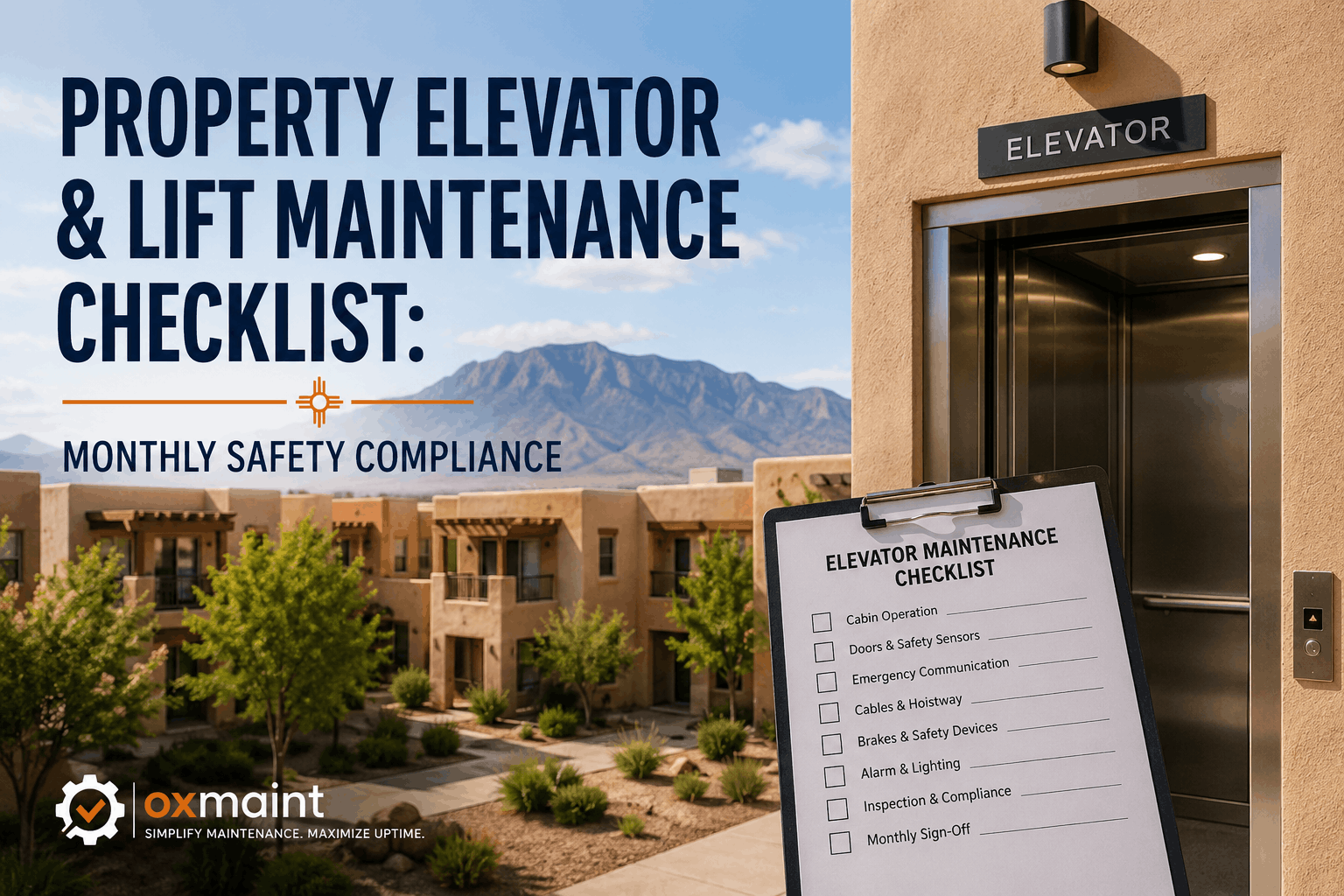
The lifts in your building move more than people—they move tenant satisfaction, property value, and regulatory compliance up or down every single day. A mid-rise commercial property with 4 lifts processes 800–1,200 trips daily, accumulating 300,000+ door cycles and 150,000+ motor starts per year. This relentless mechanical demand means every rope, sheave, brake pad, door operator, and control board is on a degradation curve that only structured preventive maintenance can manage. When a lift fails, the consequences are immediate: tenants are stranded, accessibility compliance is violated, emergency callout costs hit $2,000–$8,000 per incident, and property management credibility suffers damage that takes months to rebuild. The gap between buildings that "maintain lifts" and buildings that run world-class lift maintenance programs comes down to one thing—a structured, digital checklist system that ensures every component is inspected at the right interval with documented evidence. Sign up free on OxMaint.
Lift maintenance costs represent 3–5% of a commercial building's total operating budget, yet lift failures generate a disproportionate 15–25% of all tenant complaints. The economics are clear: every $1 invested in preventive lift maintenance prevents $4–$7 in emergency repairs, tenant compensation, and regulatory fines. Properties that implement digital inspection workflows through a CMMS platform report 50–70% fewer lift breakdowns, 35% faster mean time to repair when issues do occur, and complete audit trails that satisfy both insurance underwriters and safety regulators. This guide provides the complete preventive maintenance framework that property managers need—covering every mechanical, electrical, and safety component on a documented schedule. Book a demo to see how OxMaint automates.
What if your lifts could tell you they need service before the first tenant complaint? Stop reacting to breakdowns and start preventing them with structured digital maintenance.
Traffic Pattern Complexity
Peak morning, lunch, and evening surges create variable load patterns that accelerate wear on doors, motors, and brakes unevenly—requiring zone-specific inspection schedules.
Diverse Tenant Expectations
Office tenants expect <30-second wait times, retail expects continuous availability, and residential expects quiet nighttime operation—each requiring different maintenance priorities.
Compliance Overlap
ASME A17.1 safety codes, ADA accessibility requirements, fire service operation testing, and local authority inspections create overlapping compliance obligations that must be tracked.
Cost Concentration
Four components—door systems, control boards, traction machines, and safety devices—account for 85% of all lift maintenance costs. Targeted inspection maximizes ROI.
Door Operator
Close/open time measurement, force gauge test
Time drift >0.5 sec, force >30 lbs, hesitation
2–6 weeks
Door Tracks & Gibs
Visual inspection, gap measurement, debris check
Visible wear grooves, excessive play, noise
4–12 weeks
Traction Machine
Vibration analysis, oil analysis, amp draw
Vibration >0.15 in/sec, metal in oil, amp drift
8–24 weeks
Wire Ropes
Visual + NDE inspection, diameter measurement
Broken wires, diameter loss >6%, corrosion
12–52 weeks
Brake Assembly
Pad thickness, spring tension, stopping distance
Pad wear >50%, stopping distance drift
4–16 weeks
Controller & Drive
Error log review, IR thermography, function test
Recurring faults, hot spots, relay chatter
2–8 weeks
Safety Devices
Governor test, buffer test, interlock verification
Trip speed drift, buffer compression loss
Annual test required
Critical · Score 9–10
Immediate Safety Risk
Brake failure, door zone fault, governor trip anomaly, rope damage exceeding code limits. Lift must be taken out of service immediately until repaired.
High · Score 7–8
Repair Within 48 Hours
Door operator timing drift, leveling inaccuracy >½ inch, recurring controller faults, abnormal vibration readings. Schedule priority repair to prevent escalation.
Moderate · Score 4–6
Schedule Within 2 Weeks
Minor door track wear, guide shoe adjustment needed, car lighting issues, pit cleanliness. Plan repair during next scheduled maintenance visit.
Low · Score 1–3
Next Quarterly Service
Cosmetic cab damage, indicator lamp replacement, intercom volume adjustment, machine room housekeeping. Address during routine quarterly service.
Reactive Approach
Average Cost Per Lift/Year$12,000+
Emergency Callouts8–15/year
Unplanned Downtime60–120 hrs/year
Tenant Complaint RateHigh · 5+ monthly
Component Lifecycle60–70% of rated
Compliance DocumentationIncomplete
Preventive AI Approach
Average Cost Per Lift/Year$6,500
Emergency Callouts1–3/year
Unplanned Downtime< 10 hrs/year
Tenant Complaint RateLow · < 2 monthly
Component Lifecycle90–100% of rated
Compliance DocumentationAutomated, complete
Cost impact: Mixed-use towers with 6 lifts implementing preventive maintenance programs save $25,000–$45,000 annually through reduced emergency callouts, extended component life, and elimination of regulatory penalties. Get started free with predictive maintenance tracking.
Safety Inspection
Cat 1 · Annual
Cat 5 · 5-Year
Full ASME A17.2 safety inspection with all test results documented digitally and filed for regulatory access.
Load Testing
Full Load
Overload
125% capacity load tests per ASME A17.1 with buffer, safety, and traction tests documented with timestamps.
Fire Service Testing
Phase I
Phase II
Monthly firefighter emergency operation tests with pass/fail results and corrective action tracking for failures.
Preventive Maintenance
Monthly
Quarterly
Complete PM checklist execution with photo documentation, measurement logging, and deficiency tracking.
QR/Barcode Scan
Technician scans lift QR code to pull up asset history, open work orders, and the correct inspection checklist.
Guided Checklist
Step-by-step inspection prompts with pass/fail criteria, measurement fields, and required photo capture points.
Photo Documentation
Timestamped, GPS-tagged photos attached to each inspection point create an indisputable maintenance record.
Digital Signature
Technician and supervisor sign-off captured digitally with timestamps for complete chain-of-responsibility documentation.
System Availability
> 98%
Lift uptime target across all units in the portfolio
Mean Time Between Failures
> 90 days
Target interval between unplanned service interruptions
Callback Rate
< 5%
Percentage of repairs requiring return visits within 30 days
PM Compliance
> 95%
Scheduled inspections completed on time per ASME requirements
01
Asset Inventory
Catalog all lifts with manufacturer, model, capacity, age, installation date, service history, and current maintenance contracts.
02
Baseline Assessment
Conduct initial comprehensive inspection on each lift to establish current condition scores and identify deferred maintenance backlogs.
03
Sensor Deployment
Install vibration, temperature, and door cycle sensors on critical components. Integrate with BMS for continuous monitoring and alerting.
04
CMMS Integration
Configure OxMaint with lift-specific checklists, frequency rules, vendor contacts, and escalation workflows for each building.
05
Workflow Automation
Activate automated scheduling, mobile dispatch, photo documentation requirements, and compliance report generation.
06
Performance Optimization
Review KPI dashboards quarterly, refine inspection frequencies based on trend data, adjust alert thresholds for predictive accuracy.
Current State Costs
Service contract$4,200/lift/year
Emergency callouts (avg 10/yr)$35,000
Tenant credits & lost revenue$12,000
Compliance penalties (est.)$5,000
Total annual cost$77,200
Preventive Maintenance Results
Enhanced PM contract$5,800/lift/year
Emergency callouts (avg 2/yr)$7,000
Tenant credits & lost revenue$2,000
Compliance penalties$0
Total annual cost$43,800
$33,400
Annual savings per property
< 6 mo
Payback period on PM investment
Stop waiting for lift breakdowns to disrupt your tenants. Start predicting problems before they impact operations.
Frequently Asked Questions
How often should lifts in commercial buildings receive preventive maintenance?
Monthly inspections are the industry standard for commercial lifts, covering door operation, ride quality, leveling accuracy, and car-top equipment. Quarterly comprehensive inspections add traction machine analysis, rope inspection, brake testing, and controller diagnostics. Semi-annual inspections include pit equipment, governor testing, and buffer inspection. Annual inspections must include the full ASME A17.1 safety test and fire service operation verification. High-traffic lifts (>1,000 trips/day) may benefit from bi-weekly inspections of door systems and drive components.
Sign up on OxMaint to automate your lift PM schedule.
What are the most common causes of lift breakdowns in commercial properties?
Door system failures account for 60–70% of all lift breakdowns—including door operator malfunction, track misalignment, interlock failures, and obstruction sensor issues. Controller and drive faults cause 15–20% of breakdowns, typically from relay degradation, contactor wear, or software faults. Traction machine issues (bearing wear, brake pad degradation, sheave groove wear) account for 10–15%. Safety device trips from governor sensitivity drift or buffer faults cause the remainder. All are detectable through structured preventive inspection before complete failure occurs.
What compliance documentation should property managers maintain for lifts?
Required documentation includes: current Certificate of Inspection (COI) posted in each car, annual ASME A17.2 safety inspection reports, five-year full load and safety test results, monthly fire service operation test logs, all preventive maintenance records with dates and technician identification, any modification or repair records with code compliance verification, and current maintenance service contracts. Digital CMMS platforms like OxMaint automate this documentation, ensuring nothing falls through the cracks during regulatory audits.
How does OxMaint help property managers manage lift maintenance?
OxMaint provides complete lift lifecycle management: automated PM scheduling by frequency and component type, mobile checklists with guided inspection prompts and photo capture, QR code asset identification at each lift, real-time deficiency tracking with risk scoring and prioritization, automatic work order generation for failed inspection items, vendor management with escalation workflows, compliance report generation for ASME and local authority requirements, and portfolio-wide KPI dashboards showing availability, callback rates, and cost trends across all buildings. Try OxMaint free to streamline your lift compliance program.
Can preventive maintenance really reduce lift emergency callouts by 50–70%?
Yes—and the data is consistent across portfolio sizes. The primary mechanism is catching door system degradation (the #1 cause of callbacks) before it causes entrapments or shutdowns. Structured monthly door timing measurements, force gauge tests, and track inspections identify developing failures 2–6 weeks before breakdown. Similarly, quarterly vibration analysis on traction machines and semi-annual rope inspections catch mechanical degradation months in advance. Properties implementing digital PM programs through OxMaint consistently report 50–70% reduction in emergency callouts within the first year.



.png)