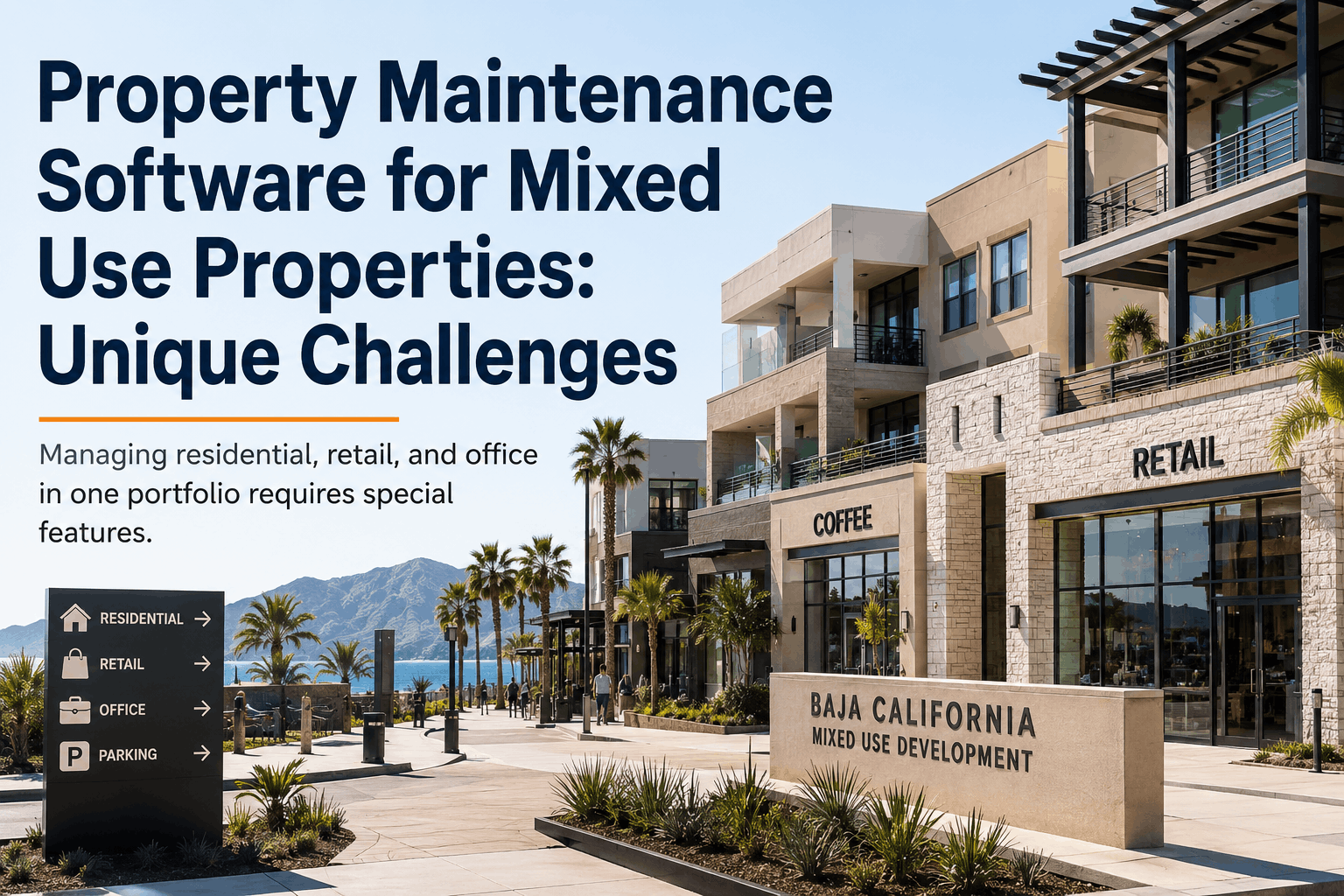
Mixed-use properties combine retail, residential, and commercial spaces under one roof — and that complexity breaks every traditional maintenance system built for single-use buildings. Managing divergent compliance requirements, shared systems with conflicting usage patterns, and tenants with entirely different service expectations demands a fundamentally different operational approach. If your current system was not built for mixed-use, see how Oxmaint handles it in a 30-minute walkthrough with our team.
3.6x
Higher coordination costs in mixed-use vs. single-use properties
68%
Of mixed-use operators report shared-system failures as their top maintenance challenge
$2.1M
Average annual maintenance cost for a mid-size mixed-use portfolio without structured tracking
40%
Of mixed-use maintenance spend is traceable to reactive failures that preventive scheduling eliminates
One Platform for Every Tenant Type, Every System, Every Site
Oxmaint gives mixed-use property teams a unified asset registry, zone-based maintenance scheduling, and portfolio-level reporting — without the spreadsheet chaos.
What Is Mixed-Use Property Maintenance?
Mixed-use property maintenance is the operational discipline of managing assets, systems, and service obligations across multiple property types — retail, residential, commercial office, hospitality, and parking — that coexist within a single building or campus. Unlike single-use facilities, mixed-use properties share infrastructure (HVAC, electrical, plumbing, elevators) across zones with fundamentally different compliance requirements, hours of operation, and tenant expectations. The maintenance system must serve all of them simultaneously without dropping any.
Zone-Based Asset Management
Organizing assets by property zone (retail, residential, common area) so work orders, histories, and compliance records stay separated and auditable by zone.
Shared System Coordination
Scheduling maintenance on infrastructure serving multiple zones — elevators, rooftop HVAC, fire suppression — without disrupting any single tenant group.
Common Area Maintenance (CAM)
Tracking and allocating costs for lobbies, corridors, parking decks, and shared amenities across tenant categories for accurate lease reconciliation.
Multi-Compliance Scheduling
Running simultaneous compliance programs for residential habitability codes, commercial fire safety, retail health regulations, and OSHA requirements in one building.
6 Operational Challenges Unique to Mixed-Use Properties
These are not scaled-up versions of single-use problems. They are structurally different challenges that require purpose-built solutions. Book a session and we will map these challenges against your current portfolio to show exactly where operational drag is costing you most.
01
Conflicting Maintenance Windows
Retail tenants operate 7am-10pm. Residential tenants sleep midnight-6am. Office tenants hold meetings 9am-5pm. HVAC and elevator maintenance that suits one zone disrupts another. 72% of mixed-use operators cite scheduling conflicts as their primary coordination failure.
02
Shared System Cost Allocation
When a shared chiller serves retail floors and residential units, repair costs must be allocated across lease types. Without tracked asset records, this becomes a guessing exercise that delays recoveries and triggers tenant disputes worth $15,000-$80,000 per event.
03
Divergent Compliance Obligations
A single mixed-use building may be subject to residential habitability codes, commercial fire inspection schedules, food service health regulations, and OSHA workplace standards simultaneously. A single missed inspection costs an average of $15,625 in citations.
04
Fragmented Work Order Tracking
Teams managing mixed-use often run separate systems per zone — one for residential, one for commercial, one for retail — resulting in no portfolio-level visibility. 61% of mixed-use operators have no single source of truth for maintenance status across zones.
05
Uneven Technician Deployment
Skilled technicians dispatched reactively across zones spend 55-65% of their time on diagnosis and travel between floors or buildings rather than planned repair work. This drives labor cost per repair up by 38% compared to single-use deployments.
06
CapEx Forecasting Blind Spots
Shared assets like elevators, fire panels, and central plant equipment have replacement costs that must be attributed across property types for investor reporting. Without condition scoring, CapEx overruns in mixed-use portfolios average 28% annually — higher than any single-use category.
Stop Managing Mixed-Use Properties With Single-Use Tools
Oxmaint's multi-property architecture handles zone-based scheduling, shared asset tracking, and compliance across every tenant type — in one platform built for operational complexity.
How Oxmaint Solves Mixed-Use Maintenance Complexity
The solution is not more spreadsheets or adding a second software tool for each zone. It is a unified platform with an asset hierarchy designed to reflect how mixed-use buildings actually operate. Start a free trial and build your first zone-based asset registry in under an hour — no implementation fees, no onboarding delays.
Step 01
Zone-Based Asset Registry
Every asset is tagged by zone (retail, residential, commercial, common area) within the same portfolio hierarchy. One login gives you full visibility across all zones with condition scores per asset.
Step 02
Conflict-Aware PM Scheduling
Preventive maintenance schedules are assigned per zone with configurable maintenance windows. Retail gets weekend AM slots, residential gets mid-day, office gets after-hours — all in one system.
Step 03
Shared Asset Cost Tracking
Work orders on shared systems log actual labor, parts, and contractor costs per event. Cost allocation across zones becomes a report pull, not a manual calculation — reducing reconciliation time by 70%.
Step 04
Multi-Compliance Scheduling
Separate compliance calendars run simultaneously per zone. Residential fire inspections, commercial HVAC certifications, and retail health checks all tracked and auditable without any overlap or gap.
Step 05
Portfolio-Level Reporting
Aggregate KPIs across all zones and properties: maintenance spend per square foot by zone, PM compliance by property type, asset condition distribution. Reports export in under 2 minutes for investor and ownership presentations.
Step 06
Rolling CapEx Forecasting
Condition scores and remaining useful life data feed 5-10 year capital models broken down by zone. Investment committees see defensible, data-backed replacement timelines — not spreadsheet estimates.
Mixed-Use Maintenance: Fragmented vs. Unified Operations
The gap between running zone-specific tools and a unified platform is not just a technology preference — it is a measurable financial and operational gap. Book a walkthrough and we will run these numbers against your actual portfolio spend in 30 minutes.
Asset Visibility
Separate records per zone. No portfolio-level view. Shared assets logged in multiple systems or none.
Single asset registry across all zones. Condition scores per asset. Full history in one dashboard.
Scheduling
Manual coordination across zones. Maintenance windows clash. 72% of teams report recurring scheduling conflicts.
Zone-aware PM scheduling with configurable windows. Conflicts eliminated before they hit tenants.
Cost Allocation
Shared system costs manually split across zones. Reconciliation takes days. Disputes cost $15K-$80K per incident.
Costs auto-tracked per work order per zone. CAM reconciliation reduced from days to a single report pull.
Compliance
Separate compliance calendars per zone with no cross-visibility. Missed inspections average $15,625 per OSHA citation.
Unified compliance calendar per zone. Audit-ready records always current. 40% fewer compliance findings.
CapEx Planning
No condition data for shared assets. CapEx overruns average 28% annually in mixed-use portfolios.
Condition-scored CapEx models by zone. 40% faster capital approval with defensible data.
Reporting
Manual assembly from multiple zone tools. Portfolio reporting takes days. Data frequently mismatched.
Automated cross-zone reports in under 2 minutes. Always investor-ready, always audit-complete.
Mixed-Use Maintenance Spend by Zone: Where Budgets Break
Understanding where spend concentrates in a mixed-use portfolio is the first step to controlling it. Shared systems consistently represent the highest per-unit cost and the lowest tracking fidelity.
Shared HVAC and Central Plant
82%
Elevators and Vertical Transport
74%
Common Area Electrical and Lighting
65%
Retail Zone Fit-Out Maintenance
58%
Residential Plumbing and Life Safety
49%
Parking and Exterior Systems
38%
Reactive spend concentration index — higher percentage indicates greater share of unplanned emergency repairs relative to total zone maintenance budget
See Your Mixed-Use Portfolio's Cost Breakdown in Real Time
Oxmaint tracks maintenance spend by zone, system, and asset class so you always know where budget is going — and where it can be recovered. See it working on your properties in a live demo.
Smart Building Investment Analysis: Costs vs. Returns
For mixed-use properties specifically, IoT-enabled maintenance management delivers stronger ROI than single-use portfolios because the operational complexity amplifies savings at every layer. We can run a custom return projection against your mixed-use portfolio in a 30-minute session with no obligations.
| Solution |
Implementation Cost |
Annual Savings |
Payback Period |
| Zone-Based PM Scheduling (CMMS) |
$1,200 / building |
$48,000 / avoided emergency repairs |
Under 2 weeks |
| Shared Asset Condition Scoring |
$900 / building |
$35,000 / deferred replacement costs |
Under 2 weeks |
| IoT Sensor Monitoring (HVAC, Electrical) |
$2,400 / building |
$52,000 / prevented failures |
Under 4 weeks |
| CAM Cost Allocation Automation |
$1,800 / portfolio |
$28,000 / reconciliation and dispute savings |
Under 3 weeks |
| Portfolio-Level Reporting Automation |
$1,100 / portfolio |
$19,000 / labor and error reduction |
Under 3 weeks |
| Full IoT + CMMS Platform Deployment |
$8,500 / building |
$143,000 / building annually |
Under 6 months |
Complete IoT implementation delivers 3.2x ROI within 18 months, with most solutions paying for themselves in under 6 months.
Investment Reality: Full IoT deployment costs average $8,500 per building but returns $143,000 annually. The 3.2x ROI makes IoT investment essential for competitive mixed-use operations.
The Numbers Behind Unified Mixed-Use Maintenance
70%
Reduction in CAM reconciliation time when shared asset costs are tracked automatically per work order
28%
Average annual CapEx overrun in mixed-use portfolios operating without condition scoring
3.2x
ROI within 18 months of deploying a unified CMMS and IoT platform across a mixed-use portfolio
45%
Fewer unplanned disruptions to tenants after implementing zone-based preventive maintenance scheduling
Frequently Asked Questions
How do you manage maintenance scheduling when retail, residential, and office tenants have conflicting hours?
Zone-based scheduling is the answer. Each zone in your property gets its own configurable maintenance window tied to tenant operating hours. Retail zones get early morning or overnight slots, residential zones get mid-day windows, and commercial office zones get after-hours or weekend scheduling. With Oxmaint, all three run simultaneously in one system with no manual coordination required — and technicians get auto-assigned work orders with zone-specific instructions.
Book a walkthrough to see exactly how zone scheduling works for your specific property configuration.
How do you allocate maintenance costs for shared systems across different tenant types?
Every work order in Oxmaint captures actual labor hours, parts used, and contractor invoices tied to the specific asset serviced. When that asset serves multiple zones, the system tracks which zones were impacted and by what proportion. CAM reconciliation reports pull this data automatically, eliminating the manual calculation that currently costs property teams days of work per billing cycle and $15,000-$80,000 per dispute event.
See a live demo of how CAM cost tracking works in a 30-minute session.
Can one platform handle different compliance requirements for residential and commercial zones?
Yes. Oxmaint runs simultaneous compliance calendars per zone without any configuration overlap. Residential zones track habitability codes, fire egress inspections, and plumbing certifications. Commercial zones track OSHA workplace requirements, HVAC certification schedules, and electrical inspections. Each zone's compliance status is auditable independently and exportable for regulatory submissions. Properties on structured compliance programs face 40% fewer findings during inspections than those operating reactively.
Start a free trial and build your first zone-based compliance calendar before the week is out.
How does Oxmaint handle CapEx forecasting for shared assets in a mixed-use building?
Shared assets like elevators, central plant equipment, and fire suppression systems are assigned condition scores and remaining useful life estimates based on maintenance history, inspection results, and age. Oxmaint's rolling 5-10 year CapEx models break replacement costs down by zone attribution so investment committees see not just when an asset needs replacement, but how that cost should be divided across property types. Mixed-use portfolios using condition-backed CapEx requests receive capital approval 40% faster than those submitting estimate-only budgets.
What happens to tenant satisfaction when maintenance is uncoordinated across zones?
It degrades across all tenant types simultaneously. Retail tenants experiencing 3+ unplanned HVAC outages per year are 2.4x more likely to not renew leases. Residential tenants file complaints that escalate to habitability proceedings when reactive maintenance leaves issues unresolved. Office tenants relocate when downtime affects productivity. A single commercial vacancy in a mixed-use building can represent $50,000-$200,000 in lost annual rent — far exceeding the cost of any preventive maintenance program.
Book a session to see how Oxmaint PM scheduling directly supports tenant retention across all your zone types.
How quickly can a mixed-use property team get up and running on Oxmaint?
Most teams build their initial zone-based asset registry and first PM schedules within the first week of deployment. There are no heavy implementation fees, no long onboarding cycles, and no need to rebuild anything as properties are added. Oxmaint's asset hierarchy (Portfolio, Property, System, Asset, Component) keeps your data structured whether you are managing a single mixed-use building or a portfolio of 20. Most teams reach 80%+ PM compliance within 60-90 days of going live.
Start your free trial and see how fast your team can move from reactive chaos to preventive precision.
Mixed-Use Properties Deserve a Maintenance Platform Built for Their Complexity.
Oxmaint gives mixed-use property teams zone-based asset management, shared system cost tracking, multi-compliance scheduling, and portfolio-level CapEx forecasting — all in one platform with no implementation fees and a live deployment measured in days, not months.
Zone-based asset registry across all property types
Conflict-aware PM scheduling per tenant zone
Shared system cost tracking for CAM reconciliation
Rolling 5-10 year CapEx models by zone