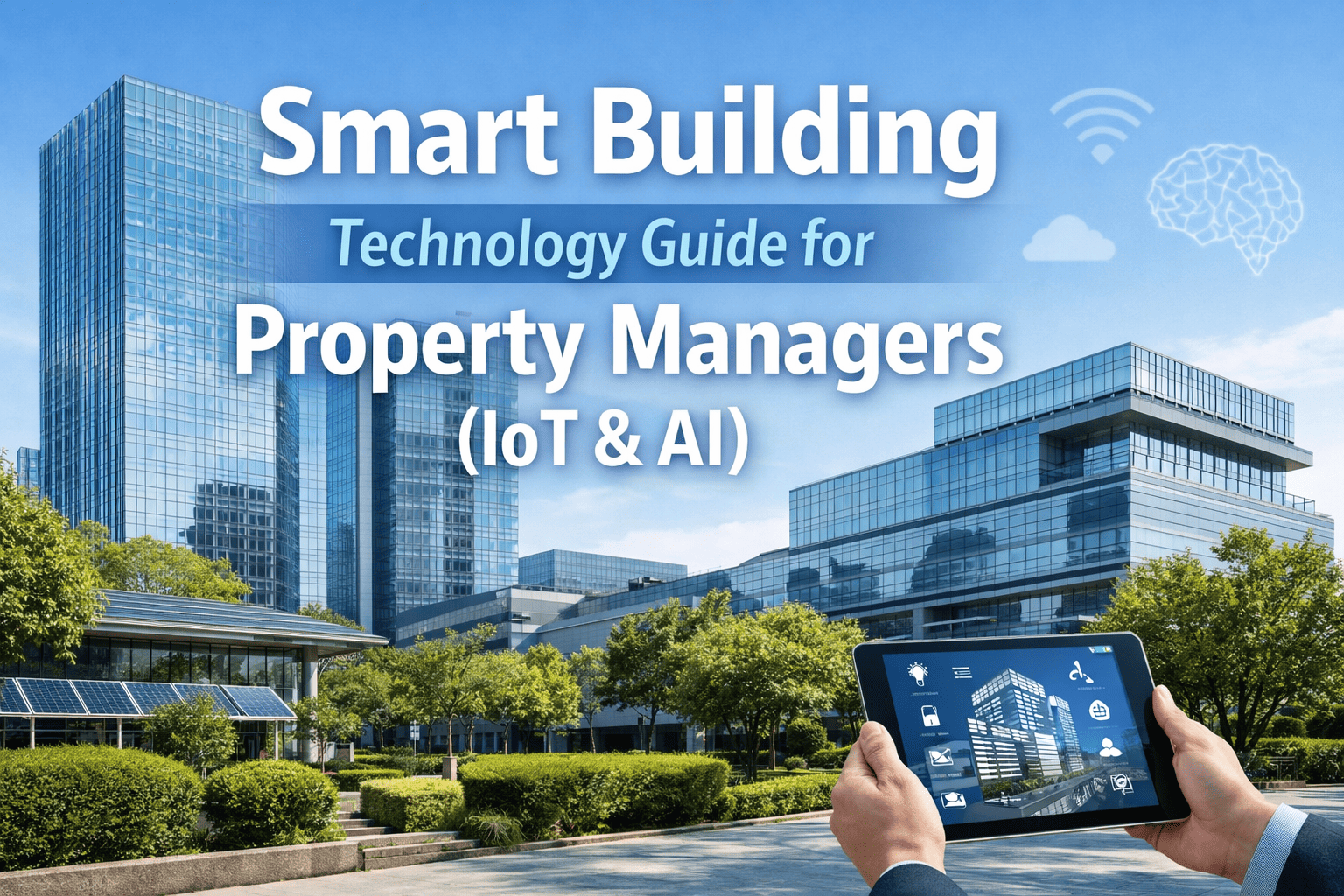
Smart Buildings Explained: How IoT is Transforming Property Management
By sara on February 13, 2026
Smart buildings represent the convergence of IoT sensor networks, cloud analytics, and automated building management—transforming commercial properties from passive structures into intelligent, self-optimizing environments. The traditional approach to property management relies on scheduled maintenance rounds, tenant complaint-driven repairs, and quarterly utility bill reviews to understand building performance. This reactive model wastes 25–35% of operating budgets on inefficient energy use, emergency repairs, and labor-intensive manual monitoring that still misses 60–80% of developing equipment failures. IoT-enabled smart building systems flip this equation by providing continuous, real-time visibility into every HVAC unit, electrical panel, plumbing system, lighting zone, and access point—generating thousands of data points per hour that reveal equipment degradation, energy waste, and comfort issues weeks before they become tenant complaints or emergency repairs. Sign up free on OxMaint.
The market trajectory is clear: the global smart building market is projected to exceed $230 billion by 2028, driven by energy regulations, tenant expectations, and the undeniable ROI that connected buildings deliver. Properties implementing comprehensive IoT monitoring through integrated CMMS platforms report 30–50% reduction in energy costs, 45–65% fewer unplanned equipment failures, 60–80% faster maintenance response times, and measurable improvements in tenant satisfaction that directly impact occupancy rates and lease premiums. Yet fewer than 20% of commercial buildings have implemented even basic IoT monitoring—primarily because property teams lack a clear framework for evaluating technologies, prioritizing systems, and integrating sensor data with maintenance operations. This guide provides that framework. Book a demo to see how OxMaint.
IoT Building Systems Performance Dashboard: Real-Time Monitoring Scorecard
A smart building generates thousands of data points per hour across HVAC, electrical, plumbing, lighting, and security systems. This scorecard framework shows how property managers can track, benchmark, and optimize every building system through a single integrated view.
Smart Building Performance DashboardBuilding: All SitesPeriod: Last 30 DaysSystem: All IoT Systems
Building System
Sensors Active
Alerts/Month
Auto Work Orders
Avg Response
Energy Impact
Health Score
HVAC Systems
148
42
38
18 min
-32%
94/100
Electrical & Lighting
96
28
24
12 min
-28%
91/100
Plumbing & Water
64
18
15
22 min
-18%
87/100
Fire & Life Safety
52
8
8
5 min
N/A
98/100
Access & Security
38
14
10
8 min
-5%
93/100
Portfolio Total
398
110
95
13 min avg
-24% avg
92/100
Quantifying Smart Building ROI Through Connected Operations
Every IoT sensor deployed in a commercial building generates measurable returns across energy savings, maintenance efficiency, tenant satisfaction, and asset longevity. These four metrics represent the core ROI framework that property managers should track from day one of their smart building journey.
30–50%
Energy cost reduction through real-time optimization and waste detection
> 85%
Of equipment issues detected before tenant impact through IoT monitoring
13 min
Average maintenance response time with automated IoT-to-work-order workflows
< 2%
Unplanned equipment downtime rate in fully connected smart buildings
Building a Smart Building Performance Scorecard
Performance Category
Key Metrics
Target Benchmark
Energy Efficiency
kWh/sqft, peak demand reduction, ENERGY STAR score
Temperature, humidity, pressure, and airflow sensors across AHUs, chillers, boilers, and VAV boxes enabling real-time performance monitoring and predictive maintenance.
Energy & Power Monitoring
Sub-metering at panel level, power quality analysis, demand response integration, and real-time consumption dashboards identifying waste patterns instantly.
Water & Leak Detection
Flow meters, moisture sensors, and fixture monitoring detecting leaks, running toilets, and consumption anomalies—preventing water damage and waste.
Fire & Life Safety
Smoke detection, sprinkler monitoring, stairwell pressurization, fire damper position sensors—all feeding into compliance-documented maintenance workflows.
Access & Security
Badge readers, occupancy sensors, surveillance integration, and visitor management systems providing both security and space utilization analytics.
Indoor Air Quality
CO₂, particulate matter, VOC, temperature, and humidity sensors ensuring ASHRAE 62.1 compliance and occupant health across all zones.
Automated IoT-to-Maintenance Workflow
1
Sensor Detects Anomaly
→
2
Rules Engine Evaluates
→
3
Work Order Created
→
4
Technician Dispatched
→
5
IoT Verifies Fix
Legacy Building vs. Smart Building Considerations
Pre-2000 Buildings
Often lack BMS infrastructure entirely. Require wireless sensor overlays (LoRaWAN/cellular) that operate independently of building networks. Focus on highest-ROI systems first: energy sub-metering and HVAC monitoring. Typical retrofit cost: $0.50–$1.50/sqft.
2000–2015 Buildings
Usually have basic BMS with BACnet or LonWorks. Integration focuses on bridging BMS data to CMMS via API middleware. Add wireless sensors for gaps: water leak detection, IAQ, and occupancy. Typical enhancement cost: $0.25–$0.75/sqft.
Post-2015 Buildings
Often have IP-based BMS and existing sensor networks. Integration is primarily software—connecting BMS outputs to OxMaint's rules engine for automated work orders. Focus on analytics layer and optimization. Typical cost: $0.10–$0.40/sqft.
IoT Technology Comparison for Property Managers
Technology
Best For
Range
Battery Life
Cost/Sensor
LoRaWAN
Large buildings, campus-wide
2+ miles
5–10 years
$30–$80
Wi-Fi Sensors
Dense office environments
150 ft
1–3 years
$50–$150
Cellular (LTE-M)
Remote/distributed sites
Unlimited
3–5 years
$60–$120
BLE Mesh
Occupancy, indoor tracking
100 ft
2–5 years
$15–$50
Zigbee
Lighting control, HVAC zones
300 ft
2–7 years
$20–$60
Key Annual Cost Benchmarks for Smart Buildings
$0.75/sqft
Average IoT Implementation Cost
Full sensor deployment, gateway infrastructure, software integration, and first-year CMMS licensing for a 100,000 sqft commercial building.
$1.80/sqft
Annual Operating Savings
Combined energy reduction, maintenance optimization, water conservation, and labor efficiency savings after smart building implementation.
2.4:1 ROI
First-Year Return on Investment
Net savings after deducting implementation costs, ongoing sensor maintenance, and software subscriptions. ROI improves to 4:1+ by year three.
Multi-Site Portfolio Smart Building Strategy
Managing IoT across a multi-building portfolio requires standardized sensor specifications, centralized data platforms, and consistent maintenance workflows that scale without proportional headcount increases. OxMaint's portfolio dashboard aggregates IoT data from all buildings into a single view—enabling facility directors to compare energy performance, maintenance responsiveness, and equipment health across every property.
Standardized sensor specs across all properties for consistent data quality and simplified procurement
Centralized rules engine with property-specific threshold overrides for climate, occupancy, and equipment age variations
Portfolio benchmarking that ranks buildings by energy efficiency, maintenance responsiveness, and tenant satisfaction scores
Vendor management with performance tracking across all sites and automated escalation workflows per trade type
Quick-Start Implementation Guide
1
Energy audit — Identify top 3 energy waste sources using utility data; these become your first IoT monitoring targets
2
Pilot building selection — Choose a representative property with cooperative engineering staff and existing network infrastructure
3
Sensor deployment — Install energy sub-meters, HVAC sensors, and water leak detectors in pilot building (typically 2–4 weeks)
4
CMMS integration — Connect sensor feeds to OxMaint, configure alert thresholds and automatic work order rules
5
90-day evaluation — Measure energy savings, response times, and complaint reduction; build portfolio-wide business case
6
Portfolio rollout — Deploy to remaining properties using pilot learnings, standardized specs, and proven ROI data
Compliance and Audit Trail
100%
Automated documentation of every sensor alert, work order, and resolution for regulatory audits
< 4 hours
Time to generate complete compliance reports for ASHRAE, NFPA, OSHA, and local authority requirements
Zero
Manual data entry required—all maintenance records generated automatically from IoT-triggered workflows
Best Practices for Smart Building Success
Start with energy monitoring—it delivers the fastest, most measurable ROI and builds organizational confidence
Integrate IoT with CMMS from day one—standalone dashboards create data silos that reduce actionability by 70%
Configure alert thresholds conservatively at first, then tighten based on 90 days of baseline data to avoid alarm fatigue
Train maintenance staff on interpreting IoT data—technicians who understand sensor context resolve issues 40% faster
Share monthly performance dashboards with building ownership—visible ROI drives budget approval for portfolio expansion
Understanding Cost-Per-Square-Foot IoT Economics
The most useful financial metric for evaluating smart building investments is cost-per-square-foot—both for implementation and ongoing savings. This normalizes comparisons across building sizes and types.
Example: 150,000 sqft Class A Office Tower
Implementation: 398 sensors × $65 avg = $25,870 hardware + $12,000 installation + $8,400 software = $46,270 total ($0.31/sqft)
Annual savings: Energy $42,000 + Maintenance $28,000 + Water $8,500 + Labor $18,000 = $96,500 ($0.64/sqft) First-year net ROI: $50,230 (2.1:1 return)
ROI Analysis: Smart Building vs. Traditional Operations
Traditional operating cost (maintenance + energy + labor)$8.50/sqft/yr
Smart building operating cost (with IoT optimization)$5.80/sqft/yr
Annual savings per square foot$2.70/sqft
For 100,000 sqft building$270,000/year
Transform Your Property Into a Smart Building
Join 500+ facilities using OxMaint to connect IoT sensors with automated maintenance workflows.
How much does it cost to make a commercial building "smart"?
Implementation costs typically range from $0.25–$1.50 per square foot depending on building age, existing infrastructure, and scope of IoT deployment. A 100,000 sqft building with no existing BMS might invest $75,000–$150,000 for comprehensive sensor coverage, while a building with existing BMS might spend $25,000–$75,000 for integration and gap-filling sensors. Annual software and connectivity costs run $0.05–$0.15/sqft. Most facilities achieve full payback within 6–18 months through energy savings alone. Sign up on OxMaint to get a customized smart building cost estimate.
What should we monitor first in a smart building implementation?
Start with energy sub-metering and HVAC monitoring—they deliver the fastest, most measurable ROI and typically represent 60–70% of total building operating costs. Energy sub-meters at the panel level immediately reveal waste patterns (equipment running during unoccupied hours, simultaneous heating/cooling, efficiency degradation). HVAC sensors on chillers, AHUs, and VAV boxes catch performance drift that compounds into major energy waste. Water leak detection is the second priority due to catastrophic damage potential. Expand to IAQ, lighting, and access systems as the program matures.
How does IoT data integrate with maintenance management systems?
IoT sensors transmit data via LoRaWAN, Wi-Fi, or cellular to cloud gateways. OxMaint's integration layer receives this data through standard APIs and applies configurable rules to evaluate every reading against normal operating baselines. When thresholds are exceeded, the system automatically generates prioritized work orders with full sensor context—asset identification, fault description, trend data, and suggested repair actions. Technicians receive mobile alerts and arrive at equipment with complete diagnostic insight. After repair, sensors verify the fix by confirming readings return to normal. The entire lifecycle is documented automatically for compliance.
Can older buildings be retrofitted with smart building technology?
Yes—modern wireless sensor technologies (LoRaWAN, cellular LTE-M) are specifically designed for retrofit applications. They operate on independent wireless networks, require no building wiring modifications, and feature battery lives of 5–10 years. A pre-2000 building with no BMS can achieve comprehensive monitoring through wireless sensor overlays at $0.50–$1.50/sqft—significantly less than a traditional BMS installation. The key is starting with the highest-ROI monitoring points (energy, HVAC, water) and expanding systematically based on measured results.
How does OxMaint help manage smart building operations?
OxMaint serves as the operational intelligence layer that transforms raw IoT data into actionable maintenance workflows. The platform provides: real-time integration with all major IoT protocols and BMS systems, configurable rules engine for automated work order generation, mobile technician dispatch with full sensor context and diagnostic data, closed-loop repair verification using post-repair sensor data, portfolio-wide dashboards comparing energy performance and maintenance metrics across buildings, predictive analytics that forecast equipment failures based on trend patterns, and automated compliance reporting for ASHRAE, NFPA, and local authority requirements. Try OxMaint free to connect your building systems.