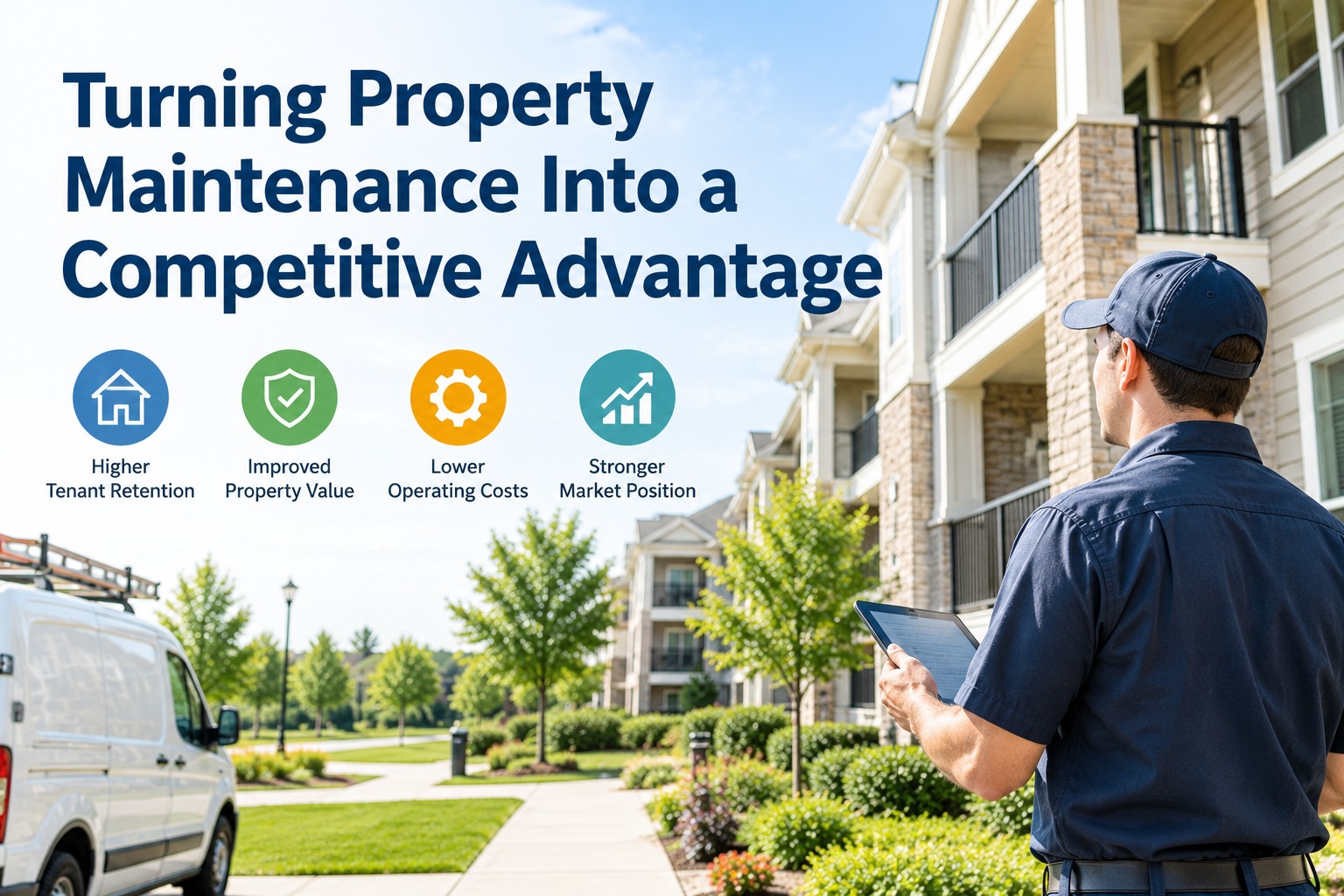
Turning Property Maintenance Into a Competitive Advantage

By William Jerry on September 8, 2026

property-maintenance-as-competitive-advantage-2026

Here's the contradiction at the heart of property management in 2026: maintenance is simultaneously the industry's biggest pain point and its single most powerful competitive advantage. It's the top source of stress for 38% of rental owners — ranking above filling vacancies, managing residents, or collecting rent — and yet the companies pulling ahead right now are winning more owner clients, retaining more tenants, and generating higher NOI on the strength of exactly that. The shift they've made is simple to state and hard to live: maintenance is not a cost to minimize, it is a system to build. This guide covers how to turn property maintenance into a competitive advantage — as a marketing story, a retention driver, an NOI protector, and an asset-value preserver — and the operational discipline that makes it real. Start free or book a demo.

Property Management · Multifamily & Residential · Maintenance Strategy · 2026

Maintenance Is Not a Cost to Minimize. It's a System to Build.

The property managers thriving in 2026 stopped treating maintenance as a fire drill and started running it as a system — and it shows up in owner retention, tenant renewals, and NOI. This is how the same work that stresses everyone out becomes the thing that sets your portfolio apart.

38%
of rental owners say maintenance is their #1 stress — above vacancies, residents, and rent collection

55% vs 32%
renewal intent of satisfied vs unsatisfied residents — maintenance is the primary satisfaction driver

The Mindset Shift That Changes the Math

Reactive companies see a work order as an expense to close as cheaply as possible. Advantage-driven companies see the same work order as a touchpoint that either builds or erodes trust with the two audiences that decide their growth: owners and tenants. That reframe is the whole game. A broken water heater at 2 AM is a cost either way — but handled as a system, it becomes proof to the owner that their asset is in good hands and proof to the tenant that they're heard. The work is identical; the positioning is everything. Sign up free — no credit card and turn every request into a tracked, visible, trust-building touchpoint.

Four Ways Maintenance Becomes an Advantage

Great maintenance doesn't pay off in one place — it compounds across four dimensions of the business at once. Here's where systematic maintenance converts into a competitive edge. Schedule a 30-minute demo to see the operational engine behind all four.

01
A Marketing Story
Response-time guarantees, preventive programs, and transparent status turn maintenance into a pitch that wins owner clients. Documented performance is a client acquisition tool, not just an operational record — most companies leave that money on the table.
02
A Retention Driver
Maintenance responsiveness is the strongest influence on tenant satisfaction — and satisfied residents renew at 55% vs 32%, and recommend you at 84% vs 16%. In a renter's market, preventing a vacancy is far cheaper than filling one.
03
An NOI Protector
A leaking HVAC caught early costs a few hundred dollars; ignored, it's a multi-thousand-dollar replacement. Preventive maintenance and controlled vendor spend defend margin from both emergency repairs and quiet cost drift.
04
An Asset-Value Preserver
Consistent, documented upkeep keeps properties holding value through every season — and gives owners, buyers, and lenders the evidence of diligent stewardship they look for when they value the portfolio.

You Can't Improve What You Don't Measure

The line between a reactive shop and an advantage-driven one is measurement. Four metrics tell you exactly where you stand — track them at portfolio level and by property, and the outliers point straight to where the money and the risk are. Create your free account and track all four automatically as work flows through the system.

< 4 hrs
Time to Acknowledge
How fast a request gets a human response. The single cheapest lever on tenant satisfaction — acknowledgment alone changes the experience.
< 48 hrs
Time to Resolve
Non-emergency resolution speed. Slow repairs damage satisfaction faster than almost anything else on the property.
< 20%
Emergency vs Planned Ratio
The share of work that's reactive. A high ratio is the signature of a portfolio being run by crisis instead of by plan.
8–12%
Maintenance Cost % of Rent Roll
Spend as a share of revenue. The guardrail that keeps maintenance efficient without starving the assets.

Two Portfolios, Same Buildings, Opposite Outcomes.

One runs on scattered texts, a whiteboard, and memory — 40% emergency work, week-long resolutions, owners who never quite trust the numbers. The other runs the identical assets on a system: requests tracked, preventive work scheduled, every metric visible on one dashboard. Same buildings, but one renews tenants and wins owner referrals while the other bleeds both. OxMaint is the difference — every request a tracked work order, preventive maintenance automated, and the response-time and cost data that proves the advantage to owners.

Build the Data Foundation Before the Fancy Tools

Everyone's talking about AI and predictive maintenance — but the pro tip from the field is blunt: build a clean data foundation first. AI tools are only as good as the data they run on, and fragmented records across texts, spreadsheets, and inboxes produce fragmented results. Centralize maintenance history, vendor records, and equipment logs in one system, and you've built both today's advantage and tomorrow's platform. Schedule a live walkthrough to see that foundation on your portfolio.

Request-to-Work-Order Tracking
Every tenant and owner request becomes a tracked, assigned work order with status — nothing lost to a text thread, and a visible response that builds trust.
Preventive Maintenance Automation
Recurring service on HVAC, water heaters, and building systems scheduled automatically — driving the emergency ratio down and catching the small fault before it's a big bill.
Response & Resolution Metrics
Acknowledge time, resolve time, emergency ratio, and cost tracked at portfolio and property level — the outliers surfaced so you know where to act.
Vendor & Cost Control
Assign, track, and record every vendor job — closing the quiet cost drift that happens when contractors set their own timelines and prices unchecked.
Centralized Asset History
One clean record of maintenance, vendors, and equipment across the portfolio — the data foundation every AI and predictive tool depends on to work.
Owner-Ready Reporting
The response times, cost control, and preventive coverage that sophisticated owners now expect to see — turning your maintenance data into a client-retention asset.

Reframe maintenance as a system, measure the four metrics that matter, and centralize the data — and the work that used to be pure cost and stress becomes the clearest proof of value you can show an owner and the strongest reason a tenant renews. Sign up free or schedule a demo to build the advantage into your portfolio.

"

We used to compete on price because we didn't have anything else to point to — maintenance was a cost we apologized for. Once we moved everything into OxMaint, that flipped. Now I walk into an owner pitch with real numbers: average acknowledge time under three hours, emergency work down under 15%, preventive service documented on every unit. Owners don't haggle on fee when they can see that. Our tenant renewals climbed because requests actually get handled and residents can see it, and we stopped losing money to vendor invoices nobody was checking. Maintenance went from our apology to our sales pitch.

Principal · Regional Residential Property Management Firm

Frequently Asked Questions

Why is maintenance called property management's biggest pain point?
Because 38% of rental owners rank it their top source of stress — above vacancies, residents, and rent collection — and it's the leading reason tenants leave. It's the constant unpredictability of physical assets that wear down and fail at the worst moments.
How does maintenance become a competitive advantage?
By treating it as a system, not a cost to minimize. Systematic maintenance drives tenant retention, reduces owner anxiety, protects NOI, and preserves asset value — and documented performance becomes a marketing story that wins owner clients.
What maintenance metrics should property managers track?
Four: time to acknowledge (target under 4 hours), time to resolve non-emergencies (under 48 hours), emergency-vs-planned ratio (under 20%), and maintenance cost as a percentage of rent roll (8–12% residential) — tracked by portfolio and by property.
How does maintenance affect tenant retention?
Maintenance responsiveness is the strongest driver of resident satisfaction, and satisfied residents renew at 55% versus 32% for unsatisfied ones — and recommend their manager at 84% versus 16%. In a renter's market, preventing vacancy is the cheapest strategy there is.
Should we invest in AI and predictive maintenance now?
Build a clean data foundation first. AI tools are only as good as the data they run on, so centralize maintenance history, vendor records, and equipment logs in one system before layering predictive tools on top.
How does a maintenance system protect NOI?
By catching small faults before they become expensive replacements, driving down costly emergency work, and controlling vendor spend that otherwise drifts upward unchecked. Sign up free to start protecting margin.

Turn Your Biggest Pain Point Into Your Strongest Pitch.

OxMaint turns every request into a tracked work order, automates preventive maintenance, measures response times and cost, and gives you the owner-ready data that wins clients and keeps tenants. Start free — no credit card. Or book a demo.
Share This Story, Choose Your Platform!