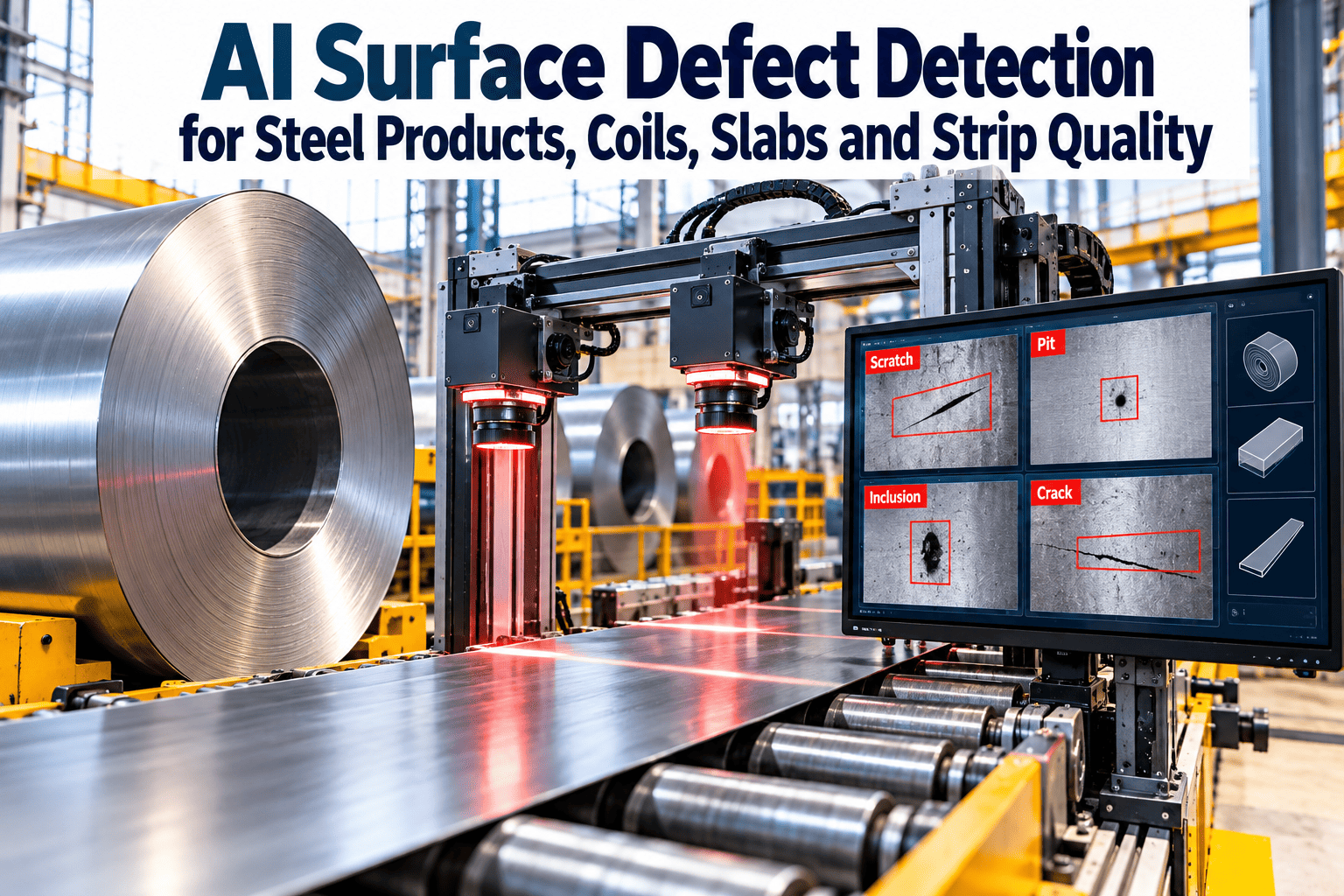
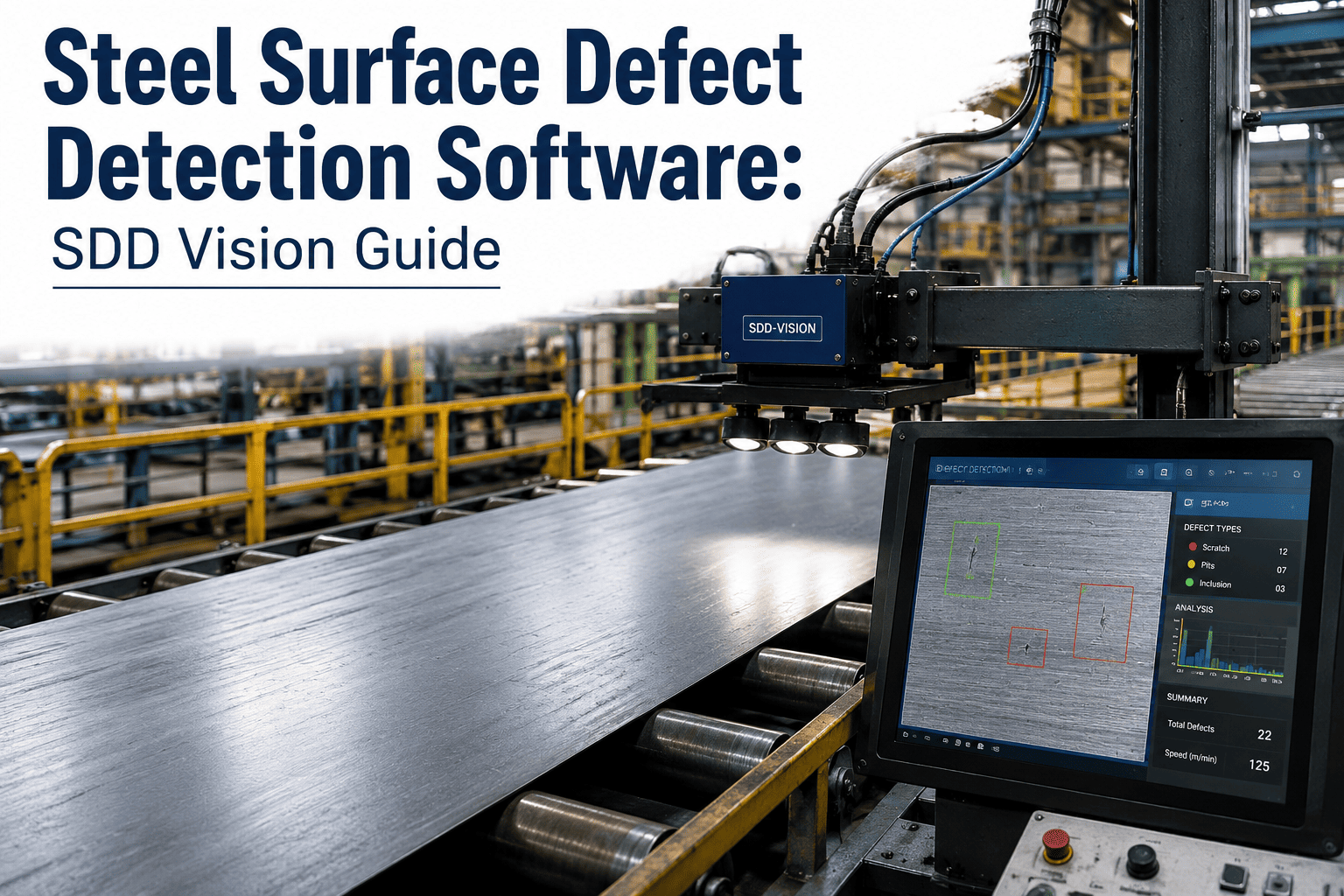
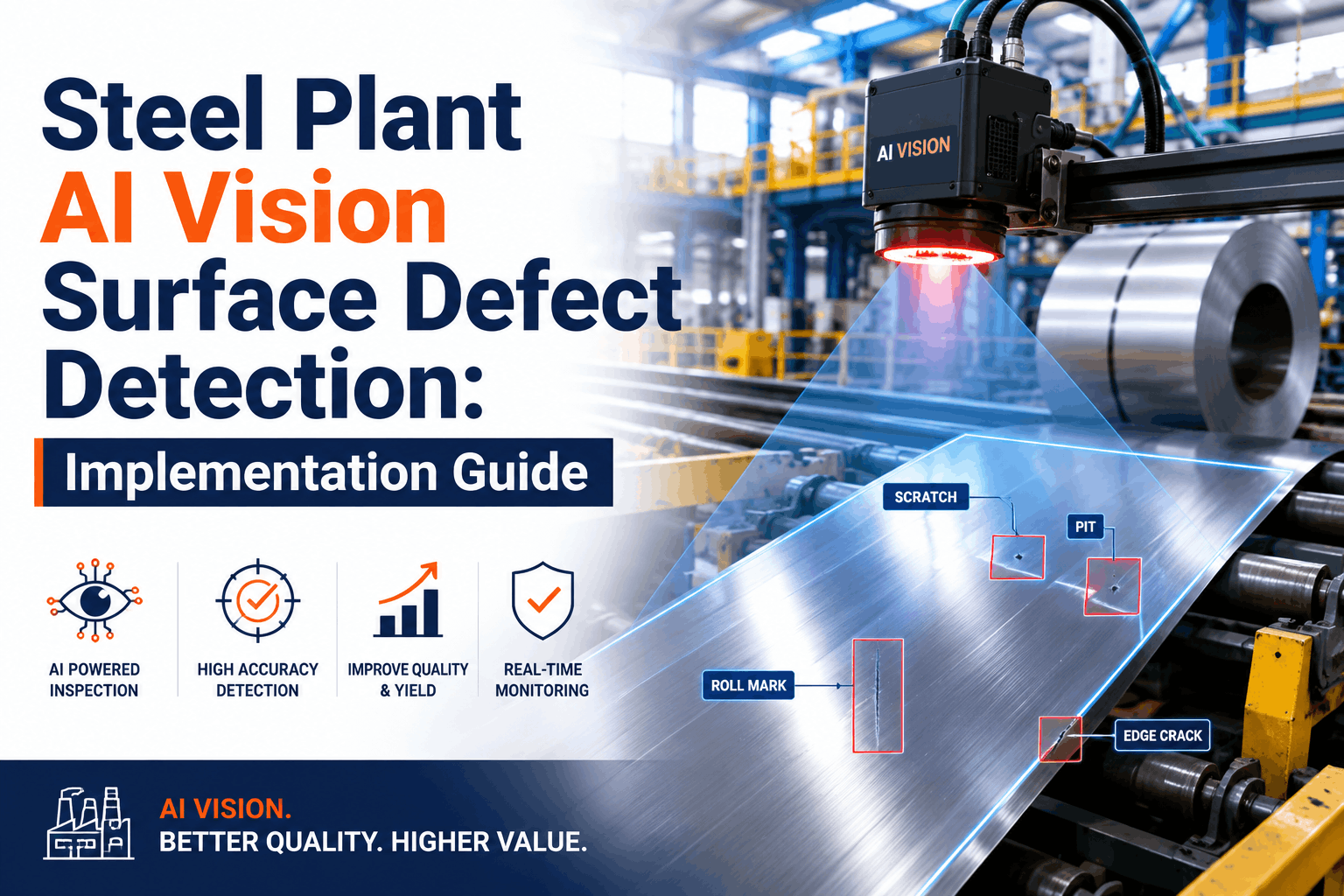
Human visual inspection of steel surfaces is fundamentally flawed. An experienced inspector working a hot strip mill catches 60-75% of surface defects on a good day — and their detection rate drops to 40-55% by the fourth hour of a shift. They can't inspect both sides of a strip simultaneously, they can't assess product moving at 15-25 meters per second, they miss subsurface defects entirely, and their judgment varies by fatigue, lighting, angle, and personal threshold. Every defect that escapes costs $2,000-$50,000 in customer claims, reprocessing, or scrap — and every false positive wastes $500-$5,000 in unnecessary downgrading or reinspection.
AI-powered visual inspection systems eliminate these limitations. High-resolution cameras operating at 4,000-16,000 frames per second, combined with deep learning algorithms trained on millions of defect images, achieve 95-99.5% defect detection rates with less than 1% false positive rates — 24 hours a day, every day, on every coil. When integrated with Oxmaint's maintenance and quality management platform, AI inspection doesn't just find defects — it traces them back to equipment root causes, triggers corrective maintenance automatically, and creates a continuous improvement loop that drives defect rates toward zero.
How AI Surface Inspection Works in a Steel Mill
The technology stack behind AI visual inspection combines industrial imaging hardware, edge computing, deep learning inference, and integration with plant systems. Here's the complete architecture:
Image Acquisition
Edge Processing & AI Inference
Decision & Integration
Defects the AI Catches: The Complete Steel Surface Defect Library
Modern AI inspection systems classify 40-80+ distinct defect types across different steel products. Here are the major categories with their detection characteristics and equipment correlations:
Mechanical Defects
Thermal & Scale Defects
Shape & Flatness Defects
Coating & Finish Defects
Every Defect Found. Every Root Cause Traced. Every Fix Automated.
Oxmaint connects AI inspection data to equipment maintenance history — when the AI detects a pattern, Oxmaint generates the work order to fix the cause before it produces another thousand metres of defective steel.
ROI of AI Visual Inspection in Steel
The financial case for AI inspection is compelling across every metric. Here's a typical ROI breakdown for a hot strip mill producing 3-5 million tonnes per year:
Reduced Customer Claims
Detection rate improvement from 65% to 98% means 90%+ fewer defective coils reaching customers. Average claim cost: $5,000-$25,000 per incident including transportation, reinspection, and credit.
Reduced False Downgrades
False positive rates drop from 5-15% to <1%. Every false downgrade sells prime product at secondary prices — a $50-200/tonne revenue loss per coil. On 3Mt production, even 0.5% yield improvement = $1.5-6M.
Defect-Driven Maintenance Savings
AI defect pattern analysis identifies equipment degradation 2-5 days before it causes mass quality events. Planned corrective maintenance costs 3-5x less than emergency repairs plus the scrap/rework they generate.
Labor Reallocation
Manual inspection teams (typically 6-12 inspectors across shifts) are redeployed to higher-value quality engineering roles: root cause analysis, customer technical service, and process improvement rather than repetitive visual scanning.
AI Inspection Maintenance: Keeping the Eyes Sharp
AI inspection hardware operates in the harshest environment in any factory — near the rolling mill exit with heat, steam, scale dust, vibration, and coolant spray. Without rigorous preventive maintenance via Oxmaint's CMMS, image quality degrades within days:
Optics & Lighting
Clean camera lenses and protective windows. Verify LED line illumination intensity and uniformity. Check air purge pressure on camera housings. Inspect for coolant or scale contamination on optical surfaces.
Calibration Verification
Run calibration target through system to verify spatial resolution, defect detection thresholds, and classification accuracy. Compare AI output against known reference samples. Log any drift in detection sensitivity.
Hardware & Environment
Inspect camera cooling systems, enclosure seals, and purge air filters. Verify edge server GPU temperatures and fan operation. Check cable integrity, connector condition, and network latency. Clean or replace protective windows.
AI Model Performance
Comprehensive model performance audit: detection rate by defect type, false positive analysis, missed defect review. Retrain model with new labeled data from the previous quarter. Validate updated model against test dataset before production deployment.
Full System Overhaul
Camera sensor assessment and replacement if degraded. LED array replacement (typical life: 20,000-30,000 hours). Edge server hardware refresh evaluation. Full system integration test with production line controls and CMMS data flow verification.
See Every Defect. Trace Every Cause. Fix It Before It Multiplies.
Oxmaint closes the loop between AI inspection and corrective maintenance — turning defect detection into defect prevention. The result: 40-65% fewer defects within 12 months.
Frequently Asked Questions
How long does it take to train the AI for our specific products?
Initial deployment uses a pre-trained base model that already recognizes 30-50 common steel defect types with 90%+ accuracy from day one. Fine-tuning to your specific product mix, defect priorities, and acceptance criteria requires 4-8 weeks of production data collection followed by 2-4 weeks of model training and validation. Full optimization to 97%+ detection rates across all your product-specific defects typically takes 3-6 months of iterative learning. The system improves continuously with every coil inspected.
Can AI inspection work on hot strip (before cooling)?
Yes, but with specialized hardware. Inspection of hot strip at 600-900°C requires infrared cameras or specially filtered optical cameras that can image through the thermal glow. Most production installations place primary inspection after cooling (below 200°C) for best image quality. Some systems add a hot-zone pre-inspection using thermal imaging to catch major defects early enough to adjust downstream process parameters in real time — for example, modifying cooling patterns to minimize the impact of a detected surface issue.
How does AI inspection integrate with our existing Level 2/3 systems?
AI inspection systems connect to plant automation via standard industrial protocols: OPC-UA for Level 2 process control (receiving coil tracking data, line speed, product specs), database integration for Level 3 (sending defect maps, quality grades, and inspection reports to MES/ERP), and API integration with Oxmaint CMMS for maintenance-quality correlation. Defect data is tagged with coil ID, production order, and process parameters automatically. Most installations take 2-4 weeks for full system integration.
What happens when the AI encounters a defect type it hasn't seen before?
Well-designed AI systems handle novel defects through anomaly detection: even if the system can't classify the defect, it detects that something is abnormal and flags it for human review. These flagged images are labeled by quality engineers and fed back into the training pipeline, expanding the model's capability. Over time, the "unknown" category shrinks toward zero. The system also maintains a confidence score for every classification — low-confidence detections are automatically queued for human verification, ensuring nothing slips through.
How does Oxmaint use AI defect data to trigger maintenance?
Oxmaint maps defect signatures to equipment root causes: periodic roll marks → work roll surface damage → roll change work order. Increasing scale pit density → descaler nozzle wear → nozzle inspection work order. Edge crack frequency trending up → side guide alignment check work order. These rules are configured during implementation and refined over time as the correlation database grows. The result is predictive quality maintenance: fixing equipment issues based on early defect signals rather than waiting for mass quality failures. This typically prevents 60-80% of quality events that would otherwise require emergency maintenance response.