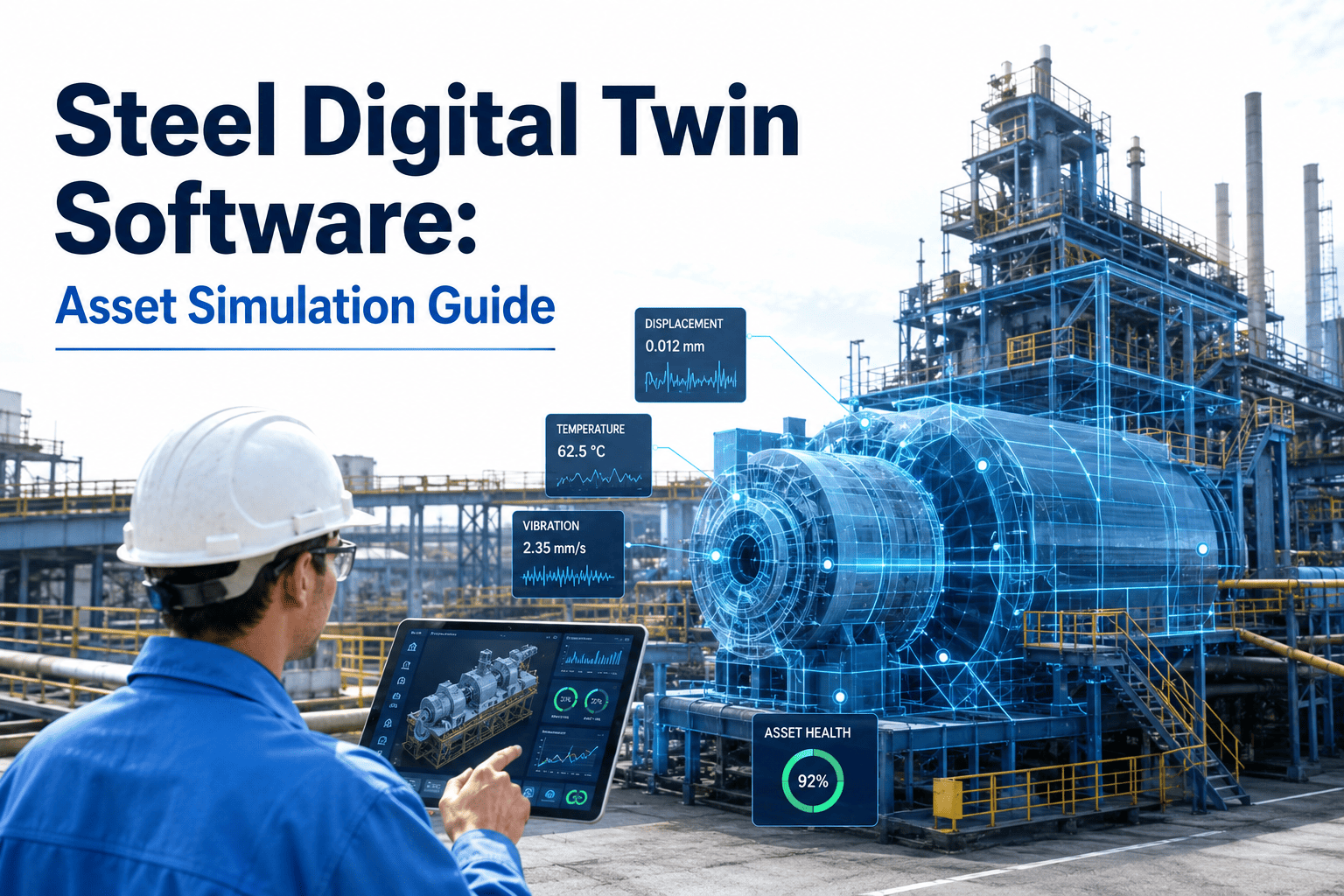
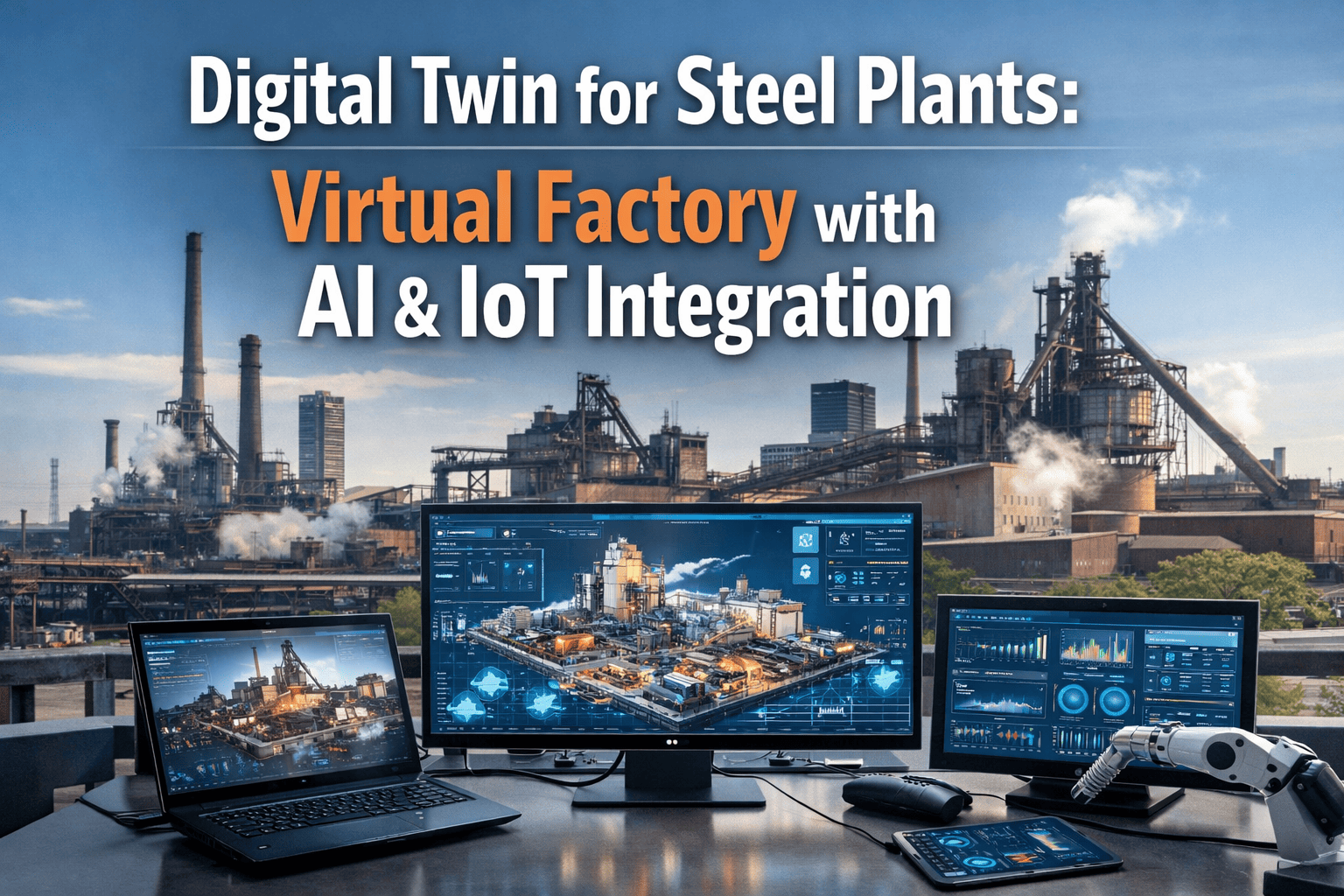
A digital twin is a real-time virtual replica of your entire steel plant — every furnace, crane, rolling mill, compressor, and conveyor mirrored in software with live data flowing from sensors, maintenance records, and production systems. In 2026, digital twin technology has moved from aerospace and automotive into heavy industry, and steel manufacturing is where it delivers the highest ROI. McKinsey estimates that digital twins reduce unplanned downtime by 30-50%, cut maintenance costs by 10-25%, and improve asset life by 20-40% in capital-intensive process industries.
But here's what most steel plants get wrong: they think building a digital twin requires a $10 million IoT project with thousands of sensors and a team of data scientists. The reality is that your CMMS already contains the foundation of your digital twin — asset hierarchies, maintenance histories, failure patterns, inspection records, and performance baselines. Oxmaint transforms this existing data into a living, breathing virtual factory that predicts failures, optimizes maintenance timing, and quantifies the cost of every decision before you make it.
What a Steel Plant Digital Twin Actually Looks Like
Forget the marketing hype of spinning 3D models. A production-grade digital twin for steel manufacturing is a data architecture that mirrors every physical asset with a digital counterpart containing real-time status, complete history, predictive analytics, and decision-support intelligence. Here are the five layers that make it work:
Decision Intelligence
Scenario modeling, what-if analysis, capital planning optimization, and autonomous maintenance scheduling based on predicted outcomes.
Predictive Analytics
Failure probability scoring, remaining useful life estimation, energy consumption forecasting, and anomaly detection across all asset classes.
Maintenance Intelligence
Complete work order history, PM compliance tracking, failure mode analysis, MTBF/MTTR calculations, and cost-per-asset lifecycle views.
Real-Time Status
Current operating condition, sensor data integration, inspection results, active work orders, and alarm states for every monitored asset.
Asset Registry (Foundation)
Complete hierarchy of every physical asset: specifications, location, criticality rating, connected systems, spare parts, and documentation.
The Steel Plant Assets That Benefit Most from Digital Twins
Not every asset needs a digital twin — but the ones that do represent 80% of your risk, downtime, and maintenance cost. Here are the critical asset classes in steel manufacturing ranked by digital twin value, along with the specific data each twin tracks:
EAF / Blast Furnace
Rolling Mill Main Drives
Overhead Cranes (Ladle/Charge)
Compressed Air System
Gas Detection & Safety Systems
Electrical Distribution
Build Your Digital Twin Without a $10M IoT Project
Oxmaint transforms your existing maintenance data into a functional digital twin — asset registry, maintenance intelligence, and predictive analytics — without expensive sensor deployments or data science teams.
How Oxmaint Powers Your Digital Twin
A digital twin is only as valuable as the data feeding it and the decisions it enables. Here's how Oxmaint's CMMS platform provides each critical capability of a production-grade digital twin for steel manufacturing:
Complete Asset DNA Registry
Every asset in your steel plant gets a comprehensive digital profile: specifications, nameplate data, criticality rating, location within the plant hierarchy, connected systems, spare parts BOM, vendor documentation, and commissioning records. This is the foundation layer every other digital twin capability builds upon.
Living Maintenance History
Every work order, inspection result, failure event, and PM completion becomes part of the asset's digital twin. Over time, each asset builds a comprehensive behavioral fingerprint showing failure patterns, degradation curves, and maintenance effectiveness.
Condition Trend Monitoring
Track any measurable parameter against time or usage: vibration levels, temperatures, thickness measurements, oil analysis results, pressure readings. Oxmaint builds trend lines that visually show degradation before it reaches failure threshold.
Failure Probability Scoring
Using accumulated history, Oxmaint calculates failure probability scores for every asset based on age, condition data, maintenance compliance, and historical failure modes. High-risk assets surface automatically on priority dashboards for proactive intervention.
Total Cost of Ownership (TCO)
Every dollar spent on each asset — parts, labor, energy, downtime cost — is tracked and accumulated into lifetime TCO. Compare actual vs. budgeted costs, identify your most expensive assets, and make data-driven repair-vs-replace decisions.
Energy & Performance Correlation
Link energy consumption data to maintenance events. See exactly how a bearing replacement affected motor current draw, how a burner service improved fuel efficiency, or how a refractory repair changed kWh/ton. Prove maintenance ROI with data.
Digital Twin vs. Traditional Maintenance: The Impact
The shift from calendar-based or reactive maintenance to digital-twin-driven maintenance fundamentally changes how steel plants operate. Here's what the data shows across key performance dimensions:
Building Your Digital Twin: The 5-Phase Roadmap
Building a digital twin is an incremental process, not a big-bang project. Each phase delivers standalone value while building toward full predictive intelligence. Follow this roadmap with Oxmaint's implementation team:
Digital Asset Registry
Catalog every asset: furnaces, cranes, mills, compressors, electrical systems, safety devices. Build a complete hierarchy with parent-child relationships, criticality ratings, and connected system maps. Import existing records and documentation.
Maintenance History Integration
Connect every work order, PM task, inspection, and failure event to its corresponding asset twin. Build behavioral baselines — normal vibration ranges, typical oil analysis results, standard replacement intervals — from accumulated data.
Condition Monitoring & Baselining
Establish measurable condition baselines for critical assets: energy consumption, temperature profiles, vibration signatures, thickness measurements. Begin trending these parameters against maintenance events to build correlation models.
Predictive Analytics Activation
With 6+ months of structured data, activate failure probability scoring and remaining useful life estimation. Oxmaint uses pattern recognition across your maintenance history to predict which assets are approaching failure, enabling proactive scheduling.
Decision Intelligence & Optimization
Use accumulated digital twin data for strategic decisions: optimal replacement timing, capital project justification, energy optimization prioritization, and staffing optimization. Run what-if scenarios before committing resources.
Start Building Your Virtual Factory Today
Your maintenance data is already the foundation. Oxmaint transforms it into a living digital twin that predicts failures, optimizes costs, and extends asset life — no IoT overhaul required.
Frequently Asked Questions
Do we need IoT sensors installed to build a digital twin?
No. The first three layers of a production-grade digital twin — asset registry, maintenance intelligence, and condition monitoring — are built entirely from CMMS data. Oxmaint creates functional digital twins from existing maintenance records, work orders, and inspection data. IoT sensors can enhance the twin later, but they're not required to start realizing value. Most steel plants achieve 60-70% of total digital twin benefits from CMMS data alone.
How long does it take before the digital twin makes useful predictions?
For assets with existing maintenance history (imported from previous systems), predictive value can begin within 2-3 months. For assets starting with no history, 6-9 months of structured data collection in Oxmaint provides enough behavioral patterns for meaningful failure probability scoring. The quality and specificity of predictions improve continuously as more data accumulates.
What ROI can we expect from a maintenance-based digital twin?
Documented outcomes from steel plants include: 30-50% reduction in unplanned downtime (worth $2-8M/year for a mid-sized plant), 10-25% lower maintenance costs through optimized scheduling and reduced emergency repairs, 20-40% extended asset life through condition-based replacement timing, and 15-25% energy savings from maintenance-performance correlation. Total first-year ROI typically ranges from 400-800%.
Can our existing maintenance team manage this, or do we need data scientists?
Oxmaint is designed for maintenance professionals, not data scientists. The platform handles all data processing, pattern recognition, and predictive scoring automatically. Your team interacts through intuitive dashboards, mobile work orders, and plain-language alerts. No coding, no data modeling, no statistical analysis required. If your team can use a smartphone and complete a work order, they can operate the digital twin.
How does a digital twin differ from just having a good CMMS?
A traditional CMMS records what happened. A digital twin uses that record to predict what will happen and recommend what should happen. The digital twin layer adds behavioral baselines, degradation curves, failure probability scoring, remaining useful life estimation, and maintenance-to-performance correlation. Oxmaint bridges this gap by building digital twin intelligence directly on top of its CMMS foundation — no separate platform or integration required.