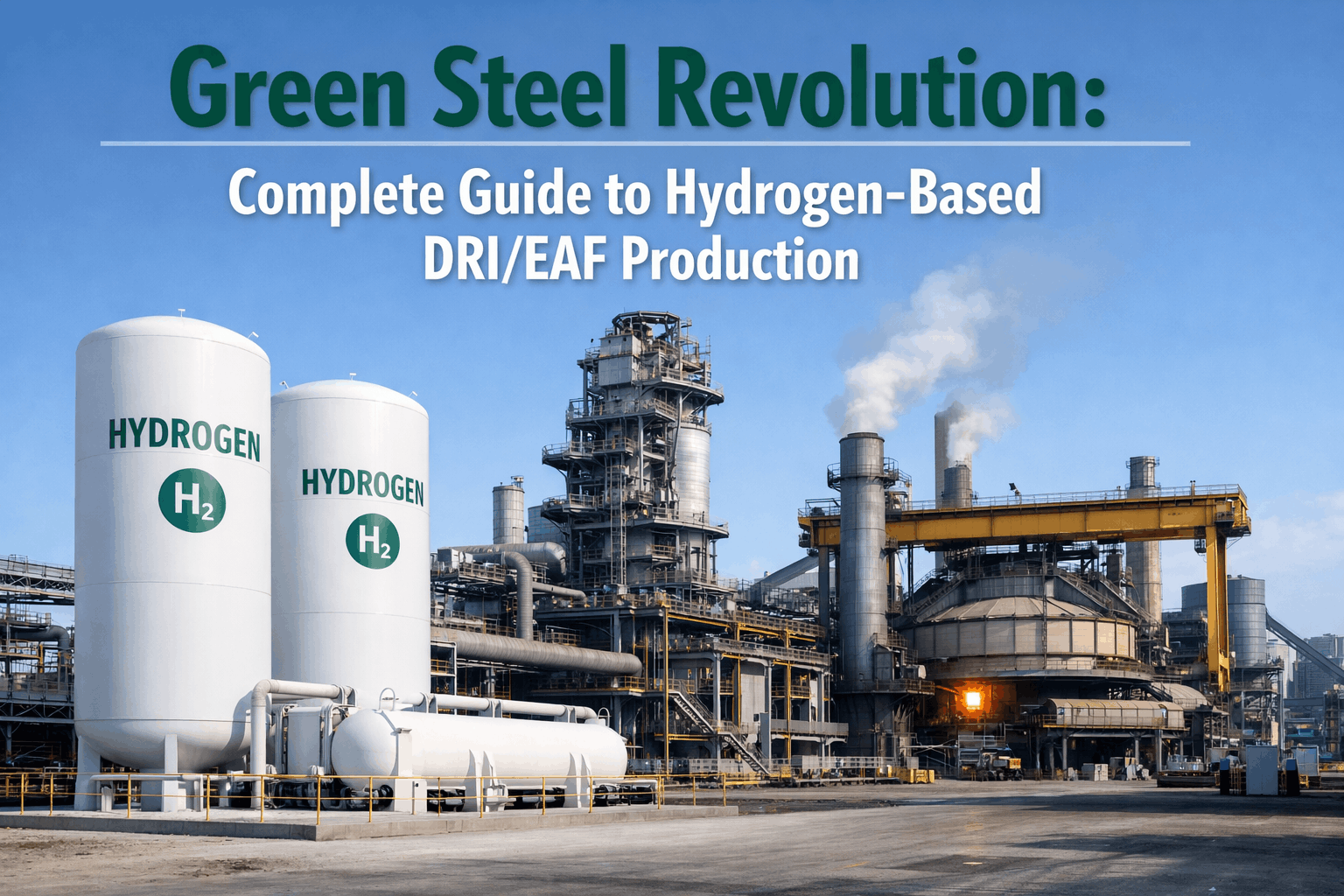
The steel industry produces 7–9% of global CO₂ emissions — approximately 1.85 tonnes of carbon dioxide for every tonne of steel made through the traditional blast furnace and basic oxygen furnace route. Hydrogen-based Direct Reduced Iron paired with Electric Arc Furnace steelmaking replaces coal and coke with green hydrogen as the primary reductant, cutting CO₂ emissions by 90–95% and producing water vapor instead of carbon dioxide as the primary byproduct. This isn't theoretical — HYBRIT in Sweden delivered the world's first fossil-free steel in 2021, and over 70 green steel projects worth $130+ billion are now in development across Europe, the Middle East, Asia, and the Americas. But hydrogen-based DRI/EAF production introduces an entirely new equipment landscape that traditional steel plant maintenance teams have never managed: electrolyzers producing green hydrogen, hydrogen storage and distribution systems operating under strict safety protocols, DRI shaft furnaces redesigned for 100% hydrogen operation, and EAFs configured for hot DRI charging. Maintaining this equipment at the availability levels required for commercially viable green steel demands CMMS systems configured for hydrogen-era maintenance — different failure modes, different inspection regimes, different safety protocols, and different spare parts strategies than anything in the conventional steel plant playbook.
The Carbon Equation: Why Green Steel Changes Everything
Traditional BF/BOF Route
Reductant: Coal & coke → CO₂
Energy: Coal-fired → CO₂
Natural Gas DRI/EAF
Reductant: Natural gas → CO₂ (less than coal)
Energy: Gas + electric → partial CO₂
Green Hydrogen DRI/EAF
Reductant: Green H₂ → H₂O (water vapor)
Energy: Renewable electric → zero direct CO₂
How Hydrogen DRI/EAF Works: The Process Chain
The green steel production chain has four major stages — each introducing equipment and maintenance requirements that don't exist in traditional steelmaking. Understanding the process chain is essential for understanding what the maintenance team needs to manage.
Stage 1
Green Hydrogen Production
Electrolyzers split water (H₂O) into hydrogen (H₂) and oxygen (O₂) using renewable electricity from wind, solar, or hydropower. A typical green steel plant requires 50–100 MW of electrolyzer capacity to produce 20,000–40,000 Nm³/hr of hydrogen — enough to feed a single DRI shaft furnace producing 1–2 million tonnes of DRI per year. This is the largest single investment in the green steel chain and the component most unfamiliar to traditional steel plant maintenance teams.
Maintenance reality: Electrolyzer stacks degrade over time — cell voltage increases, efficiency drops, membranes deteriorate. Stack replacement cycles of 60,000–90,000 hours require long-term planning. Cooling systems, water purification (deionized water quality is critical), power electronics, and gas purification all require maintenance regimes that don't exist in traditional steel plants.
Stage 2
Hydrogen Storage & Distribution
Hydrogen is stored in pressurized tanks (30–70 bar) or underground caverns and distributed to the DRI shaft furnace through a dedicated piping network. Because renewable energy is intermittent (wind doesn't always blow, sun doesn't always shine), hydrogen storage buffers the gap between variable production and continuous DRI furnace demand. Storage capacity typically covers 4–24 hours of furnace operation.
Maintenance reality: Hydrogen embrittlement of carbon steel piping, valve seats, and pressure vessels is a failure mode that doesn't exist elsewhere in the steel plant. All hydrogen-wetted components require specific material grades (austenitic stainless, special alloys), specialized inspection techniques (hydrogen-specific UT and acoustic emission), and leak detection systems far more sensitive than natural gas systems because hydrogen molecules are the smallest in existence.
Stage 3
DRI Shaft Furnace (Hydrogen-Based Reduction)
Iron ore pellets descend through a vertical shaft furnace while hot hydrogen gas (800–1,000°C) flows counter-current, stripping oxygen from the iron oxide (Fe₂O₃ + 3H₂ → 2Fe + 3H₂O). The product is Direct Reduced Iron (DRI/HBI) — solid metalite iron at 90–94% metallization, ready for melting in an EAF. Unlike natural gas-based DRI where the reduction gas is a mix of H₂ and CO, pure hydrogen reduction produces only water vapor as byproduct — requiring different gas handling, heat recovery, and water management systems.
Maintenance reality: Pure hydrogen operation changes thermal profiles, gas velocities, and water condensation patterns inside the shaft compared to natural gas DRI. Water management is critical — the reaction produces large volumes of water vapor that must be removed from the recycled gas loop to maintain reduction efficiency. Gas heater maintenance intensity increases because hydrogen's lower volumetric energy density requires higher gas volumes. Shaft refractory wear patterns differ from natural gas operation due to different gas composition and temperature profiles.
Stage 4
EAF Steelmaking (Hot DRI Charging)
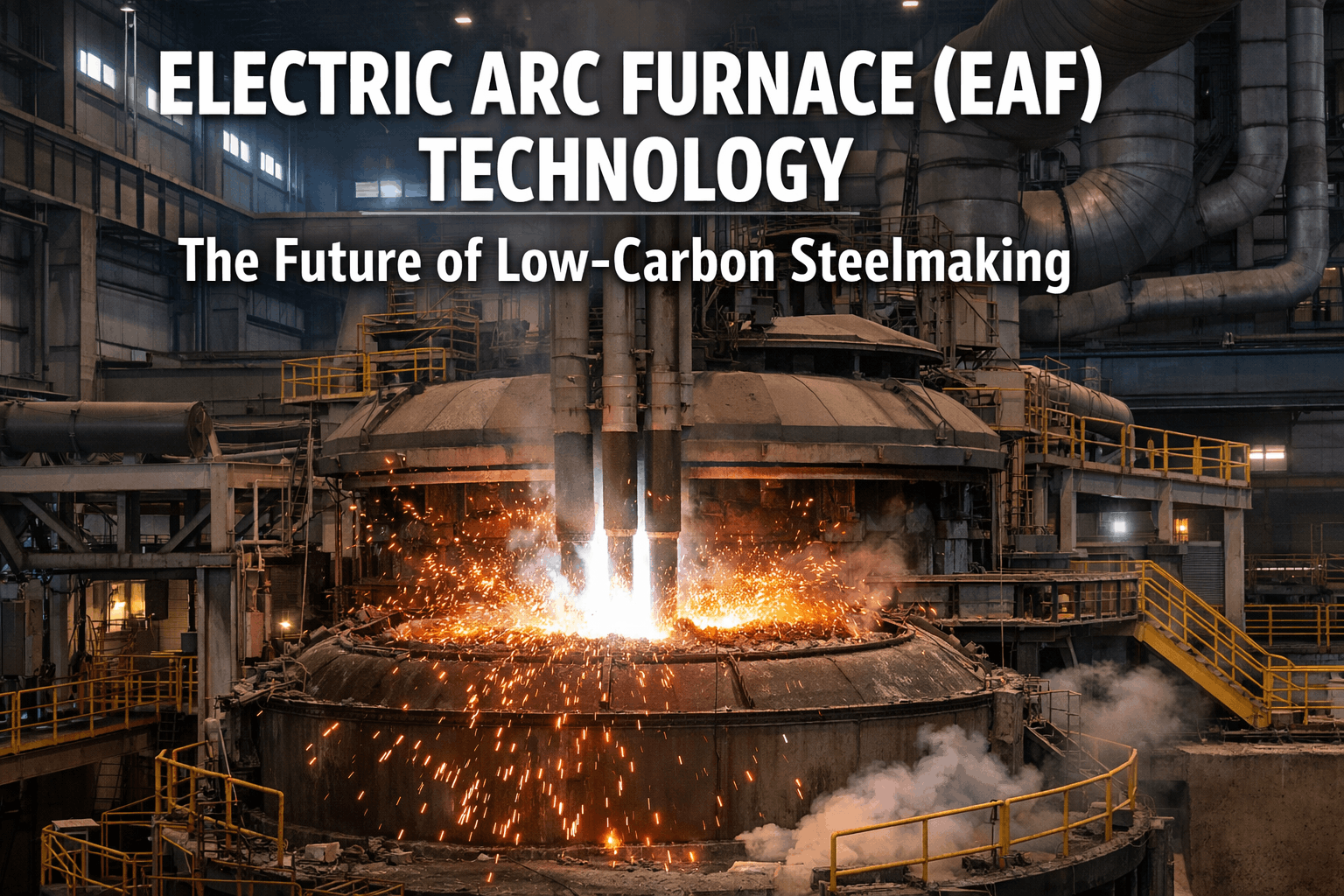
Hot DRI at 600–700°C is charged directly into the EAF, reducing electricity consumption by 15–25% compared to cold DRI or scrap charging because the thermal energy doesn't need to be rebuilt from room temperature. The EAF melts the DRI, adjusts chemistry, and taps liquid steel for downstream processing. Hot charging requires sealed transfer systems between the DRI shaft and EAF to prevent reoxidation of the metallic iron.
Maintenance reality: Hot DRI charging creates different wear patterns on EAF refractory compared to scrap charging — less mechanical impact but more consistent thermal load. The sealed hot transport system (typically pneumatic or gravity-fed through insulated pipes) is a new maintenance domain: refractory-lined transfer vessels, hot material valves, nitrogen blanketing systems, and temperature monitoring throughout the transfer path. DRI fines handling and dust suppression systems are also new maintenance requirements.
Plants building maintenance programs for hydrogen-based production should sign up to see how CMMS manages equipment across the complete green steel chain — from electrolyzer stack health to DRI shaft operation to EAF hot charging.
The New Equipment Landscape: What Traditional Steel Plants Don't Have
A green steel plant adds four entirely new equipment categories to the maintenance portfolio that have no equivalent in traditional BF/BOF steelmaking. Each category brings failure modes, inspection methods, and spare parts requirements that the existing maintenance team has never encountered.
Typical capacity: 50–100 MW (multiple stacks)
Stack life: 60,000–90,000 hours (PEM) / 80,000–100,000 hours (Alkaline)
Availability target: 95%+ (directly limits hydrogen supply to DRI furnace)
Key maintenance domains:
Stack health monitoring (cell voltage trending per cell — rising voltage indicates membrane/electrode degradation), water purification system (deionized water quality must be maintained below 1 μS/cm conductivity — higher conductivity destroys membranes within weeks), power electronics (rectifiers, DC bus, cooling systems), hydrogen gas drying and purification, cooling circuits (electrolyzer stacks generate significant waste heat), and safety systems (hydrogen leak detection, ventilation, emergency shutdown). CMMS must track individual stack performance to schedule replacements before efficiency drops below economic threshold — typically when cell voltage has increased 10–15% above initial baseline.
Storage pressure: 30–70 bar (above-ground tanks) or 50–200 bar (underground caverns)
Distribution network: 2–5 km of hydrogen-rated piping between electrolyzer, storage, and DRI furnace
Safety classification: ATEX/IECEx Zone 1 or 2 throughout
Key maintenance domains:
Hydrogen embrittlement inspection (specialized UT techniques for detecting hydrogen-induced cracking in pressure boundaries), valve maintenance (hydrogen-rated seats and packings have different wear characteristics than natural gas), compressor maintenance (hydrogen compressors operate at different conditions than process gas compressors), leak detection system calibration (hydrogen sensors must detect concentrations as low as 0.4% — the lower flammability limit is 4%), pressure relief valve testing (critical safety devices requiring annual proof testing), and pipeline integrity management (internal and external corrosion monitoring, cathodic protection for buried sections).
Gas temperature: 800–1,000°C at shaft inlet
Gas volume: 30–50% higher than natural gas DRI (hydrogen's lower volumetric energy density)
Water removal: Critical — reaction produces ~540 kg water per tonne of DRI
Key maintenance domains:
Gas heater refractory and tube bundles (higher gas volumes increase erosion rates), heat exchangers in the gas recycling loop (water condensation creates corrosion at temperature transition zones), water scrubbing/condensation system (must remove 540 kg of water per tonne of DRI from the recycled gas — any reduction in water removal efficiency directly reduces metallization rate), gas analysis instrumentation (hydrogen purity, moisture content, and residual oxygen must be monitored continuously — calibration drift in any analyzer can cause process deviation within hours), and blower/compressor maintenance (higher gas volumes mean larger or faster-running blowers with correspondingly higher maintenance intensity).
DRI temperature: 600–700°C during transfer
Transfer method: Gravity-fed insulated chutes, pneumatic conveying, or hot transport vessels
Critical requirement: Inert atmosphere (nitrogen blanket) to prevent reoxidation
Key maintenance domains:
Refractory lining in transfer vessels and chutes (DRI at 600–700°C is highly abrasive), hot material gate valves (high-temperature valve seats wear from abrasive DRI flow), nitrogen blanketing system (any air ingress causes immediate DRI reoxidation — nitrogen purity monitoring and supply system reliability are critical), temperature monitoring instrumentation (thermocouples in transfer path must be accurate — temperature drop below 500°C causes DRI to become pyrophoric), and dust collection (DRI fines are metallic iron that ignites spontaneously in air — dust handling system failures create fire hazards).
New Equipment. New Failure Modes. New Maintenance Strategy. Same Need for System.
OxMaint provides the CMMS foundation for green steel maintenance — electrolyzer stack health tracking, hydrogen system integrity management, DRI shaft furnace condition monitoring, hot transfer system maintenance, and the safety-protocol integration that hydrogen-era steel plants require from day one of operation.
The Economics: Green Steel Cost Trajectory
Green hydrogen-based steel is currently 20–40% more expensive than traditional BF/BOF steel — primarily because of green hydrogen production cost. But the cost gap is narrowing rapidly as electrolyzer costs decline, renewable electricity becomes cheaper, and carbon pricing increases the cost of traditional steelmaking.
2024–2025
$4–6 /kg
+30–40% vs BF/BOF
EU ETS at €80–100/t CO₂ closes ~15% of the gap
2028–2030
$2–3 /kg
+15–25% vs BF/BOF
EU CBAM fully effective — imported steel faces same carbon cost
2033–2035
$1.5–2 /kg
+5–10% vs BF/BOF
Carbon prices at €120–150/t make BF/BOF more expensive in EU
2035–2040
$1–1.5 /kg
Cost parity or cheaper
At $1.50/kg hydrogen + €130/t CO₂ price, green steel is cheaper than BF/BOF
The crossover point where green steel becomes cheaper than traditional production depends on two variables: hydrogen production cost (driven by electrolyzer cost and renewable electricity price) and carbon pricing (driven by policy). Both are moving in the direction that favors green steel — hydrogen costs are falling, carbon prices are rising. Plants building green steel capacity today will be operating at cost advantage by the time they reach full production.
Global Green Steel Projects: The Implementation Wave
Green steel has moved from pilot to commercial scale. These projects represent over $130 billion in committed investment, creating the world's first generation of fossil-free steel production capacity. Teams managing these projects should book a free demo to see how CMMS supports the transition from traditional to hydrogen-based maintenance management.
HYBRIT (Sweden)
World's first fossil-free steel delivered to Volvo. SSAB, LKAB, and Vattenfall joint venture. Pilot plant in Luleå demonstrated hydrogen-based DRI at industrial scale. Commercial plant targeting 2.7 Mt/year by 2030.
H2 Green Steel (Sweden)
€6.5 billion investment in Boden for a fully integrated green steel plant. Initial capacity 2.5 Mt/year, expanding to 5 Mt/year. 700 MW electrolyzer — one of the largest in the world. First steel production commenced, targeting automotive and construction sectors.
Salzgitter SALCOS (Germany)
Converting one of Germany's largest integrated steel plants from BF/BOF to DRI/EAF. €2.2 billion first phase. Planned in three stages, replacing three blast furnaces sequentially with hydrogen-ready DRI plants. Initially using natural gas with progressive hydrogen blending to 100%.
ArcelorMittal (Spain, France, Belgium)
Multiple DRI/EAF conversion projects across European operations. Gijón (Spain): 2.3 Mt DRI plant with hydrogen blending. Dunkirk (France): largest European decarbonization project at €1.8 billion. Ghent (Belgium): DRI/EAF replacing BF/BOF with 2.5 Mt capacity.
Middle East & Asia Wave
NEOM Green Hydrogen (Saudi Arabia) targeting green steel feedstock. Tata Steel (Netherlands) BF to DRI/EAF conversion. POSCO (South Korea) hydrogen steelmaking R&D with commercial target by 2030. Indian steel producers evaluating hydrogen DRI at Midrex and HYL plants currently running natural gas — hydrogen blending trials underway at multiple sites.
Maintenance Strategy for the Green Steel Era
Managing a green steel plant requires a fundamentally different maintenance strategy than traditional steelmaking — not because the principles change, but because the equipment mix, failure modes, safety requirements, and supply chains are entirely new. Here's how the maintenance approach must adapt.
Traditional steel plant maintenance teams have zero experience with hydrogen systems. Electrolyzer maintenance, hydrogen piping integrity, ATEX zone management, and hydrogen leak detection require skills that must be developed before the plant commissions — not learned through trial and error on live equipment. CMMS should include hydrogen-specific PM task libraries, safety protocols linked to work orders (hydrogen hot work permits, purging procedures, leak testing requirements), and training tracking to ensure every technician working on hydrogen systems has completed the required competency program before receiving work order assignments.
Electrolyzer availability directly determines hydrogen supply to the DRI shaft furnace. If electrolyzers are down, hydrogen production drops, and the DRI furnace either reduces throughput or switches to natural gas (if the plant has dual-fuel capability). CMMS must track individual stack performance (cell voltage per cell, efficiency trending, membrane resistance) and schedule stack replacements months in advance — because replacement stacks have lead times of 12–26 weeks. Production planning needs visibility into predicted electrolyzer maintenance windows the same way traditional steel plants plan around blast furnace relines.
Hydrogen is flammable at 4–75% concentration in air (far wider range than natural gas at 5–15%), burns with an invisible flame, and can embrittle carbon steel over time creating crack-propagation risks in pressure boundaries. The hydrogen distribution network — piping, valves, storage tanks, compressors — must be maintained under a safety-critical regime equivalent to the most stringent pressure equipment directives. CMMS enforces this through mandatory inspection schedules (UT thickness, acoustic emission testing, hydrogen leak surveys), material certification tracking for all replacement components, and work permit protocols that prevent maintenance work on hydrogen systems without verified isolation, purging, and atmospheric testing.
Green steel production consumes and generates enormous quantities of water. Electrolyzers consume ~9 liters of ultrapure deionized water per kg of hydrogen produced. The DRI shaft furnace generates ~540 kg of water vapor per tonne of DRI. Water purification systems, condensation equipment, and water recycling loops become critical maintenance assets that traditional steel plants either don't have or treat as low-priority utilities. In green steel, water system failure can shut down hydrogen production (contaminated water destroys electrolyzer membranes within days) or reduce DRI metallization (insufficient water removal from the gas loop degrades reduction efficiency). CMMS must elevate water systems to the same maintenance priority as cooling systems in traditional steelmaking.
Plants developing green steel maintenance strategies should sign up to see how CMMS configures for hydrogen-era equipment with safety-critical protocols, electrolyzer health tracking, and hydrogen-specific PM libraries.
Expert Perspective: The Biggest Risk Isn't Technology — It's Maintenance Readiness
I've been involved in green steel project development and commissioning for 7 years, working across three of the major European hydrogen DRI projects, and the observation I share with every project team is this: the technology works. HYBRIT proved that. H2 Green Steel is scaling it. The electrolyzers, the shaft furnaces, the EAFs — the equipment performs as designed. The risk that keeps me up at night isn't whether the technology will work. It's whether the maintenance organization will be ready to keep it working at 95% availability once the commissioning team leaves. Every green steel project I've seen has world-class process engineering and equipment procurement. Not one has invested the same level of effort in building the maintenance management system and the maintenance team competency for hydrogen-era equipment. The electrolyzer vendor provides a maintenance manual. But who builds the PM schedule in the CMMS? Who configures the hydrogen-specific safety work permits? Who establishes the spare parts strategy for electrolyzer stack components with 26-week lead times? Who trains the mechanical crews in hydrogen system purging procedures? These aren't afterthoughts — they're prerequisites for commercial operation. A green steel plant that commissions its equipment without a configured CMMS and a trained maintenance team will spend its first 18 months at 70–75% availability instead of the 92–95% its business case assumes. That gap costs $40–80 million in lost production during the period when the plant most needs to demonstrate commercial viability. My single strongest recommendation: start building the CMMS configuration, PM libraries, hydrogen safety protocols, and maintenance team competency 18–24 months before commissioning — not 3 months before.
Start CMMS Configuration 18–24 Months Before Commissioning
Equipment hierarchies, PM task libraries, hydrogen safety protocols, spare parts databases, and work permit templates must be built and tested before the first hydrogen molecule flows. Post-commissioning is too late — the maintenance team needs to walk into a working system, not build one while trying to keep a $2 billion plant running.
Staff Hydrogen Competency From Chemical/Energy Industries
Traditional steel plant mechanics don't have hydrogen system experience. Recruit 20–30% of the green steel maintenance team from chemical plants, refineries, or power generation — industries that already manage hydrogen systems. Their competency accelerates the entire team's hydrogen readiness by years.
Order Electrolyzer Stack Spares With the Equipment
Electrolyzer stack replacements have 12–26 week lead times and there are currently more projects than manufacturing capacity. Order the first set of replacement stacks when you order the initial equipment — having spares available from day one prevents the scenario where a degraded stack runs at poor efficiency for 6 months waiting for a replacement to arrive.
New Era. New Equipment. New Maintenance. Built on Proven CMMS Foundation.
OxMaint provides the CMMS platform that green steel plants need from day one — hydrogen-specific PM libraries, electrolyzer stack health tracking, safety-critical work permit integration, ATEX zone management, water system monitoring, DRI shaft furnace condition tracking, and the maintenance readiness framework that ensures 92%+ availability from commissioning forward.
Frequently Asked Questions
What is hydrogen-based DRI/EAF steelmaking?
It replaces coal/coke with green hydrogen as the reductant for iron ore. Electrolyzers split water into hydrogen and oxygen using renewable electricity. The hydrogen reduces iron ore in a DRI shaft furnace (producing iron + water vapor instead of iron + CO₂). The DRI is melted in an EAF to produce liquid steel. Total CO₂ reduction: 90–95% compared to traditional BF/BOF.
How does green steel maintenance differ from traditional steel plant maintenance?
Four entirely new equipment categories: electrolyzers (stack degradation, membrane health, water purity), hydrogen storage and distribution (embrittlement inspection, ATEX compliance, leak detection), gas heaters redesigned for hydrogen (higher volumes, water management), and hot DRI transfer systems (refractory, inert atmosphere, pyrophoric material handling). All require hydrogen-specific safety protocols that don't exist in traditional steelmaking.
When will green steel reach cost parity with traditional steel?
Projected 2035–2040, driven by two converging trends: green hydrogen cost falling from $4–6/kg today to $1–1.50/kg, and carbon pricing rising to €120–150/t CO₂. In regions with strong carbon pricing (EU under CBAM), green steel may become cheaper than BF/BOF steel by 2033–2035. Plants building capacity today will be operating at cost advantage by the time they reach full production.
What is the biggest maintenance risk for green steel plants?
Maintenance readiness at commissioning. The technology works — the risk is whether the maintenance organization has the hydrogen competency, configured CMMS, PM libraries, safety protocols, and spare parts (especially electrolyzer stacks with 12–26 week lead times) ready before commercial operation begins. Plants that commission without maintenance readiness typically operate at 70–75% availability instead of the 92–95% their business case requires.
How many green steel projects are currently in development?
Over 70 projects worth $130+ billion globally, with major investments from SSAB/HYBRIT (Sweden), H2 Green Steel (Sweden), Salzgitter (Germany), ArcelorMittal (Spain, France, Belgium), Tata Steel (Netherlands), and multiple projects across the Middle East and Asia. The first fossil-free steel was delivered commercially in 2021, and multiple multi-million-tonne plants are now commissioning or under construction.