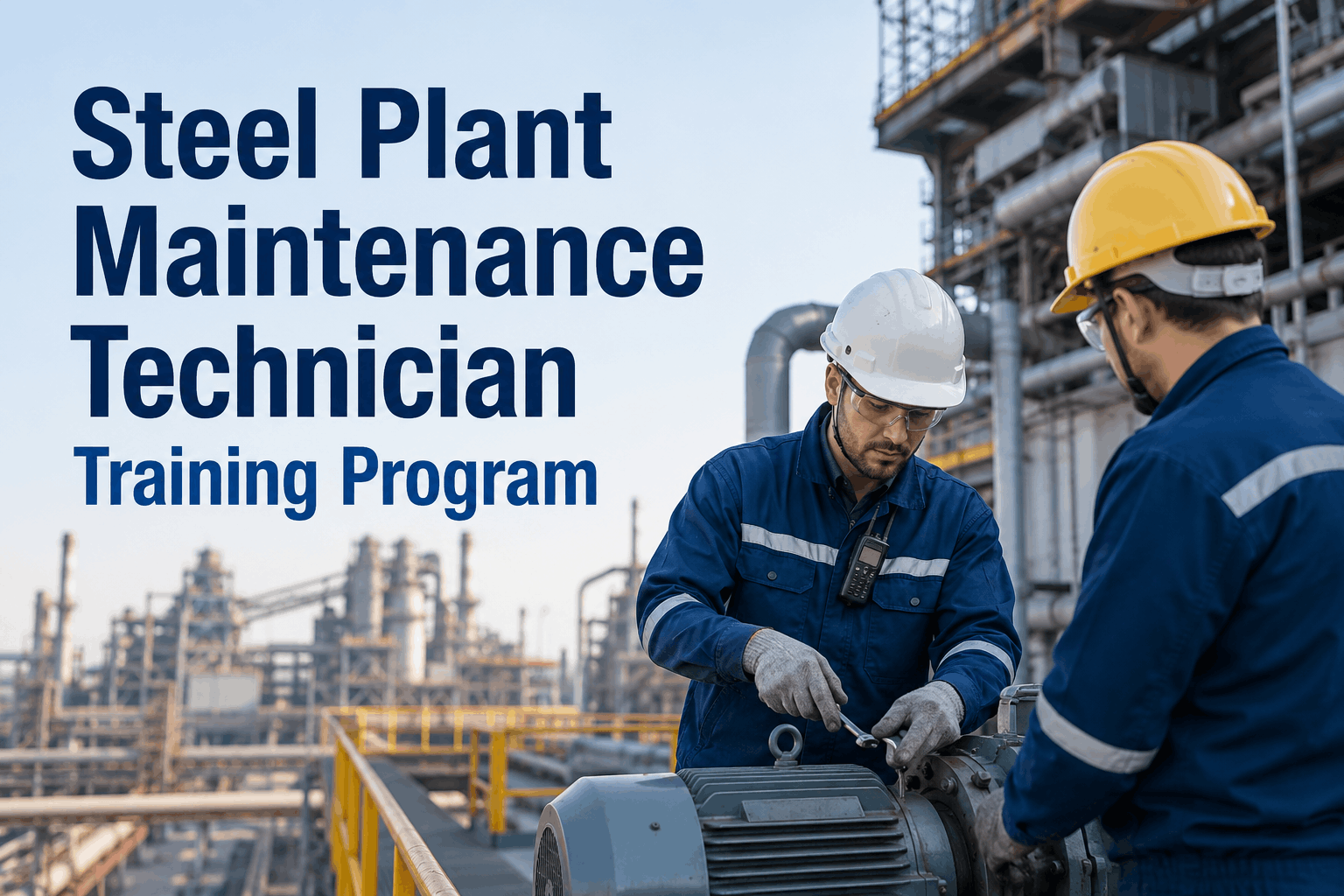
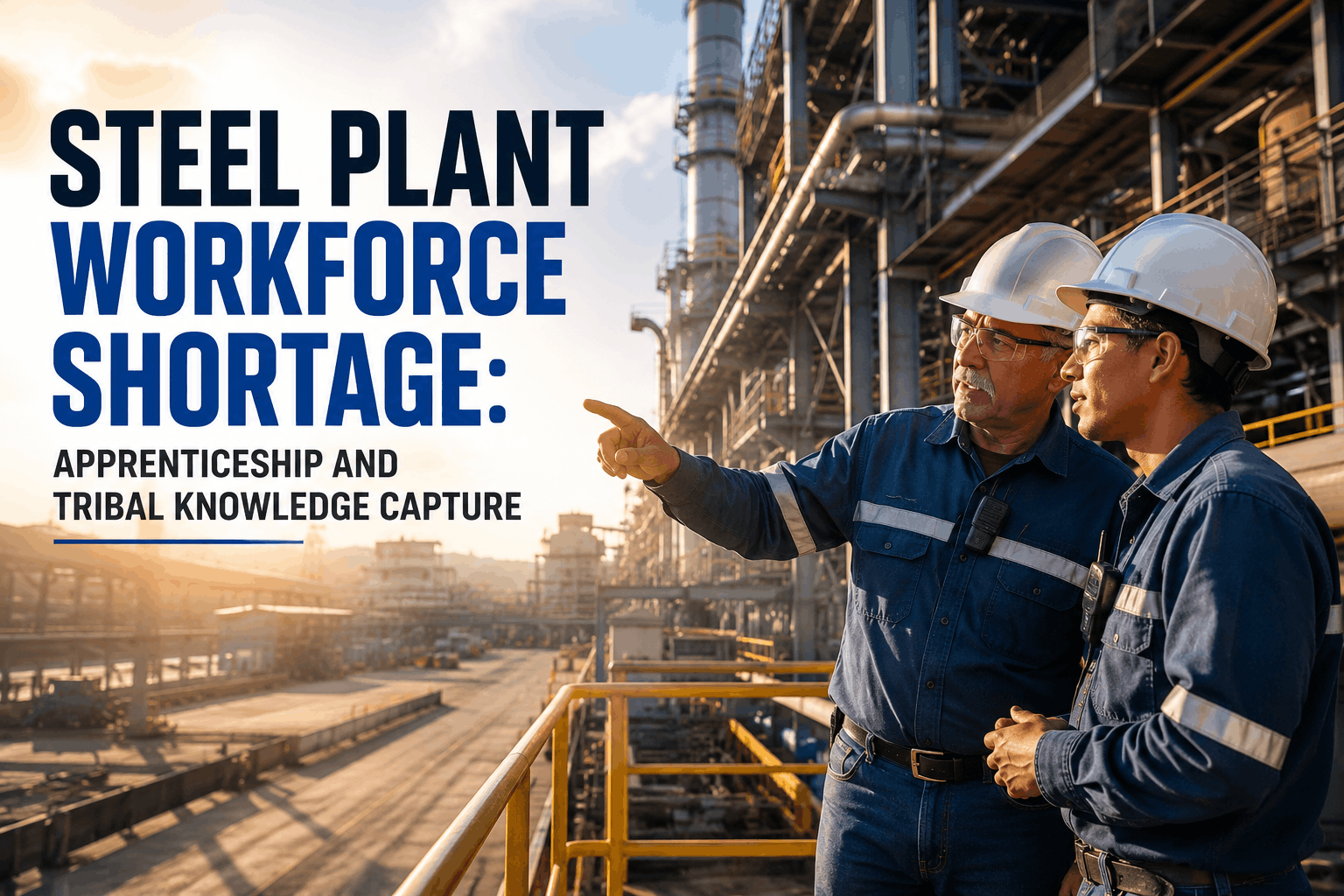
In a steel plant, equipment doesn't fail — people fail to maintain it correctly. The most advanced CMMS, the best predictive sensors, and the highest-grade spare parts are worthless without a workforce trained to use them properly. Steel industry maintenance requires a uniquely broad skill set: mechanical, electrical, hydraulic, thermal, metallurgical, and increasingly digital competencies — all performed in environments reaching 1,600°C with molten metal, toxic gases, and heavy moving equipment. The global industrial maintenance training market exceeded $8.2 billion in 2024, with metals and heavy manufacturing accounting for 22% of demand (Training Industry, Inc.). Plants with structured maintenance training programs experience 25% fewer safety incidents and 30% lower corrective maintenance costs compared to those relying on informal on-the-job learning (Aberdeen Group, 2024). Yet 74% of maintenance managers report a growing skills gap as experienced technicians retire faster than new ones are trained (Deloitte Manufacturing Skills Gap Study, 2024). The solution isn't just hiring — it's building a systematic, multi-tier training infrastructure that develops competency from apprentice to master technician.
Building and sustaining maintenance competency across a steel plant means managing training curricula, certification tracking, competency assessments, on-the-job mentoring, and compliance documentation for hundreds of technicians across dozens of craft specialties — while the plant runs 24/7. Oxmaint CMMS integrates training records with work order assignments, ensures only certified technicians are assigned to critical tasks, tracks license expirations, and links competency gaps directly to equipment failure trends — building workforce capability into your maintenance management system. Schedule a demo.
Training at a Glance
Where Maintenance Training Matters in a Steel Plant
Every production area demands specialized maintenance knowledge. Training programs must address the unique hazards, equipment types, and failure modes of each zone — a technician skilled in rolling mill hydraulics may be unprepared for coke oven refractory work:
Raw Materials & Coke Ovens
Conveyor systems, crushers, stackers, reclaimers, coke pushing machines. Training: mechanical drives, belt alignment, refractory basics, gas safety (CO, H₂S).
Blast Furnace & Steel Making
BF cooling systems, hot blast stoves, BOF vessels, ladle metallurgy. Training: high-temperature work, hydraulic systems, refractory maintenance, molten metal safety.
Continuous Casting
Mold oscillation, strand guidance, spray cooling, cut-off equipment. Training: precision alignment, servo drives, PLC diagnostics, water system maintenance.
Rolling Mills (Hot & Cold)
Stand drives, roll bearings, AGC hydraulics, coilers, loopers. Training: vibration analysis, bearing replacement, roll grinding, drive alignment, oil analysis.
Utilities & Infrastructure
Power distribution, compressed air, water treatment, gas networks, cranes. Training: electrical safety (arc flash), crane inspection, HVAC, instrumentation calibration.
Link Training Records to Work Orders — Assign the Right Tech Every Time
Oxmaint tracks certifications, competency levels, and license expirations for every technician — ensuring only qualified personnel are assigned to critical maintenance tasks, with automated alerts when credentials expire.
The Five Training Gaps That Cause Failures
Most maintenance-related equipment failures and safety incidents in steel plants trace back to five workforce capability gaps. Each one is addressable through structured training — and each one compounds over time if ignored:
Lack of Craft Fundamentals
Technicians who can't properly torque a flange, align a coupling, read a hydraulic schematic, or interpret vibration data will create more problems than they solve. Steel plants increasingly hire from outside the trade — workforce surveys show 40% of new maintenance hires lack formal craft training. Without fundamentals, even simple PM tasks are performed incorrectly: wrong lubricant quantities, improper bearing installation, incorrect belt tensioning, cross-threaded fittings causing leaks.
Safety Knowledge Gaps
Steel plant maintenance involves lockout/tagout on 10kV electrical systems, confined space entry in gas-filled vessels, hot work permits near molten metal, crane lifts over operating equipment, and working at heights on blast furnace structures. OSHA data shows maintenance workers in steel plants are 4× more likely to suffer a serious injury than production operators. Inadequate training doesn't just risk fines — it risks lives. Every year, steel plants worldwide record fatalities from inadequate isolation, gas exposure, or fall protection failures during maintenance.
Equipment-Specific Knowledge Deficit
A technician trained on general mechanical maintenance may understand bearings and couplings but be completely unprepared for blast furnace cooling plate replacement, BOF vessel relining, continuous caster mold oscillation adjustment, or rolling mill AGC hydraulic servo valve calibration. Steel plant equipment is highly specialized — generic training produces generic (and often wrong) maintenance. OEM training is expensive but the cost of a botched repair on a $2M gearbox far exceeds the training investment.
Digital & Analytical Skills Gap
Modern steel plant maintenance increasingly relies on CMMS data entry, vibration analysis software, infrared thermography interpretation, oil analysis trending, PLC/HMI diagnostics, and IoT sensor dashboards. A 2024 Deloitte study found that 62% of maintenance technicians in heavy industry lack proficiency in digital tools their plants have already deployed. The result: expensive condition monitoring systems generate data nobody uses, CMMS work order histories are incomplete, and maintenance decisions remain reactive and gut-feel based.
Knowledge Transfer Failure
The average age of experienced steel plant maintenance technicians exceeds 50 in most developed economies. When a 30-year veteran retires, they take with them knowledge of every equipment quirk, every undocumented modification, every "trick" that keeps aging equipment running. Plants that don't systematically capture and transfer this knowledge face a cliff — sudden capability loss that manifests as increased failure rates, longer repair times, and repeated mistakes that veterans would never have made.
Training Program Structure: Apprentice → Journeyman → Specialist → Master
Effective steel plant maintenance training follows a progressive competency model. Each tier builds on the previous one, with formal assessment gates preventing advancement without demonstrated capability:
Build Competency Into Your Maintenance System
Oxmaint CMMS links training records to work order assignments — ensuring only certified technicians work on critical equipment, tracking competency progression, and alerting when certifications expire or training is overdue.
What the CMMS Must Track for Training Management
Training management in a steel plant requires the same rigor as equipment maintenance — with tracking, scheduling, and compliance verification:
Frequently Asked Questions
What core skills do steel plant maintenance technicians need?
Steel plant maintenance demands a uniquely broad skill set spanning multiple disciplines. Mechanical fundamentals — bearing installation (press-fit and thermal expansion methods), shaft alignment (dial indicator and laser), coupling installation, bolt torquing to specification, gasket and seal replacement, gear and chain drive maintenance, and lubrication science (grease types, oil viscosity selection, contamination control). Electrical competencies — motor circuit troubleshooting, VFD parameter setting, control panel diagnostics, cable termination, switchgear maintenance, and arc flash safety awareness for systems up to 33kV common in integrated plants.
How should a steel plant structure its maintenance training program?
The most effective steel plant training programs follow a four-tier progressive competency model with formal assessment gates between levels. Tier 1 — Apprentice (Year 1-2): Comprehensive safety certification (LOTO, confined space, hot work, fall protection — minimum 40 hours), hand/power tool proficiency, basic mechanical and electrical skills, blueprint reading, CMMS navigation, and 100% mentored PM task execution.
How do you address the maintenance skills gap caused by retiring workers?
The retirement-driven skills gap is the single largest workforce challenge facing steel plant maintenance — 74% of maintenance managers report it as a critical concern (Deloitte, 2024). Addressing it requires a multi-pronged strategy executed over 3-5 years: Formal mentoring programs — pair every veteran (within 5 years of retirement) with 1-2 designated successors for a minimum 18-month overlap period. Mentoring must be structured with specific knowledge transfer milestones, not just "work together." Video documentation — record experienced technicians performing complex procedures on critical equipment, narrating their decision-making process, including the "tribal knowledge" that exists nowhere in writing.
What safety training is mandatory for steel plant maintenance workers?
Steel plant maintenance safety training must cover hazards that are unique to or amplified in the steelmaking environment. Mandatory certifications before shop floor access: Lockout/Tagout (LOTO) — covering electrical isolation (up to 33kV), mechanical energy isolation, hydraulic/pneumatic stored energy, thermal energy lockout, and multi-employer lockout coordination. Annual recertification with practical demonstration required. Confined space entry — BF tuyere stock access, BOF vessel entry, gas holder maintenance, and ductwork inspection all require confined space procedures with atmospheric monitoring for CO, H₂S, O₂ deficiency, and combustible gases.
How does CMMS software support maintenance training management?
A properly configured CMMS transforms training from an HR administrative function into an integrated maintenance management capability. Qualification-gated work assignment — the system prevents work orders for specific equipment or task types from being assigned to technicians lacking required certifications. A journeyman without OEM hydraulic training cannot be assigned AGC servo valve work. Certification expiration management — automated alerts at 90, 60, and 30 days before certifications expire (LOTO, confined space, crane, electrical safety, OEM qualifications), with escalation to supervisors and training coordinators.
Start Building Your Maintenance Training Program Today
Join steel plants already using Oxmaint to track technician competencies, manage certification compliance, close skills gaps, and ensure every maintenance task is performed by a qualified, trained professional.