Steel plant managers who track the right KPIs make better decisions than those who track more KPIs. In a 24/7 continuous steelmaking operation — where a single unplanned blast furnace shutdown costs $500,000 per day in lost production and a caster breakout event removes $2M from the balance sheet before the shift ends — the difference between a world-class maintenance program and a reactive one is measured in the precision and real-time availability of a focused set of performance metrics. This guide covers the top 10 steel plant KPIs every plant manager must track in 2026 and — because KPIs only have value when your field crews can access the data that drives them — the best mobile CMMS for steel plant floor crews that delivers those metrics to the people doing the work. Sign Up Free and see your steel plant KPIs calculated automatically in real time — no spreadsheets, no monthly reporting delays.
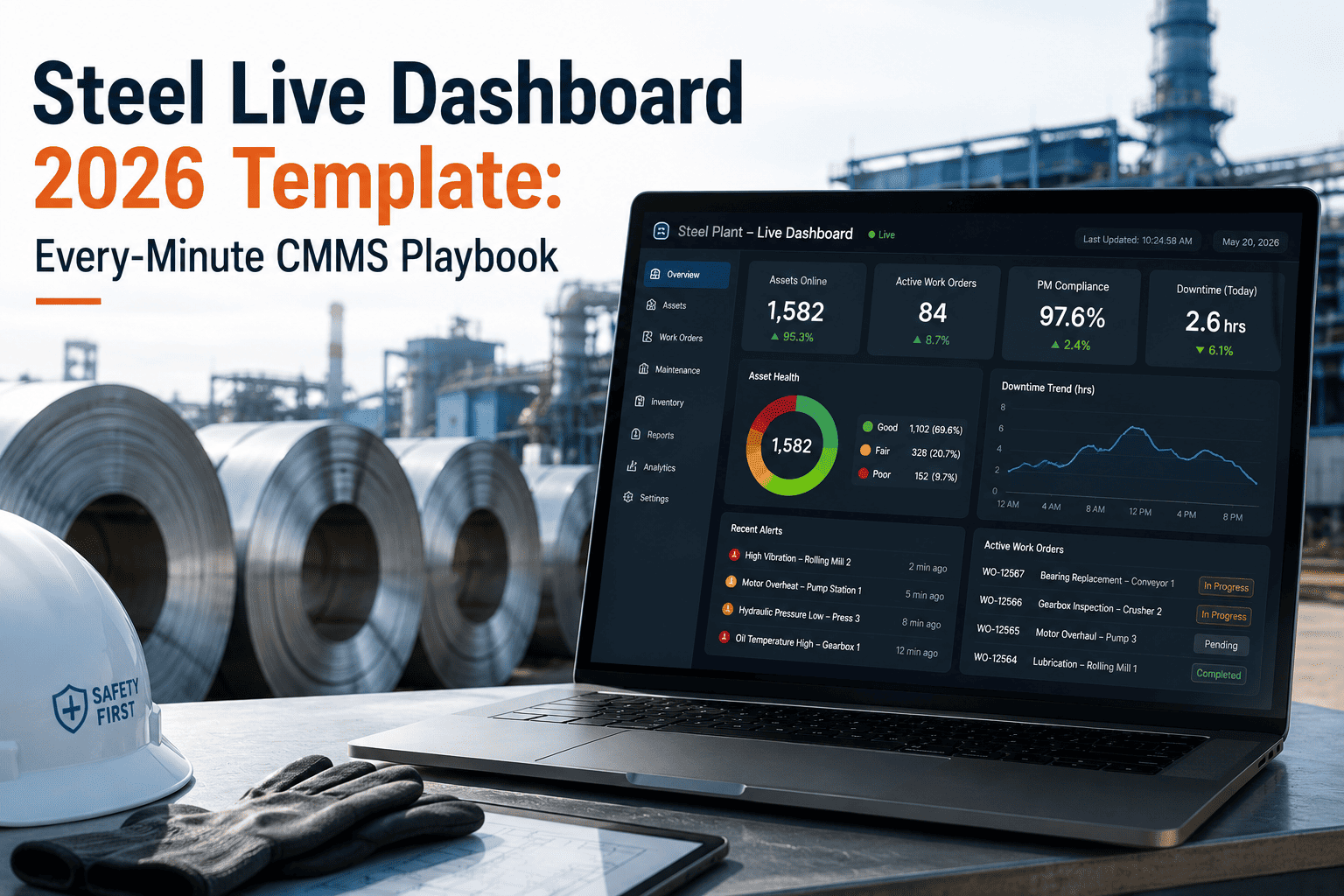
Live Steel Plant KPI Dashboard
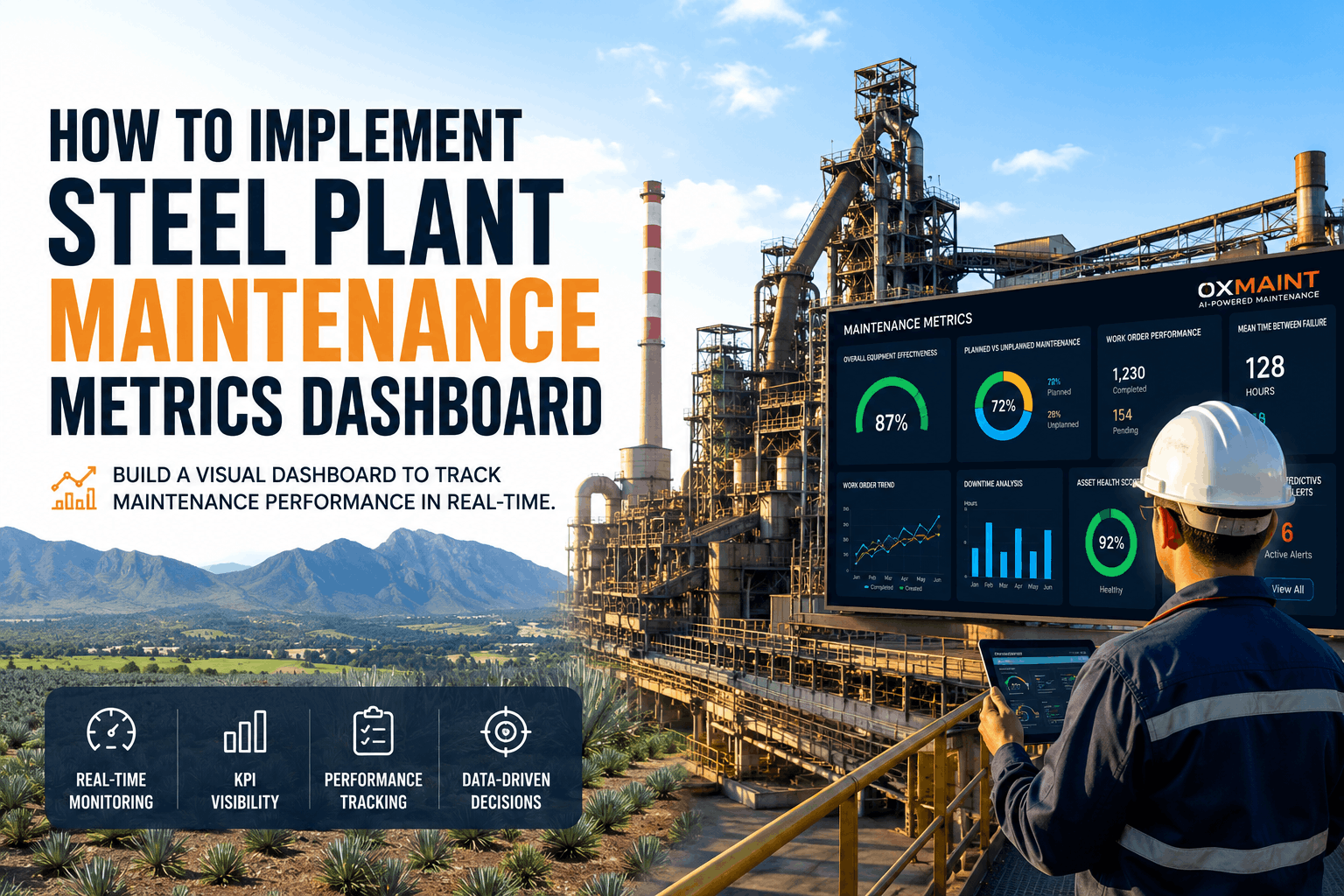
Oxmaint calculates MTBF, MTTR, OEE, PM compliance, and 6 more critical steel plant KPIs automatically from your work order and sensor data — and delivers them to floor crews on a mobile app that works offline in your taphouse, caster platform, and rolling mill.
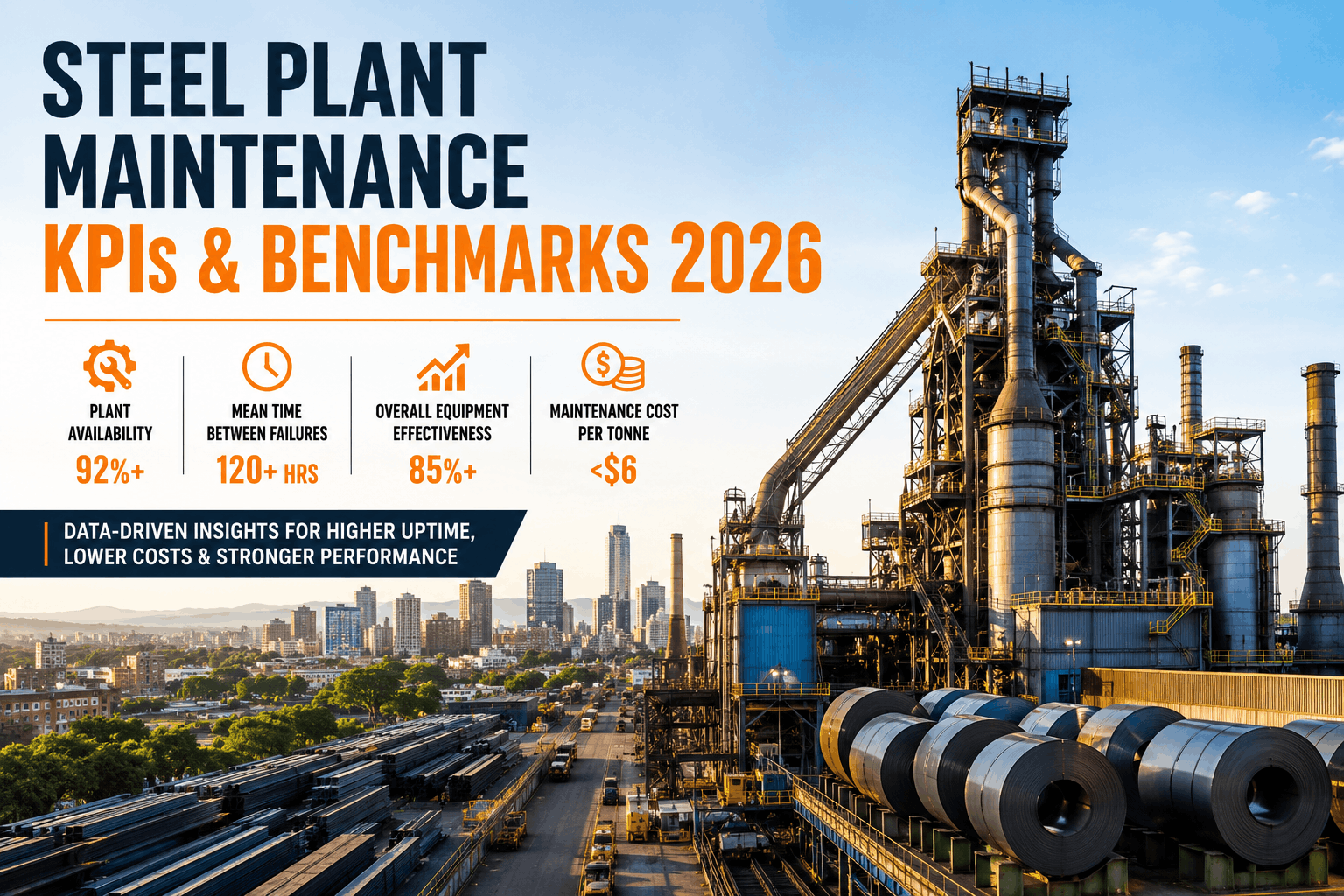
Part 1: Top 10 Steel Plant KPIs Every Plant Manager Tracks in 2026
The worst mistake a steel plant manager can make is tracking 25 KPIs on a monthly report that nobody reads before next month's report arrives. The best steel plant maintenance organizations in the U.S. track a focused set of metrics — updated in real time, organized by operational role, and connected to specific corrective actions. These are the top 10 steel plant KPI metrics for 2026 — what each measures, what the benchmark target is, and why it matters in steelmaking specifically. Book a demo to see all 10 calculated automatically across your plant's asset hierarchy in Oxmaint's live KPI dashboard.
Blast Furnace / EAF Availability (%)
Furnace availability is the single most consequential KPI in any steel plant. Every hour of BF downtime costs the integrated mill its hot metal supply for the downstream melt shop — cascading into caster idle time, reheating furnace relight costs, and rolling mill schedule disruption. BF availability is calculated as (Total Available Hours − Unplanned Downtime Hours) ÷ Total Available Hours. A well-maintained BF with structured cooling system PM, stave inspection records, and tuyere condition monitoring consistently holds 99.5%+ availability. Below 98% signals a failing PM program. Oxmaint tracks BF availability per shift, updating in real time as work orders open and close on cooling pumps, charging systems, and gas cleaning equipment.
MTBF — Mean Time Between Failures (Hours)
MTBF measures how long, on average, a piece of equipment runs before an unplanned failure. In a steel plant, equipment-level MTBF is the engineering tool that exposes developing reliability problems before they become shutdown events. A caster spray cooling pump with MTBF declining from 9,000 hours to 4,000 hours over two quarters is telling you it needs attention — now, during a planned window, not during an active cast sequence. Oxmaint calculates MTBF automatically as every work order closes, tracking 30, 90, and 365-day trends per individual asset. A 20%+ quarter-over-quarter MTBF decline on any critical asset triggers an automatic escalation alert to the maintenance planner. Steel plants with structured MTBF tracking achieve 15–20% higher equipment availability than those relying on gut feel and shift reports.
MTTR — Mean Time To Repair (Hours)
MTTR measures how long your team takes to restore equipment after failure — from detection to return-to-run. In a steel plant, 47% of extended MTTR is attributable to parts unavailability rather than technician capability. A rolling mill roughing stand bearing failure that takes 8 hours to repair when 4 hours is achievable is costing $400,000–$800,000 in lost production for the extra delay alone. Oxmaint reduces MTTR by providing technicians with instant mobile access to asset repair history, parts requirements, and procedure documentation at the point of failure — eliminating the 90-minute average that field technicians currently spend at a desktop in the control room reviewing records before they begin a repair. Spare parts inventory tracking integrated with work orders eliminates the parts-sourcing delay that causes 47% of MTTR overruns.
OEE — Overall Equipment Effectiveness (%)
OEE is the single metric that answers the question every plant manager asks but rarely gets an honest answer to: of the steel we could have produced, how much did we actually produce at saleable quality? A steel plant operating at 65% OEE is losing 35% of its production capacity to downtime, speed restrictions, and quality rejections — and at $10M revenue impact per OEE point at a 2 MTPA mill, that gap is worth $200M annually. The critical insight: 3–5 OEE points are typically hidden in micro-stoppages under 5 minutes that never appear in shift reports. Oxmaint integrates with mill and caster automation to capture micro-stoppages automatically, making these invisible losses visible for the first time and directing maintenance to the highest-value improvement targets.
PM Compliance Rate (%)
PM compliance rate measures the percentage of scheduled preventive maintenance work orders completed on time. It is the leading indicator most tightly correlated with MTBF improvement — because PM completions directly prevent the failures that degrade MTBF. A steel plant with 70% PM compliance is accumulating a maintenance debt that will materialize as unplanned failures within 6–12 months. Oxmaint tracks PM compliance per asset class, per technician, and per production zone — surfacing the specific PM categories being deferred so the maintenance planner can prioritize backlog recovery before the reliability consequences appear. See PM compliance tracking in a live Oxmaint dashboard.
Planned vs. Unplanned Maintenance Ratio
The ratio of planned work orders to emergency/reactive work orders tells you more about the health of a maintenance organization than any single metric. A steel plant where less than 70% of maintenance hours are planned is in firefighting mode — technicians are perpetually reactive, PM schedules are impossible to complete because emergencies consume all available capacity, and MTBF continues declining because prevention never happens. Oxmaint classifies every work order as planned or unplanned at creation, calculating the ratio automatically per shift, per week, and per month. Plants that use this metric as a management KPI typically improve their planned ratio by 15–20 percentage points within 12 months of CMMS deployment.
Specific Energy Consumption — SEC (GJ/tonne)
Specific energy consumption is the primary operational lever for both cost reduction and ESG compliance in U.S. steelmaking — and it is directly maintenance-dependent. A BF with degraded stave coolers runs hotter and less efficiently. A reheating furnace with failing regenerator bricks consumes 15–20% more gas than its design specification. An EAF with electrode alignment issues consumes excess electrical energy per heat. Oxmaint tracks SEC at the asset level, correlating energy consumption with maintenance event history so that the reliability engineer can identify the specific equipment condition issues driving energy cost above benchmark. This is the data that feeds both the maintenance improvement plan and the annual ESG sustainability report. Book a demo to see SEC tracking in Oxmaint.
Scrap Rate and Yield Loss (%)
Scrap rate and yield loss are quality KPIs that are maintenance-driven at their root: 60–70% of rolling mill speed losses and surface quality defects are caused by equipment condition issues that maintenance can address. AGC hydraulic degradation causes gauge variation. Worn work roll bearings cause strip waviness. Reheating furnace temperature non-uniformity from burner management system failures causes surface scale and underfill. Oxmaint connects quality outcome data to the maintenance records of the equipment responsible — making the maintenance root cause of quality losses visible in a CMMS context for the first time, rather than requiring a forensic investigation after each scrap event.
Maintenance Cost per Tonne Produced ($/t)
Maintenance cost per tonne normalizes maintenance spend against actual production volume — keeping cost trends meaningful even when output changes seasonally or with market demand. A steel plant that spends $28/tonne in Q1 but increases to $40/tonne in Q2 with flat production is showing early signs of asset deterioration or PM program slippage. Oxmaint attributes every work order cost — labor, parts, contractor — to the correct asset and production zone, allowing maintenance cost per tonne to be calculated automatically per month with drill-down to the specific equipment categories driving cost increases. Budget variance below 12% requires this level of documentation discipline; most steel plants running paper-based cost tracking report 25–40% budget variance.
Refractory Campaign Life vs. Design Target (%)
Refractory campaign life performance is a steel-specific KPI with no equivalent in any other industry — and it is one of the highest-value maintenance metrics in an integrated mill. A BF campaign ending 15% early due to accelerated lining wear forces a $50–$200M unplanned reline. A BOF vessel relined at 95% of design heat count versus 80% represents millions in avoided campaign-shortfall costs. Oxmaint tracks heat count per campaign for every refractory asset — BF, BOF, EAF, ladle, torpedo car — against the design campaign target, providing the reliability engineer with early warning when wear rates are trending toward early campaign end. Start your free trial and configure campaign life tracking for your vessel fleet today.
Steel Plant KPI Dashboard — Visual Overview
SVG Radial Gauge Chart for KPI scoringPart 2: Best Mobile CMMS for Steel Plant Floor Crews in 2026
KPIs only improve when the people doing the work — the floor technicians on the taphouse, the caster operators checking segment alignment, the rolling mill electricians diagnosing a drive fault at 3 AM — have the right tools in their hands at the point of work. A mobile CMMS for steel plant floor crews in 2026 has different requirements than a mobile app for an office maintenance team: it must operate offline in zero-connectivity environments, it must survive in 90°C taphouse conditions on a rugged device, it must handle QR-tagged asset scanning for rapid work order lookup, and it must support OSHA crane inspection exports without a trip to the control room. Most enterprise CMMS platforms added mobile as an afterthought — bolt-on apps with clunky interfaces that field technicians abandon within weeks. Oxmaint was designed mobile-first, with the steel plant floor crew as the primary user. Schedule a mobile demo on your own device to experience the field interface before your rollout decision.
What the Best Mobile CMMS for Steel Must Deliver
Offline-First Architecture
Taphouses, caster platforms, and rolling mill underbelly locations have no reliable WiFi. Oxmaint's mobile app caches work orders, asset records, inspection checklists, and procedure documents locally — technicians complete full maintenance workflows offline and sync automatically when they move into a connected area. No connectivity required at the point of work.
QR-Tagged Asset Scanning
Every asset in your steel plant — from a BF tuyere to a caster segment to a crane hoist motor — gets a QR code linked to its Oxmaint asset record. Technicians scan the tag with their phone and instantly see the complete service history, open work orders, last inspection results, and procedure documentation for that specific asset. No asset number lookup, no system navigation — point, scan, work.
Photo-Documented Work Orders
Steel plant maintenance documentation — especially crane inspections, refractory condition records, and OSHA compliance sign-offs — requires photo evidence that survives regulatory audit. Oxmaint's mobile work order requires photo capture at configured inspection steps before the work order can be closed. Photos are timestamped, GPS-tagged, and permanently stored in the asset's service history — accessible as PDF audit packages within seconds.
OSHA Crane Inspection Export
Oxmaint generates OSHA 1910.179-compliant crane inspection records directly from completed mobile checklists — pre-shift, periodic, and annual — exportable as timestamped PDF reports that satisfy OSHA inspector requests, insurance auditor requirements, and internal safety department records within 60 seconds of request. No manual reconstruction, no missing records, no after-the-fact paperwork.
Real-Time KPI Push to Floor Crews
Shift technicians on a steel plant floor don't have time to pull KPI dashboards — but they need to know when a critical asset's MTBF is declining toward a threshold or when a PM work order is overdue on a crane they're about to operate. Oxmaint pushes configurable alerts to the mobile app when KPI thresholds are breached, ensuring that the right crew member gets the right signal at the right time without looking at a dashboard.
Rugged Device Compatibility
Oxmaint runs on iOS and Android across standard smartphones and rugged industrial tablets (Zebra, Panasonic Toughpad, Samsung Galaxy XCover). The interface is designed for gloved-hand operation — large touch targets, high-contrast display, simplified navigation for environments where a technician is wearing heat-resistant gloves. No proprietary hardware required; your existing device fleet works on day one of deployment.
Mobile CMMS Platform Comparison for Steel Plant Floor Crews
| Capability | Oxmaint | Maximo Mobile | UpKeep | Generic Work Order Apps |
|---|---|---|---|---|
| Offline-First Operation | ✅ Full offline, auto-sync | ⚠ Limited offline, IT config required | ⚠ Partial offline | ❌ Requires connectivity |
| QR Asset Scanning | ✅ Native, instant lookup | ✅ Available | ✅ Available | ⚠ Basic or absent |
| OSHA Crane Inspection Export | ✅ PDF, timestamped, photo | ⚠ Requires custom config | ❌ Not available | ❌ Not available |
| Campaign-Based PM Triggers | ✅ Heat count + calendar | ⚠ Calendar only standard | ❌ Calendar only | ❌ Calendar only |
| Steel Plant Deployment Time | ✅ 3–5 days | ❌ 6–18 months | ⚠ 2–4 weeks | ⚠ Variable |
| Rugged Tablet Support | ✅ Zebra, Toughpad, XCover | ✅ Enterprise devices | ⚠ Standard only | ⚠ Standard only |
| Mandatory Photo on Closure | ✅ Configurable per work type | ⚠ Custom workflow required | ⚠ Optional only | ❌ Not available |
| Steel-Industry Support Team | ✅ U.S.-based, steel-experienced | ⚠ General support | ⚠ General support | ❌ Limited |
"Before Oxmaint, our technicians were carrying paper inspection sheets onto the caster platform and transcribing them into SAP at a desktop terminal after every shift. We were losing data, we were getting timestamps wrong, and our crane inspection records were a compliance liability. After Oxmaint deployment, every caster inspection and every crane pre-shift check is done on a phone, photo-documented, and synced automatically. Our OSHA audit went from a 3-week preparation exercise to a 15-minute dashboard export. OEE improved 7 points in 14 months because for the first time we could see micro-stoppages under 5 minutes. The mobile offline mode was the non-negotiable — our taphouse has zero WiFi and Oxmaint never skips a beat."
Track All 10 Steel Plant KPIs + Equip Your Floor Crews With the Best Mobile CMMS in 2026
Oxmaint calculates KPIs automatically from work order data and delivers them to every role — from floor technician to plant manager. Book a plant-specific demo today.
Frequently Asked Questions: Steel Plant KPIs and Mobile CMMS 2026
The top 5 are: BF/EAF Availability, MTBF per critical asset, OEE, PM Compliance Rate, and Planned vs. Unplanned Maintenance Ratio. These five metrics, tracked in real time, give a plant manager actionable visibility into every dimension of maintenance performance before it becomes a production or cost crisis.
World-class OEE for a steelmaking operation is 85%+. Most U.S. integrated mills operate between 60–75%, leaving 10–25% of theoretical production capacity consumed by downtime, speed restrictions, and quality rejections. At a 2 MTPA plant, each OEE point represents approximately $10M in annual revenue.
World Steel Association benchmarks set BF cooling pump MTBF targets at 8,000–15,000 hours and hot blast stove valve targets at 12,000–20,000 hours. A BF cooling pump with MTBF declining below 6,000 hours is approaching a reliability threshold that warrants immediate PM review and condition-based intervention.
Offline-first architecture for zero-connectivity environments, glove-compatible interface design, rugged device support (Zebra, Panasonic Toughpad), and mandatory photo documentation capabilities are the non-negotiables. Apps designed for office maintenance environments consistently fail in taphouse, caster, and rolling mill conditions within the first month of deployment.
Oxmaint converts every crane inspection into a timestamped, photo-documented digital record completed on a mobile device at the crane. OSHA 1910.179-compliant inspection packages — pre-shift, periodic, and annual — are exported as PDF documents within seconds of request, eliminating the paper records that become compliance liabilities during OSHA audits.
World-class steel plants target 80–90% of maintenance hours as planned work. Below 70% indicates a firefighting culture where reactive emergencies consume all available capacity — making PM completion impossible and driving MTBF decline that compounds over 6–12 month cycles into major unplanned events.
Oxmaint calculates MTBF, MTTR, PM compliance, planned ratio, and maintenance cost per tonne directly from work order data as technicians close work orders in the field — no spreadsheets, no manual formulas, no monthly reporting lag. Sensor integration adds OEE and availability tracking updated every 30–60 seconds from your existing process automation.
Yes — campaign life tracking is a native Oxmaint feature for refractory assets including EAF vessels, BOF vessels, ladles, torpedo cars, and blast furnace linings. Heat count accumulates per asset per campaign, tracked against the design target, with escalation alerts when wear rates trend toward early campaign-end scenarios.
Deploy the Best Mobile CMMS for Your Steel Plant Floor Crews — in 3–5 Days
Start your free Oxmaint trial. No IT project, no production disruption, no expensive consulting engagement. Your first digital work orders go live this week.