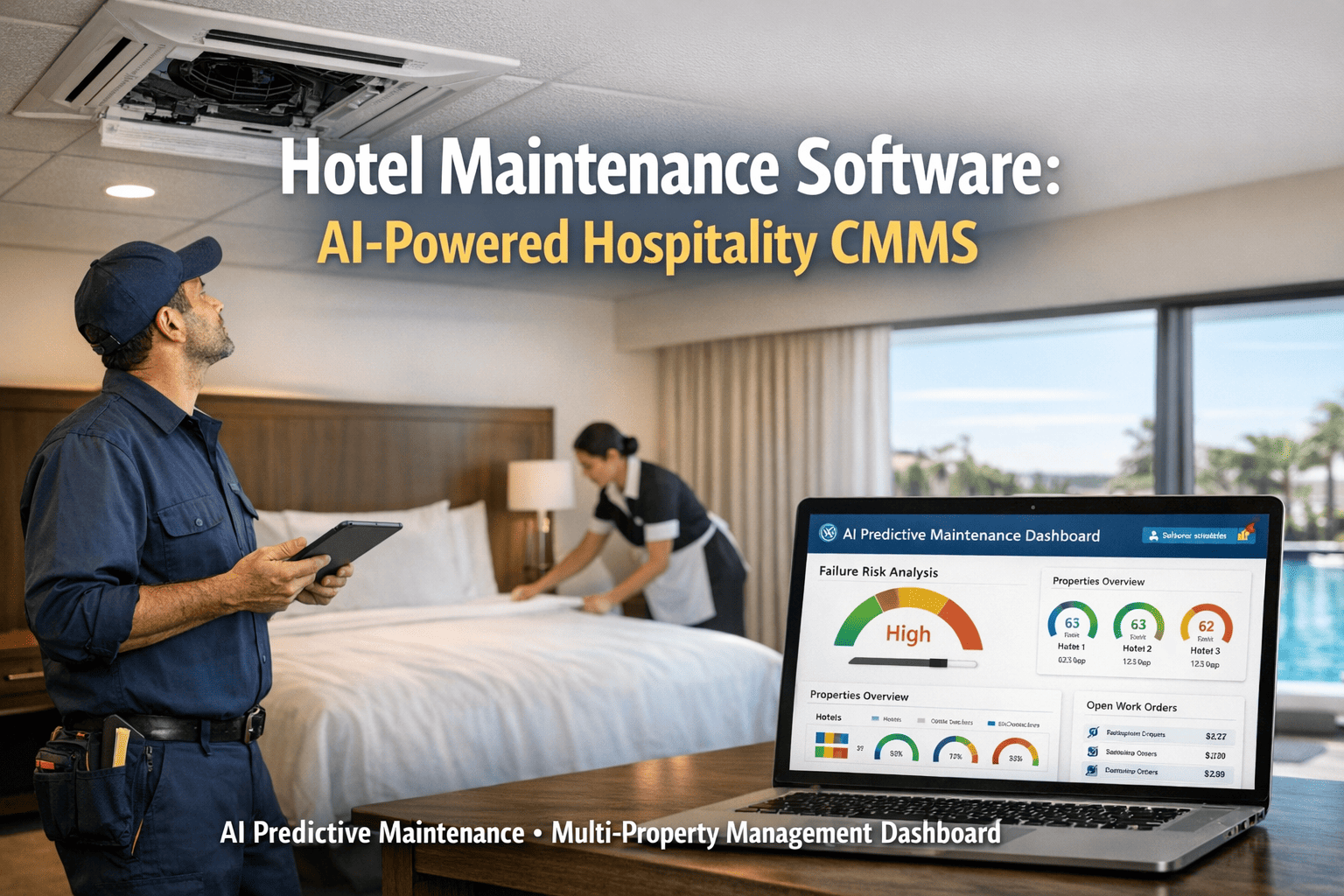
Hotel maintenance is not building maintenance with nicer lobbies — it is a guest-facing operational discipline where a broken AC unit in Room 412 at 11 PM becomes a TripAdvisor review by 7 AM, where kitchen equipment failures shut down revenue-generating F&B outlets mid-service, and where the maintenance team is expected to keep pools, spas, elevators, laundry systems, and hundreds of guest rooms operating flawlessly while remaining completely invisible to guests. A 300-room hotel manages 4,000+ maintainable assets across guest rooms, back-of-house kitchen equipment, HVAC systems, pool and spa mechanicals, fire safety, elevators, and landscaping irrigation — each with different PM frequencies, vendor relationships, and guest impact profiles. Hotels using structured CMMS platforms report 46% fewer guest-impacting maintenance failures, 33% reduction in emergency repair costs, and a measurable improvement in online review scores directly tied to room condition and facility uptime. The platforms ranked here are evaluated on hospitality-specific criteria — guest request speed, multi-property hotel chain scalability, F&B equipment management, and whether a maintenance engineer walking floors at 2 AM can actually complete work orders from a phone without waking up the IT department.
Best CMMS for Hotels and Hospitality 2026
Top hotel maintenance platforms ranked on guest room response speed, F&B equipment management, multi-property chain scalability, and real-world adoption by engineering teams managing 24/7 hospitality operations.
See How OxMaint Handles Multi-Property Hotel Maintenance
Guest request routing, kitchen equipment PMs, multi-property dashboards, and room-level asset tracking — deployed across your hotel portfolio in days.
What Makes Hotel Maintenance Different
Hotel maintenance operates under constraints no other property type faces simultaneously. Every maintenance event is measured against guest experience — not just equipment uptime. A leaking faucet in a commercial office is a work order; a leaking faucet in an occupied guest room is a potential comp, a negative review, and lost future revenue. The maintenance team must handle reactive guest requests with restaurant-speed urgency while simultaneously executing preventive programs across HVAC, kitchen equipment, pool chemistry, fire safety, and building envelope systems that prevent future guest complaints before they happen.
Multi-property hotel chains compound this complexity — a regional VP of engineering needs portfolio-level visibility into PM completion rates, equipment failure trends, and capital needs across 15 properties while each chief engineer manages their property's daily operations independently. A hotel CMMS must bridge both realities from the same platform. Explore how OxMaint handles this for hospitality — start a free trial or book a demo to see hospitality-specific configurations in action.
The Real Pain Points of Hotel Engineering Teams
These are not theoretical problems — they are the daily operational failures that cost hotels revenue, damage brand reputation, and burn out engineering staff.
Front desk calls engineering on the radio, engineer is mid-task in the boiler room, request gets forgotten. 28% of guest maintenance complaints stem from delayed or lost internal handoffs — not slow repairs.
A walk-in cooler failure at 6 PM on a Friday means spoiled inventory, menu disruption, and emergency vendor calls at overtime rates. Hotels without F&B equipment PM programs experience 2.4x more kitchen emergencies annually.
62% of negative hotel reviews mention a maintenance issue — stained ceilings, broken fixtures, HVAC noise, slow drains. Room-level asset tracking and PM schedules prevent the condition decline that drives these reviews.
Regional engineering directors managing 10-30 hotels cannot compare PM completion rates, equipment failure trends, or capital needs across properties when each hotel runs its own disconnected system or spreadsheet.
Resorts and seasonal hotels face maintenance demand spikes of 300-400% during peak season. Without structured PM completion tracking, preventive work gets abandoned during the periods when equipment is under heaviest load.
Chief engineers requesting $500K for HVAC replacements cannot defend the ask to ownership without asset condition data, maintenance cost history, and remaining useful life projections. Requests get deferred until failure forces emergency spending.
Evaluation Criteria for Hospitality CMMS
A hotel CMMS must serve the front desk, the kitchen, the boiler room, and the corporate office simultaneously. These six weighted criteria reflect what actually determines platform success in hospitality operations.
Can guest-reported issues route from front desk or housekeeping to engineering instantly with priority classification and response time tracking?
Does the platform support 5, 20, or 100 hotel properties with centralized KPI dashboards, brand-standard PM templates, and property-level operational independence?
Can it manage commercial kitchen assets — walk-in coolers, ovens, dishwashers, hood systems — with PM schedules, health inspection documentation, and vendor service records?
Does the platform track assets at the individual room level — PTAC units, plumbing fixtures, TVs, furniture condition — to support room renovation planning and preventive room maintenance?
Can a maintenance engineer complete work orders, capture photos, and update asset records from a phone while moving between guest floors, kitchens, and mechanical rooms?
Can the platform deploy at a single hotel in under two weeks and scale across a chain without per-user pricing that punishes the large team sizes hospitality requires?
Top Hospitality CMMS Platforms — 2026 Rankings
Ranked specifically for hotel and hospitality maintenance — guest experience integration, kitchen equipment management, multi-property chain operations, and the 24/7 reality of keeping hotels running while guests sleep.
OxMaint takes the top hospitality ranking for 2026 because it combines multi-property chain architecture with the operational speed that hotel engineering teams require. Guest-reported issues route from front desk or housekeeping directly into prioritized work orders — no radio calls, no paper logs, no lost requests. The response time tracking means every guest-impacting work order carries a timestamp trail from report to resolution, giving management teams the data to measure and improve engineering responsiveness. F&B equipment management handles kitchen asset PM schedules, walk-in cooler temperature monitoring integration, hood system inspections, and health department documentation from the same platform that manages guest room HVAC units and pool mechanicals. The multi-property architecture gives regional engineering directors a portfolio dashboard showing PM completion rates, equipment failure trends, and CapEx projections across every property — while each chief engineer sees only their hotel. Room-level asset tracking supports room renovation planning by linking every maintainable component to its room number with condition scoring and maintenance cost history. Unlimited user pricing means every engineer, housekeeping supervisor, front desk agent, and regional director has access without per-seat cost pressure — critical for hospitality operations where user counts scale with property size.
Quore was built specifically for hotel operations — and it shows. The platform combines maintenance, housekeeping, and front desk communication in a single interface designed for hospitality workflows. Guest request escalation, room inspection checklists, and preventive maintenance scheduling are all tightly integrated. The deep hospitality focus means every feature is relevant to hotel teams. The trade-off is that Quore's asset management and CapEx forecasting depth is lighter than platforms with broader maintenance management heritage — it excels at operational communication but is less robust for long-term asset lifecycle planning and equipment cost analysis.
Flexkeeping targets luxury hotels and resort properties with a communication-first platform that connects housekeeping, maintenance, F&B, and guest services departments. The task management and escalation workflows are designed for the high-touch service standards luxury properties demand. Multi-language support and European market focus make it particularly strong in EMEA. Engineering-depth features — detailed asset registries, condition-based maintenance, and rolling CapEx plans — are less developed than maintenance-heritage platforms, positioning Flexkeeping as an operations communication tool rather than a full CMMS.
Limble's intuitive interface and rapid deployment make it a practical choice for independent hotels and small hotel groups where the engineering team is 3-8 people and the priority is getting PM schedules and work orders digitized quickly. The mobile app adoption rate is strong, and basic preventive maintenance for building systems and guest room equipment works well. Hotel-specific features — guest request routing, housekeeping integration, brand-standard PM templates, and multi-property chain dashboards — require workarounds that purpose-built hospitality platforms handle natively.
UpKeep's mobile-first design serves hotel engineering teams that spend their entire shift on their feet moving between floors and mechanical spaces. Work order creation, photo documentation, and parts tracking are strong on mobile. The platform was not designed for hospitality specifically — guest communication flows, housekeeping coordination, F&B equipment specialization, and multi-property brand-standard management require manual configuration. Best for single-property hotels that need solid PM and work order management without hospitality-specific workflow requirements.
Platforms 6-8: Additional Hospitality Options
Hotel operations platform with maintenance, housekeeping, and guest service modules. Strong in US full-service hotel market. Maintenance depth is lighter than dedicated CMMS platforms — better suited as an operations communication layer than an asset lifecycle management system. Per-property pricing with 3-6 month implementation.
Solid general-purpose CMMS that some hotel chains adopt for engineering depth — detailed asset registries, condition tracking, and parts management. Industrial heritage means building system maintenance is strong. Hotel-specific features like guest request routing and housekeeping coordination require custom configuration.
Mobile-friendly with strong procedure and checklist features useful for hotel room inspection workflows. Works for boutique hotels with simple PM needs. Multi-property architecture, CapEx forecasting, and F&B equipment specialization are not yet developed to the level hospitality-focused platforms provide.
Handles building maintenance well with good PM scheduling and work order management. Hospitality-specific features — guest request integration, room-level tracking, F&B equipment management — require adaptation. Stronger in education and government facilities than hospitality vertical.
Feature Comparison: Top 5 Hotel CMMS Platforms
This comparison focuses on the hospitality-specific capabilities that determine whether a CMMS improves guest satisfaction scores or just digitizes paperwork.
| Hospitality Capability | OxMaint | Quore | Flexkeeping | Limble | UpKeep |
|---|---|---|---|---|---|
| Guest Request Routing | Built-in with SLA tracking | Purpose-built | Communication-first | Not included | Not included |
| Multi-Property Chain Dashboard | Full portfolio roll-up | Multi-property capable | Group-level views | Basic multi-site | Limited |
| F&B / Kitchen Equipment PM | Full asset management | Basic PM scheduling | Task-based only | Standard PM | Standard PM |
| Room-Level Asset Tracking | Component-level per room | Room inspection checklists | Room task tracking | Location-based | Location-based |
| CapEx Forecasting | 5-10 year condition-based | Not included | Not included | Not included | Not included |
| Mobile App for Engineers | Offline-capable | Good | Good | Excellent | Excellent |
| Pricing Model | Unlimited users | Per room | Per property | Per user | Per user |
Before vs. After: Hotel Maintenance Operations
The operational transformation when a hotel moves from radio-and-paper maintenance to a structured CMMS is measurable in guest satisfaction, engineering efficiency, and maintenance cost control.
| Metric | Before CMMS | With CMMS |
|---|---|---|
| Guest Request Response Time | 45-90 minutes average | Under 15 minutes average |
| PM Completion Rate | 35-50% of scheduled PMs completed | 90%+ PM completion tracked and documented |
| Kitchen Equipment Downtime | Equipment runs to failure | PM-driven with 41% fewer breakdowns |
| Room Out-of-Order Duration | 8-24 hours average per incident | Under 4 hours with priority routing |
| CapEx Planning | Annual guesswork by chief engineer | Rolling 5-year plans from asset condition data |
| Engineering Staff Utilization | 70%+ time spent on reactive calls | Balanced PM and reactive with priority management |
Hotels that structure their maintenance operations around a CMMS consistently outperform reactive properties on RevPAR, guest satisfaction, and maintenance cost per available room. The data pattern is clear across every hotel segment from select-service to luxury resorts. See how OxMaint delivers these results for hospitality — start a free trial or book a demo to walk through hospitality configurations.
How OxMaint Solves Hotel Maintenance
Six capabilities designed for the way hotel engineering actually operates — not adapted from industrial maintenance, but built for the 24/7 guest-facing reality of hospitality.
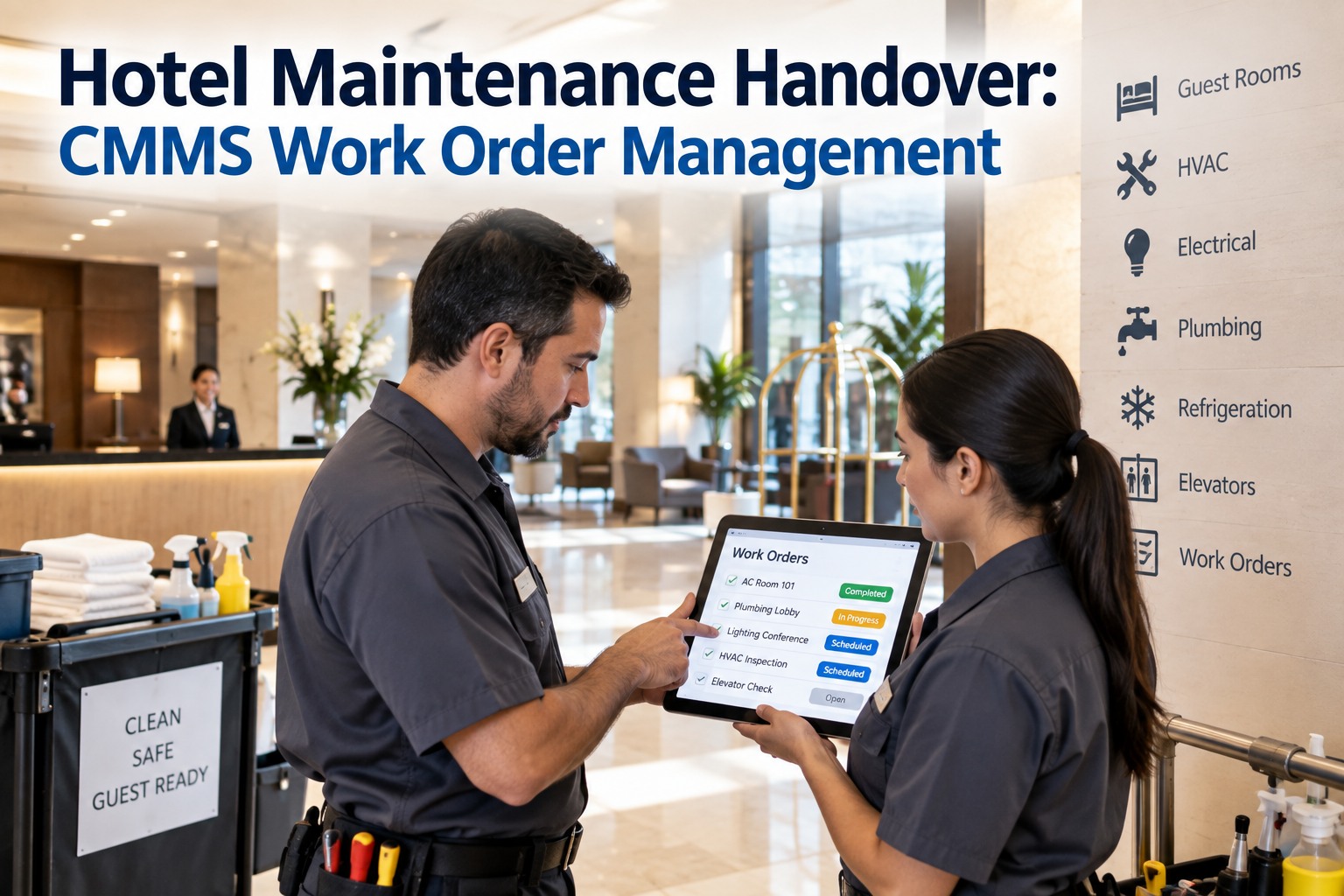
Front desk and housekeeping submit guest issues directly into prioritized work orders. Auto-routing assigns the right engineer. Response time tracking creates accountability and data for management review.
Regional VP sees PM completion, failure trends, and CapEx projections across all properties. Chief engineers see their hotel only. Brand-standard PM templates push consistency across every location.
Walk-in coolers, ovens, dishwashers, hood systems — each with manufacturer-specified PM schedules, health inspection documentation, and vendor service history. No more Friday night kitchen emergencies.
PTAC units, plumbing fixtures, furniture, TVs — tracked at the room level with condition scores and cost history. Room renovation planning driven by data, not walk-through impressions.
Asset condition scoring generates rolling 5-10 year capital plans. Ownership groups and lenders get investor-grade reports. No more deferred maintenance because the chief engineer could not make the case.
Offline-capable mobile app works in basements, mechanical rooms, and areas with poor connectivity. Engineers complete work orders, capture photos, and update assets without returning to the office.
Matching CMMS to Your Hotel Type
The right hospitality CMMS depends on your property type, chain affiliation, and whether your primary challenge is guest-facing speed, engineering depth, or portfolio-level visibility.
Complex operations with F&B outlets, banquet facilities, pool and spa, and large engineering teams. OxMaint's unlimited users and deep asset management serve the operational complexity. Quore adds strong housekeeping integration at per-room cost.
Regional engineering directors need portfolio dashboards with property drill-down and brand-standard PM consistency. OxMaint's chain architecture and unlimited user pricing serve 5-property groups to 100+ hotel portfolios without per-site or per-user cost escalation.
High-touch service standards demand rapid guest request response and detailed room condition tracking. OxMaint combines operational speed with engineering depth. Flexkeeping excels at luxury service communication for European properties.
Smaller engineering teams managing primarily guest room HVAC, plumbing, and building systems. OxMaint deploys quickly with unlimited users. Limble works for independent properties with simple PM requirements and teams under 8 people.
Frequently Asked Questions
How does a CMMS integrate with our Property Management System (PMS)?
Can we manage both hotel engineering and housekeeping from one platform?
How does room-level asset tracking work for renovation planning?
What does deployment look like for a 10-hotel chain?
Your Guests Notice When Maintenance Falls Behind
Every broken fixture, every slow AC repair, every out-of-order room is a guest experience failure that shows up in reviews, satisfaction scores, and rebooking rates. OxMaint gives hotel engineering teams the guest request speed, preventive maintenance structure, and portfolio visibility that transforms maintenance from a cost center into a guest satisfaction driver. Most hotels are running live operations within 14 days of signup — including guest request routing, kitchen equipment PMs, and room-level asset tracking.


.png)