Your next food safety audit does not care that the refrigeration log was misplaced, the CCP verification was done on paper and the paper got wet, or the corrective action record from March is in a binder somewhere. Auditors need evidence. Digital, timestamped, traceable evidence. Start Oxmaint free — HACCP compliance templates are pre-built and ready to deploy in under an hour.
HACCP Compliance Software
Audit-Ready HACCP Records. Automatically.
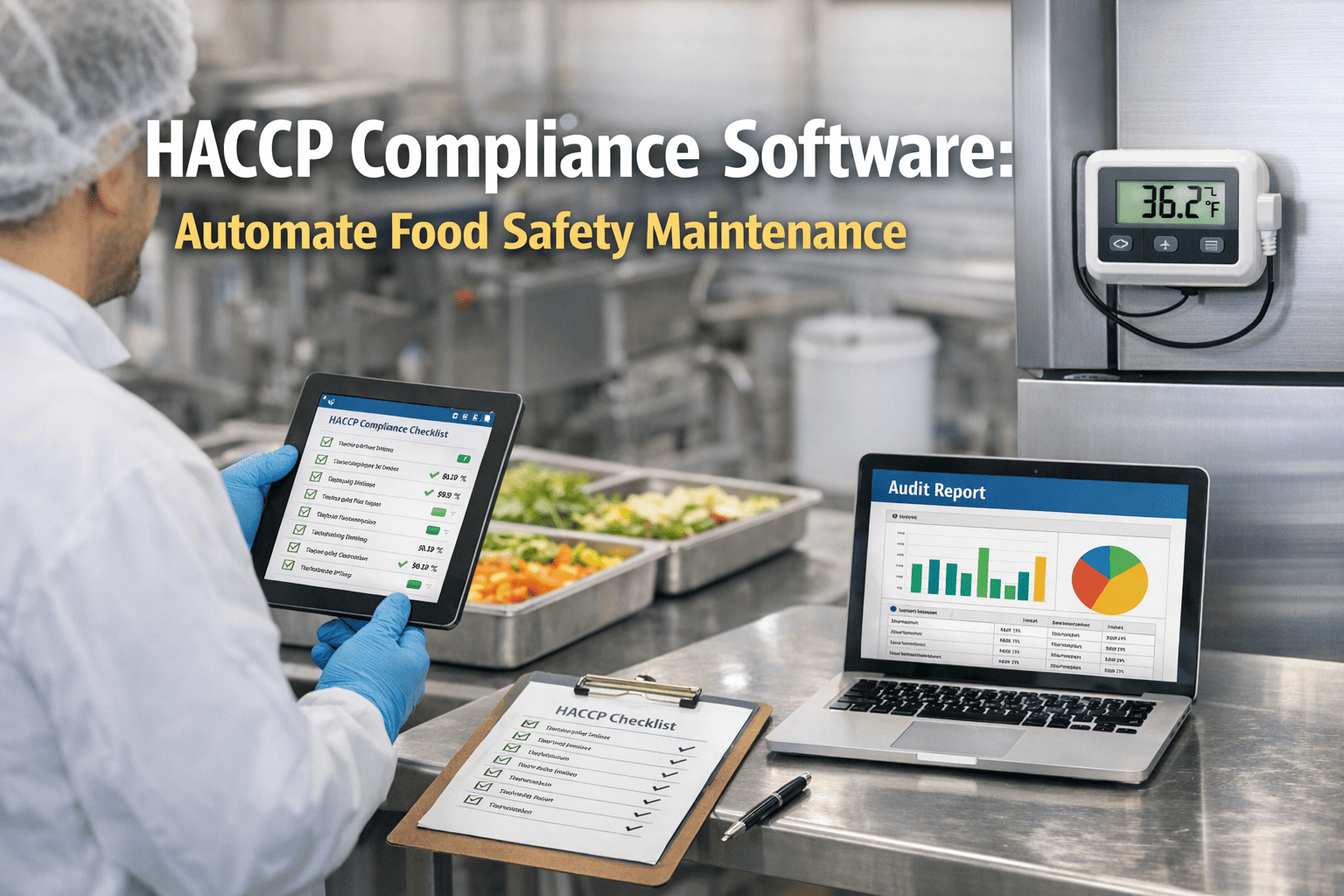
Oxmaint turns your HACCP plan into digital checklists, temperature monitoring alerts, and instant audit reports — so your food safety compliance is never dependent on a binder that might be missing when an auditor walks in.
The Seven HACCP Principles — How Oxmaint Automates Each
Every HACCP plan is built on seven principles. Oxmaint has a specific capability that supports each one — turning the principle from a planning exercise into an operational system with documented evidence. Book a demo to see your HACCP plan mapped to Oxmaint's compliance modules.
01
Hazard Analysis
Hazard identification for each process step — biological, chemical, and physical hazards documented with risk assessment scores.
Oxmaint
Hazard register stored per production asset. Each hazard linked to the monitoring tasks and control measures that address it — one record, full traceability from hazard to control to evidence.
02
Critical Control Points
Identifying the points in the process where control is essential to prevent or eliminate a food safety hazard or reduce it to an acceptable level.
Oxmaint
Each CCP is configured as a monitored asset with critical limits, monitoring frequency, and responsible personnel. Sensor integration feeds CCP values automatically — no manual data entry required for temperature, pH, or pressure CCPs.
03
Critical Limits
The minimum or maximum value to which a biological, chemical, or physical parameter must be controlled to prevent, eliminate, or reduce food safety hazards.
Oxmaint
Critical limits configured per CCP with high and low alert thresholds. Readings outside limits trigger immediate alerts to the responsible food safety team member — no manual checking of logs required to detect a limit breach.
04
Monitoring Procedures
The planned sequence of observations or measurements to assess whether a CCP is under control and to produce an accurate record for future verification.
Oxmaint
Monitoring tasks scheduled as recurring work orders with configurable frequency — per shift, hourly, daily. Mandatory fields ensure readings are recorded with timestamp, location, and operator identity. Missed checks are flagged automatically before the monitoring interval is exceeded.
05
Corrective Actions
Procedures taken when monitoring indicates a CCP is not under control — including actions to correct the cause of deviation and restore process control.
Oxmaint
When a critical limit breach is detected, Oxmaint auto-creates a corrective action work order with predefined response steps from your HACCP plan. The work order captures who took action, what was done, when control was restored, and the disposition of affected product — all in a single timestamped record.
06
Verification Procedures
Activities other than monitoring that confirm the HACCP system is working effectively — including equipment calibration, review of CCP records, and audit activities.
Oxmaint
Calibration schedules for temperature probes, pH meters, and measurement instruments managed as PM work orders with certificate storage. Verification audit checklists are scheduled and completed in Oxmaint — records stored with the same timestamp and approver trail as CCP monitoring records.
07
Record Keeping
Documenting the HACCP system and maintaining records that demonstrate effective application of all seven principles during actual production.
Oxmaint
All HACCP records — CCP monitoring, corrective actions, calibrations, and verifications — are stored in Oxmaint with full timestamp, operator identity, and digital signature. One-click audit report exports all records for a selected date range in the format auditors require. No binders, no paper, no missing records.
Every HACCP principle has a documented record in Oxmaint.
Start free — pre-built HACCP templates, no configuration required to begin your first compliance audit trail.
4–6 hrs/week compiling paper logs into spreadsheets for management review
8–16 hrs preparing documentation packages for each external audit
$50K–$250K average cost of a major non-conformance from a missed or undocumented HACCP deviation
No instant visibility — limit breaches discovered on next paper log review, hours or days after the event
Corrective action records often incomplete — action taken but root cause and product disposition not documented
Oxmaint HACCP Automation
Zero compilation time — all records auto-generated from digital checklists and sensor feeds
One-click audit report — complete compliance documentation package generated in under 60 seconds
Complete deviation documentation — every corrective action has root cause, resolution, and product disposition on record
Real-time limit breach alerts — responsible team member notified within seconds, corrective action started immediately
Missed check prevention — automated reminders ensure no monitoring interval is exceeded without record or documented reason
Frequently Asked Questions
How quickly can we deploy Oxmaint's HACCP compliance templates for our facility?
Most food facilities have their first HACCP monitoring checklists running within 2–4 hours of signing up. Oxmaint's pre-built HACCP template library includes CCP monitoring forms, corrective action workflows, calibration records, and verification checklists that match the most common food safety standard requirements — BRC, SQF, FSMA, FSSC 22000, and IFS. You customise the CCP names, critical limits, and monitoring frequencies to match your specific HACCP plan, and the record-keeping infrastructure is live immediately. Start your free account to access the full template library today.
Can Oxmaint connect to our temperature loggers and sensors automatically?
Yes. Oxmaint integrates with continuous temperature monitoring systems via REST API, MQTT, and direct data feed integrations with popular food industry monitoring platforms. Cold storage temperatures, cooking temperatures, and pasteurisation parameters can all feed automatically into CCP records — eliminating manual data entry and the transcription errors that create compliance vulnerabilities. For facilities with legacy data loggers, Oxmaint also supports structured manual data entry with mandatory field enforcement. Book a demo to discuss your specific monitoring hardware and integration options.
Will Oxmaint's records satisfy an FDA or GFSI auditor — or do we still need paper backup?
Oxmaint's digital records fully satisfy FDA 21 CFR and GFSI-recognized standard requirements when properly configured. Records include: date and time stamp, operator identity (logged-in user), digital sign-off, and complete audit trail showing any modifications with the reason and authorising user. The one-click audit report exports the full evidence package in PDF format — which auditors from BRC, SQF, and FDA inspections have accepted at Oxmaint customer facilities. Paper backup is not required. We recommend reviewing the electronic records requirements of your specific certification body with your food safety consultant before transitioning from paper, as some auditors have individual preferences.
How does Oxmaint handle the corrective action process when a CCP limit is breached?
When a CCP limit breach is detected — either from a sensor alert or a manual reading outside the configured critical limit — Oxmaint immediately: (1) sends an alert to the designated food safety team member, (2) auto-creates a corrective action work order with pre-defined response steps from your HACCP plan, (3) records the breach event with timestamp and CCP value, and (4) requires sign-off on each corrective action step before the work order can be closed. The completed corrective action record includes the deviation value, the steps taken, who took them, when control was restored, and the disposition of any potentially affected product — the complete documentation that auditors need to see. Start Oxmaint free to configure your corrective action workflows.
Your Next Audit Starts With Today's Records
Every CCP monitoring record, corrective action, calibration, and verification your team completes in Oxmaint is automatically audit-ready. Stop compiling compliance evidence — start producing it automatically, every shift, every day.