Every hotel room is quietly wearing out between guests — a PTAC filter clogging, a faucet starting to drip, a lock battery fading — and you have exactly two chances to catch it before a guest does: the moment the room turns over, and the deep-PM window when you pull it from inventory. The mistake most engineering teams make is treating those as one thing. Post-stay checks are cheap, fast, and constant, but they only *detect* — housekeeping can flag a dripping faucet in thirty seconds, but can't stop to descale a showerhead mid-turn. Deep-PM windows *resolve*, but every room in a deep-PM is a room not selling, and a hotel room pulled from service costs around $180 in lost RevPAR a night. Run only post-stay and issues pile up unfixed; run too many deep-PMs and you're bleeding inventory. The answer is a deliberate two-tier cycle where each tier does the job it's good at. This guide designs that cycle, and shows how OxMaint's maintenance management software runs both tiers on one rotation.
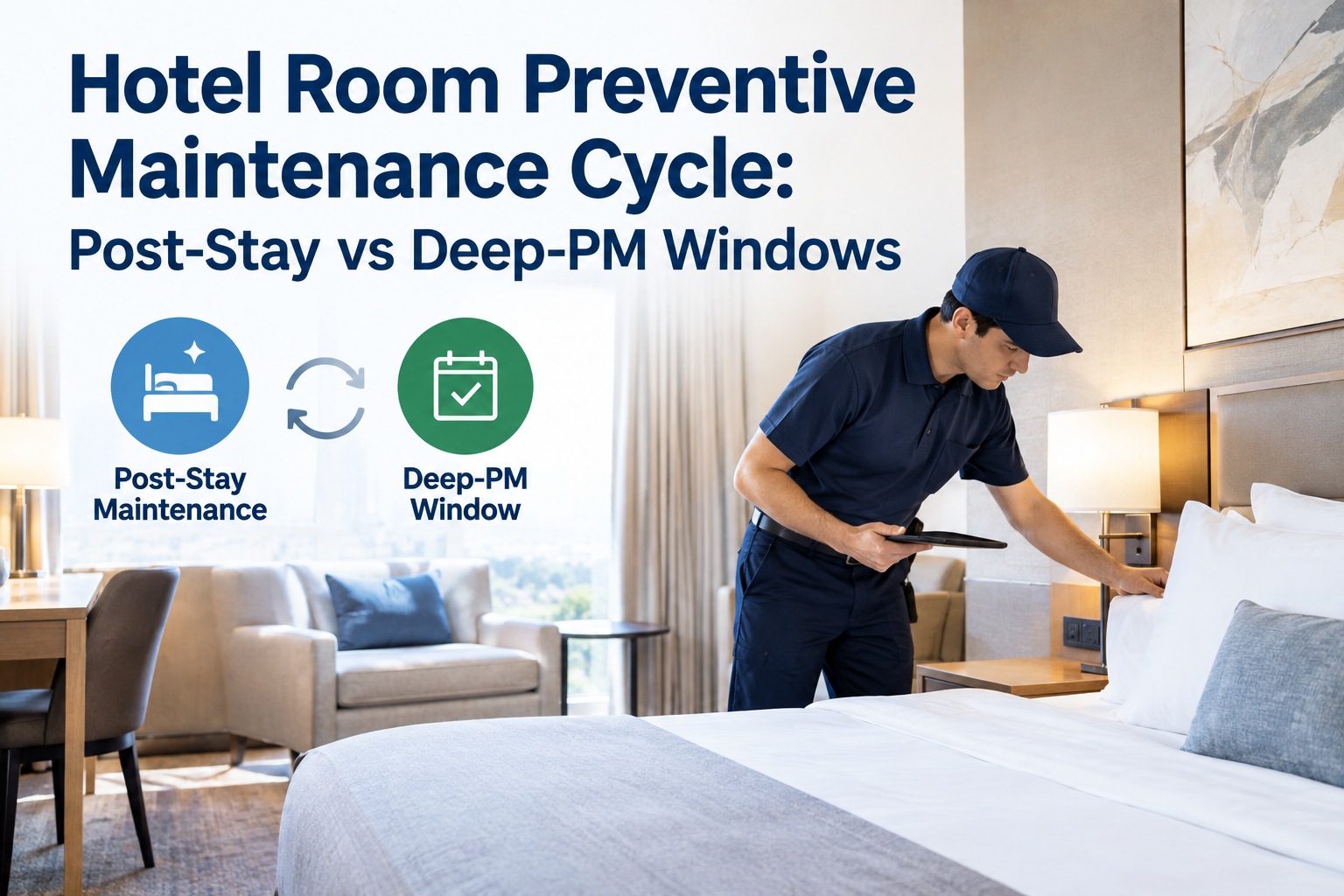
Hotel Room Preventive Maintenance Cycle: Post-Stay vs Deep-PM Windows
Two tiers, two jobs: post-stay checks detect the small stuff at every turnover; deep-PM windows resolve it on a planned rotation. Run them together and you protect reviews without pulling too many rooms.
Two Tiers, Two Different Jobs
The whole design rests on one distinction: detection and resolution are different activities with different costs, so they belong in different tiers. Post-stay is high-frequency and near-free because it rides an event already happening — the turnover. Deep-PM is low-frequency and expensive because it consumes a saleable room. Match each task to the tier whose economics fit it. Sign up free and OxMaint runs both tiers per room on one rotation.
Tier 1 · The 60-Second Post-Stay Checklist
A room can pass a visual "looks clean" inspection and still fail a functional test — and the functional failure is the one that becomes a 1-star review. The post-stay check is a fast functional sweep housekeeping can do without slowing the turn: not to fix anything, just to catch it and route it. Book a demo to see photo-tag-to-work-order in the turnover flow.
The Gap That Kills Reviews Is Between Housekeeping and Engineering.
Post-stay only works if a flagged issue actually reaches a technician. On paper logs and shift huddles, half of them evaporate — housekeeping notices, engineering never hears. OxMaint closes that gap: housekeeping snaps a photo on mobile during the turn, and the tag becomes a routed, prioritized work order with photo evidence and a parts list, instantly — teams see up to an 80% cut in inspection reporting time, and nothing falls between the two departments.
Tier 2 · What the Deep-PM Window Actually Does
The deep-PM is where the room gets the work post-stay only flagged — the component-level service that needs the room offline and a technician with time. Because you're paying RevPAR for the window, it should clear the whole accumulated list at once, not one item at a time. Sign up free to bundle open work orders into the deep-PM.
Frequency: Match Each Asset to Its Wear Rate
Not everything belongs on the 90-day deep-PM. High-traffic mechanical parts wear faster than furniture, so the smart cycle runs several frequencies at once on a per-room basis — the filter on its own clock, the FF&E on another. Book a demo to see multiple frequencies per room, coordinated.
Two triggers should also pull a room forward, outside the calendar: a long stay (weeks of continuous wear with no turnover to catch it), and a specific fault report. Trigger-based PMs keep a heavily-used room from coasting a full quarter on a failing component.
Reactive / Paper vs. OxMaint Two-Tier Cycle
The old model is a paper turnover sheet and a reactive scramble when a guest complains — which is exactly how you end up pulling 8–12 rooms a week. Here's what changes when both tiers live in a CMMS tied to occupancy. Start free and put one floor on the two-tier cycle this week.
What OxMaint Gives Hotel Engineering
OxMaint runs both tiers as one system — turnover detection feeding the deep-PM window, all coordinated with occupancy — so rooms stay guest-ready without pulling more inventory than you have to. Here's the concrete mapping. Book a demo to see it on your property.
Use this two-tier cycle plus OxMaint to catch the small issues at every turnover, resolve them in planned deep-PM windows, and keep rooms review-ready while pulling as little inventory as the work truly requires. Try OxMaint free or book a demo to see it on your hotel.
We used to pull 8 to 12 rooms a week for reactive repairs — always at the worst time, always because a guest had already hit the problem first. The fix wasn't more PM, it was smarter PM. In OxMaint, housekeeping now flags anything off during the turn with a photo, and it lands on engineering as a work order before the next guest checks in. The real repairs get batched into a quarterly deep-PM window we plan around occupancy, so we pull a room once and clear everything, not five times for five small things. We're down to 2 to 3 rooms a week, the PTAC filter schedule killed our most common complaint, and our guest-room scores climbed. Same team, far fewer rooms out of order.
Frequently Asked Questions
Catch It at Turnover. Fix It on Your Schedule.
OxMaint runs the two-tier cycle as one system — photo-tag detection at every turnover feeding a per-room deep-PM rotation coordinated with occupancy — so rooms stay review-ready and you pull only the inventory the work truly needs. Start free — no credit card, unlimited users, forever. Or book a demo.