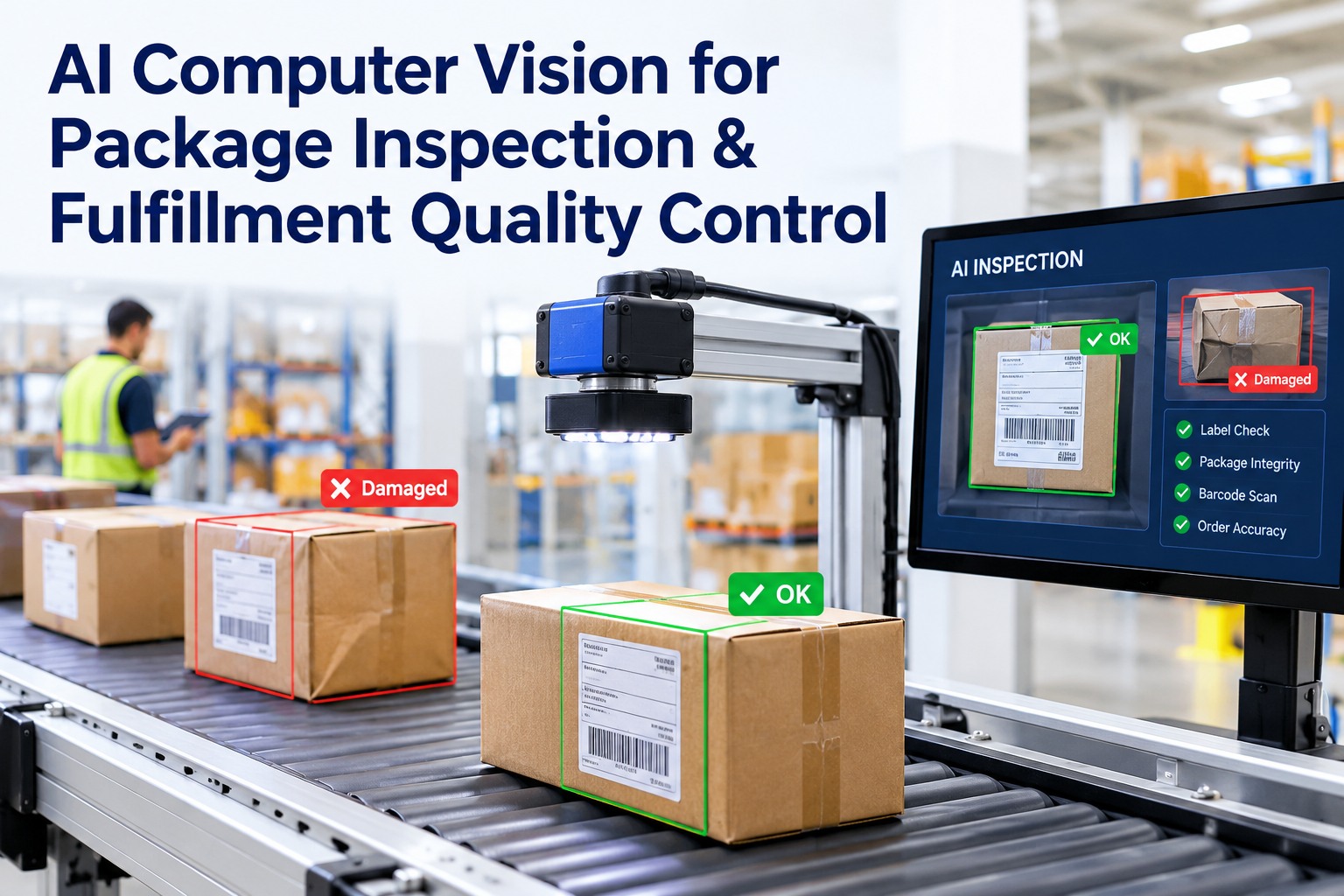
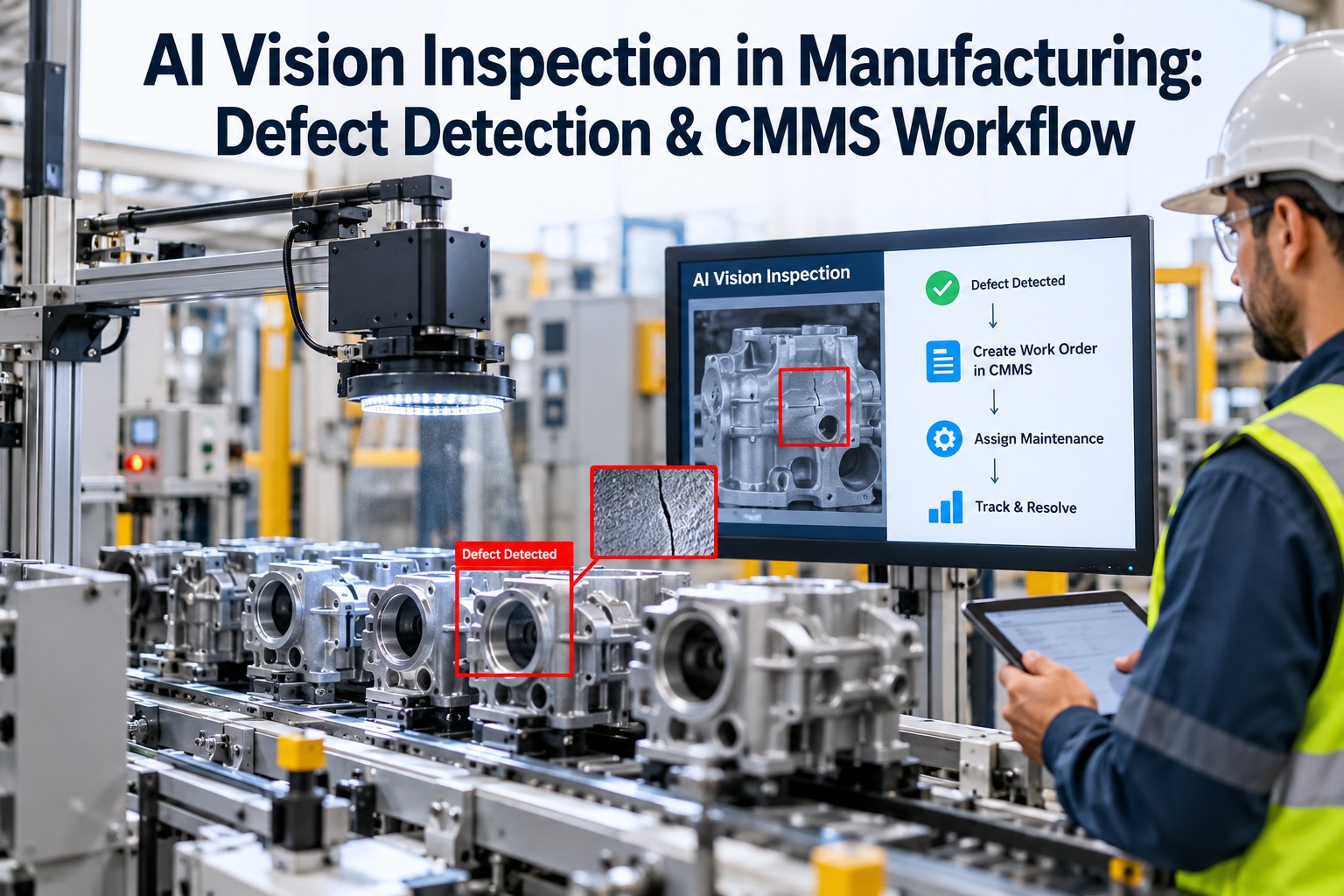
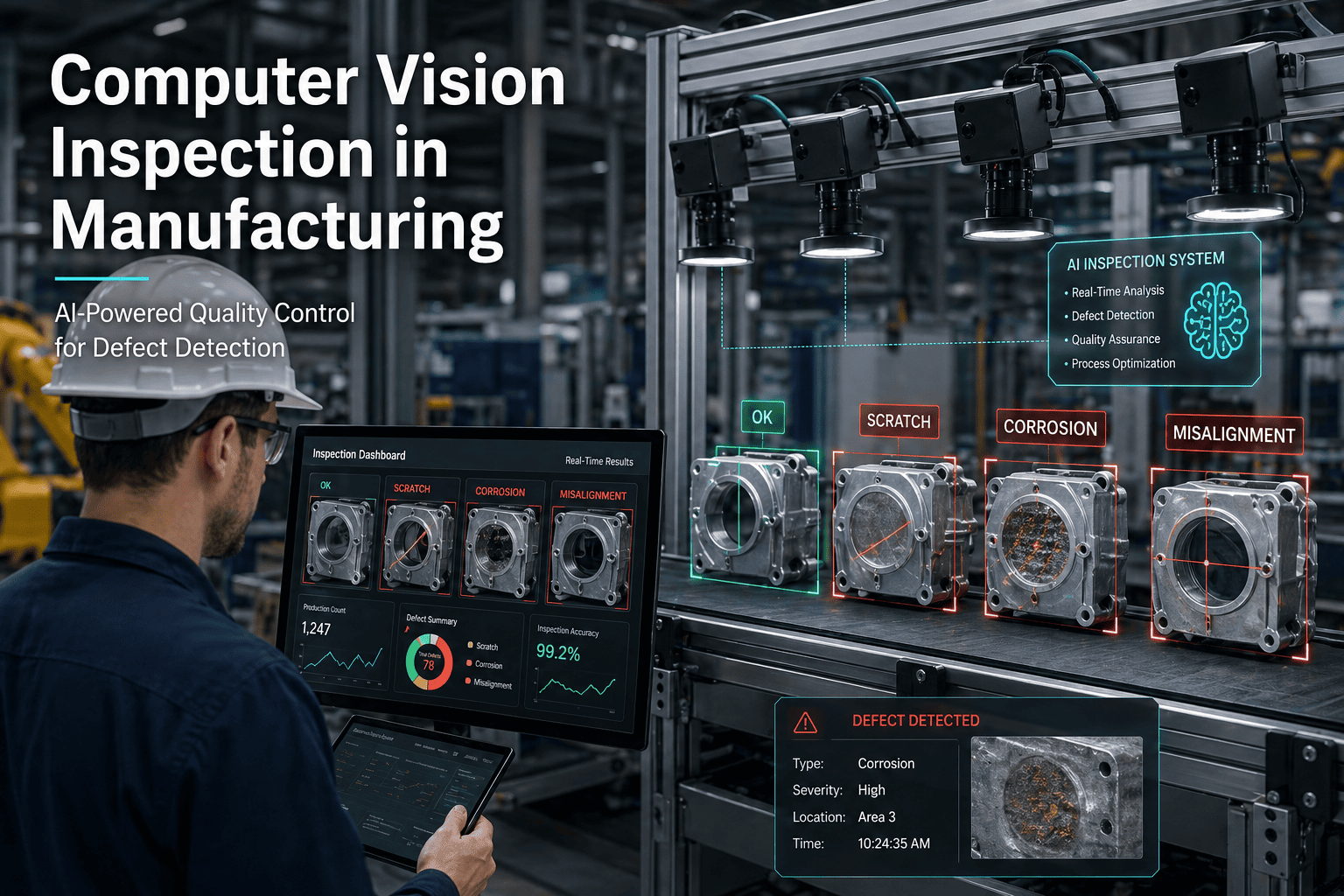
A single defective unit slipping through a high-speed production line is not a quality embarrassment — it is a signal that your inspection system is operating at the edge of its detection capability. At 600 units per minute, human visual inspection catches 60–80% of defects on a good day, and that number degrades sharply after the first two hours of a shift. AI vision defect detection running on NVIDIA Jetson AGX Orin changes the math entirely: 98%+ detection accuracy at line speed, sub-15ms inference latency, automatic rejection triggering, and every defect event logged directly into your CMMS as a quality work order — without a quality engineer manually transcribing findings from a separate inspection system. Start a free trial to see how OxMaint connects AI vision inspection results to your maintenance workflow and asset reliability tracking automatically.
AI Vision · Quality Control · Manufacturing
AI Vision Defect Detection in Manufacturing
600+ Units/min · 98%+ Accuracy · Sub-15ms Inference · Auto-Reject + CMMS Work Orders
Deep learning vision models on NVIDIA Jetson detect surface defects, dimensional variation, and assembly errors at line speed — and feed every defect event into OxMaint for root cause tracking and PM adjustment.
Zero slowdown on high-speed production lines — inference in under 15ms
Automatic rejection signal and CMMS quality work order on every defect event
Defect Pareto analysis drives PM schedule adjustments that eliminate root causes
No heavy implementation · Works across multi-site portfolios · Measurable results in 30 days
OxMaint · Vision Inspection Dashboard
● Inspecting
Recent Defect Events — Auto-Logged
Surface Crack
Press Line 2 · Die Station 4
WO-5812 Created
Dimensional Shift
Milling Cell A · Fixture 3
WO-5809 Created
Surface Scratch
Conveyor Exit · Station 7
WO-5806 Logged
Defect Rate by Line — Last 8 Hours
60–80%
Human Inspection Accuracy
Degrades sharply after 2 hours on-shift — AI vision holds 98%+ across full production runs (Quality Progress, 2023)
$8,500
Average Defect Escape Cost
Per escaped defect reaching the field — warranty, recall, rework, and customer relationship costs combined (ASQ, 2024)
600+
Units per Minute
NVIDIA Jetson AGX Orin inspection throughput — zero line speed penalty on high-speed manufacturing lines
25–40%
Rework Cost Reduction
Plants connecting vision defect data to CMMS root cause tracking achieve within 12 months of deployment (Aberdeen Group)
Get Your Custom Maintenance Plan Based on Real Defect Data
OxMaint converts AI vision defect events into CMMS work orders, Pareto analysis, and PM schedule adjustments — closing the loop between what the camera sees and what the maintenance team fixes. If your quality and maintenance systems still operate in separate silos, start a free trial or book a demo to see the integration live on your production line data.
What Is AI Vision Defect Detection?
AI vision defect detection uses deep learning computer vision models — typically convolutional neural networks (CNNs) and vision transformers — trained on thousands of images of acceptable and defective parts to classify and locate defects in real time during production. Unlike traditional rule-based machine vision that requires hand-coded thresholds for color, size, and position, AI models learn complex visual patterns that resist explicit programming: surface porosity, micro-cracks, subtle dimensional shifts, and cosmetic irregularities that vary with lighting, orientation, and material batch variation.
On NVIDIA Jetson AGX Orin hardware, these models run inference in under 15 milliseconds per frame — fast enough to inspect every unit on a 600-unit-per-minute line without triggering a conveyor slowdown. When a defect is detected, the system simultaneously triggers the pneumatic rejection mechanism, logs the defect type and location with a captured image, and creates a quality work order in OxMaint with the defect category, production line, station, and shift context attached.
The critical insight most plants miss is that defect detection data is also maintenance data. A sudden spike in surface crack defects from Press Line 2 is not just a quality event — it is a signal that die wear has reached a threshold requiring replacement, that lubrication intervals need shortening, or that a guide rail is misaligned. OxMaint uses defect Pareto data to drive PM schedule adjustments automatically, turning quality inspection from a cost center into a predictive maintenance feed. Teams that connect these two systems report 25–40% rework cost reduction and 30–50% lower defect escape rates — start a free trial to see how OxMaint builds that connection for your production lines.
Defect Types AI Vision Detects
Surface cracks and porosity
Dimensional variation and out-of-tolerance parts
Scratches, dents, and cosmetic damage
Missing or misplaced components
Weld defects and incomplete bonds
Label misalignment and print errors
Color deviation and finish variation
Assembly sequence errors
AI vs Rule-Based Vision
Setup time
Weeks of threshold tuning
Days of model training
New defect types
Requires reprogramming
Retraining with examples
Accuracy
70–85%
96–99%
Lighting variation
Brittle — recalibrate often
Robust via augmentation
Quality and maintenance are the same problem. A defect spike on your line is a maintenance failure waiting to be investigated — AI vision makes that connection automatic.
8 Core Capabilities of AI Vision Defect Detection
01
Real-Time Surface Defect Classification
CNN models classify defect type — crack, scratch, pit, porosity — and localize defect position with bounding box coordinates per frame. Defect maps accumulate across production runs to identify which die zones, conveyor sections, or tooling positions generate the highest defect density.
02
Dimensional Gauging and Tolerance Verification
Structured light and stereo vision setups measure critical dimensions against CAD tolerances at line speed. Out-of-tolerance parts are rejected and logged with measured deviation data — feeding directly into fixture wear tracking and tool life management in OxMaint.
03
Multi-Camera Production Line Coverage
Jetson AGX Orin processes streams from 4–8 cameras simultaneously — top, bottom, side, and end-face views in a single inspection pass. Complete part coverage eliminates the missed-angle defects that single-camera inspection systems routinely pass downstream.
04
Automatic Rejection Signal Integration
Defect classification triggers pneumatic or divert rejection within the 15ms inference window — before the defective unit reaches the next station. Rejection events log automatically with defect type, confidence score, image capture, and production context for traceability.
05
Defect Pareto and Root Cause Linking
OxMaint aggregates defect events by type, station, shift, and asset — building live Pareto charts that identify which equipment failures drive 80% of quality escapes. A die generating 70% of surface crack defects triggers a PM work order automatically rather than waiting for a monthly quality review.
06
Model Retraining on New Defect Types
When production introduces new materials, geometries, or processes, the vision model retrains on newly labeled examples — typically 200–500 images per new defect class — without redeploying hardware. NVIDIA TAO toolkit accelerates retraining to hours rather than days.
07
SPC Integration and Control Chart Triggering
AI vision defect rates feed directly into Statistical Process Control charts. When defect rate trends signal process drift — before the SPC control limit is breached — OxMaint creates a corrective maintenance work order while the process is still within tolerance, preventing quality escapes.
08
Traceability and Audit Trail
Every inspected unit generates a timestamped inspection record with pass/fail classification, defect image, confidence score, production batch, and equipment ID — stored in OxMaint for GMP-compliant audit trails, customer complaint investigation, and regulatory inspection readiness.
6 Quality and Maintenance Pain Points AI Vision Solves
!
Defect Escapes Reaching the Field at $8,500 Per Unit
Human inspection at 60–80% accuracy on a 600-unit-per-minute line means 120–240 defective units pass per minute during detection gaps. At $8,500 average escape cost — warranty, rework, returns, and customer impact — a single production shift with compromised inspection can generate $500K+ in field quality costs.
!
Quality Data Never Reaches the Maintenance Team
Quality engineers document defect trends. Maintenance teams fix equipment failures. Neither system talks to the other. The die generating 70% of surface crack defects gets a corrective work order three weeks after the quality report lands on the maintenance supervisor's desk — by which time 10,000 additional defective parts have been produced.
!
Operator Fatigue Destroys Inspection Consistency
Studies show human visual inspection accuracy drops from 85% to 60% after 2 hours on task. Night-shift inspection is statistically worse than day-shift across every documented quality system. A defect that would be caught at 8 AM slips through at 3 AM — not because the operator is careless, but because human attention cannot sustain 100% inspection vigilance across a full shift.
!
Rule-Based Vision Systems Require Constant Recalibration
Traditional machine vision with hand-coded thresholds fails when lighting conditions shift, material batches vary, or new defect types emerge. Every product changeover requires threshold reconfiguration — consuming quality engineering time and generating inspection downtime while parameters are validated.
!
No Traceability for Regulatory and Customer Audits
When a customer complaint or regulatory audit demands production traceability for a specific batch, the answer should not be paper logs and operator memory. Without automated inspection records linked to production batches and equipment state, traceability investigations take days and often yield incomplete answers that damage customer confidence.
!
Cloud Inspection Latency Incompatible with Line Speed
Cloud AI inference adds 200–500ms round-trip latency. At 600 units per minute, a unit passes through the inspection zone every 100ms — making cloud inference physically impossible to connect to an automatic rejection mechanism. Edge AI on NVIDIA Jetson is the only architecture that supports real-time rejection at production line speeds.
Teams that integrate AI vision inspection with CMMS defect tracking eliminate 80% of their repeat quality escapes within 6 months by connecting defect events to the equipment failures driving them — start a free trial to see how OxMaint closes that loop automatically, or book a demo to walk through your specific production line and defect profile.
How OxMaint Connects AI Vision to Your Maintenance Workflow
01
Vision System Detects Defect Event
NVIDIA Jetson runs inference in under 15ms and classifies the defect — surface crack, dimensional deviation, cosmetic damage. Pneumatic rejection triggers simultaneously. Defect image, type, confidence score, location, and production context captured.
→
02
OxMaint Quality Work Order Auto-Generated
Every defect event creates a CMMS work order automatically — classified by defect type, linked to the specific equipment asset, assigned to the appropriate maintenance or quality team, and tagged with the production batch for traceability.
→
03
Pareto Analysis Identifies Root Cause Equipment
OxMaint aggregates defect events by asset and defect type in real time. When one asset generates more than 20% of a defect category, a root cause flag triggers — surfacing the specific die, fixture, or tooling driving quality degradation before the next production run.
→
04
PM Schedule Adjusts to Defect Trend Data
Rising defect rates from a specific asset trigger PM interval shortening automatically. A die showing increasing crack defect frequency gets a tool inspection PM scheduled 30% earlier than the calendar interval — preventing the failure mode rather than reacting to it after it drives a quality escape.
This closed loop — vision detects, CMMS logs, Pareto identifies, PM adjusts — is what separates facilities with 25–40% rework cost reduction from those still managing quality and maintenance as separate disciplines.
Reactive Quality Management vs AI Vision + OxMaint
| Dimension |
Reactive / Manual Inspection |
AI Vision + OxMaint CMMS |
| Inspection accuracy |
60–80%, degrades with fatigue — worst at end of shift |
98%+ consistent across full production run, every shift |
| Inspection throughput |
100% inspection requires extra headcount or line slowdown |
100% inspection at 600+ units/min, zero line speed penalty |
| Defect event logging |
Manual entry, batch logging at end of shift — missing context |
Automatic per-unit logging with image, type, location, timestamp |
| Maintenance integration |
Quality report emailed weekly — maintenance reacts 1–3 weeks later |
Defect Pareto triggers PM work orders in real time |
| Rejection response time |
Operator dependent — 2–5 second reaction, multiple units pass |
Sub-15ms automatic rejection — only the defective unit diverts |
| Traceability |
Paper logs and operator memory — incomplete for audits |
Full per-unit inspection record linked to batch and equipment state |
| New defect adaptation |
Operator retraining — inconsistent until pattern recognized |
Model retraining with 200–500 examples — hours, not weeks |
| Defect escape cost |
$8,500 average per escaped unit — warranty, rework, customer |
30–50% lower escape rate within 12 months of deployment |
ROI and Results — Documented Quality Outcomes
98.6%
Detection Accuracy
Sustained across full production runs — versus 60–80% human inspection accuracy that degrades with fatigue and shift changes
$8,500
Per-Escape Cost Avoided
Average cost of a defect escaping to the field — warranty, rework, returns, and customer impact. AI vision at 98%+ accuracy eliminates the majority of this exposure
40%
Rework Cost Reduction
Plants connecting AI vision defect data to CMMS PM adjustment report 25–40% rework cost reduction within 12 months by targeting the equipment root causes, not just logging defect events
6 hrs
Deployment Lead Time
From NVIDIA Jetson unit power-on to first live inspection results — including camera mounting, lighting setup, model deployment, and OxMaint CMMS integration
80%
Repeat Escape Elimination
Connecting defect Pareto data to automatic PM triggers eliminates 80% of repeat quality escapes from the same root cause equipment within 6 months
sub-15ms
Inference + Rejection Latency
Complete cycle: image capture → model inference → defect classification → rejection signal — faster than any human reaction time at any production line speed
The fastest payback scenario: a plant with a recurring defect escape from a known equipment cause. One prevented field recall typically covers 12 months of AI vision operating cost — start a free trial to model your ROI with OxMaint's calculator, or book a demo to project outcomes against your specific defect history.
Frequently Asked Questions
How many defect images do we need to train an AI vision model?
A production-ready model for a well-defined defect class typically requires 500–2,000 labeled images per defect type using transfer learning from NVIDIA pre-trained industrial vision models. For common defect types — surface cracks, scratches, porosity — pre-trained base models accelerate convergence significantly, and acceptable accuracy is often achievable with as few as 200 labeled examples per class. Data augmentation (rotation, brightness variation, noise addition) multiplies effective training data by 5–10×, reducing physical image collection requirements. The baseline model for anomaly detection — flagging anything that deviates from a normal part — requires no defect examples at all, only a dataset of good parts. This allows deployment before failure data accumulates. To discuss your specific product type and expected defect classes,
start a free trial and our engineering team will assess your readiness.
Can AI vision detection work alongside our existing quality management system?
Yes. OxMaint integrates AI vision inspection results with existing QMS platforms — SAP QM, Siemens Opcenter, Intelex, and others — via REST API. Defect events can simultaneously create OxMaint maintenance work orders and log quality records to the existing QMS, eliminating duplicate data entry. For plants with no existing QMS, OxMaint provides the complete quality record-keeping, traceability, and reporting functionality required for ISO 9001, IATF 16949, and FDA 21 CFR Part 11 compliance. The integration path depends on your current system stack —
book a demo and we will map the specific API connections for your environment.
How does AI vision handle product changeovers and different part geometries?
Each product variant has a separate trained model stored in the NVIDIA Jetson model library. Changeover triggers a model swap via production schedule integration or manual operator selection — model loading takes under 5 seconds on Jetson AGX Orin hardware. For product families with shared defect types and similar geometries, a single model often covers multiple variants with acceptable accuracy. For highly diverse product mixes, multi-class models trained across the full product family reduce the number of stored models required. OxMaint tracks which model version was active during each production run, providing complete model traceability alongside the inspection records.
How does defect data from AI vision connect to preventive maintenance scheduling in OxMaint?
OxMaint maps each vision inspection station to the upstream equipment assets that influence defect generation — dies, fixtures, tooling, conveyor drives, and positioning guides. When defect rate from a specific station exceeds a configurable threshold, OxMaint cross-references which asset changes most recently preceded the defect rate change, flags the likely root cause equipment, and creates a predictive maintenance work order. PM intervals for high-influence assets shorten automatically when defect trends signal accelerating wear. This connection — from what the camera sees to what the maintenance team fixes — is what eliminates repeat quality escapes from the same root cause. Teams using this integration report 25–40% rework cost reduction within 12 months of deployment.
AI Vision Defect Detection · OxMaint CMMS
Your Production Line Already Generates Every Defect Signal You Need. OxMaint Turns It Into the Maintenance Actions That Eliminate Root Causes.
Stop managing quality and maintenance as separate systems. AI vision inspection on NVIDIA Jetson AGX Orin detects defects at 98%+ accuracy, auto-generates work orders in OxMaint, and drives PM adjustments that eliminate the equipment failures producing them — all in a single platform your quality and maintenance teams use together.
98%+ inspection accuracy at 600+ units per minute — every shift
Automatic CMMS work orders on every defect event — no manual handoff
25–40% rework cost reduction via defect-to-PM closed loop
Used by operations teams managing 10,000+ assets · Measurable results in the first 30 days · Limited onboarding slots this quarter
No heavy implementation required · Live in 6–12 weeks · Works across multi-site portfolios