Here's the principle that makes apartment safety inspections different from every other kind: when a tenant pulls the battery out of a smoke alarm, the violation lands on the owner's record — not the tenant's. The building owner carries legal responsibility for fire and life-safety compliance in every space, common areas and occupied units alike, which means a safety program can't be a once-a-year scramble the week the fire marshal calls. It has to be a standing discipline with documented checks, clear pass/fail criteria, and a corrective-action trail an inspector can follow. This guide walks the full apartment building safety inspection: the zones your team covers on every walkthrough, the fire and life-safety systems that carry the most liability, the pass/fail criteria, and the documentation auditors expect to see — structured so you can run it as a defensible, repeatable program instead of ad-hoc paperwork. Book a free safety-program review for your properties.
The Owner Owns Every Violation
A tenant disables a detector. The citation, the fine, and the liability go to the building.
Annual
Fire-marshal inspection mandated for most multi-family buildings (3+ units)
NFPA 101
Life Safety Code + the IFC set the baseline most jurisdictions enforce
10 yrs
Smoke detector replacement life — batteries yearly, unit every decade
Owner
Bears the violation even when a tenant creates the deficiency
The Five Inspection Zones · Where the Walkthrough Goes
A structured apartment inspection moves through the building by zone. Each has its own hazards and its own code exposure. Cover them in the same order every visit so nothing gets skipped on a busy day.
Egress & Exits
Stairwells, corridors, and exit routes clear and unobstructed; exit signage lit and legible; emergency lighting functional; fire escapes sound. The single highest life-safety priority.
Fire Protection Systems
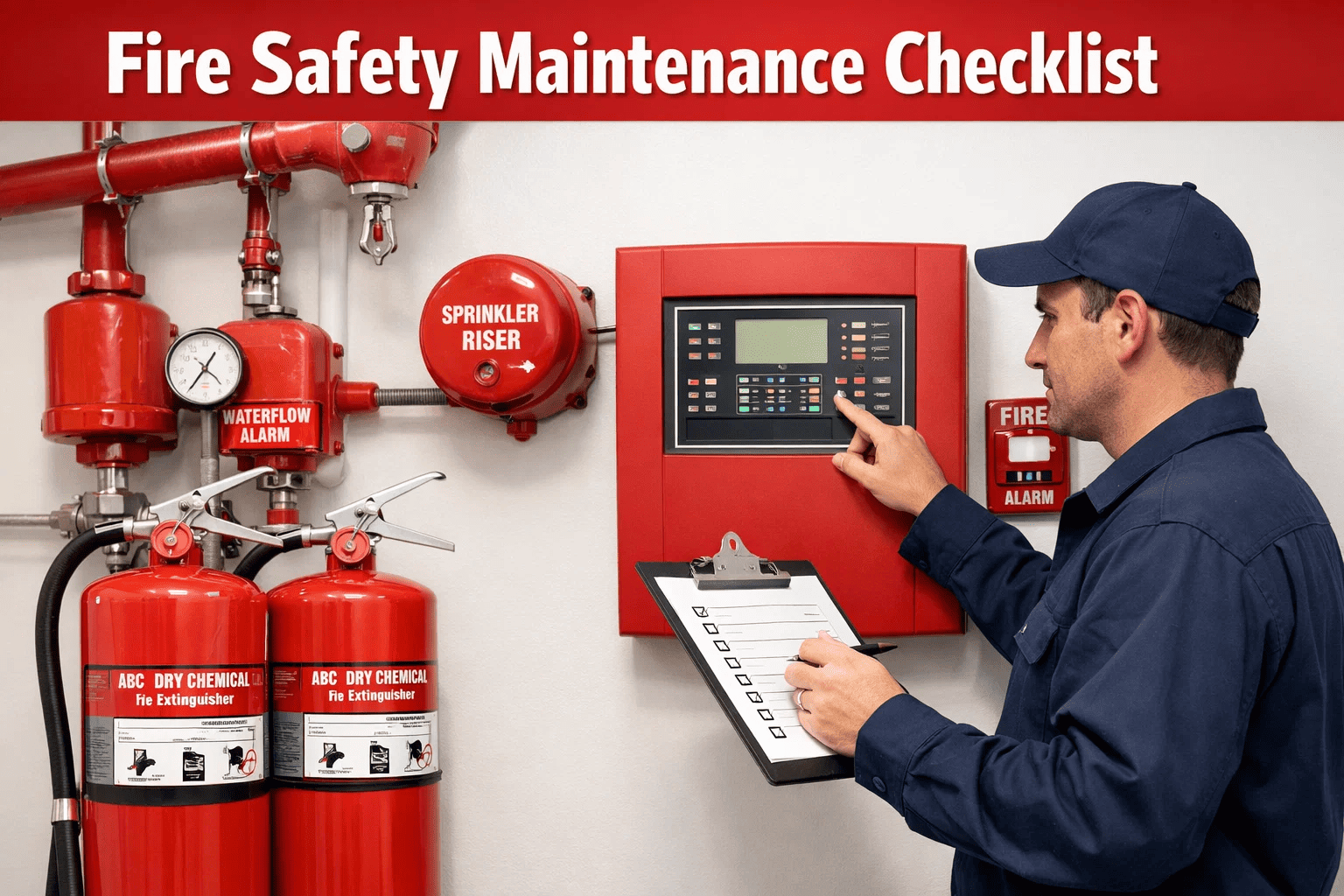
Sprinkler heads unobstructed and in good condition, fire alarm devices working, extinguishers certified and in place, fire doors self-closing with intact smoke gaskets.
Electrical & Mechanical
Panels labeled and accessible, no exposed or frayed wiring, GFCI protection where required, boiler and HVAC rooms clear, no combustible storage near equipment.
Common Areas & Storage
Laundry rooms, basements, and bonus rooms free of trash and combustibles; no bikes or furniture blocking egress; dryer vents clean; no LP tanks or flammable liquids stored improperly.
Dwelling Units
Working smoke and CO detectors mounted correctly, egress windows in sleeping areas unobstructed, no altered or disabled life-safety devices. Remember: a tenant-created deficiency is still the owner's violation — which is why unit-level tracking matters as much as common areas.
Fire & Life-Safety Systems · The Highest-Liability Checks
Within those zones, a handful of systems carry the most weight in an inspection — and the most liability if they fail. These are the checks that must be documented, dated, and defensible.
01
Smoke & CO Detectors
Test operation, confirm correct mounting near sleeping areas, verify devices are free of paint and damage, and log batteries replaced yearly, units every ten years.
02
Sprinkler System
Heads unobstructed with adequate clearance, no storage crowding, no corrosion or damage. Systems inspected, tested, and maintained at least annually per code.
03
Fire Extinguishers
Present in required locations, current certification tag, correct type and charge, mounted and accessible, not blocked or removed from their station.
04
Fire Doors & Rated Assemblies
Self-closing operation verified, smoke gaskets intact, no wall or ceiling penetrations, fire caulking sound. Rated corridors and separations maintained.
05
Exit Signage & Emergency Lighting
Illuminated exit signs at every required point, emergency lighting operational on test, egress paths marked and continuous to a safe exit.
06
Fire Department Access
Fire lanes clear and marked, hydrants accessible, address visible, no vehicles or storage blocking access. Owner-maintained and enforced with tenants.
Turn This Checklist Into a Live Program in 30 Minutes
Working session with our team — bring your property list and inspection cadence. We'll show how OxMaint auto-generates inspection work orders, enforces mandatory fields and photo capture, links records to assets, and builds the audit trail regulators expect.
Finding a hazard is only half the job. What separates a defensible program from a stack of paper is the loop from finding to fix — documented at every step. This is the flow an auditor follows.
1
Inspect & Document. Complete the zone walkthrough with a pass/fail on every item and a photo of any deficiency, timestamped and tied to the location.
2
Classify the Finding. Sort each deficiency by severity — immediate hazard, scheduled repair, or pass — so the urgent ones get acted on today, not next cycle.
3
Assign & Track. Each finding becomes a work order with an owner and a deadline. Nothing closes the inspection until the corrective action is assigned.
4
Verify & Log. Confirm the fix with a follow-up photo and e-signature. The closed-loop record is the evidence that proves the deficiency was resolved.
Paper Walkthrough vs Digital Program
A clipboard captures a checkmark. It can't prove the inspection happened, when, by whom, or that the hazard was actually fixed. When the fire marshal arrives — or a claim does — that gap is the whole case.
Paper Walkthrough
Scheduling by memory — easily missed
A checkmark, no proof of condition
Signature that can't be verified
Findings depend on someone following up
A binder someone has to locate
Digital Program
Auto-generated work orders on the right interval
Mandatory photo capture on every item
Timestamped e-signature tied to the inspector
Findings become tracked work orders with deadlines
Full history per asset, retrievable in seconds
How OxMaint Runs the Apartment Safety Program
OxMaint operationalizes safety compliance — inspection records linked to assets, mandatory safety checks, photo evidence, e-signatures, and an audit trail that satisfies regulators without a scramble the week before the audit.
Schedule
Auto-Generated Inspections
Annual, quarterly, and turnover inspections fire as work orders per building and asset — no missed cadence, no reliance on memory.
Mobile
Execution With Photo Proof
Technicians complete walkthroughs on mobile with mandatory fields and photo capture on every item — consistent evidence across every property.
Sign-Off
Timestamped E-Signatures
Every completed inspection carries a timestamped e-signature tied to the inspector — accountability that holds up under regulatory review.
Escalate
Findings Become Work Orders
A flagged hazard auto-generates a tracked corrective-action work order with an owner and deadline — the closed loop auditors look for.
Assets
Records Linked to Equipment
Detectors, sprinklers, extinguishers, and fire doors tracked as assets with full inspection history — the owner-responsibility record made defensible.
Scale
One Building or a Whole Portfolio
Manage a single property or a multi-building portfolio from one dashboard — standardized safety inspections across every location.
Be Audit-Ready Every Day, Not Just Inspection Week
Stop scrambling before the fire marshal arrives. See how OxMaint schedules inspections, enforces photo capture and e-signatures, tracks corrective actions to closure, and keeps a defensible audit trail per asset. Free forever plan available.
How often must an apartment building be safety inspected?
Most jurisdictions mandate an annual fire and life-safety inspection for multi-family residential buildings of three or more units, typically performed by the local fire authority and often unannounced. Beyond that legal minimum, many systems have their own cadence — sprinkler systems are inspected, tested, and maintained at least annually, and smart property managers run their own quarterly or turnover walkthroughs between official inspections. Exact requirements vary by state and locality, so confirm your building's obligations with your local fire department and authority having jurisdiction. Book a review of your inspection schedule.
Who is responsible when a tenant disables a safety device?
The building owner. This is the single most important principle in apartment fire-code enforcement and the biggest difference from commercial inspections: the owner must maintain all fire and life-safety devices in working condition throughout the building, and a tenant who removes a smoke-alarm battery or disconnects a CO detector does not shift liability to themselves. The owner receives the violation and pays the fine. That's exactly why a program needs to track devices at the unit level, not just in common areas — and document every check, so the owner can demonstrate ongoing diligence.
Which fire hazards are most commonly overlooked?
The recurring ones are blocked egress in stairwells and corridors (bikes, furniture, storage), dryer vents packed with lint, fire doors propped open or with damaged smoke gaskets, storage crowding sprinkler heads, wall and ceiling penetrations that defeat fire separations, missing or expired extinguisher certifications, and disabled or painted-over detectors. Improperly stored flammables and LP tanks near the building are also frequent findings. Most are cheap to fix and catastrophic to miss — which is why a structured, documented walkthrough beats an informal look-around.
What standards govern apartment safety inspections?
The two most influential are the NFPA Life Safety Code (NFPA 101), which sets minimum requirements for building design, fire detection, and emergency exits, and the International Fire Code (IFC), adopted by many cities as their fire-prevention baseline. On top of those, states and municipalities layer their own fire and building codes, and OSHA general-industry standards apply to the work environment for maintenance staff. Because the exact mix varies by location, the practical approach is to build your checklist to the strictest applicable standard and document to it consistently. Sign up free to standardize your checklist.
Can OxMaint manage safety inspections across multiple properties?
Yes. OxMaint auto-generates inspection work orders per building and asset, supports mobile execution with mandatory fields and photo capture, records timestamped e-signatures, converts flagged hazards into tracked corrective-action work orders with owners and deadlines, and links every record to the relevant asset — detectors, sprinklers, extinguishers, fire doors. Whether you manage one building or a multi-property portfolio, inspections stay standardized and every record is retrievable in seconds for a fire-marshal visit or audit. A free forever plan is available to trial the full workflow.
By William Jerry
✨
Experience Oxmaint's Power
Take a personalized tour with our product expert to see how OXmaint can help you streamline your maintenance operations and minimize downtime.