Deloitte projects a shortage of 2.1 million skilled manufacturing workers by 2030 in the US alone. Meanwhile, 84% of equipment failures are self-induced — caused by careless work habits, improper or no training, and human error. The maintenance skills gap is not a future problem. It is a 2026 operational crisis that shows up every day as unplanned downtime, first-article failures, and rising contractor spend. Baby Boomer retirement is accelerating institutional knowledge loss while Gen Z hiring pipelines run 3 to 5 years behind demand. The facilities winning in 2026 are not waiting for the hiring market to fix this — they are building structured training programs that turn what their best technicians know into a scalable, transferable system that survives retirement. Start building your training program on Oxmaint or book a demo to see digital SOPs and certification tracking in action.
Workforce and Training · Skills Development 2026
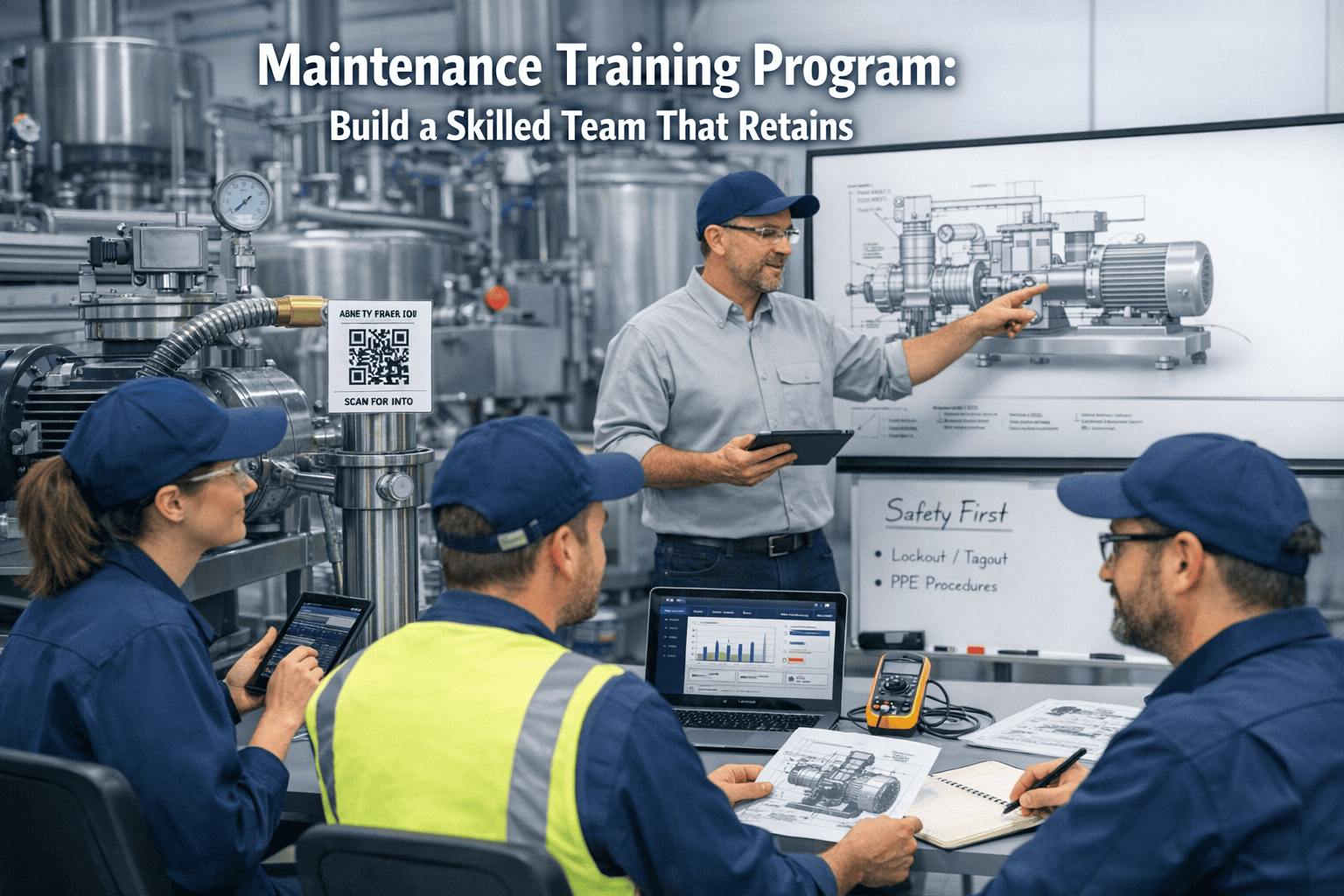
Maintenance Training Program: Build a Skilled Team That Retains
Create a maintenance training program that improves technician skills, digital adoption, and safety awareness using CMMS-based certification tracking and workforce development strategies.
skilled manufacturing jobs projected to go unfilled by 2030 — maintenance technicians at the heart of the shortage
84%
of equipment failures are self-induced due to careless work habits, improper training, or human error
500K
manufacturing jobs unfilled through 2030 per US Bureau of Labor Statistics projections
70%
of skilled maintenance technicians at or nearing retirement age in most industrial organizations
Why Maintenance Training Programs Matter Now
A company's greatest asset is its workforce. Maintenance departments are struggling to find skilled workers to keep facilities running safely and efficiently. With industrial technology evolving rapidly — CNC, robotics, automation, IoT — existing workers need constant training and retraining. The conventional approach of apprenticeships, classroom training, and shadowing experienced technicians was built for a world where knowledge transfer happened over decades and equipment complexity changed slowly. Neither condition exists in 2026. Firms can no longer rely on the job market alone. Structured training programs are the solution to upskill existing workers and quickly onboard new hires. Plants that invest in digital training tools and clear career progression paths see measurably better retention — because skilled workers stay where they feel competent and supported. Try Oxmaint free and start capturing institutional knowledge from day one.
Components of an Effective Training Program
Technical Skills Training
Mechanical, electrical, hydraulic, pneumatic, and PLC troubleshooting. Equipment-specific diagnostics, vibration analysis, thermography, and oil analysis. Role-specific curriculum from entry-level to advanced.
Digital Tools Adoption
CMMS navigation, mobile work order management, digital inspection completion, QR code scanning, IoT dashboard interpretation, and data-driven decision making. Critical for younger hires and digital transformation.
Safety and Compliance
OSHA standards, lockout-tagout procedures, confined space entry, electrical safety, PPE usage, and hazard recognition. Regulatory compliance training with documented completion records for audit readiness.
Knowledge Transfer
Structured SOP creation, mentorship programs, one-point lessons, and digital capture of institutional knowledge from experienced technicians before retirement. The most time-sensitive component of any program.
Skills Assessment
Baseline competency testing, skills gap analysis by role and department, proficiency tracking over time, and CMRT certification preparation. Data-driven identification of where training investment delivers the highest return.
Career Progression
Clear advancement pathways from entry-level to senior technician to supervisor. Pay-for-progression levels tied to demonstrated competencies. The strongest retention lever available to maintenance organizations.
Traditional Training vs. Technology-Driven Approach
Tribal knowledge stored in one veteran technician's head
Apprenticeship takes 3 to 5 years to produce a competent technician
Training records in spreadsheets — certifications expire unnoticed
New hire onboarding is sink-or-swim with minimal documentation
Skills assessment based on supervisor opinion, not measured data
vs
Technology-Driven Training
Digital SOPs and one-point lessons available at the machine when needed
CMMS captures diagnostic steps and resolution notes from every work order
Structured onboarding with digital modules reduces time-to-competency by 40%
CMMS tracks certifications with automated renewal alerts 60 days before expiry
Step-by-step digital work instructions guide new hires through every procedure
Skills matrices tracked digitally with proficiency levels measured over time
Capture institutional knowledge before your best technicians retire
Oxmaint automatically records diagnostic steps and resolution notes from every work order — building a knowledge base without extra effort from your team.
Store digital standard operating procedures, one-point lessons, and equipment manuals in a centralized library accessible from any mobile device at the point of work.
Certification Tracking
Track technician certifications, licenses, and safety training completion with automated renewal alerts. Ensure no technician works on equipment they are not qualified for.
Automatic Knowledge Capture
When technicians complete work orders, their diagnostic steps, resolution notes, and parts decisions are automatically recorded and tied to the specific asset — building a rich knowledge base passively.
Multi-Site Knowledge Consistency
Centralized SOP library ensures a technician transferred between sites operates from the same knowledge base. Best practices discovered at Site A propagate to all other sites automatically.
Digital Work Instructions
Attach step-by-step instructions with photos and video to work order templates. New hires complete maintenance tasks with guided procedures — reducing errors and accelerating learning.
Technician Performance Analytics
Track work order completion rates, first-time fix rates, and task duration by technician. Identify where additional training is needed and measure improvement over time.
Training Investment Impact
40%
faster time-to-competency for new hires using digital SOPs vs. traditional shadowing alone
25%
higher technician retention at facilities with structured career progression and training programs
3-6 mo
to build a comprehensive knowledge base from work order history with zero extra effort from technicians
$340K
first-year benefits from CMMS implementation including reduced contractor costs and improved uptime
Stop Losing Knowledge. Start Building a Workforce That Stays.
Oxmaint captures institutional knowledge from every work order, tracks certifications and training compliance, and provides digital SOPs at the point of work — so your team is always qualified, always confident, and always improving.
How do I build a maintenance training program from scratch?
Start with a skills gap assessment to identify where your team's biggest knowledge gaps exist. Then prioritize training by impact — safety and compliance first, then equipment-specific technical skills, then digital tools. Use your CMMS to capture knowledge passively from work orders while building formal SOP documents in parallel. Most organizations see measurable improvement within 90 days of structured program execution.
How does a CMMS help with maintenance training?
A CMMS supports training in three ways: it captures knowledge automatically from completed work orders (diagnostic steps, resolution notes, parts used), it tracks certifications and training compliance with automated renewal alerts, and it delivers digital SOPs and work instructions at the point of work. Together, these features reduce dependency on any single expert and make every new hire productive faster.
What is the biggest risk of not having a maintenance training program?
The biggest immediate risk is institutional knowledge loss when experienced technicians retire. When a 28-year maintenance veteran leaves, decades of diagnostic intuition and equipment-specific workarounds walk out the door. The second risk is safety — untrained technicians cause 84% of self-induced failures, which include safety incidents. The third risk is retention — skilled workers leave organizations that do not invest in their development.
How does Oxmaint capture institutional knowledge from experienced technicians?
The most effective approach is embedding knowledge capture into normal daily workflow. When experienced technicians complete work orders in Oxmaint, their diagnostic steps, resolution notes, and parts decisions are automatically recorded and tied to the specific asset. Over 3 to 6 months of active use, this creates a rich knowledge base without any extra effort from your team.
By Lewis Abbott
✨
Experience Oxmaint's Power
Take a personalized tour with our product expert to see how OXmaint can help you streamline your maintenance operations and minimize downtime.