Your MRO inventory accounts for 40–50% of your total maintenance budget, yet 15–25% of it sits obsolete on shelves while critical parts run out during emergency repairs. This paradox — storerooms overflowing with parts you don't need while missing the ones you do — costs manufacturing and industrial facilities millions annually in both tied-up capital and unplanned downtime. The root cause is not insufficient inventory; it's insufficient intelligence. Without a CMMS linking spare parts to equipment criticality, consumption patterns, and PM schedules, maintenance teams operate blind — reordering by gut feel, overstocking low-value consumables, and discovering stockouts only when a production line stops. Start a free trial to implement intelligent spare parts management in OxMaint — ABC-VED criticality matrices, automatic reorder triggers, and AI-driven demand forecasting — or book a demo to see how your facility can eliminate stockouts while reducing inventory carrying costs by 23%.
Maintenance Management / Inventory Control
Spare Parts Management in CMMS: Stop Stockouts Without Overstocking
ABC-VED criticality analysis, intelligent reorder automation, AI demand forecasting, and consumption-based planning — the complete framework for optimizing MRO inventory and eliminating the paradox of simultaneous stockouts and overstocking.
40-50%
of maintenance budget
MRO spare parts inventory represents 40–50% of total maintenance spend in manufacturing environments — making optimization a direct path to budget relief
20-30%
annual carrying cost
Holding spare parts costs 20–30% of inventory value annually in warehousing, obsolescence, and opportunity cost — $500K inventory = $100-150K yearly expense
15-25%
inventory is obsolete
Industry data shows 15–25% of MRO inventory at most facilities is obsolete or surplus — capital sitting idle on shelves tied to retired equipment
23%
inventory reduction
Facilities using risk-based spare parts strategies achieve 98% service levels while holding 23% less inventory through criticality-driven stocking policies
Implement Intelligent Spare Parts Management in OxMaint Today
ABC-VED criticality classification, automatic min-max calculations from consumption history, reorder alerts tied to lead times, and AI-powered demand forecasting based on PM schedules — all integrated with your equipment records and work order system.
The Spare Parts Paradox — Overstocked and Out of Stock Simultaneously
Walk into any industrial maintenance storeroom and you will see the same contradiction: shelves overflowing with parts that never move, while technicians wait days for critical components that should have been in stock. This is not a storage problem or a procurement problem — it is an intelligence problem. Without a system that links parts to equipment criticality, consumption patterns, and maintenance schedules, facilities guess at what to stock and how much to hold. The result is predictable: low-value consumables accumulate in excess while high-criticality components stock out during failures. Start a free trial to connect spare parts inventory to equipment records, PM schedules, and failure history in OxMaint.
Stockouts During Critical Failures
A production line stops. The failure is diagnosed. The part needed is a $400 bearing with 6-week lead time — and zero in stock. Emergency air freight costs $1,200. Downtime costs $8,000 per hour. The part was never flagged as critical because no system linked it to equipment impact.
Overstocking Low-Value Items
Consumables like filters, fasteners, and lubricants accumulate to 18-month supply levels because reordering is easier than auditing. These C-class parts represent 60% of SKUs but only 8% of inventory value — yet consume 40% of warehouse space and handling effort.
Obsolete Inventory from Retired Assets
Equipment is replaced or decommissioned. Parts specific to that asset remain in inventory indefinitely because no automated link exists between equipment lifecycle and parts obsolescence. Capital stays trapped on shelves — inaccessible until a physical audit forces disposition.
No Visibility Into True Criticality
Maintenance teams know which equipment is critical, but parts are managed separately by purchasing. A bearing for a critical compressor receives the same stocking priority as a bearing for a non-essential pump — because the inventory system has no equipment context.
What Effective Spare Parts Management in CMMS Actually Delivers
Spare parts management is not inventory management borrowed from retail or warehousing. It is a maintenance discipline built on equipment knowledge — which parts fail, on which assets, with what frequency, and with what operational consequence. A CMMS transforms parts management from a purchasing function into a predictive maintenance capability. Book a demo to see equipment-centric spare parts management in OxMaint configured for your facility's asset profile.
Equipment-Linked
Parts Tied to Asset Bill of Materials
Every spare part in the CMMS links to the specific equipment it serves. When a pump fails, technicians see which parts are in stock for that exact model — no guesswork, no wrong part orders. When equipment is retired, all associated parts are flagged for obsolescence review automatically.
Criticality-Driven
ABC-VED Risk Matrix Stocking
Parts inherit criticality from their parent equipment. A bearing on a blast furnace blower (critical asset, high downtime cost) gets Vital classification and insurance stocking. The same bearing on a non-essential conveyor gets Desirable classification and on-demand ordering. Stocking policy follows risk, not part number.
Consumption-Based
Forecasting from PM and Failure History
The CMMS tracks every part consumed against the work order and equipment that required it. PM schedules predict future consumption. Failure history identifies high-wear components. Reorder points calculate from actual usage patterns — not vendor minimums or guesswork from three years ago.
Automated
Reorder Alerts with Lead Time Intelligence
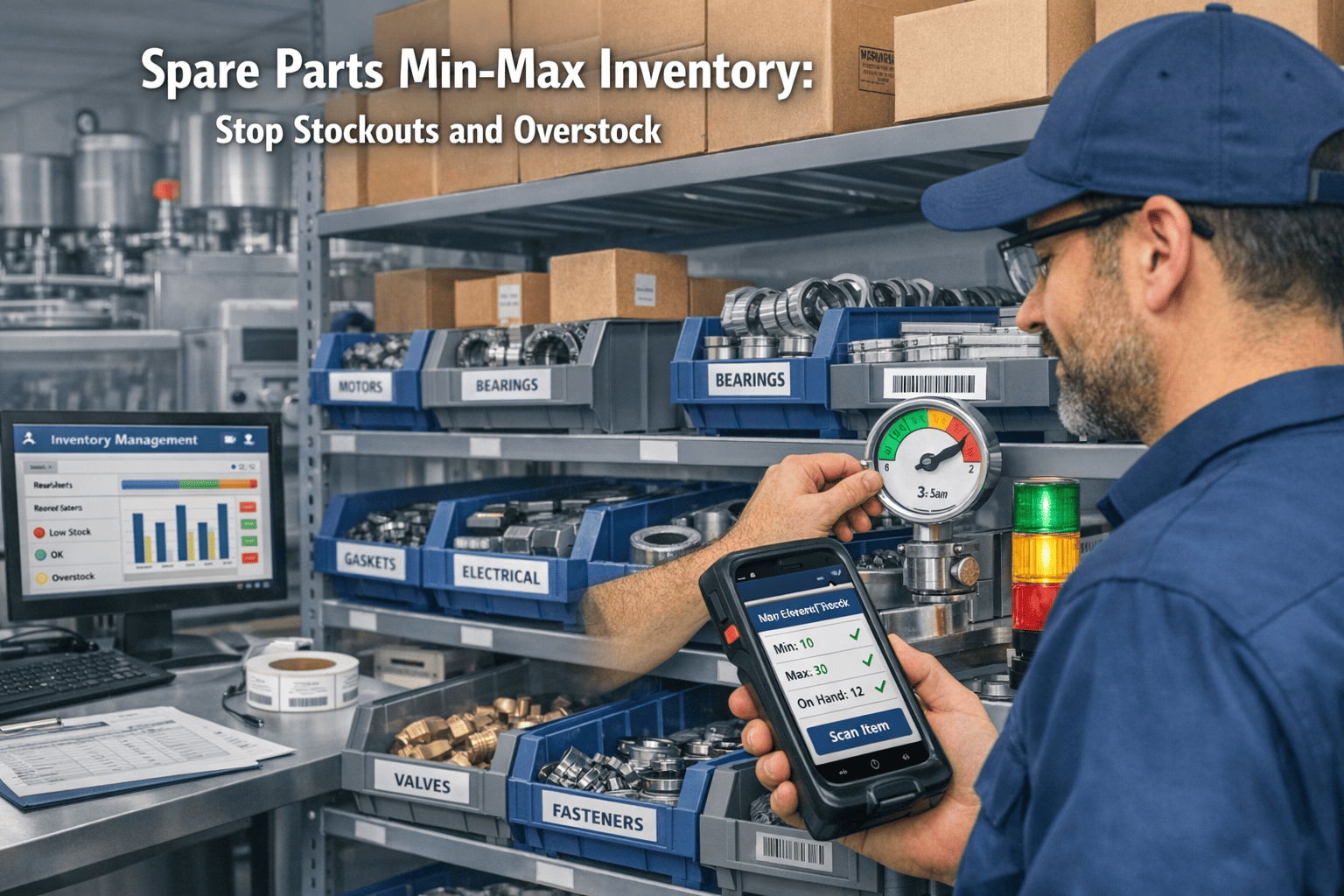
Reorder points factor both consumption rate and vendor lead time. A part with 8-week delivery and monthly consumption triggers reorder at 10-unit threshold. A part with 2-day delivery and the same consumption triggers at 3 units. The system prevents both premature reordering and stockouts.
Cost-Optimized
Carrying Cost Reduction Through Smart Policy
High-criticality parts get safety stock buffers. Low-criticality parts order on-demand. The CMMS calculates optimal stock levels per risk tier — eliminating both excessive inventory for non-critical items and insufficient stock for critical failures. The result is lower total carrying cost at higher service levels.
Audit-Ready
Full Traceability from Receipt to Consumption
Every part movement is logged: received from which vendor, issued to which work order, consumed on which equipment, by which technician. Financial reconciliation is instant. Obsolescence audits run on-demand. No spreadsheet reconciliation required — the CMMS is the single source of truth. Start a free trial to implement audit-ready spare parts tracking in OxMaint.
ABC-VED Criticality Analysis — The Foundation of Intelligent Stocking
Not all spare parts are equal. A $12 O-ring and a $12,000 gearbox both appear in inventory as single line items, but they require fundamentally different stocking strategies. ABC-VED analysis is the framework that prevents treating all parts identically. ABC classifies parts by financial consumption value. VED classifies parts by operational criticality — the consequence if unavailable. Combining them creates a risk matrix that assigns the right stocking policy to each part. Facilities using this approach achieve 98% parts availability while reducing inventory investment by 23%. Book a demo to see ABC-VED automated classification in OxMaint.
ABC
Financial Value Classification
ABC analysis segments spare parts by annual consumption value — unit cost multiplied by annual usage. The Pareto principle applies: 10–20% of parts account for 70–80% of inventory value.
A-Class
10-20% of SKUs
High-value parts representing 70–80% of total inventory spend. Require tight control, accurate forecasting, and frequent review. Examples: main drive motors, control systems, high-precision bearings.
B-Class
20-30% of SKUs
Moderate-value parts representing 15–25% of spend. Standard reorder point management with quarterly review. Examples: pumps, sensors, mid-range electrical components.
C-Class
50-70% of SKUs
Low-cost consumables representing 5–10% of spend but 60% of line items. Bulk ordering, minimal tracking effort. Examples: filters, fasteners, lubricants, gaskets.
VED
Operational Criticality Classification
VED analysis categorizes parts by operational consequence if unavailable — independent of cost. A $50 seal on a critical reactor is Vital. A $5,000 motor on a non-essential pump is Desirable.
Vital
immediate stoppage
Parts whose absence halts production or creates safety risk. Unavailability costs exceed part value within hours. Require safety stock and insurance inventory regardless of cost. Examples: blast furnace tuyeres, autoclave seals, control module replacements.
Essential
temporary disruption
Parts causing operational delays or workarounds but not immediate shutdown. Unavailability extends downtime from hours to days. Stock based on lead time and failure frequency. Examples: conveyor belts, secondary pumps, HVAC components.
Desirable
minimal impact
Parts with negligible production impact if unavailable. Can be ordered on-demand or sourced locally. No safety stock required. Examples: paint, signage, low-priority lighting, aesthetic components.
ABC-VED Combined Risk Matrix
ABC / VED
Vital (V)
Essential (E)
Desirable (D)
A (High-Value)
AV: Insurance Stock
100% service level, safety stock regardless of cost, expedited procurement
AE: Tight Control
Min-max with lead time buffer, monthly review, vendor performance tracking
AD: Standard Reorder
Economic order quantity, quarterly review, standard lead time
B (Mid-Value)
BV: Priority Stock
Safety stock buffer, reorder point with expedite option, bimonthly review
BE: Standard Stock
Min-max management, automatic reorder alerts, quarterly audit
BD: Low Priority
Reorder on consumption, annual review, consolidate with other orders
C (Low-Value)
CV: Bulk Stock
Large buffer despite low cost, avoid stockout risk on critical equipment
CD: On-Demand
Order as needed, no stocking, source locally when required
OxMaint automates this matrix: equipment criticality assigns VED classification to all linked parts, consumption history calculates ABC class, and the system applies the appropriate stocking policy automatically. Start a free trial to implement automated ABC-VED classification in your facility.
Intelligent Reorder Points — Preventing Stockouts Without Excess Inventory
A reorder point is not an arbitrary threshold. It is a calculated value that balances consumption rate, vendor lead time, and acceptable risk of stockout. Set it too high and you carry excess inventory. Set it too low and you stock out before replenishment arrives. The formula is straightforward — but only if your CMMS tracks the inputs accurately. Most facilities set reorder points once during system setup and never revisit them, even as consumption patterns change. Book a demo to see dynamic reorder point calculation in OxMaint based on live consumption data.
Reorder Point Calculation
Reorder Point = (Average Daily Usage × Lead Time in Days) + Safety Stock
Average Daily Usage
Calculated from consumption history in CMMS work orders. A bearing consumed 24 times in the past year = 24 ÷ 365 = 0.066 per day. This value updates quarterly as new consumption data accumulates.
Lead Time in Days
Vendor delivery performance tracked in CMMS purchase orders. If a part consistently arrives in 21 days despite vendor's quoted 14-day lead time, use actual 21 days in the calculation — not the promise.
Safety Stock
Buffer against variability in both demand and delivery. For critical parts with high downtime cost, set safety stock at 1.5–2× normal lead time consumption. For non-critical parts with short lead times, safety stock can be zero.
Example: Critical Pump Bearing
Annual consumption:18 units
Daily usage:18 ÷ 365 = 0.049
Vendor lead time:28 days
Lead time consumption:0.049 × 28 = 1.4 units
Safety stock (critical):2 units
Reorder point:1.4 + 2 = 4 units
When stock drops to 4 units, the CMMS generates a purchase requisition automatically. Reorder arrives before stock reaches zero — even if consumption spikes or delivery delays occur.
AI-Powered Demand Forecasting — From Historical Consumption to Predictive Planning
Traditional reorder points assume constant consumption. Reality is more complex: PM schedules create known future demand, seasonal production drives consumption variability, and equipment age affects failure frequency. AI-driven forecasting in modern CMMS platforms incorporates all three signals — historical usage, scheduled maintenance, and predictive analytics — to forecast demand with 40% greater accuracy than static calculations. The result is fewer emergency orders and lower safety stock requirements. Start a free trial to enable AI demand forecasting in OxMaint linked to your PM schedule and equipment condition data.
Historical Consumption Pattern Analysis
AI models analyze multi-year consumption history to identify seasonal patterns, trending increases from equipment aging, and anomalies from one-time events. A filter consumed 120 times last year but 140 this year suggests equipment degradation — forecast adjusts upward for next year.
Preventive Maintenance Schedule Integration
PM tasks scheduled in the CMMS create known future demand. An annual overhaul scheduled for Q2 requires 14 specific parts. The forecast model reserves those parts in advance and excludes them from normal reorder calculations — preventing double-ordering and stockouts simultaneously.
Equipment Condition-Based Prediction
CMMS platforms with IoT integration track equipment run hours, cycle counts, and condition indicators. When a compressor approaches its service interval, the system flags associated consumables for reorder before the PM task is scheduled — bridging the gap between reactive and predictive parts planning.
Multi-Site Demand Aggregation
Facilities with multiple sites using identical equipment pool demand forecasts. Instead of each site carrying safety stock independently, the CMMS identifies opportunities for centralized stocking and inter-site transfers — reducing total inventory while maintaining local availability.
Reactive Parts Management vs CMMS-Driven Parts Optimization
Reactive Spreadsheet Approach
Stocking Decisions
Parts ordered based on vendor minimums, past emergency purchases, or technician requests. No link to equipment criticality or consumption history. Every part treated equally regardless of risk.
Reorder Triggers
Physical bin checks or spreadsheet tracking with manual updates. Reorder points set once during setup, never revised. No lead time intelligence — parts reorder at same threshold regardless of delivery time.
Obsolescence Management
Equipment is retired but parts remain in inventory until someone manually notices during physical audit. No automated link between asset lifecycle and parts disposition. Capital stays trapped indefinitely.
Consumption Tracking
Parts issued from storeroom with paper logs or honor system. No visibility into which equipment consumed which parts, or whether usage is increasing. Historical data is fragmented or missing entirely.
Cost Visibility
Total inventory value known from accounting system. Cost per equipment asset, cost per work order, and cost trends over time require manual spreadsheet analysis — rarely performed due to effort required.
CMMS-Optimized Spare Parts Management
Stocking Decisions
ABC-VED matrix assigns policy per part based on value and equipment criticality. Vital parts on critical assets get insurance stock. Desirable parts on non-critical assets order on-demand. Stocking follows risk, not guesswork. Book a demo to see risk-based stocking in action.
Reorder Triggers
Automatic reorder alerts when stock drops below calculated threshold. Reorder point factors consumption rate, vendor lead time, and safety stock per criticality tier. System updates thresholds quarterly based on actual usage — no manual revision required.
Obsolescence Management
When equipment status changes to "retired" in CMMS, all linked parts are flagged for obsolescence review automatically. System identifies parts with zero consumption in past 18 months and generates disposition report — return to vendor, sell as surplus, or scrap.
Consumption Tracking
Every part issued is logged against work order and equipment asset. CMMS tracks who consumed the part, when, on which equipment, and whether it was planned PM or reactive failure. Consumption trends identify high-wear components requiring design review.
Cost Visibility
Instant cost reporting per equipment, per work order, per technician, and per department. Identify which assets consume most parts value. Track cost trends month-over-month. Allocate maintenance budget by equipment criticality with full cost justification. Start a free trial to access real-time parts cost analytics in OxMaint.
Measurable Results from CMMS Spare Parts Optimization
23%
Inventory Reduction
Facilities implementing risk-based ABC-VED stocking policies reduce total inventory value by 23% while maintaining 98% parts availability through targeted safety stock on critical items only.
40%
Demand Forecast Accuracy
AI-driven forecasting incorporating PM schedules, consumption history, and equipment condition data achieves 40% greater accuracy than static reorder points — reducing both stockouts and excess inventory.
30%
Maintenance Cost Reduction
Manufacturing facilities using CMMS-integrated parts management report up to 30% reduction in total maintenance costs through elimination of emergency expedited shipping and optimized bulk purchasing.
67%
Faster Parts Retrieval
Technicians equipped with mobile CMMS access reduce average parts retrieval time from 12 minutes to 4 minutes through bin location tracking, barcode scanning, and instant visibility into stock availability.
Stop Overstocking Low-Priority Parts While Running Out of Critical Ones
OxMaint delivers intelligent spare parts management built on equipment knowledge — ABC-VED criticality matrices, automatic reorder point calculation from consumption data, AI demand forecasting from PM schedules, and full cost traceability from receipt to work order. Eliminate the parts paradox.
What OxMaint Delivers for MRO Inventory Management
Equipment-Linked
Parts Bill of Materials per Asset
Every equipment asset has a linked BOM showing all associated spare parts, consumables, and service kits. When equipment is retired, all parts are flagged for obsolescence review. When a failure occurs, technicians see exactly which parts fit that asset model — no wrong orders.
ABC-VED
Automated Criticality Classification
OxMaint calculates ABC class from consumption value and assigns VED class from parent equipment criticality. The system applies stocking policy automatically per risk tier — insurance stock for AV parts, on-demand ordering for CD parts. Start a free trial to enable automated criticality classification.
Reorder Automation
Dynamic Min-Max with Lead Time Intelligence
Reorder points calculate from consumption history, vendor lead time performance, and safety stock per criticality tier. When stock drops below threshold, purchase requisitions generate automatically. System recalculates thresholds quarterly as usage patterns evolve.
AI Forecasting
Predictive Demand from PM Schedules
AI models forecast parts demand from scheduled PM tasks, historical consumption trends, and equipment run hours. Annual overhaul in Q2 reserves required parts in advance. Aging equipment with increasing filter consumption adjusts forecast upward automatically. Book a demo to see AI forecasting in action.
Mobile Access
Barcode Scanning and Bin Tracking
Technicians scan part barcodes from mobile devices to issue inventory, update stock levels, and log consumption against work orders in real time. Bin location tracking eliminates search time. Stock counts complete in minutes instead of hours.
Cost Analytics
Parts Cost Reporting per Equipment and Work Order
Instant visibility into parts cost per asset, per department, per month. Identify which equipment consumes most inventory value. Track cost trends to detect degrading assets requiring replacement. Allocate budget by equipment criticality with full justification. Start a free trial to access parts cost dashboards in OxMaint.
Frequently Asked Questions
What is ABC-VED analysis in spare parts management and why does it matter?
ABC analysis classifies parts by financial consumption value — A-items are high-value parts representing 70–80% of inventory spend but only 10–20% of SKUs. VED analysis classifies parts by operational criticality — Vital parts cause immediate production stoppage if unavailable, Essential parts cause delays, Desirable parts have minimal impact. Combining ABC and VED creates a risk matrix that assigns the right stocking policy to each part. A critical bearing on a blast furnace (AV category) gets insurance stock regardless of cost. The same bearing on a non-critical pump (AD category) orders on-demand. This approach achieves 98% parts availability while reducing total inventory by 23% through targeted stocking. Start a free trial to implement ABC-VED analysis in OxMaint with automated classification per equipment criticality.
How does a CMMS prevent spare parts stockouts without increasing inventory levels?
A CMMS calculates reorder points from actual consumption data, vendor lead time performance, and safety stock requirements per criticality tier — not guesswork. The formula is: Reorder Point = (Average Daily Usage × Lead Time) + Safety Stock. When stock drops below this threshold, automatic purchase requisitions generate before inventory reaches zero. Critical parts with long lead times get higher safety stock buffers. Non-critical parts with short lead times carry minimal buffer. The system recalculates thresholds quarterly as usage patterns change, preventing both premature reordering and stockouts. Facilities using dynamic reorder points achieve 98% parts availability while reducing inventory carrying costs by 20–30%. Book a demo to see intelligent reorder automation in OxMaint.
How does AI-powered demand forecasting improve spare parts planning compared to static reorder points?
Static reorder points assume constant consumption — but reality is more complex. PM schedules create known future demand. Seasonal production affects usage rates. Equipment aging increases failure frequency. AI-driven forecasting in modern CMMS platforms incorporates all three signals: historical consumption patterns over multiple years, scheduled maintenance tasks requiring specific parts, and equipment condition indicators predicting component wear. A compressor approaching service interval triggers reorder of associated consumables before the PM task is scheduled. Annual overhaul reserves required parts months in advance, preventing last-minute emergency orders. This approach achieves 40% greater forecast accuracy than static calculations, reducing both stockouts and excess safety stock requirements. Start a free trial to enable AI demand forecasting in OxMaint linked to your preventive maintenance schedule.
What percentage of MRO inventory is typically obsolete and how can a CMMS address this problem?
Industry data shows 15–25% of MRO spare parts inventory at most facilities is obsolete or surplus — parts tied to retired equipment or components with zero consumption in 12–24 months. This represents significant capital trapped on shelves. A CMMS addresses obsolescence through equipment lifecycle integration: when equipment status changes to "retired," all linked parts are flagged for disposition review automatically. The system identifies parts with zero consumption over defined periods and generates obsolescence reports showing candidate items for return to vendor, surplus sale, or disposal. Regular quarterly audits compare active equipment lists against parts inventory to catch obsolete items before they accumulate. This structured approach reclaims tied-up capital and frees warehouse space for critical spares. Book a demo to see automated obsolescence management in OxMaint.
By Lewis Abbott
✨
Experience Oxmaint's Power
Take a personalized tour with our product expert to see how OXmaint can help you streamline your maintenance operations and minimize downtime.