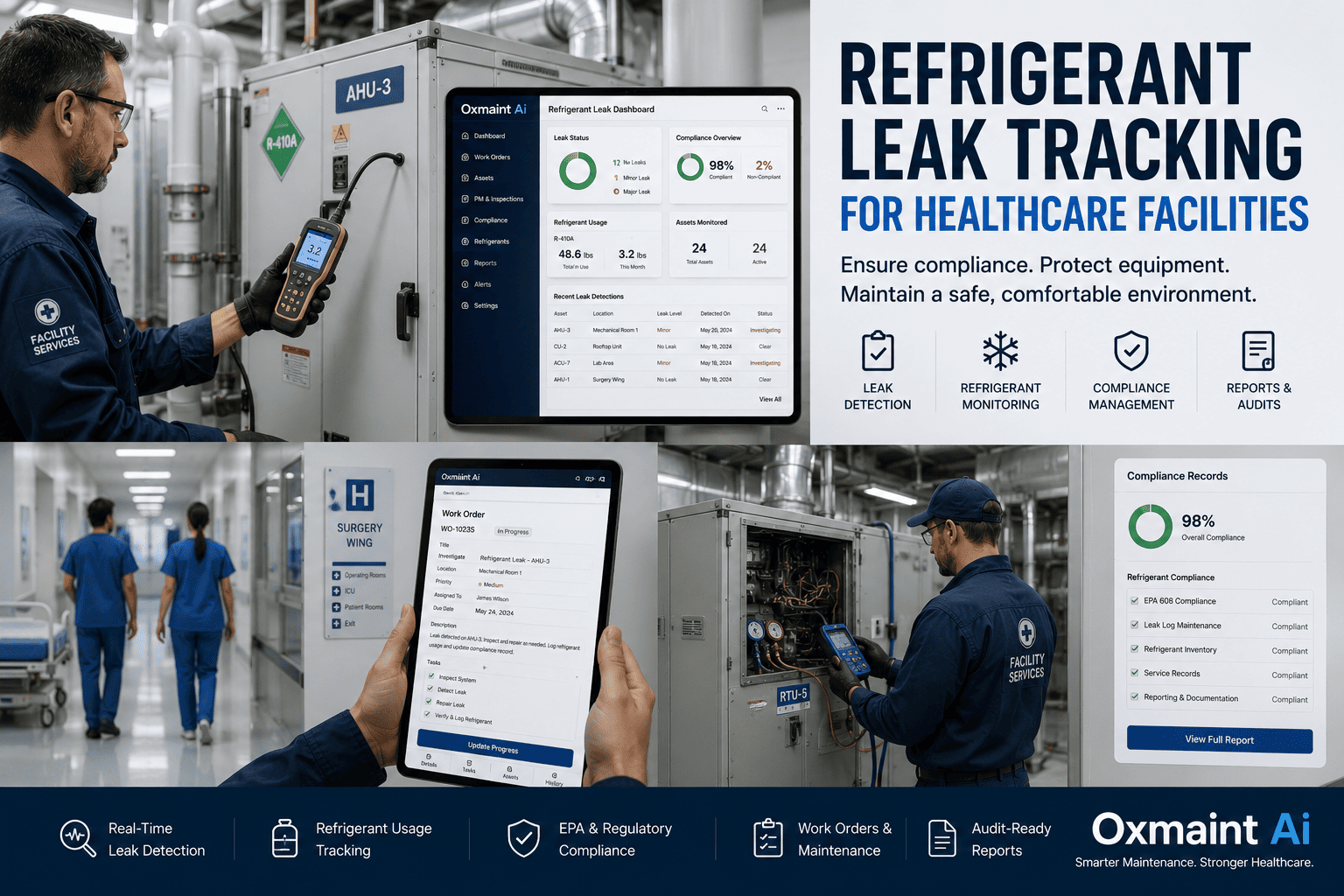
Hospital HVAC systems are unique in scale and complexity — chillers serving operating rooms, MRI cooling loops, isolation room pressure controls, kitchen and pharmacy refrigeration, and computer room cooling for the electronic health record infrastructure. Many of these systems still operate on legacy refrigerants regulated under the EPA Section 608 program and the AIM Act, and a single mismanaged leak can trigger five-figure fines, mandatory shutdowns of patient care areas, and Joint Commission findings. The compliance burden is not minor: every system with a charge over fifty pounds requires leak rate calculation, formal repair within thirty days of a leak above the regulatory threshold, and complete records retained for three years. Most hospital facilities teams know the rules, but their documentation lives in three places — the HVAC technician's notebook, a spreadsheet on a shared drive, and the refrigerant cylinder log in the boiler room. When the EPA auditor or Joint Commission surveyor asks for records, the team scrambles. Oxmaint consolidates refrigerant tracking into the facilities CMMS so leak events, repair records, and compliance reports live in one auditable system — start a free trial to map your refrigerant assets and build the compliance trail, or book a 30-minute demo to see the healthcare-specific workflow.
Stop scrambling for refrigerant records every audit cycle.
- EPA Section 608 leak rate tracking automated per system
- Repair workflow with 30-day deadline enforcement
- Joint Commission and accreditation reports on demand
Compliance Snapshot
Healthcare Refrigerant Compliance by the Numbers
50 lb
Charge threshold triggers EPA 608 tracking
40 CFR Part 82 Subpart F
30 days
Repair deadline after leak rate exceeded
EPA Section 608, commercial refrigeration 20%
$59,114
Maximum EPA civil penalty per violation per day
EPA 2024 inflation adjustment
3 years
Record retention requirement
EPA refrigerant management rule
Definition
What is Refrigerant Leak Tracking for Healthcare?
Refrigerant leak tracking is the structured process of recording every refrigerant addition, leak detection, repair action, and verification test on every HVAC and refrigeration system in a healthcare facility that contains regulated refrigerant — primarily systems with full charges above fifty pounds. The tracking program must capture refrigerant added per event, the calculated annualized leak rate per system, the date the rate was discovered to exceed the regulatory threshold, the repair actions taken, follow-up verification leak tests, and the disposition of any retired refrigerant.
For hospitals, this is not just an environmental compliance program. Joint Commission surveys, CMS conditions of participation, state department of health inspections, and grant funder oversight all touch on facility management discipline — and refrigerant records are often the easiest indicator surveyors use to assess how well the facilities team runs its overall maintenance program. Start a free trial to build a unified refrigerant register across your facility, or book a demo to walk through a hospital deployment.
Compliance Framework
The Six Elements of a Defensible Refrigerant Program
Element 01
System Inventory and Charge Records
Every applicable system identified with refrigerant type, full charge, location, and EPA compliance status.
Element 02
Leak Detection Records
Annual leak tests for systems over 50 lb charge, with date, technician, method, and results captured.
Element 03
Refrigerant Addition Log
Every pound added recorded against the system, with cylinder source, technician, and reason for addition.
Element 04
Annualized Leak Rate Calculation
Rolling 12-month leak rate calculated per system, alerting facilities when threshold approached.
Element 05
30-Day Repair Workflow
When a leak rate violation is found, repair work order opens with the 30-day deadline tracked to closeout.
Element 06
Verification and Follow-up Tests
Post-repair leak tests documented to verify the issue is resolved, completing the compliance loop.
A single mismanaged refrigerant leak at a hospital can trigger five-figure fines, mandatory operating room cooling shutdowns, and Joint Commission findings that follow the facility for years.
Signature Timeline
A Single Leak Event from Detection to Compliance Closure
D1
Day 1 — Detection
Refrigerant Addition Logged
Technician adds 28 lb of R-410A to OR chiller; entry captured in Oxmaint with cylinder source and labor time.
D1
Day 1 — Rate Check
Annualized Leak Rate Exceeds Threshold
System rolls past 20% commercial refrigeration threshold; system flagged, compliance clock starts.
D2
Day 2 — Work Order
Repair WO Auto-Generated
Work order opens with 30-day countdown, parts list pre-staged, EPA-certified tech assigned.
D8
Day 8 — Repair
Repair Completed
Leak source identified at evaporator coil joint; brazed, pressure tested, technician notes captured.
D15
Day 15 — Verification
Initial Verification Test Passes
Electronic leak detector confirms no detectable leak at repair site; record locked into compliance trail.
D30
Day 30 — Closeout
Follow-up Verification and Compliance Report
30-day follow-up leak test completes; compliance closeout documented; deadline cleared before expiration.
Operational Pain Points
Why Healthcare Facilities Fail Refrigerant Audits
Records Split Across Three Systems
HVAC technician notebook, facilities spreadsheet, and cylinder log in the boiler room — three sources that rarely reconcile when the surveyor asks for the full trail.
No Live Leak Rate Calculation
Leak rates calculated retroactively at audit time, when the team discovers a system has been in violation for months and the compliance clock has already expired.
30-Day Repair Deadline Missed
Once the leak rate is exceeded, the 30-day clock starts; without automated tracking, repairs slip past the deadline and the violation cascades into a federal enforcement matter.
Cylinder Inventory Walks Off
Refrigerant cylinders disappear from inventory without records; when EPA reconciliation requests come in, the team cannot account for pounds purchased versus pounds installed.
Joint Commission Findings on Documentation
Even when refrigerant compliance is acceptable, weak records produce documentation findings during accreditation surveys that hospital leadership has to respond to formally.
Verification Tests Forgotten
Initial and follow-up verification leak tests are required after a repair; without workflow enforcement, the verification step is the most commonly missed compliance item.
Hospitals running structured refrigerant tracking in Oxmaint pass EPA and Joint Commission documentation reviews without scramble — start a free trial to consolidate your refrigerant records, or book a demo to see the healthcare-specific workflow.
The Solution
How Oxmaint Builds the Refrigerant Compliance Trail
Asset-Level Refrigerant Tracking
Every HVAC and refrigeration system over 50 lb charge tagged with refrigerant type, full charge, EPA status, and history.
Mobile Refrigerant Addition Capture
Technicians log additions on mobile at the moment of work with cylinder source, weight, and reason captured.
Live Annualized Leak Rate
Rolling 12-month leak rate calculated per system with threshold alerts before a violation becomes a compliance event.
30-Day Repair Deadline Enforcement
When threshold is crossed, repair work order opens with countdown clock and escalation if deadline approaches without closeout.
Verification Workflow Built In
Initial and follow-up verification leak tests sequenced as part of the repair workflow — verification cannot be skipped.
EPA and Joint Commission Reports
Compliance reports formatted for EPA Section 608 and Joint Commission documentation exported on demand.
When the EPA auditor walks in, the difference between a clean report and a $59,114 daily penalty is whether your records are in one system or scattered across three.
Before vs After
Paper-Based Tracking vs Oxmaint Refrigerant Workflow
| Compliance Capability |
Spreadsheet and Notebook |
Oxmaint Refrigerant Workflow |
| System Inventory |
List on a shared drive, last updated 18 months ago |
Live registry tied to facility asset hierarchy with charge data |
| Refrigerant Additions |
Technician notebook entries, transcribed later if at all |
Mobile capture at the work site with cylinder and weight |
| Leak Rate Calculation |
Calculated annually before audit, often retroactively |
Rolling 12-month rate live per system with threshold alerts |
| Repair Deadline Tracking |
Tracked verbally or in a calendar reminder |
30-day countdown on the repair WO with escalation logic |
| Verification Tests |
Often skipped, occasionally forgotten until audit |
Initial and follow-up tests sequenced into the workflow |
| Cylinder Inventory |
Boiler room log, rarely reconciled with additions |
Cylinder receipts and issues tracked against system additions |
| Audit Report Generation |
3–6 weeks of manual reconstruction before surveyor arrives |
EPA Section 608 and Joint Commission reports on demand |
| Multi-Site Visibility |
Each campus runs its own records, no system-level rollup |
Health system dashboard with site and asset drill-down |
Measured Outcomes
ROI of Structured Refrigerant Tracking
100%
EPA Section 608 Records Captured
For every system over 50 lb charge
0
Missed 30-Day Repair Deadlines
With enforced workflow countdown
$59K+
Daily Penalty Risk Avoided
EPA maximum civil penalty per violation
40–60 hr
Audit Prep Hours Recovered
Per accreditation or EPA review
15–25%
Refrigerant Purchase Reduction
As repeat leaks get caught earlier
2–4 wk
Time to Operational Tracking
From kickoff to first compliance trail
A single avoided EPA penalty event typically funds the entire annual cost of the refrigerant tracking program — start a free trial to consolidate your records, or book a demo to see the workflow live.
Frequently Asked Questions
Common Questions on Healthcare Refrigerant Compliance
Which refrigerant regulations does Oxmaint support?
Oxmaint supports the recordkeeping and workflow requirements of EPA Section 608 under 40 CFR Part 82 Subpart F including leak rate thresholds, 30-day repair deadlines, initial and follow-up verification tests, and three-year record retention. The AIM Act phase-down for high-GWP refrigerants is also supported via refrigerant-type tagging at the system level.
Does Oxmaint integrate with our existing BMS or refrigerant detection sensors?
Yes. Oxmaint integrates with building management systems and refrigerant leak detection sensors via standard protocols including BACnet, Modbus, and REST APIs. Continuous leak detection signals can auto-generate refrigerant inspection work orders, and BMS data can feed system runtime hours into the asset record.
How does Oxmaint handle health systems with multiple hospital campuses?
Multi-campus is the default architecture for health system deployments. Each campus is a property in the portfolio with its own refrigerant inventory, leak history, and repair workflow, rolling up to a system-level compliance dashboard. Role-based access ensures site staff see their campus while corporate compliance teams see the full portfolio.
Can Oxmaint generate the EPA Section 608 records needed for an audit?
Yes. Oxmaint includes report templates formatted for EPA Section 608 documentation including system inventory, refrigerant addition log, annualized leak rate, repair records, verification tests, and cylinder reconciliation. Records export to PDF or Excel filtered by date, system, refrigerant type, or campus for surveyor review.
Build Your Refrigerant Compliance Trail
Stop Scrambling for Refrigerant Records Every Audit Cycle
Turn every leak, addition, and repair into a documented, deadline-tracked, audit-ready record with Oxmaint.
- EPA Section 608 records captured at the moment of work
- 30-day repair deadline enforcement with escalation
- Joint Commission and accreditation reports on demand
Live in 2–4 weeks. Works across multi-campus health systems. Used by hospital facilities teams under EPA and Joint Commission oversight.