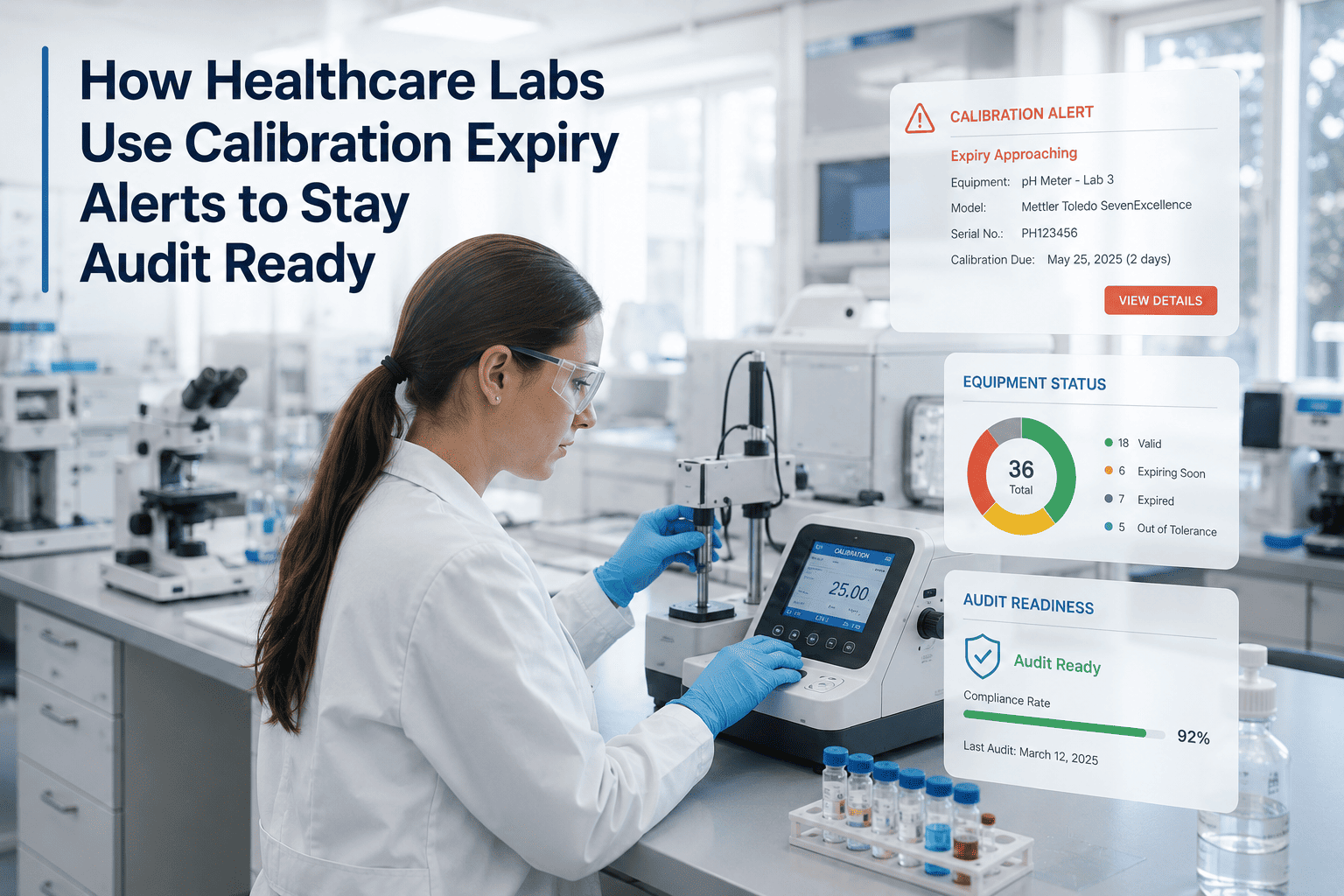
In healthcare labs, calibration is not a maintenance preference — it is a regulatory mandate. CLIA (Clinical Laboratory Improvement Amendments) §493.1255 requires documented calibration procedures and frequency for every quantitative test system; CAP accreditation, ISO 15189:2022, and FDA 21 CFR Part 820 layer additional requirements; and the College of American Pathologists routinely cites missed calibration as one of the top 5 deficiencies in laboratory inspections. A single missed calibration on a chemistry analyzer can invalidate weeks of patient results, force re-run protocols, and trigger a Plan of Correction submission within 30 days. Industry reporting shows that 41% of lab quality non-conformances trace back to expired calibrations on instruments that nobody flagged in advance. Most lab teams lose 20-40% of QA budget chasing calibration paperwork that should have alerted them weeks earlier — start a free trial to put every analyzer, pipette, centrifuge, and incubator on a CMMS-enforced calibration schedule, or book a demo to walk through your audit-ready calibration register.
of lab quality non-conformances trace back to expired calibrations missed by manual tracking
30 days
window to submit a CMS Plan of Correction after a CLIA calibration deficiency citation
5 of top 10
most-cited CAP laboratory deficiencies relate to calibration, QC, or instrument documentation
$10,000+
cost of a single batch invalidation when calibration lapse forces patient sample re-run
What calibration expiry alerts actually deliver
Calibration expiry alerts are the operational backbone of lab quality systems — automated, asset-level notifications that flag every instrument approaching its calibration due date, every calibration that fails verification, and every certified personnel record approaching expiry. The point is not the reminder itself. The point is replacing the institutional memory of one senior tech with a system that survives turnover, holidays, and the inevitable Monday morning when six analyzers all need recalibration before patient samples can run.
Under CLIA, every quantitative test system must have a documented calibration procedure and frequency — typically every 6 months or after major maintenance, with verification each day of testing. CAP-accredited labs additionally maintain calibration verification records, instrument maintenance logs, and competency assessments tied to each technologist who performs the work. Miss any link in that chain and the entire test result chain of custody becomes auditable as deficient. Try Oxmaint free and put your full instrument inventory on a CLIA-aligned calibration schedule in under an hour.
Lab instruments that require calibration tracking
Chem
Clinical Chemistry Analyzers
Roche cobas, Beckman AU, Siemens ADVIA — 6-month calibration plus daily verification across every assay channel.
Hem
Hematology Analyzers
Sysmex XN, Beckman DxH — CBC parameter calibration, reagent lot validation, and verification with each new shipment.
Imm
Immunoassay Platforms
Abbott Architect, Siemens IMMULITE — assay-specific calibration with lot-to-lot verification and master curve revalidation.
Mol
Molecular Platforms
Cepheid GeneXpert, Hologic Panther — temperature calibration, thermocycler verification, pipette accuracy checks per cycle.
Pip
Pipettes & Liquid Handlers
Annual gravimetric calibration per ISO 8655 — accuracy and precision verification across volume ranges.
Daily temperature verification, annual calibration of thermometers against NIST-traceable standards.
Bal
Analytical Balances
Daily calibration check with certified mass standards, annual external calibration by accredited provider.
5 of the top 10 most-cited CAP laboratory deficiencies relate directly to calibration, QC, or instrument documentation gaps.
Why manual calibration tracking fails inspections
Calendar-Based Reminders Drift
Outlook reminders and shared calendars get muted, ignored, or lost when the QA lead is on PTO. Inspectors see the gap and cite it.
Paper Logs Cannot Be Queried
When an inspector asks for the last 18 months of calibration history on one analyzer, paper means opening every binder. By minute 10 the inspector has formed a view.
No Pre-Expiry Visibility
Manual systems alert the day it expires — not 30 days out. By the time anyone notices, the analyzer is already in non-compliant operation.
Competency Records Disconnected
Calibration record signed by a tech whose CLIA competency assessment lapsed last quarter invalidates the calibration — paper systems never link the two.
Multi-Site Aggregation Pain
Hospital systems with 5+ labs cannot produce a single calibration register without days of manual consolidation — and accreditation now demands portfolio views.
No Failure Mode History
When a calibration fails verification, there is no asset-level history showing prior failures or repair work — the root cause investigation starts from zero every time.
Labs that migrate to CMMS-driven calibration management typically resolve all citation-level documentation gaps within 90 days and prepare for CAP and CLIA inspections in under a quarter of the previous time. The change is not just compliance — it is operational confidence. Book a demo to see your full instrument inventory on a CAP-aligned calibration register.
How Oxmaint manages lab calibration workflows
Instrument-level calibration register
Every analyzer, pipette, centrifuge, and incubator tagged with manufacturer, serial, calibration interval, last/next due, and full historical record from commissioning forward.
Multi-tier expiry alerts
90, 60, 30, and 7-day pre-expiry alerts route to QA lead, lab supervisor, and bench technologist — the alert chain does not depend on one person being in.
Calibration work order generation
When an instrument enters its calibration window, a work order auto-generates with the procedure, required materials, expected duration, and competent personnel list.
Competency-validated entries
Only technologists with current CLIA competency assessment on the specific test system can sign off calibration. Lapsed competency blocks the entry automatically.
GMP-compliant audit trail
Every calibration, verification, repair, and competency event recorded with 21 CFR Part 11-aligned electronic signature, timestamp, and user identifier.
Multi-site portfolio dashboard
Aggregate calibration status across every lab in the hospital system — single-click visibility into which sites have pending calibrations, expired instruments, or open citations.
A single missed calibration on a chemistry analyzer can invalidate weeks of patient results and force a 30-day Plan of Correction submission.
Manual calibration tracking vs CMMS calibration register
Quality Capability
Manual / Paper Tracking
Oxmaint Digital Register
Pre-expiry alerting
None or day-of
90/60/30/7-day tiered
Calibration history retrieval
Binder hunting
Under 30 seconds per instrument
Competency validation
Visual check, often skipped
System-enforced at entry
Failed verification tracking
Manual note in log
Auto-flagged with root cause field
Multi-site aggregation
Days of consolidation
One-click portfolio dashboard
Inspector-ready export
Photocopy and PDF scan
Native CLIA/CAP report format
Audit trail integrity
Editable paper
21 CFR Part 11-aligned electronic signature
Inspection prep time
2-3 weeks
2-3 days
ROI of automated calibration expiry management
94%
reduction in missed calibrations within the first 6 months of automated expiry alerting
75%
reduction in CAP and CLIA inspection preparation time when records are queryable on demand
$10K-50K
per avoided batch invalidation when calibration lapses are prevented before sample run
100%
competency-record integrity when technologist credentials gate the calibration sign-off
Lab directors that move to CMMS-driven calibration tracking typically describe the result as "we stopped finding out about missed calibrations from the inspector." Pre-expiry visibility is the difference between a managed lab and a citation-prone one. Start a free trial and put your full instrument inventory on automated calibration governance this week.
Frequently Asked Questions
Is Oxmaint compliant with CLIA, CAP, and 21 CFR Part 11
Yes. Oxmaint provides electronic records with attributable timestamps, user authentication, and immutable audit trails aligned with 21 CFR Part 11 requirements for electronic signatures. CLIA calibration interval enforcement, CAP-aligned documentation fields, and competency record gating are configurable per lab. ISO 15189:2022 requirements are also supported.
How does Oxmaint handle calibration verification versus full calibration
Both are tracked as distinct event types in the asset record. Calibration verification (typically daily or per-shift) logs against the instrument with QC material lot, expected range, observed value, and pass/fail status. Full calibration (typically 6-month) generates a separate work order with linked procedure, required standards, and competent personnel sign-off.
Can we import existing calibration records from our LIS or paper logs
Yes. Oxmaint supports bulk import of historical calibration records from spreadsheet templates, and integrates with major LIS platforms for ongoing data exchange. Historical records typically import within the first week of implementation, giving inspectors a full multi-year view from day one of go-live.
Does this work for hospital systems with multiple lab locations
Yes. Oxmaint is built around a Portfolio > Site > Department > Instrument hierarchy that aggregates calibration status across every lab in the system. QA directors see a single portfolio dashboard while each lab retains its own asset register, procedures, and competency profiles.
Decision Point
Stop discovering missed calibrations from the inspector
Every CAP deficiency, every CLIA citation, every batch invalidation begins with a calibration that nobody flagged in advance. Oxmaint replaces calendar memory with system enforcement — alerting 90 days out, gating sign-off by competency, and producing inspection-ready reports on demand. Used by lab teams managing 10,000+ instruments across multi-site healthcare networks. Live in days, not months.