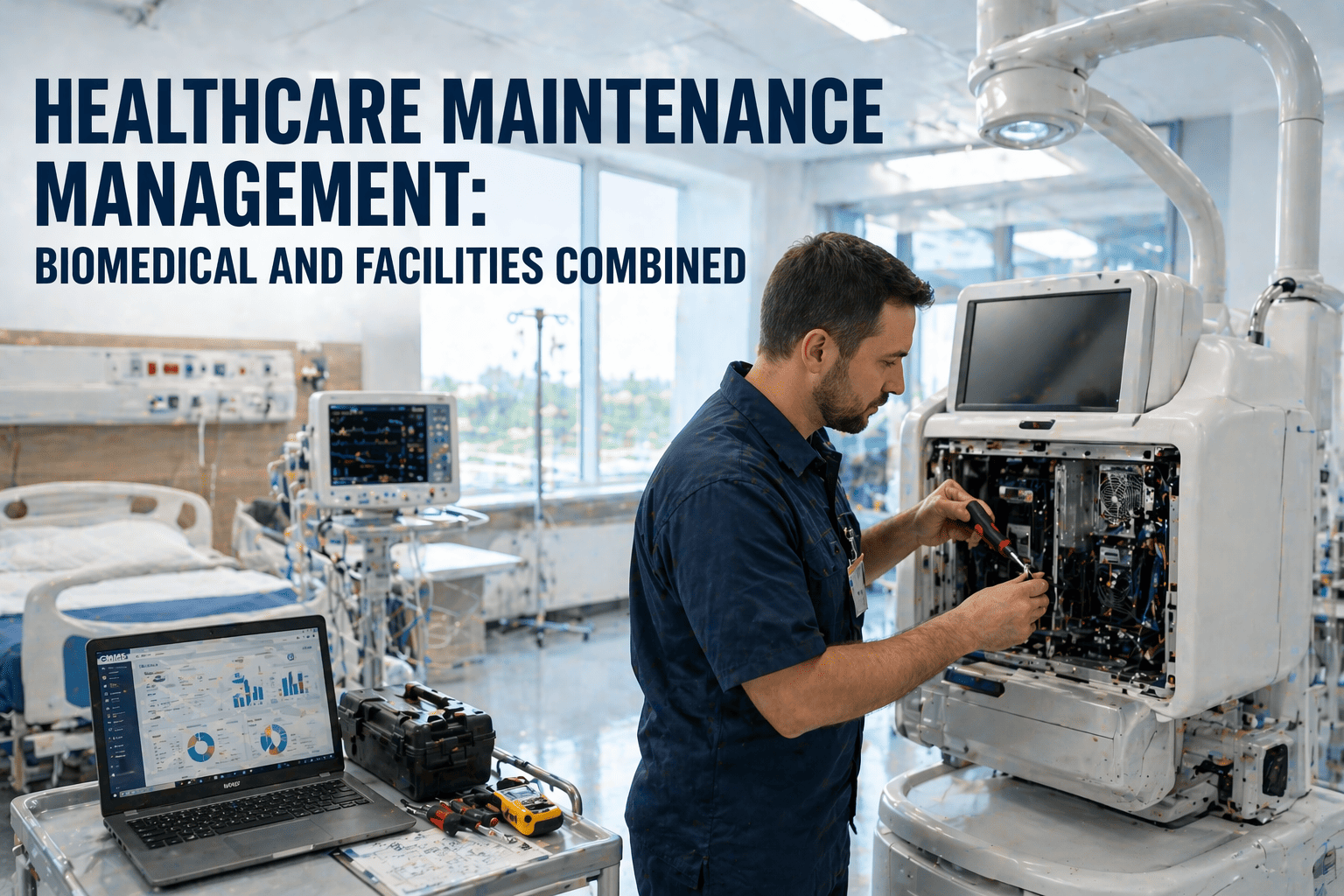
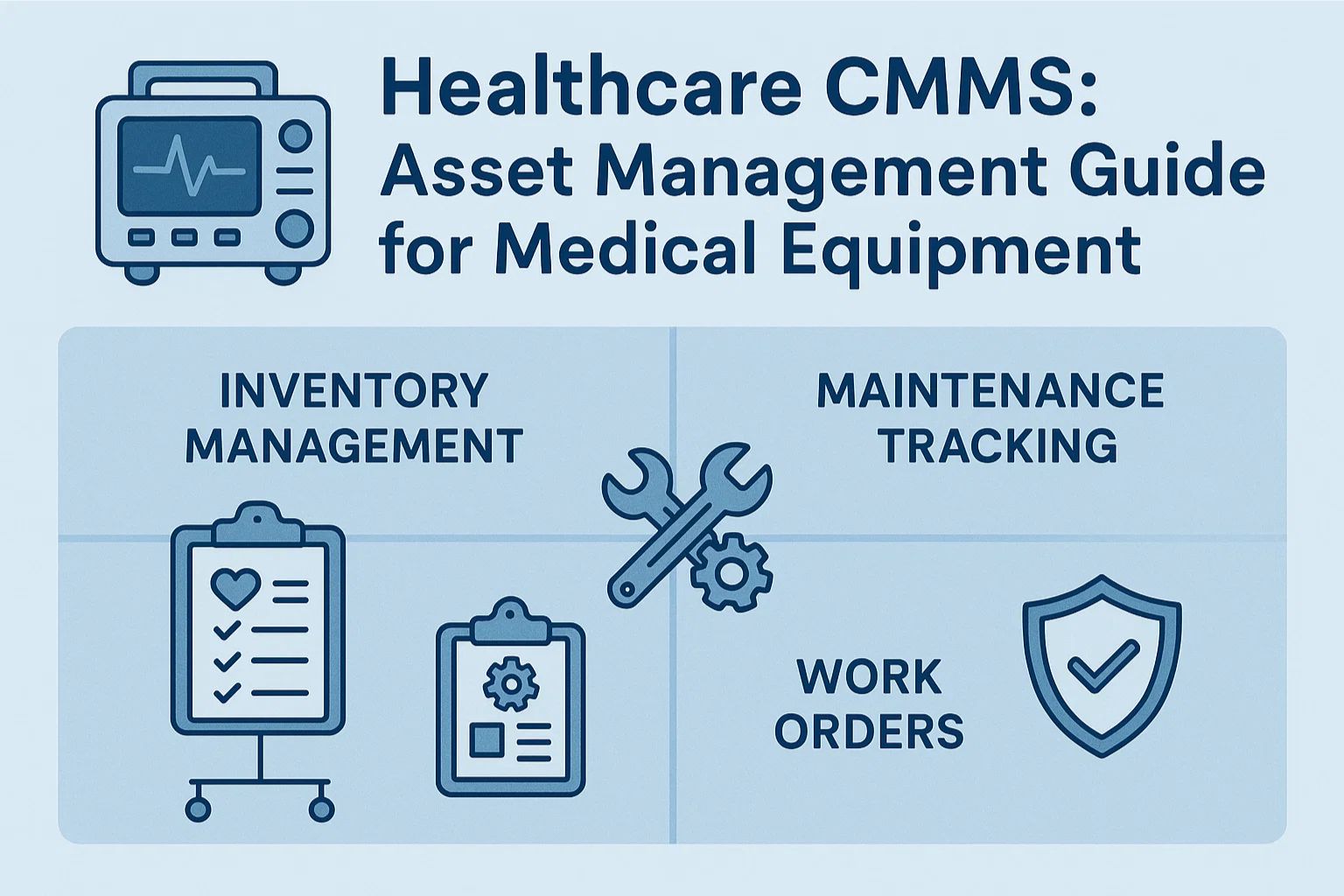
Oxmaint is the healthcare maintenance management software that gives hospital biomedical engineering teams a single system to inventory every medical device, schedule preventive maintenance to manufacturer IFU, capture calibration records, and produce audit-ready documentation the moment a Joint Commission surveyor asks for it. The average hospital manages more than 35,000 medical devices across roughly 500 equipment categories — and Oxmaint replaces the fragmented spreadsheets, paper binders, and disconnected trackers that turn every surveyor visit into a three-day compilation exercise. This 2026 guide covers what the new Physical Environment chapter of Accreditation 360 actually requires and how Oxmaint's healthcare CMMS automates the compliance workflow behind it.
Medical Equipment Maintenance & Compliance for Hospitals
Oxmaint's healthcare CMMS is purpose-built for hospital biomedical engineering teams, clinical engineering directors, and facility managers — automating PM scheduling, calibration tracking, and Accreditation 360 documentation from one platform.
Oxmaint maps directly to every framework hospitals answer to
Effective January 1, 2026, The Joint Commission's Accreditation 360 initiative consolidated the Environment of Care and Life Safety chapters into a single Physical Environment (PE) chapter. Total Elements of Performance dropped by 48%, but the core compliance requirements were reorganized, not eliminated. Combined with the FDA's Quality Management System Regulation taking effect February 2, 2026, and CMS's 42 CFR §482.41 remaining the single most cited deficiency area, biomedical engineering teams face a documentation burden no spreadsheet can survive. Oxmaint's healthcare CMMS is configured to the new PE chapter out of the box — every device, every PM record, every calibration certificate, every incoming inspection tied to the exact standard it satisfies.
| Regulatory body | Standard / Code | What it governs | How Oxmaint answers it |
|---|---|---|---|
| The Joint Commission Accreditation 360 |
PE chapter, EC.02.04.01, EC.02.04.03 EP1 | Medical equipment management, performance verification, PM documentation | PE-mapped compliance dashboards with full PM and inspection history per device |
| CMS Conditions of Participation |
42 CFR §482.41 Physical Environment | Facility safety, equipment maintenance under IFU, water management | IFU-aligned PM templates, water management module, unified asset register |
| FDA QMSR effective Feb 2, 2026 |
21 CFR Part 820 / ISO 13485 | Device servicing quality system, complaint handling, adverse events | ISO 13485-aligned servicing records, complaint tracking, audit trail generation |
| NFPA | NFPA 99 (Health Care Facilities), NFPA 101 (Life Safety) | Medical gas systems, electrical safety, egress, fire protection | Life safety module covering medical gas, generators, and fire suppression PM |
| OSHA | 29 CFR Bloodborne pathogens, LOTO, HazCom | Biomed technician safety during equipment servicing | LOTO procedures, competency tracking, and hazard documentation per work order |
Oxmaint manages every device category in a hospital biomedical inventory
A hospital biomedical inventory spans 500 device categories from infusion pumps to MRI scanners, and each category has a distinct PM interval, regulatory anchor, and failure signature. Oxmaint ships with category-specific PM templates for every device class below — configured to manufacturer Instructions for Use, mapped to Joint Commission and FDA standards, and ready to schedule the moment a device is added to the asset register. To scope Oxmaint against your device inventory, book a demo with our biomedical team.
Life support & ventilators
ICU ventilators, anesthesia machines, ECMO. Oxmaint schedules monthly PMs, tracks battery cycles, and alerts before a single interval slips.
Imaging systems
MRI, CT, X-ray, ultrasound. Oxmaint captures OEM PM contracts, daily QA logs, and calibration certificates in one device history.
Patient monitors
Bedside monitors, telemetry, pulse oximetry. Oxmaint tracks devices across unit transfers with barcode scan and PM history follows the device.
Infusion & syringe pumps
IV infusion, PCA pumps, syringe pumps. Oxmaint schedules calibration verification and links every pump to its NIST-traceable certificate.
Sterilization & autoclaves
Steam sterilizers, low-temperature systems. Oxmaint logs every cycle with biological indicator results and flags failed loads for immediate action.
Defibrillators & AEDs
Crash cart defibs, AEDs, external pacers. Oxmaint enforces monthly battery, pad, and self-test verification with a mobile scan-and-log workflow.
The six documentation categories Oxmaint produces in seconds
When a Joint Commission surveyor arrives unannounced and requests the maintenance history of every ventilator in the ICU, hospitals running paper work orders face two days of manual compilation — assuming records are complete, filed correctly, and not lost. Most are not. Oxmaint eliminates the compilation entirely: the six documentation categories below are pre-structured in the platform and retrievable in under 60 seconds. To see the surveyor-view export in action, start a free Oxmaint trial.
Complete asset inventory
Oxmaint holds every medical device with serial number, location, risk classification, and current PM status — one source of truth, live for every unit.
PM history per device
Every scheduled PM logged with completion date, technician, tasks performed, and outcome. Retrievable per device or per category in seconds.
Calibration records
Oxmaint links NIST-traceable calibration certificates to devices with next-due alerts and automated out-of-tolerance escalation.
Incoming inspection logs
Oxmaint enforces performance verification for new devices and post-repair returns to service — exactly as TJC EC.02.04.03 EP1 requires.
Technician competency
Training records, certifications, and competency assessments live in Oxmaint alongside the work orders they authorize — no separate HR system.
Recall & alert action logs
Oxmaint links FDA safety alerts and manufacturer recalls to affected devices with the action taken, verification, and full audit trail.
Six capabilities that turn Oxmaint into your biomedical engineering backbone
Oxmaint is the healthcare maintenance management software that consolidates 35,000+ device records, PM schedules, calibration certificates, and compliance documentation into a single audit-ready platform. The six capabilities below are how biomedical engineering directors, clinical engineering teams, and hospital facility managers use Oxmaint to satisfy the consolidated PE chapter of Accreditation 360 and answer surveyor requests in seconds instead of days. To see these against your device inventory, book a healthcare demo with our biomedical team.
Category PM templates
Oxmaint ships with pre-built PM checklists for every device class — ventilators, imaging, monitors, pumps, sterilizers — configured to manufacturer IFU and TJC standards.
Sub-60-second retrieval
Surveyor asks for every ventilator's PM history — Oxmaint produces it in one query. Three days of manual compilation becomes a single dashboard export.
Calibration tracking
Oxmaint links NIST-traceable calibration certificates to devices with next-due alerts, out-of-tolerance workflows, and automatic escalation before drift becomes a finding.
PE chapter mapping
Oxmaint compliance dashboards are mapped to the 2026 Physical Environment standards while preserving historical records under the old EC and LS codes for full continuity.
Mobile biomed app
Biomed technicians complete Oxmaint work orders bedside — photo capture, barcode scan, offline sync — so documentation happens at the point of work, not hours later.
Recall & alert logs
Oxmaint links FDA safety alerts and manufacturer recalls to affected devices with action taken, verification, and audit trail — reviewed on every survey.
Oxmaint for hospital biomedical engineering — FAQ
How does Oxmaint handle the Joint Commission Accreditation 360 changes from January 2026?
Oxmaint's compliance framework maps to the consolidated Physical Environment (PE) chapter that replaces the previous EC and LS chapters in Accreditation 360. Every dashboard, PM template, and documentation export was updated to match the new PE structure while preserving historical records under the previous EC and LS codes for continuity. Biomedical engineering teams see real-time compliance status against the active PE standards, and surveyor-ready report templates reflect current expectations without any manual reconfiguration.
Can Oxmaint schedule PMs at different intervals for different device categories?
Yes — this is a core Oxmaint capability. Every device category carries its own PM interval driven by manufacturer IFU combined with the device's risk classification. Oxmaint ships with pre-built templates: monthly PMs for life-support and defibrillators, quarterly for imaging, semi-annual for patient monitors, annual for infusion pumps. Custom intervals and risk-based alternatives are fully configurable. The platform enforces the schedule automatically, escalates overdue tasks, and generates the documentation trail proving compliance with the interval you selected.
What does Oxmaint do about the most common survey finding — missing PM documentation?
Missing or incomplete PM documentation is why 42 CFR §482.41 remains the single most cited deficiency during hospital surveys. Oxmaint eliminates this at the source — every scheduled PM auto-generates a work order, requires technician sign-off with tasks performed, and stores the record against the specific device with a retrievable timestamp. The second most common finding, missing performance verification after repair, is handled by Oxmaint's incoming inspection workflow that blocks a device from returning to service until the verification checklist is complete.
Is Oxmaint aligned with the FDA Quality Management System Regulation effective February 2026?
Yes. The QMSR harmonizes FDA 21 CFR Part 820 with ISO 13485, and Oxmaint's servicing quality system was designed against ISO 13485 from the start. Complaint handling, adverse event tracking, and every device servicing action are recorded with the technician, test equipment used, and outcome — the exact evidence FDA inspectors request. Hospital biomed departments that ran ad-hoc documentation before Oxmaint reach FDA-inspection readiness typically within 30 days of platform go-live.
Can one Oxmaint instance cover both biomedical equipment and facility infrastructure?
Yes, and this is the recommended approach under Accreditation 360's consolidated PE chapter. A single Oxmaint instance covers biomedical devices, facility utilities (medical gas, generators, HVAC under ASHRAE 170), and life safety (fire suppression, egress, emergency lighting) — one asset register, one compliance dashboard, one documentation trail for surveyors. Multi-hospital health systems run the same Oxmaint platform across every facility with site-level views rolling up to a system-level compliance dashboard.
What is the realistic ROI when a hospital deploys Oxmaint?
Hospitals typically see measurable benefit within 6 months and full payback inside 12-18 months of Oxmaint deployment. The primary drivers are the 50-70% reduction in device-related incidents, the 25-40% cut in total maintenance cost, and the elimination of the 3-day manual record compilation before every survey. On a mid-size community hospital with 35,000 devices, avoiding a single Joint Commission condition-level finding and preventing 8-10 hours per month of critical equipment downtime typically covers the Oxmaint investment inside the first year. To model this against your facility, start a free Oxmaint trial.
Purpose-built for hospitals. Ready for the next survey.
Oxmaint gives biomedical engineering teams, clinical engineering directors, and hospital facility managers one platform to inventory every device, schedule PMs by manufacturer IFU, capture calibration records, and produce surveyor-ready documentation in seconds — mapped directly to the 2026 Physical Environment chapter of Accreditation 360.