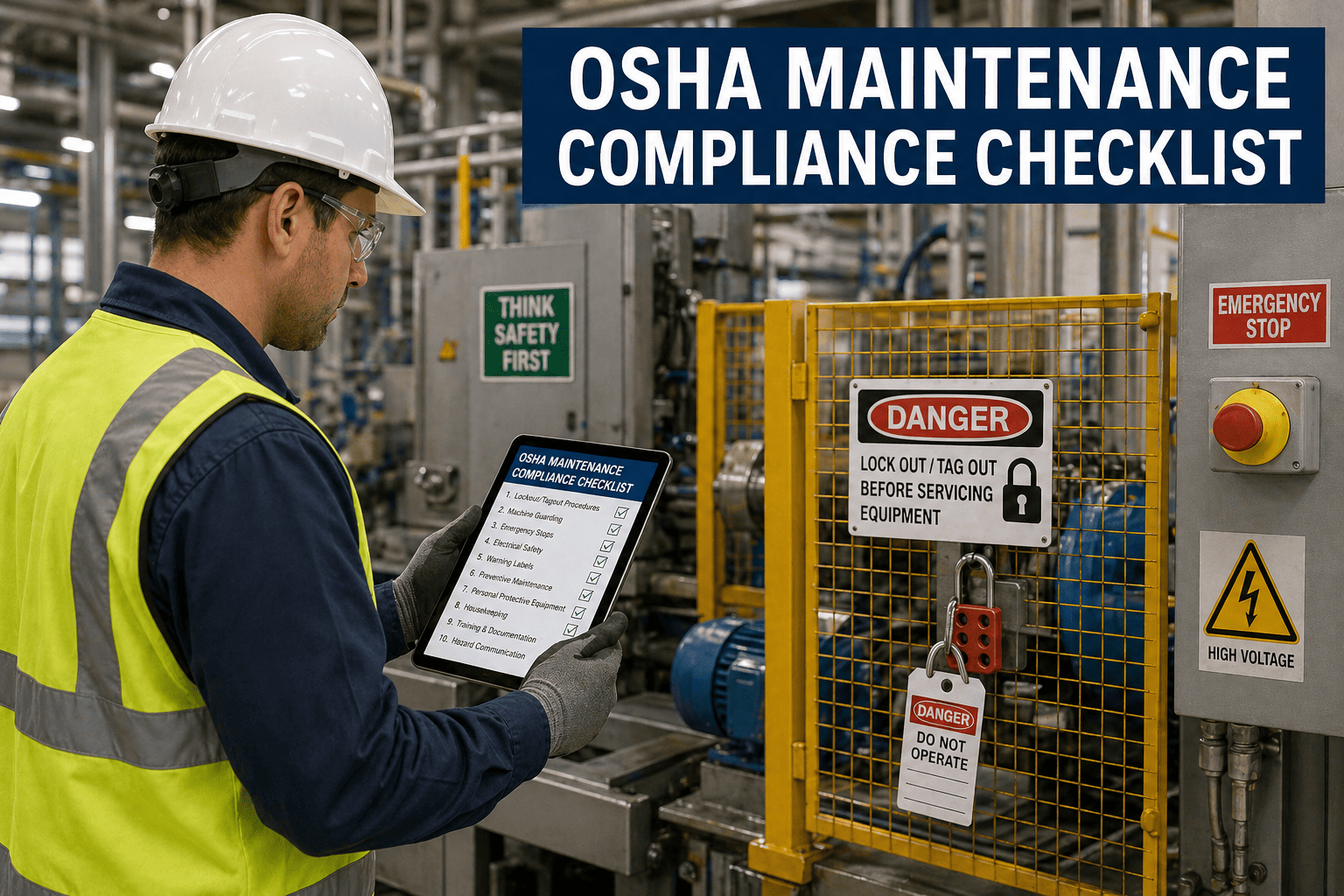
A hospital opening and closing checklist is the structured procedure facility teams use to verify that mechanical, electrical, life-safety and environmental systems are fully operational before a facility goes live and properly secured when it shuts down. OSHA 1910 compliance, Joint Commission standards and NFPA codes require documented evidence that every critical asset was inspected, tested and signed off — a photocopied paper form no longer holds up in an audit. OxMaint turns this checklist into a digital, mobile-first preventive maintenance program that auto-generates work orders, captures photo evidence and logs a complete history against each asset so your team can prove compliance instantly. You can Start Free Trial today or book a personalized demo to see it on your own equipment.
The digital hospital opening and closing checklist your facility can audit in seconds
Replace clipboard rounds and photocopied forms with mandatory-field mobile capture, photo evidence, e-signatures and auto-generated PM work orders — all logged against the asset for instant OSHA 1910 and Joint Commission proof.
-
Emergency power — transfer switch test
Verify generator auto-transfer within 10 seconds; log voltage & fuel level. -
Medical gas — alarm panel verification
Confirm pressure readings on O₂, N₂O, medical air; photo required. -
HVAC — pressure & filtration check
Confirm OR pressure differentials; replace HEPA if ΔP < threshold. -
Fire & life safety — panel walk
Acknowledge all zones green; test one pull station per floor.
Hospital opening checklist: critical systems to verify before doors open
A single missed step during opening rounds — an unverified transfer switch, a tripped medical gas alarm — can cascade into a patient-safety incident, a delayed surgery or a failed Joint Commission survey. The grid below covers the six core domains every hospital opening and closing checklist SOP should mandate before a facility goes live.
Emergency & Standby Power
- Test automatic transfer switch (ATS) — verify transfer ≤ 10 seconds
- Check generator fuel level ≥ 75%; log runtime hours
- Inspect battery charger & alarm indicators; clear fault codes
- Confirm exit signs & egress lighting fully illuminated
HVAC & Environmental Controls
- Verify OR / ICU pressure differentials per design spec
- Check HEPA filter ΔP; replace if outside threshold
- Confirm temperature & humidity within ASHRAE 170 range
- Inspect chilled-water & steam valve actuation
Medical Gas & Vacuum Systems
- Read master alarm panel — O₂, N₂O, medical air, vacuum
- Verify zone valve box labels & accessibility
- Check source equipment for leaks; log cylinder inventory
- Confirm local alarm panels annunciate correctly
Fire & Life Safety
- Walk FACP — all zones green, no trouble signals
- Test one manual pull station per floor; verify annunciation
- Confirm fire doors latch, close & are unobstructed
- Inspect sprinkler valve tamper switches — normal position
Plumbing & Domestic Water
- Verify hot-water recirculation temp ≥ 124°F at fixtures
- Check backflow preventer gauge readings
- Inspect mechanical room sump pumps & high-level alarms
- Confirm eyewash & emergency shower flow indicators
Security & Access Control
- Verify badge reader function at restricted zones
- Test CCTV coverage at entrances & loading dock
- Confirm panic / duress alarm signal path
- Check automatic door operators & safety sensors
Hospital closing checklist: secure systems & document handover
Closing rounds are where compliance gaps hide. A facility audit typically finds that 1 in 4 closing checklists is incomplete or back-dated — making OSHA 1910 audit defense nearly impossible. The table below maps each closing step to the standard it satisfies and the evidence OxMaint captures automatically.
| Closing Procedure Step | Standard / Code | Evidence Captured | Sign-off |
|---|---|---|---|
| De-energize non-essential equipment per LOTO | OSHA 1910.147 | Photo + e-signature on lockout tag | Lead tech |
| Verify all fire doors secured & armed | NFPA 101 | Zone-by-zone checklist timestamp | Security supervisor |
| Log generator cool-down & fuel polish status | NFPA 110 | Runtime meter reading + fuel % | Facility engineer |
| Set back HVAC unoccupied zones | ASHRAE 90.1 | BMS setpoint screenshot | Building operator |
| Secure hazardous-material storage rooms | OSHA 1910.106 | Door-seal photo + badge log | EHS officer |
| Complete shift handover log & open WOs | Internal SOP | Auto-generated work-order list | Shift lead |
Hospital opening and closing checklist SOP: build it in 5 steps
Moving from a photocopied form to a standardized, measurable procedure takes less than a day in OxMaint. Here is the five-step SOP that reliability teams follow to build a defensible, audit-ready program.
Inventory critical assets
Import every asset — generators, transfer switches, AHUs, medical gas manifolds, fire panels — into OxMaint with location, criticality rank and OEM spec sheet attached.
Define checklist templates
Build digital checklist forms with mandatory fields, dropdowns, numeric thresholds and photo-capture requirements. No step can be skipped or back-filled.
Set PM schedule & triggers
Configure auto-generated PM work orders on the right interval — daily, shift-change or event-based — so no round is ever missed or duplicated.
Execute on mobile
Technicians complete rounds on phone or tablet; failed inspections auto-generate a corrective work order with photo evidence and priority flag.
Prove compliance instantly
Every sign-off is time-stamped, geotagged and logged against the asset. Pull a full audit trail in two clicks for OSHA, Joint Commission or internal review.
What a digital checklist costs — and what it saves
A 180-bed hospital running paper-based opening and closing rounds typically spends $48K–$62K per year in avoidable labor, rework and unplanned downtime. Below is a worked example showing the payback of moving that procedure into OxMaint.
| Cost Category | Paper-Based (Annual) | OxMaint Digital (Annual) | Savings |
|---|---|---|---|
| Technician labor — rounds & rework | $31,000 | $18,500 | $12,500 |
| Unplanned downtime from missed steps | $168,000 | $106,000 | $62,000 |
| Compliance penalty & audit prep | $14,000 | $3,200 | $10,800 |
| Paper, printing & storage | $2,400 | $0 | $2,400 |
| Total annual cost | $215,400 | $127,700 | $87,700 |
From clipboard rounds to a measurable maintenance program
OxMaint maps four concrete capabilities to your hospital opening and closing checklist — each with a measurable outcome your reliability team can track from week one.
Auto-generated PM work orders
Schedule daily or shift-change rounds on every critical asset. OxMaint generates the work order, assigns the technician and closes the loop — eliminating 100% of missed or duplicate rounds.
Mandatory photo & field capture
Every checklist step can require a photo, a numeric reading or an e-signature before it can be closed. Failed items auto-create corrective work orders — cutting unplanned downtime 30–50%.
Full audit trail in two clicks
Every sign-off is time-stamped, geotagged and permanently logged against the asset. Generate an OSHA 1910 or Joint Commission compliance report in under 30 seconds.
Predictive analytics on asset health
OxMaint's AI analyzes inspection readings over time to flag assets trending toward failure — letting you schedule corrective work before a breakdown or survey finding occurs.
Hospital opening and closing checklist: frequently asked questions
What should be included in a hospital opening and closing checklist?
A complete checklist covers six domains: emergency power (ATS, generator, fuel), HVAC and environmental controls, medical gas systems, fire and life safety, plumbing and domestic water, and security/access control. Each item should have a pass/fail threshold, a photo-capture requirement and a named sign-off so the record is audit-defensible.
How does a digital checklist improve OSHA 1910 compliance?
A digital checklist enforces mandatory fields — a technician cannot close a work order without entering the required reading, photo or e-signature. OxMaint time-stamps and geotags every entry and stores it permanently against the asset, so you can produce a complete OSHA 1910 audit trail in seconds. Start Free Trial to see it on your assets.
How often should hospital opening and closing rounds be performed?
Most facilities run opening rounds at the start of each day or shift and closing rounds at end-of-shift. High-criticality areas like operating rooms, ICUs and pharmacies may require per-use or hourly checks. OxMaint's PM scheduler auto-generates work orders on whatever interval each asset or zone requires.
Can I customize the checklist template for different facility zones?
Yes. OxMaint lets you build unlimited checklist templates — one for the OR suite, another for the loading dock, another for the central utility plant — each with its own fields, thresholds and sign-off roles. You can clone and modify templates as your facility evolves.
How long does it take to switch from paper forms to OxMaint?
Most teams are live in 1–2 days. You import your asset list via CSV, build or upload your existing checklist templates, and schedule the first PM round. OxMaint supports migration from spreadsheets, paper SOPs and legacy CMMS platforms — Book a Demo and we will map your current process live.
Ready to make every opening and closing round audit-ready?
See OxMaint on your own assets — book a 30-minute demo and we will build your first checklist template live.
Free 14-day trial · No credit card