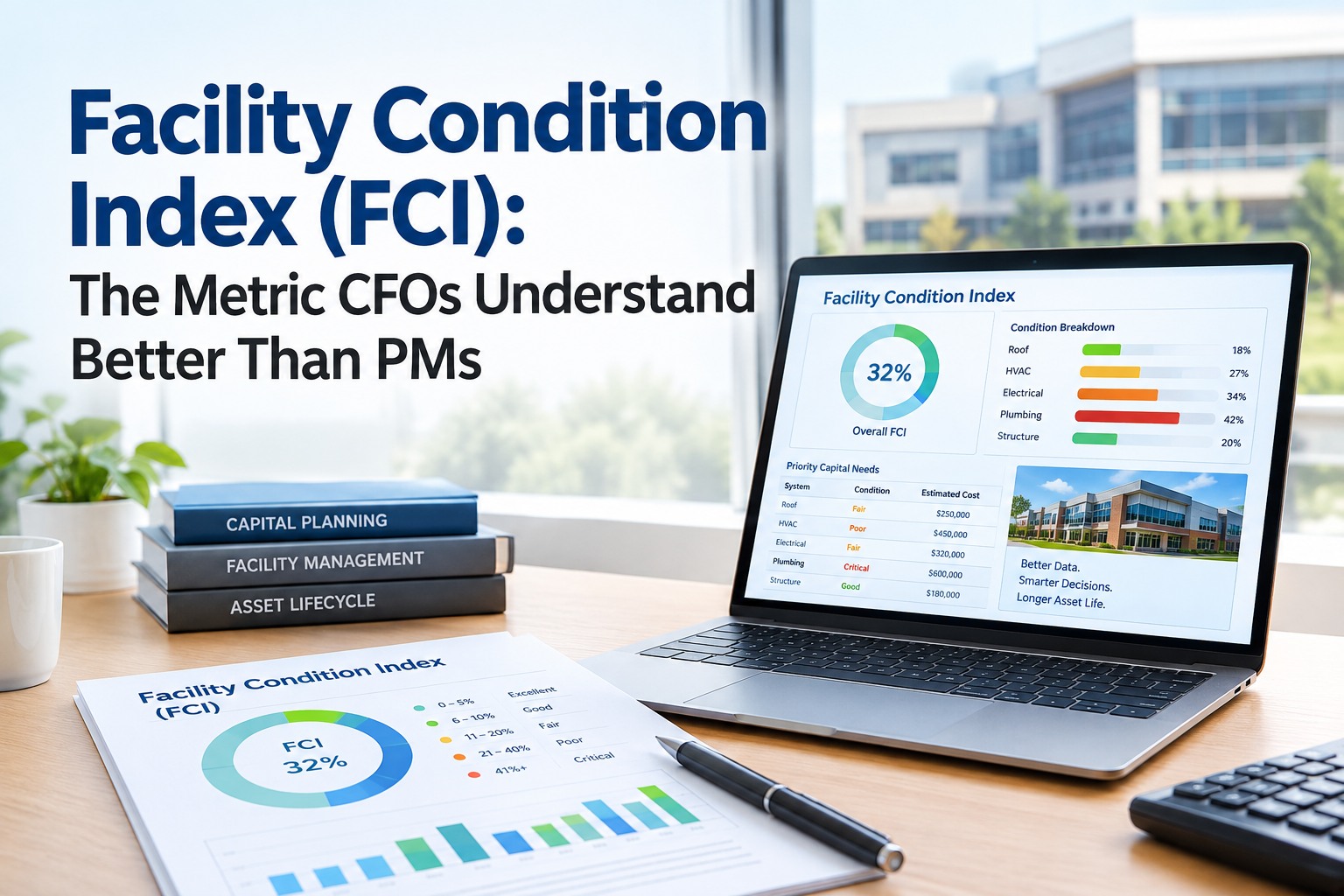
A hospital facility condition assessment (FCA) is the systematic evaluation of a healthcare building's physical assets—including HVAC, electrical, plumbing, medical gas, and life safety systems—to quantify deficiencies, calculate a Facility Condition Index (FCI), and prioritize capital spending. For hospital facility directors, an FCA hospital review is not just a real estate exercise; it is the foundation for Joint Commission survey readiness, infrastructure lifecycle planning, and hospital deferred maintenance tracking. By integrating healthcare FCA data into an AI-powered CMMS like OxMaint, facilities teams transform static audit reports into live, funded work orders that protect patient safety and operational uptime. You can immediately apply this framework to your own infrastructure by starting a Start Free Trial today.
Healthcare FCA Guide 2026
Is your hospital's deferred maintenance hiding a compliance or safety risk?
A hospital facility condition assessment reveals the true state of your infrastructure. But without a CMMS to track deficiencies, that FCA data becomes a static PDF within months. Turn your 2026 healthcare facility condition audit into live, prioritized recovery plans.
deferred maintenance backlog
The 5-Phase FCA Framework
How to conduct a hospital facility condition assessment
A defensible hospital infrastructure assessment follows a structured progression from asset discovery to funded execution, aligning with ISO 55000 asset management principles and Joint Commission Environment of Care (EC.02.05.01) standards.
Hospital Asset Assessment & Discovery
Compile a comprehensive registry of facility assets—AHUs, generators, chillers, medical gas manifolds, and fire panels. A complete hospital asset assessment captures make, model, install date, criticality, and location. OxMaint's EAM platform serves as the single source of truth, automatically categorizing assets by system and risk tier.
Deficiency Identification
Assessors physically walk down the building to document deficiencies, end-of-life equipment, and code violations. Using OxMaint's mobile CMMS app, technicians log defects, attach photos, and flag safety risks in real-time—eliminating the clipboard-to-spreadsheet delay that plagues traditional hospital facility audits.
FCI Calculation & Scoring
Each deficiency is assigned a remediation cost. The aggregate is divided by the facility's current replacement value (CRV) to calculate the Facility Condition Index (FCI). An FCI below 0.05 indicates good condition; above 0.10 triggers critical capital intervention. OxMaint auto-calculates these metrics as costs are updated.
Hospital Capital Planning Integration
Prioritize projects by combining FCI scores, life-safety impact, and regulatory mandates. OxMaint's analytics dashboard visualizes which assets need immediate replacement vs. preventive maintenance, giving facility directors defensible data for board-level capital allocation requests.
Deferred Maintenance Tracking
Convert the capital plan into scheduled work orders. OxMaint tracks hospital deferred maintenance recovery from approved budget to completed execution, ensuring that funded deficiencies actually get resolved before the next Joint Commission survey cycle.
The Math Behind the Audit
Calculating the Facility Condition Index (FCI) for hospitals
The Facility Condition Index (FCI) is the industry-standard benchmark used in healthcare facility condition assessments to objectively measure building health and justify capital funding.
Facility Condition Index Formula
Example: A hospital wing with $4.5M in identified deficiencies and a CRV of $60M has an FCI of 0.075 (or 7.5%). This indicates moderate condition requiring targeted capital investment.
Routine preventive maintenance is sufficient. Maintain current PM schedules in the CMMS.
Targeted upgrades required. Begin hospital capital planning for high-risk assets.
Immediate intervention needed. High risk to patient safety and survey compliance.
Real-World Scenario
From $4.2M backlog to funded recovery in 90 days
A 180-bed regional hospital conducted a facility condition assessment revealing $4.2M in deferred maintenance across 62 critical assets, resulting in an FCI of 0.12. Previously tracking deficiencies on offline spreadsheets, the facility director struggled to secure board funding because the data lacked real-time validation.
By migrating their hospital FM assessment data into OxMaint, they mapped every deficiency to a specific asset record, auto-calculated FCI by building zone, and generated a prioritized 3-year capital plan. The board approved $2.8M in immediate funding. Within 90 days, the facilities team resolved 45% of life-safety deficiencies using automated work order scheduling.
CMMS Integration
How OxMaint turns hospital FCA data into action
A hospital building assessment is only valuable if it drives action. OxMaint bridges the gap between the FCA report and daily maintenance execution, ensuring deficiencies are tracked, funded, and resolved.
Centralized Asset Registry
Map every FCA deficiency directly to its parent asset in OxMaint's EAM. Track serial numbers, warranty status, and maintenance history to prevent duplicate assessments and eliminate shadow asset inventories.
Automated FCI Dashboards
As repair costs are updated in work orders, OxMaint automatically recalculates your Facility Condition Index. Present real-time infrastructure health metrics to hospital administrators without rebuilding spreadsheets.
Survey-Ready Audit Trails
Every deficiency note, photo, and resolved work order is time-stamped and permanently archived. Generate Joint Commission compliance reports in seconds, proving that identified FCA risks have been actively mitigated.
Predictive Capital Planning
OxMaint's AI analyzes asset age, failure history, and PM compliance to predict end-of-life events before they become critical. Shift your hospital capital planning from reactive replacements to proactive budget forecasting.
FCA vs. Standard Maintenance
Why hospitals need dedicated FCA tracking over basic CMMS
A standard CMMS handles daily work orders, but a hospital infrastructure assessment requires specialized tracking to quantify long-term capital risk. Here is how a dedicated healthcare FCA strategy compares to reactive maintenance management.
| Capability | Standard CMMS (Reactive) | OxMaint (FCA-Integrated) |
|---|---|---|
| Deficiency Scoring | Not supported | Automated FCI calculation by zone/building |
| Capital Plan Integration | Manual spreadsheet exports | Live dashboards for board presentations |
| Joint Commission Readiness | Scramble to compile records | One-click audit trails and deficiency logs |
| Deferred Maintenance Tracking | Work orders only | Funded project tracking from FCA to completion |
| Asset Lifecycle Prediction | Age-based only | AI-driven failure prediction and risk scoring |
Turn your next hospital facility audit into a live capital recovery plan
See how OxMaint maps FCA deficiencies to funded work orders and automates your Facility Condition Index tracking.
Frequently Asked Questions
Hospital facility condition assessment FAQs
What is a hospital facility condition assessment (FCA)?
A hospital facility condition assessment is a systematic audit of a healthcare building's physical infrastructure—HVAC, electrical, medical gas, and life safety systems—to identify deficiencies, estimate repair costs, and calculate a Facility Condition Index (FCI). It provides the baseline data required for Joint Commission compliance, capital planning, and hospital deferred maintenance tracking.
How is the Facility Condition Index (FCI) calculated for hospitals?
The FCI is calculated by dividing the total deferred maintenance (TDM) cost by the facility's current replacement value (CRV). For example, if a hospital has $3M in deficiencies and a CRV of $50M, the FCI is 0.06. An FCI above 0.10 typically indicates a critical need for capital intervention. You can automate this tracking using a platform like OxMaint—Start Free Trial to see how.
How often should a healthcare facility condition audit be performed?
Best practices dictate that a comprehensive hospital facility audit should be conducted every 3 to 5 years. However, the data must be updated continuously. Integrating FCA findings into a CMMS like OxMaint ensures that condition data is refreshed daily as technicians complete work orders and log new deficiencies.
Why is hospital deferred maintenance tracking critical for compliance?
Untracked deferred maintenance directly threatens Joint Commission Environment of Care standards and patient safety. Tracking it in a CMMS provides a defensible, time-stamped audit trail proving that identified risks are being actively managed and funded, which is essential for passing unannounced surveys.
Can a CMMS integrate with hospital capital planning?
Yes. An AI-powered CMMS like OxMaint bridges the gap by linking real-time asset condition data, failure predictions, and resolved work orders directly to budget forecasting. This allows facility directors to present data-driven capital funding requests rather than relying on static spreadsheet estimates. Book a Demo to see it in action.
Stop managing FCA data in spreadsheets
OxMaint transforms your hospital facility condition assessment into live work orders, automated FCI tracking, and defensible capital plans. See it on your assets today.
Free 14-day trial · No credit card