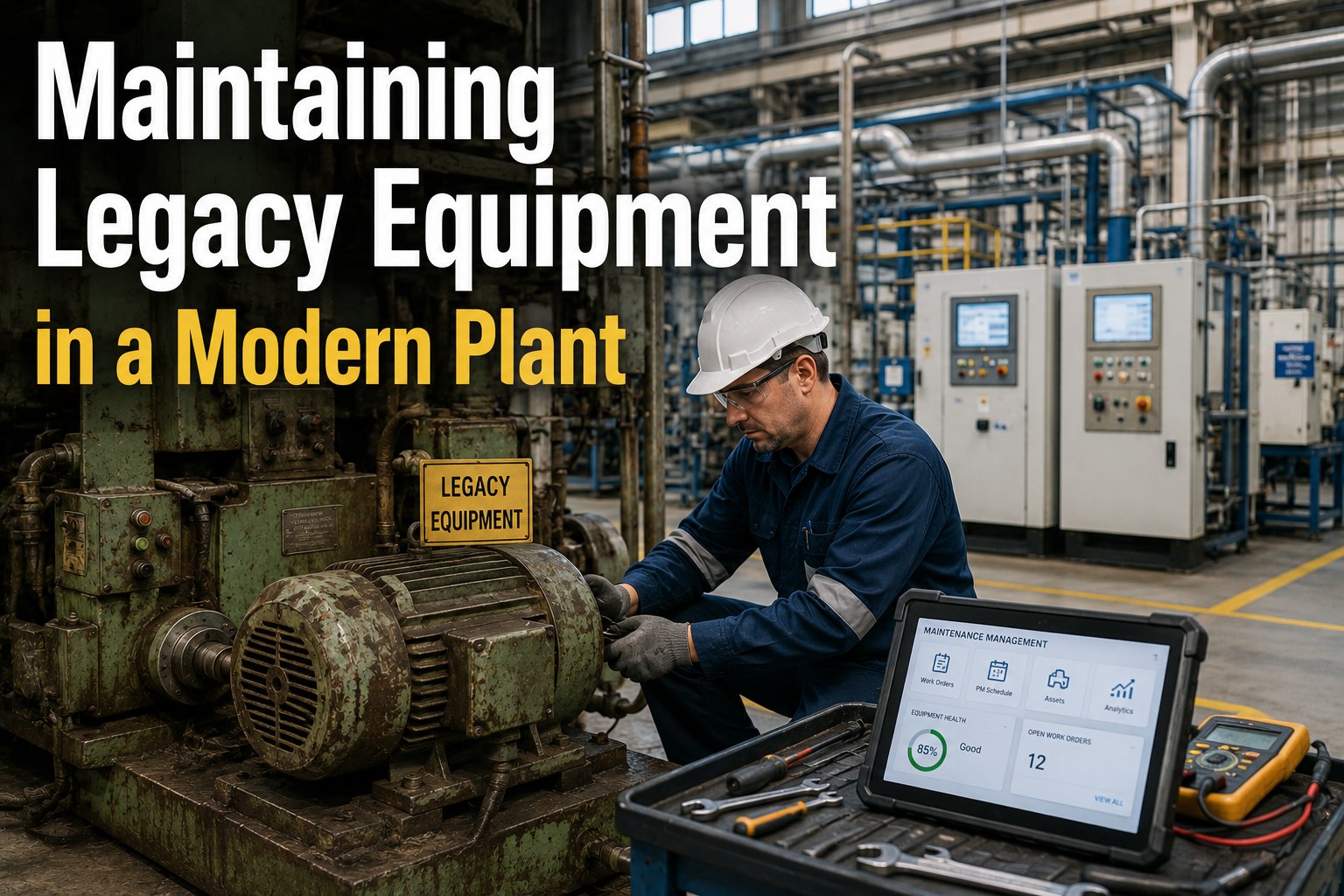
Most plants run on machines that were commissioned before the current maintenance team was hired — and that reality is rarely a problem until a critical asset fails, a spare takes eleven weeks to source, or a controls board nobody makes anymore trips the line at 2 a.m. Legacy equipment maintenance is the discipline that keeps those aging assets productive without bleeding the maintenance budget, and it lives or dies on the quality of the data behind each repair, PM, and obsolescence decision. OxMaint gives reliability engineers a CMMS built for exactly this: condition tracking on aged assets, PM optimization that accounts for wear curves past nameplate life, obsolescence registers tied to real lead times, and the analytics that convert tribal knowledge into a documented lifecycle strategy you can defend to finance. The alternative — reactive firefighting on equipment you no longer fully understand — is how a 20-year-old extruder ends up costing more in unplanned downtime than its replacement would have. Start with a Start Free Trial and a fresh asset register, and the rest of this page lays out the playbook.
Legacy Asset Strategy
Are you maintaining legacy equipment — or just postponing its failure?
Most plants spend 60–80% of their maintenance labor on assets past nameplate life, yet fewer than 1 in 4 has a documented obsolescence plan for them. The gap between "still running" and "strategically managed" is where budgets quietly leak. OxMaint turns that gap into a defensible lifecycle roadmap.
The Real Cost Of "Still Works"
Legacy equipment hides three costs your CMMS probably isn't surfacing
A 2019 ARC study put unplanned industrial downtime near $50B annually in the U.S. alone, and the disproportionate share falls on assets older than 15 years. The damage isn't only the hourly line rate — it's the compounding, mostly-invisible spend that finance never sees as a single line item.
Expediting fees, freight, and broker markups stack fast on obsolete parts — a single hard-to-find servo drive can run 4× list.
When the OEM no longer stocks the part, you're at the mercy of secondary markets, reverse-engineering shops, and 3D-printing vendors.
Compared to assets under 10 years — driven by diagnostics, rework, and the absence of modern telemetry on older machines.
Worked Example
A 180-asset Midwest packaging plant was spending roughly $42K/yr on expedited spares and weekend call-outs for three 1990s-era fillers. After mapping failure modes in OxMaint and pre-buying long-lead seals, belts, and a refurbished PLC rack, emergency spend dropped to $9K within nine months — and the freed budget funded the first phase of a controls retrofit on the worst offender.
Asset Lifecycle Framework
The five decisions that separate life-extension from life-support
ISO 55000 asks asset owners to make lifecycle decisions on evidence, not sentiment. For legacy equipment, that evidence lives in five places — and most plants only look at the first two.
Condition tracking on aged assets
Vibration, oil, thermography, and operator round data feed a single asset health score in OxMaint — so a 22-year-old compressor with rising bearing temperature gets attention before it becomes a 14-hour outage. Assets past nameplate life need condition-based monitoring more, not less.
PM optimization for wear curves that have shifted
Time-based PMs calibrated at commissioning rarely match a 15-year-old machine's actual failure pattern. OxMaint's PM-optimization view correlates work-order history with failure data to re-balance intervals — tightening what fails early, stretching what doesn't, cutting labor without cutting coverage.
Obsolescence planning with real lead times
Every critical asset gets an obsolescence register: which parts are discontinued, current lead time, alternate vendors, reverse-engineering options, and a "last-time-buy" trigger. The register is what turns a 16-week panic into a planned purchase order.
Refurbish vs. replace on documented numbers
When the next major repair ticket opens, OxMaint surfaces lifetime spend, downtime hours, and obsolescence risk beside the asset — so the decision to refurbish, retrofit, or replace is backed by a three-year cost curve instead of a mechanic's gut call.
Knowledge capture before the expert retires
The technician who can start that 1987 boiler with a rubber mallet and a specific sequence is walking out the door within five years. OxMaint captures startup procedures, known quirks, and one-off workarounds as structured asset documentation — searchable, not oral.
Build The Business Case
The math behind keeping vs. replacing an aging asset
When someone asks "why haven't we replaced that thing yet," the honest answer is usually that nobody has run the numbers. Here's the framework OxMaint's analytics module applies — and a worked example for a legacy CNC machining center.
Annual Cost of Ownership — Legacy Asset
ACO = ( PM Labor + Repair Labor + Parts + Unplanned Downtime + Obsolescence Risk Premium ) − Residual Value
Compare ACO against the annualized cost of a replacement (capex amortized + lower maintenance + downtime differential). When legacy ACO exceeds replacement ACO for two consecutive years, replacement is the defensible call.
| Cost Component | Legacy CNC (22 yrs) | Replacement (new) | Annual Delta |
|---|---|---|---|
| PM labor (hrs × burdened rate) | $8,400 | $4,200 | +$4,200 |
| Repair labor | $11,800 | $2,600 | +$9,200 |
| Parts & spares (incl. expedite) | $15,200 | $3,900 | +$11,300 |
| Unplanned downtime (38 hrs × $1,850) | $70,300 | $9,250 | +$61,050 |
| Obsolescence risk premium | $6,000 | $0 | +$6,000 |
| Annual cost of ownership | $111,700 | $19,950 | $91,750 |
| Annualized capex (new machine, 7-yr) | $0 | $48,000 | −$48,000 |
| Net annual cost | $111,700 | $67,950 | $43,750 saved |
In this real example, the legacy machine costs $43,750 more per year to operate than its replacement — a payback window under three years on a $336K capital outlay. OxMaint's analytics surface this comparison automatically as each asset crosses configurable age, downtime, or spend thresholds, so the conversation with finance happens on year two instead of year five.
Obsolescence Management
A 12-month roadmap from reactive to strategic
You can't fix legacy asset management in a quarter, but you can build the data foundation in one. Here's the phased plan most OxMaint plants follow — each phase produces a measurable output finance and operations can both see.
Asset register & criticality ranking
Import every asset, tag it with commissioning date, OEM, criticality (A/B/C), and current condition. Output: a ranked list of the 20% of legacy assets driving 80% of risk.
Failure mode & PM baseline
Pull three years of work-order history, map top failure modes per asset, and flag PMs that are either too frequent or missing the actual failure pattern. Output: PM optimization queue.
Obsolescence register
For each A-critical legacy asset, document discontinued parts, current lead times, alternate sources, and last-time-buy triggers. Output: a live obsolescence dashboard tied to procurement.
Condition monitoring integration
Wire vibration, oil, and temperature sensors (or handheld readings) into OxMaint's asset health scores for the top 10–15 legacy assets. Output: condition-based work orders replacing calendar PMs.
Refurbish-vs-replace business cases
Run the ACO formula on every A-critical legacy asset and present ranked capex requests to finance with full cost backing. Output: a defensible 3-year modernization roadmap.
From The Floor
What changes when legacy decisions stop being gut feel
"We had three packaging lines from the late '90s that everyone wanted to replace and nobody could justify. OxMaint's cost-per-asset view showed two of them were actually fine — and the third was costing us $52K a year we couldn't see. We replaced one, optimized the other two, and freed up capex for a new line."
— Reliability Manager, mid-size CPG plant (400 assets)
"The obsolescence register alone paid for the software. We caught a discontinued PLC module six weeks before the OEM's last buy, stocked three spares at list price, and avoided what would have been a 10-week line stoppage. That's a single event that returned the CMMS investment four times over."
— Maintenance Director, industrial automation integrator
Stop firefighting aging assets. Start managing their lifecycle.
OxMaint gives you the condition data, obsolescence tracking, and cost analytics to defend every keep, refurbish, or replace decision with numbers — not nostalgia.
Legacy Maintenance FAQ
Answers plant managers ask before they switch
How does OxMaint handle assets with no original documentation?
Every asset record has structured fields for manuals, schematics, startup procedures, and known quirks — and a "tribal knowledge" notes section technicians can update from the floor app. Over the first 60 days most plants rebuild 70–80% of missing documentation by attaching photos, recording one-off procedures as work-order templates, and importing OEM spec sheets where they still exist. You can accelerate this with a Start Free Trial and a focused documentation sprint.
What's the difference between asset life extension and just delaying replacement?
Life extension is a deliberate, documented strategy: you've analyzed failure modes, optimized PMs, stocked critical spares, and set a replacement trigger based on cost or condition data. Delaying replacement is what happens when none of that exists and the asset keeps running because nobody has run the numbers. The first saves money; the second usually costs more than the replacement would have.
Can OxMaint track obsolescence for parts, not just whole machines?
Yes. Each part in the BOM has an obsolescence status field — active, limited availability, discontinued, last-time-buy — plus lead time, alternate vendors, and a trigger date. When a part flips to discontinued, OxMaint flags every asset that uses it so procurement can act before the OEM's final stock is gone. Book a Demo to see the obsolescence dashboard live.
How long does it take to see value on legacy asset management?
Most plants see measurable results in 60–90 days: emergency spare spend drops as the obsolescence register comes online, PM labor drops as intervals get optimized, and unplanned downtime on monitored assets falls as condition data replaces calendar-based inspections. Full ROI — including the first defensible modernization roadmap — typically lands inside 12 months.
Does this work for plants with mostly older equipment?
Especially well. OxMaint was built with asset-heavy, legacy-heavy operations in mind — the features that matter most (condition tracking, PM optimization, obsolescence registers, knowledge capture) are designed for machines past nameplate life. If 60%+ of your assets are over 15 years old, this is exactly the use case the platform targets.
Turn aging equipment into a documented lifecycle strategy
See how OxMaint's legacy asset module surfaces the costs, risks, and decisions hiding in your oldest machines — and gives you the data to act on them with confidence.
Free 14-day trial · No credit card


.png)

