Machine Learning for Equipment Failure Prediction: A Practical Guide

Connect with Industry Experts, Share Solutions, and Grow Together!

Join Discussion Forum
machine-learning-equipment-failure-prediction-practical-guidev

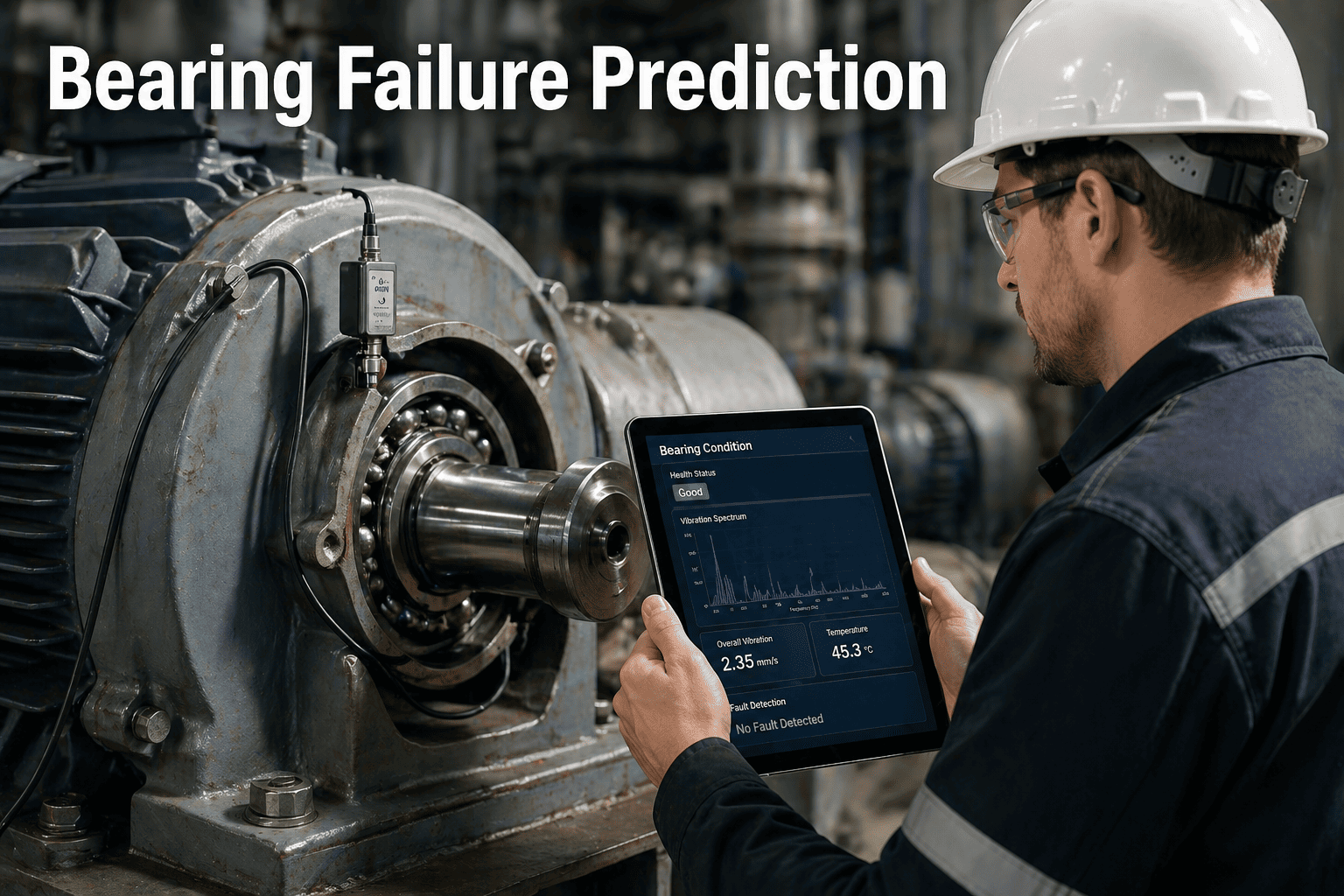
A water utility's centrifugal pump ran for 11 months on a calendar-based PM schedule — oil change every 90 days, bearing inspection every 180 days, full overhaul every 3 years. The pump failed catastrophically 47 days after its last "passed" inspection because the failure mode was not something a human inspector could detect: the inner race of the drive-end bearing had developed a subsurface fatigue crack that produced a 0.8mm/s vibration increase at the ball pass frequency — invisible to the naked eye, inaudible to the human ear, and undetectable by a technician with a stethoscope. A machine learning model monitoring the same bearing would have detected the spectral anomaly 34 days before failure, correlated it with the 0.2°C temperature rise in the bearing housing and the 1.1% increase in motor current, and generated a predictive work order with the specific failure mode, recommended parts, and optimal repair window. The repair during a planned shutdown: $4,800. The emergency replacement after catastrophic failure: $186,000 including production loss, overtime labor, and expedited parts shipping. Machine learning does not replace maintenance technicians. It replaces the impossible expectation that humans can detect failure patterns hidden in multi-dimensional sensor data across hundreds of assets simultaneously. Schedule a demo to see ML-powered failure prediction running on industrial equipment data.

Practical Implementation Guide 2026
Machine Learning for Equipment Failure Prediction: From Sensor Data to Prevented Failures

No data science degree required. This guide explains how ML models detect equipment failures weeks before they happen, what data you actually need, and how to deploy prediction on your critical assets in 60 days using a cloud-based CMMS platform.

34 DaysAvg. Advance Detection
92%Prediction Accuracy
38×Cost Avoidance Ratio
ZeroData Scientists Needed
60 DaysFull Deployment
$4.8Kvs $186K Emergency

What Machine Learning Actually Does in Maintenance

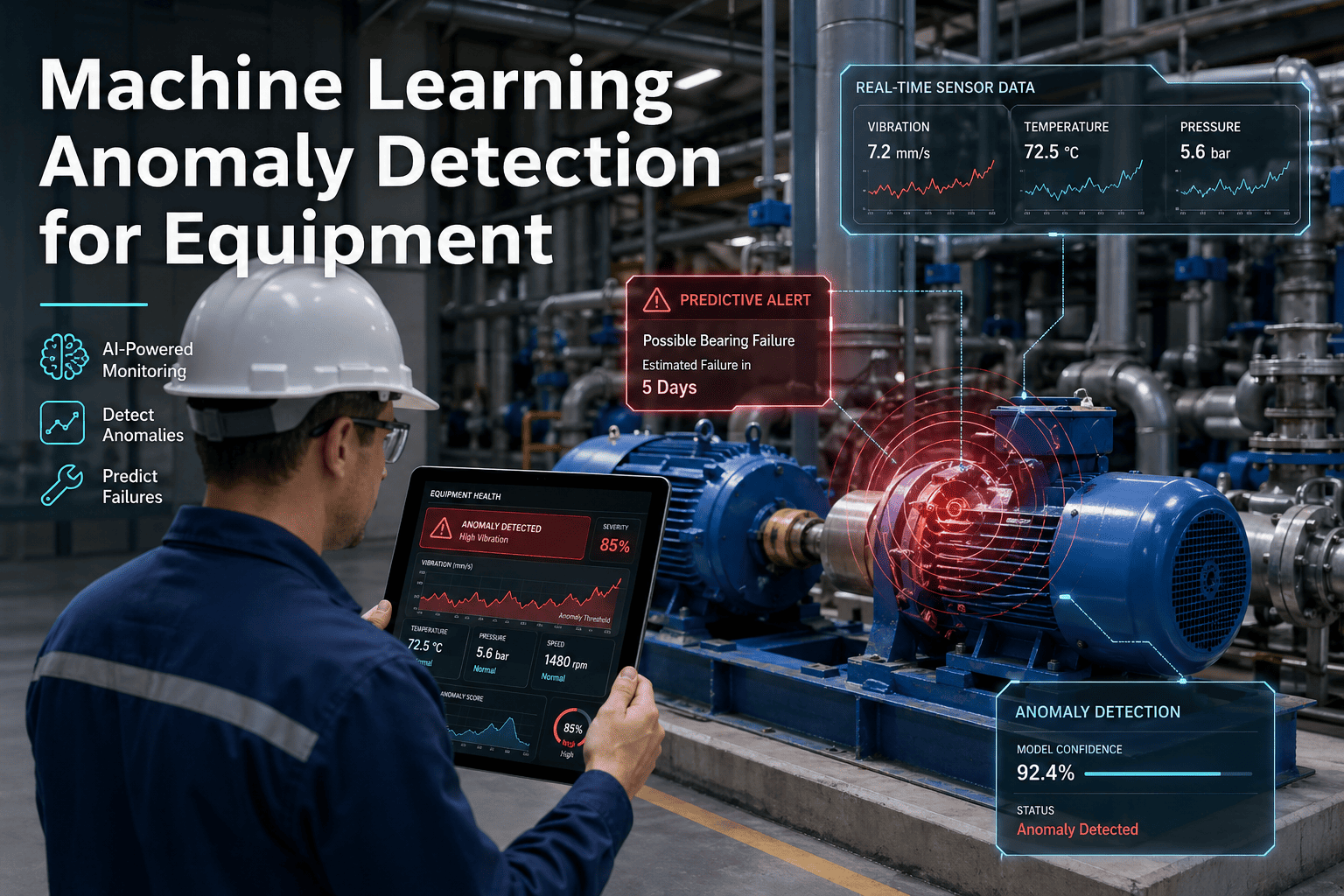
Machine learning for equipment failure prediction is not magic — it is pattern recognition at a scale and speed that humans cannot match. An ML model learns what "normal" looks like for a specific piece of equipment by analyzing thousands of hours of operational data. When the equipment begins deviating from its learned normal behavior — even by amounts too small for humans to notice — the model flags the anomaly, identifies the most likely failure mode, and estimates time-to-failure. The critical difference from threshold-based alarms: ML detects multi-parameter correlations that no single sensor alarm would trigger. Sign up free and see ML failure prediction active on your critical assets from day one.

Anomaly Detection
The model learns the normal operating envelope — vibration spectra, temperature profiles, current draw patterns, pressure relationships — for each monitored asset. Any deviation from learned behavior triggers investigation. Unlike fixed thresholds, the "normal" envelope adjusts for load, ambient conditions, and production context.
Unsupervised learningContext-aware baselinesSub-threshold detection
Failure Mode Classification
Once an anomaly is detected, supervised classification models identify which failure mode is developing. The model was trained on thousands of labeled failure events across similar equipment — bearing inner race defect, seal leak, impeller imbalance, winding insulation breakdown — and matches the current anomaly signature to the most likely diagnosis.
Supervised classification14,000+ failure libraryConfidence scoring
Remaining Useful Life (RUL)
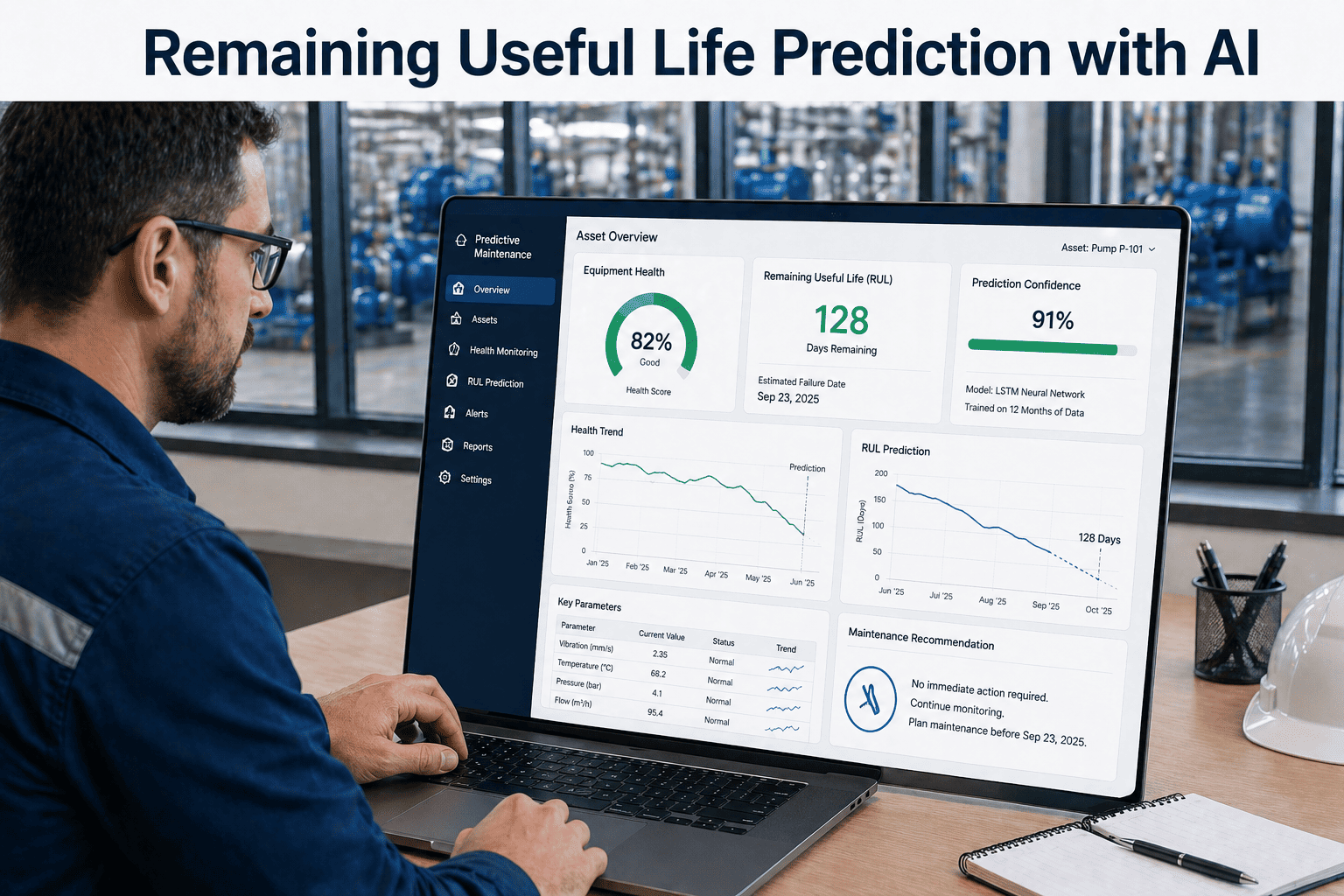
Regression models estimate how much operational time remains before the component reaches functional failure. Output: "Bearing #3 has 22–28 days of remaining useful life at current operating conditions." This window determines whether the repair fits into the next planned outage or requires schedule acceleration.
Survival analysisDegradation curve fittingConfidence intervals
Autonomous Action Generation
The ML pipeline does not stop at prediction — it generates the maintenance response. A complete work order is auto-created with: diagnosed failure mode, specific component, recommended repair procedure, required parts (inventory checked), estimated labor, and optimal scheduling window. The planner approves; the AI builds.
Auto work ordersParts pre-stagingSchedule optimization

What Data Do You Actually Need?

The biggest misconception about ML failure prediction is that you need massive sensor deployments and years of historical data before you can start. In 2026, cloud-based ML platforms use transfer learning from industry-wide datasets — meaning your model starts with 90%+ accuracy on common equipment types using data you already have.

Data Requirements: What You Need vs. What You Think You Need
Data Source What Most Think What ML Actually Needs You Already Have It?
Vibration Data Dedicated wireless sensors on every asset Existing BAS/SCADA vibration points or portable route data Likely Yes
Temperature Infrared cameras on every bearing BAS/SCADA temperature points, RTDs, or thermocouples already installed Almost Certainly
Motor Current Power quality analyzers on every motor VFD built-in current monitoring or MCC metering already logging data If VFD-Driven
Maintenance History 5+ years of perfectly labeled failure data Transfer learning from 14,000+ industry failure events fills the gap Helpful, Not Required
Process Data Historian with 1-second resolution on every parameter 5-minute averages from existing SCADA/BAS are sufficient for most models Yes (BAS/SCADA)
You Already Have the Data. You Just Need the Model.
OxMaint connects to your existing BAS, SCADA, and telematics data — no new sensor deployments required. Cloud-based ML models trained on 14,000+ failure events start predicting on your equipment from week one.

ML Prediction Accuracy by Equipment Type

Failure Prediction Accuracy: Day 1 vs. Month 12 Transfer learning accuracy (day 1) vs. site-tuned accuracy (12 months) across common industrial equipment
Pumps and Compressors92% → 96%

Electric Motors and Drives91% → 95%

HVAC Systems (Chillers, AHUs)90% → 94%

Conveyors and Material Handling89% → 93%

Generators and Turbines88% → 94%

Custom/Specialized Equipment80% → 93%

The Economics of ML Failure Prediction

Cost Comparison: Reactive vs. Calendar PM vs. ML Predictive Annual maintenance cost for a facility with 200 critical rotating assets
Reactive + Calendar PM
Emergency repairs (40% reactive)$1.8M/yr
Calendar PM (30% unnecessary)$620K/yr
Production downtime losses$2.4M/yr
Overtime and expedited parts$380K/yr
Planned vs. unplanned ratio60/40
Total Annual Cost: $5.2M
VS
ML Predictive Maintenance
Emergency repairs (under 8%)$360K/yr
Condition-based PM (optimized)$430K/yr
Downtime losses (70% reduction)$720K/yr
OT eliminated, parts pre-staged$95K/yr
Planned vs. unplanned ratio92/8
Total Annual Cost: $1.6M

60-Day Practical Deployment Roadmap

ML failure prediction deploys in 60 days — not 12 months. Cloud-based models start predicting from week one using transfer learning. Your site-specific accuracy improves every week as the model learns your equipment's unique operating patterns. Start your free trial and have ML prediction active on critical assets within the first week.
Weeks 1–2: Connect Data and Deploy Models Predictions Begin
Connect BAS/SCADA/telematics data feeds to OxMaint ML engine Import asset registry with equipment type, criticality, and nameplate data Activate pre-trained models on pumps, motors, compressors, and HVAC Configure confidence thresholds for auto work order generation vs. watchlist
Weeks 3–4: Validate and Calibrate Accuracy Tuning
Review first predictions — confirm, dismiss, or defer each AI recommendation Feedback loop: confirmed predictions improve model; dismissed ones retrain it Adjust RUL confidence intervals based on your risk tolerance and outage schedule Activate autonomous work order generation for high-confidence predictions
Weeks 5–6: Expand and Optimize Portfolio Coverage
Extend ML monitoring to secondary and tertiary assets by criticality tier Activate condition-based PM optimization — replace calendar triggers with ML triggers Deploy predictive dashboards for reliability engineering and plant leadership Configure outage planning integration — ML predictions feed planned shutdown scope
Weeks 7–8: Self-Improving Intelligence Continuous Learning
Review 45-day prediction accuracy — benchmark against industry targets Activate remaining useful life trending for capital replacement planning Generate first ML-backed budget justification with documented prevented failures Model accuracy reaches 92–95% on monitored equipment — self-improving monthly
The Bearing Is Already Cracking. The Question Is Whether You Detect It.
OxMaint's ML engine detects the failure signatures hiding in your existing sensor data — generating predictive work orders weeks before failure so repairs happen on your schedule, not the equipment's. No data scientists. No 12-month projects. Predictions from week one.

Frequently Asked Questions

Do we need a data science team to implement ML failure prediction?
No. Cloud-based ML platforms like OxMaint handle all model training, deployment, and optimization automatically. Your reliability engineers review AI recommendations and provide feedback (confirm/dismiss) that improves the models. The ML runs in the background — your team interacts with work orders and dashboards, not algorithms or code.
How does transfer learning work — and why does it mean we can start immediately?
Transfer learning means the ML model was pre-trained on failure data from 14,000+ similar assets across hundreds of facilities. When you connect a centrifugal pump to OxMaint, the model already knows what bearing failure, seal degradation, and impeller imbalance look like on centrifugal pumps — it does not need to learn from scratch on your specific unit. Your unit's data then fine-tunes the model for site-specific accuracy improvement over time. Book a demo to see transfer learning accuracy benchmarks for your equipment types.
What happens when the ML model makes a wrong prediction?
Every prediction includes a confidence score. When a technician inspects and finds no defect (false positive), they mark the prediction as "not confirmed" in the mobile app. The ML model retrains on this feedback — the same false positive pattern will not trigger again. False positive rates drop below 5% within 6 months. False negatives (missed failures) are addressed by continuously expanding the training dataset with every confirmed failure across the platform's global user base.
Can ML prediction work with only monthly vibration route data instead of continuous monitoring?
Yes, but with reduced advance warning. Continuous monitoring provides 3–8 weeks of advance warning. Monthly route data provides 1–3 months of advance warning per collection cycle but may miss rapidly developing faults between routes. The practical approach: continuous monitoring on critical Tier 1 assets and monthly route data on Tier 2–3 assets. ML models adapt to both data frequencies automatically.
What is the realistic ROI for deploying ML failure prediction?
A single prevented critical failure ($50K–$2M depending on equipment and industry) exceeds years of platform cost. Across a portfolio of 200 critical assets, documented annual savings average $3.6M from emergency cost elimination, PM optimization, downtime reduction, and parts pre-staging. ROI is typically 15–40× platform investment within the first 12 months. Start free and calculate your facility's ML prediction ROI.
By Jennie

Experience
Oxmaint's
Power

Take a personalized tour with our product expert to see how OXmaint can help you streamline your maintenance operations and minimize downtime.

Book a Tour

Share This Story, Choose Your Platform!

Connect all your field staff and maintenance teams in real time.

Report, track and coordinate repairs. Awesome for asset, equipment & asset repair management.

Schedule a demo or start your free trial right away.

iphone

Get Oxmaint App
Most Affordable Maintenance Management Software

Download Our App