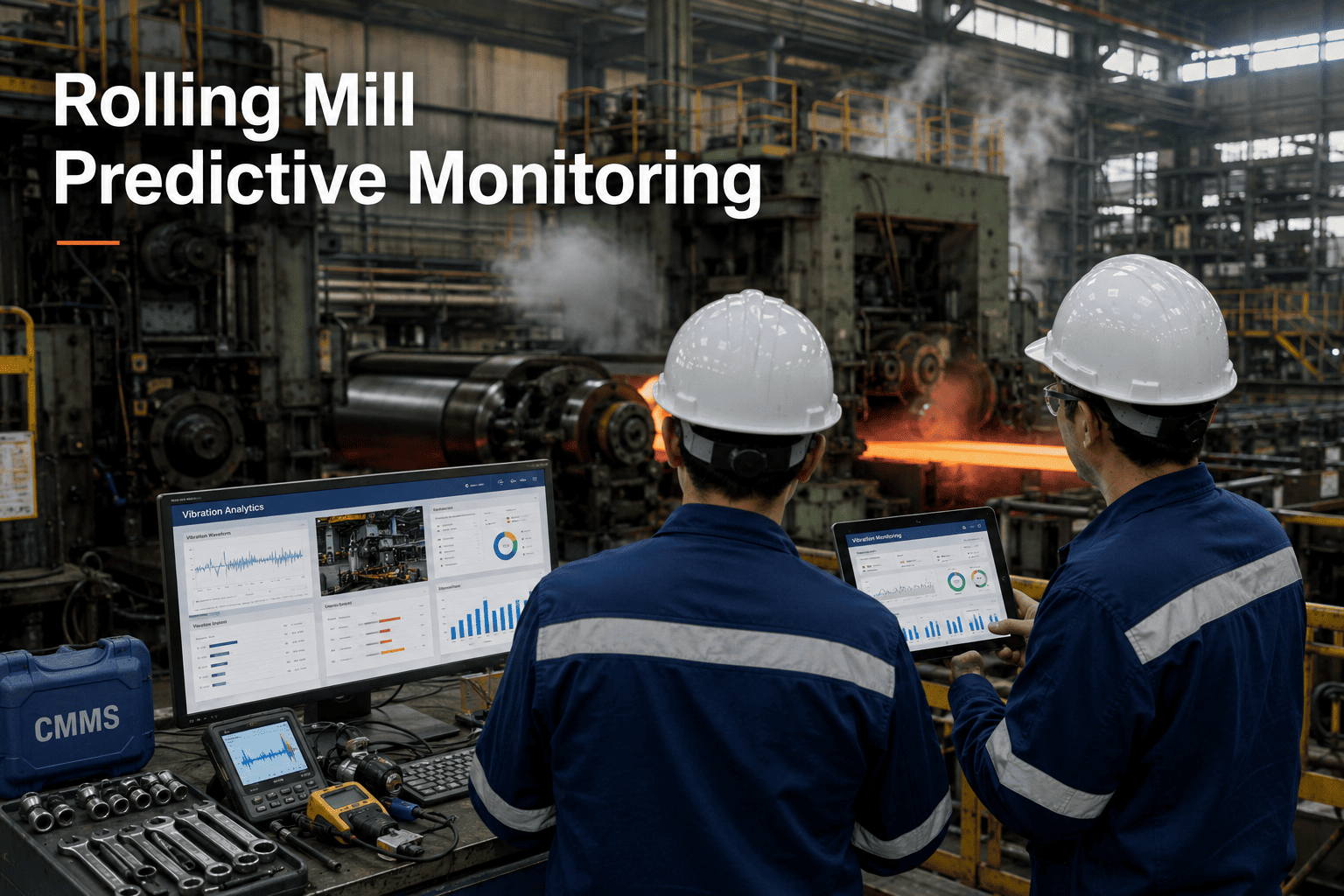
Rolling mills generate vibration signatures that tell a precise story about mechanical health — bearing wear, roll eccentricity, gear mesh degradation, chock looseness, and drive coupling fatigue all produce distinct vibration patterns that appear weeks before a mill trip or roll change emergency. Yet the majority of steel plants still monitor rolling mill vibration reactively — using alarm thresholds that trip after the failure signature has already progressed to a critical level, or scheduling vibration surveys on quarterly intervals that miss the rapid progression window between degradation onset and failure. Plants that have deployed predictive vibration monitoring integrated with CMMS report 50–70% reductions in unplanned mill stoppages and average savings of $800K–$2.4M annually per major rolling line. OxMaint CMMS integrates with vibration monitoring systems to convert raw sensor data into structured maintenance work orders, condition trend dashboards, and predictive PM schedules — giving maintenance engineers the lead time to intervene before rolling mill vibration becomes a production stoppage.
Rolling Mill Vibration Monitoring and Predictive Maintenance Alerts
Detect rolling mill faults weeks before they cause production stoppages. Integrate vibration monitoring data with CMMS to convert condition signals into structured work orders, predictive PM schedules, and roll change planning.
What Is Rolling Mill Vibration Monitoring and Predictive Maintenance
Rolling mill vibration monitoring is the continuous measurement and analysis of mechanical vibration signals from mill stands, drive trains, rolls, chocks, and associated equipment to detect degradation before it causes failure or product quality loss. Each component in a rolling mill produces a characteristic vibration signature at healthy baseline — when that signature changes due to wear, imbalance, misalignment, or mechanical looseness, the deviation is detectable weeks before the component reaches failure threshold.
Predictive vibration monitoring goes beyond alarm threshold management. It applies trend analysis, spectral signature recognition, and condition-based maintenance logic to surface specific fault indicators — bearing BPFO/BPFI frequencies, gear mesh harmonics, roll eccentricity signatures, and chatter frequencies — and translates those signals into maintenance intelligence that maintenance engineers can act on. Integrated with CMMS, vibration findings generate work orders automatically at the optimal intervention point.
The economic case is substantial. A single unplanned hot mill stoppage typically costs $150,000–$600,000 in lost production, emergency repair, and downstream disruption. A predictive vibration program that prevents 8–12 such events annually delivers $1.2M–$7M in direct savings. Steel plants managing rolling mill assets can start a free trial to see how Oxmaint structures vibration monitoring integration, or book a demo for a live walkthrough of rolling mill condition dashboards.
8 Key Vibration Failure Modes CMMS Predictive Monitoring Catches
BPFO, BPFI, BSF, and FTF frequency signatures identify bearing defects 4–12 weeks before failure. CMMS triggers bearing replacement work orders at the optimal intervention point — before the defect becomes a mill stoppage.
Eccentricity and mass imbalance in work rolls and backup rolls generate 1X rotational frequency signatures that affect both mill vibration and strip thickness variation. CMMS links vibration findings to roll change scheduling and quality records.
Gear mesh frequency harmonics and sidebands indicate pinion wear, pitch error, and gear damage in mill gearboxes and spindle couplings. Early detection prevents the catastrophic gear failures that cause multi-day mill outages.
Mill chatter — the regenerative vibration instability that causes surface defects and strip gauge variation — has a distinct vibration signature. CMMS condition tracking identifies chatter onset and links it to roll gap, speed, and lubricant parameters.
Misalignment generates 2X and 3X rotational frequency harmonics in mill drive spindles and universal joint couplings. CMMS work orders for alignment correction are generated before misalignment progresses to spindle failure.
Structural looseness in roll chocks, housing windows, and mill stand frames generates subharmonic and broadband vibration signatures. CMMS PM scheduling for chock inspection and preload verification prevents looseness from escalating to roll dropping events.
Rotor bar defects, eccentricity, and winding faults in mill drive motors generate vibration and current signatures. CMMS integration with motor current analysis and vibration data provides early warning on drive system failures before they trip the mill.
Hydraulic AGC and roll gap control system instabilities generate pressure and vibration signatures that affect both mill dynamics and product quality. CMMS PM scheduling for hydraulic system maintenance is linked to mill vibration trend data.
4 Pain Points in Reactive Rolling Mill Vibration Management
Fixed vibration alarm thresholds alert only when severity crosses a critical level — often less than 24–48 hours before failure. By the time the alarm fires, the intervention window for a planned, low-cost repair has already closed. Emergency maintenance at overtime rates becomes the only option.
Vibration data lives in a separate condition monitoring system while work orders live in a CMMS — and the two systems rarely communicate. Maintenance engineers must manually translate vibration findings into CMMS work orders, introducing delay, data loss, and priority misalignment between the condition finding and the maintenance response.
Quarterly or monthly vibration surveys on high-speed rolling mill assets create coverage gaps that miss rapidly developing failure modes. A bearing that was at alert level on Monday can reach failure threshold by Wednesday — completely invisible between survey dates.
Without condition-based roll change scheduling linked to vibration data, roll changes are driven by calendar, campaign length assumptions, or quality complaints — not actual roll condition. Both over-maintenance (premature roll changes) and under-maintenance (delayed changes causing quality failures) represent significant avoidable cost. Ready to close the gap — start a free trial today.
How Oxmaint CMMS Integrates Vibration Monitoring for Steel Mills
Oxmaint connects to vibration monitoring platforms and online sensor systems via OPC-UA, REST API, and MQTT. Condition readings flow directly into CMMS asset records — eliminating manual data transfer and closing the vibration-to-work-order gap.
Configure vibration condition thresholds at the asset and component level. When readings cross alert or danger thresholds, Oxmaint auto-generates maintenance work orders with pre-populated fault type, asset ID, severity, and recommended action.
Maintenance engineers see rolling trend charts for every monitored mill component — bearing vibration velocity, temperature, gear mesh amplitude — with alert band overlays. Trends are visible across shift, week, month, and campaign time windows.
Link roll condition data from vibration monitoring, roll shop records, and quality feedback to CMMS roll change scheduling. Condition-based roll change intervals replace calendar cycles — reducing unnecessary changes and preventing quality-driven emergency roll pulls.
When vibration trends indicate a bearing or gear replacement is approaching, Oxmaint checks parts inventory and auto-generates procurement requests if stock is below the required level. The right parts are in stock before the work order is scheduled.
Production and maintenance managers see condition scores, active alerts, and upcoming PM events across every mill stand in the rolling line from a single dashboard. Portfolio-level visibility enables proactive resource allocation before degradation events develop.
Reactive vs Predictive Vibration Maintenance — Before and After
| Maintenance Factor | Reactive Vibration Management | Predictive CMMS Integration |
|---|---|---|
| Failure Warning Lead Time | 0–48 hours. Alarm thresholds trigger only when failure is imminent. Repair window is emergency-only. | 4–12 weeks for most bearing and gear failures. Full planning window for scheduled, low-cost intervention. |
| Unplanned Mill Stoppages | 12–24 per year per major rolling line. Each event costs $150K–$600K in production loss and emergency repair. | 4–8 per year after 12 months of predictive monitoring. 55–70% reduction in unplanned events. |
| Repair Cost Basis | Emergency rate: 3–5x planned. Overtime labour, expedited parts, specialist call-out premiums. | Standard planned rate. Parts ordered ahead, scheduled maintenance window, standard labour. |
| Roll Change Efficiency | Calendar or complaint-driven. 20–30% of roll changes are premature; 15–20% are delayed to the point of quality impact. | Condition-driven. Roll changes scheduled at optimal condition point — neither premature nor delayed. |
| Annual Maintenance Cost | $4M–$12M per major rolling line including emergency events and over-maintained equipment. | $2.5M–$7M — 30–40% reduction through elimination of emergency premiums and optimised roll change cycles. |
ROI and Results — Rolling Mill Predictive Vibration Programs
Frequently Asked Questions
What vibration monitoring systems does Oxmaint CMMS integrate with?
How does CMMS handle false-positive vibration alerts on rolling mills?
Can Oxmaint track roll condition across roll shop, mill, and grinder for predictive roll change scheduling?
How quickly can Oxmaint vibration integration be deployed on an active rolling mill without disrupting production?
Stop Losing Millions to Rolling Mill Failures You Could Have Seen Coming
Every major rolling mill bearing and gear failure produces a vibration signature weeks before it becomes an emergency. Oxmaint converts that signal into structured maintenance action — condition-based work orders, optimised roll change scheduling, and a real-time dashboard that shows every mill stand's health across your entire rolling line.
Used by operations teams managing complex multi-stand rolling line portfolios. See measurable results in the first 30 days.




.png)
