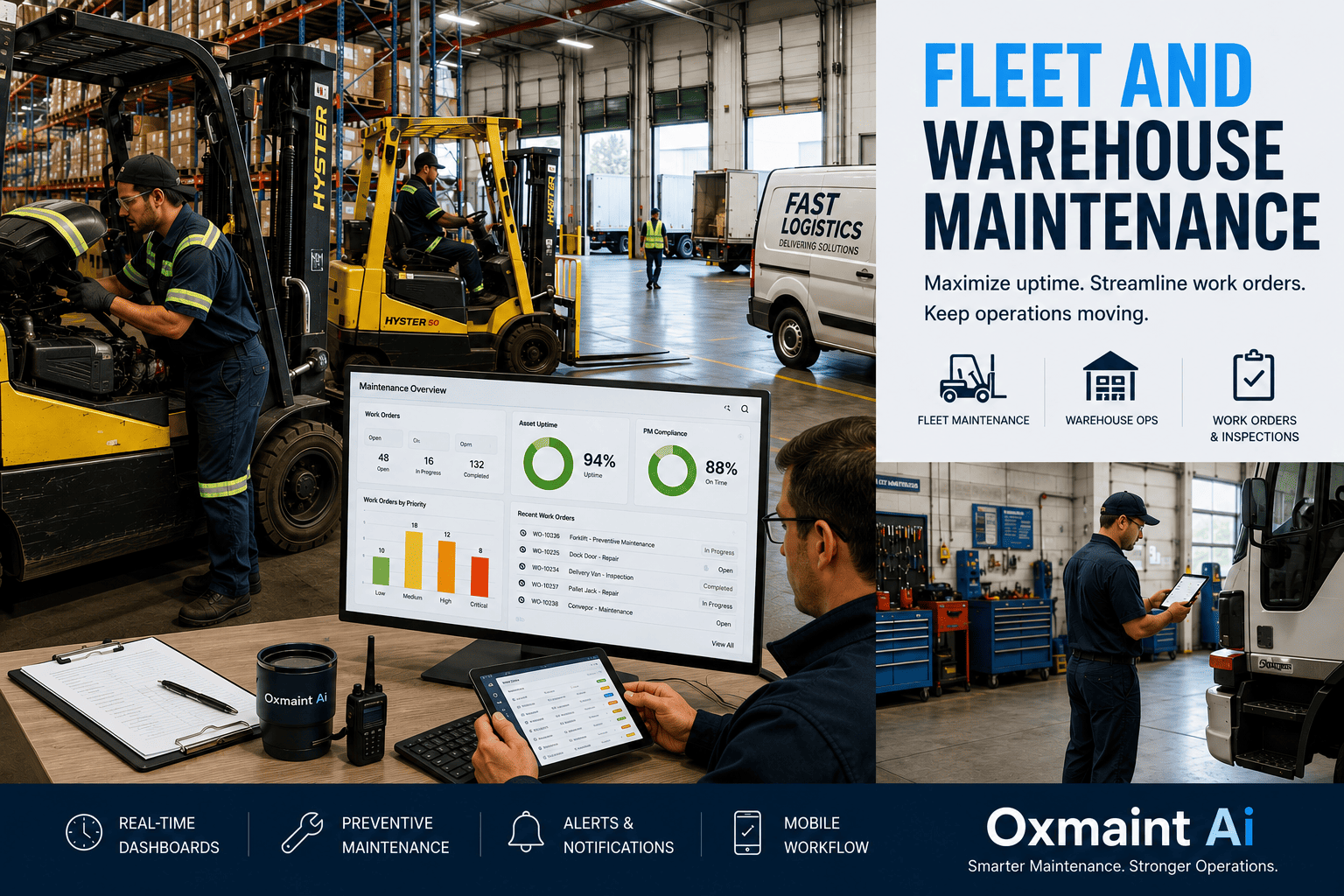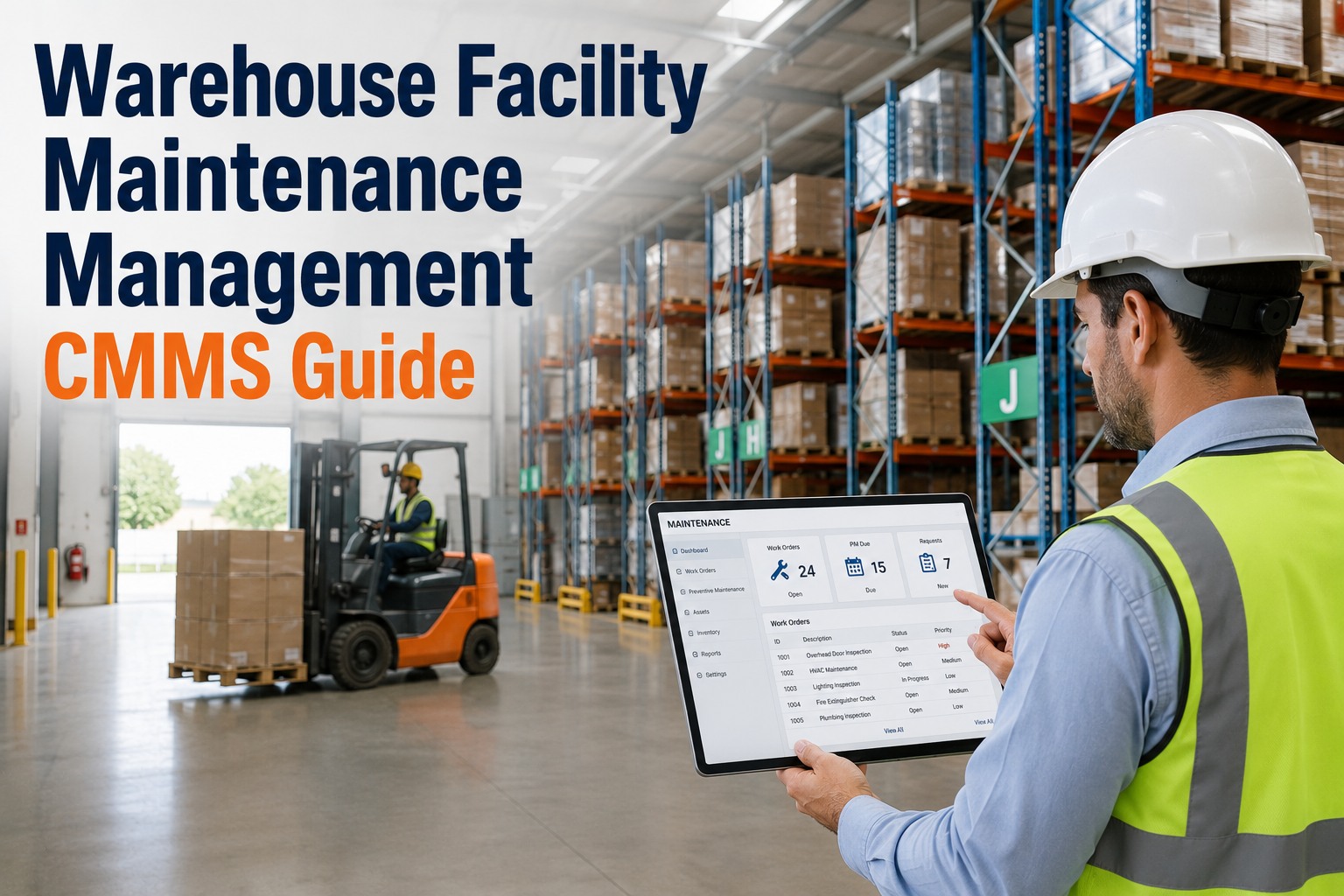
Warehouse maintenance management is the discipline of keeping distribution center assets — dock doors, conveyor and sortation systems, HVAC, lighting, fire suppression, racking, and material handling equipment — running at the throughput levels modern DCs require. A warehouse CMMS centralizes work orders, preventive maintenance scheduling, asset tracking, and spare-parts inventory so facility teams move from reactive firefighting to planned, predictive reliability. Distribution center maintenance teams using paper logs or spreadsheets typically lose 15–20 hours per week to administrative overhead and suffer 30% higher unplanned downtime than peers on a digital platform. OxMaint brings AI-powered CMMS and EAM capabilities to warehouse facility management, cutting unplanned downtime by up to 50% and turning every dock, conveyor, and building system into a tracked, predictable asset — you can Start Free Trial today or book a personalized demo to see it on your operation.
Every minute a dock door or conveyor is down costs a DC up to $1,200 in lost throughput. Is your maintenance ready?
From dock levelers to sortation conveyors, racking inspections to fire suppression — warehouse facility management teams juggle hundreds of mission-critical assets across large facilities. OxMaint's warehouse CMMS digitizes PM schedules, work orders, and asset tracking so no equipment fails unnoticed and no compliance deadline slips.
A single unplanned dock door failure during peak shipping can delay an entire outbound wave — and reactive teams take 3–5x longer to restore service than those running structured PM cycles inside a warehouse CMMS.
What assets does a warehouse CMMS need to manage?
A distribution center's reliability depends on six interlocking asset categories. Each one carries its own failure modes, compliance requirements, and PM cadence — and each must be tracked individually inside your warehouse maintenance software to prevent the cascading delays that cost DCs millions annually.
Dock Doors & Levelers
Vehicle restraints, leveler lip wear, hydraulic seals, and door-panel tracks. PM every 30–90 days. A failed restraint is an OSHA citation waiting to happen.
Conveyor & Sortation
Belt tension, drive motors, photo-eye sensors, rollers, and diverters. Belts, chains, and gearboxes need lubrication on a strict 40-hour runtime cycle.
HVAC & Climate Control
Rooftop units, evaporative condensers, and zoning controls protect temperature-sensitive inventory and worker safety in facilities exceeding 500K sq ft.
Lighting Systems
High-bay LEDs, emergency egress lighting, and occupancy sensors. Failed egress lighting is a fire-code violation that can halt operations during an audit.
Fire Suppression
ESFR sprinklers, valve rooms, fire pumps, and clean-agent systems in server/electrical rooms. NFPA 25 mandates quarterly inspections and full annual flow tests.
Racking & Storage
Selective, pushback, and drive-in rack systems. SEMA / RMI inspections annually; damaged uprights must be offloaded immediately and tagged out.
The true cost of reactive warehouse maintenance — a 180-asset DC
Consider a 450,000-sq-ft distribution center running 180 tracked assets: 24 dock doors, 12 conveyor lines, 8 RTUs, 180 high-bay fixtures, and 6 fire-suppression zones. The maintenance team relies on paper work orders and a shared spreadsheet. Here is what that status quo actually costs them every year.
By migrating the same 180 assets to OxMaint's warehouse PM software with automated PM triggers, mobile work orders, and predictive analytics on conveyor motor vibration data, this DC could reduce unplanned downtime by 35–50%, recover the 15 weekly admin hours, and pay back the software investment in under 90 days. The shift from reactive to planned maintenance is the single highest-ROI move a warehouse facility manager can make.
Spreadsheet vs. warehouse CMMS: what changes when you go digital
Most DC maintenance teams know they have outgrown spreadsheets but hesitate to switch. The comparison below maps exactly what changes — and what it costs to keep waiting — when you move from paper and Excel to a purpose-built warehouse maintenance tracking platform.
| Maintenance Capability | Spreadsheets & Paper | OxMaint Warehouse CMMS |
|---|---|---|
| Work order creation & assignment | Manual entry, email/text follow-up, lost tickets | Auto-generated from PM triggers or requests; assigned to mobile technicians in seconds |
| Dock door PM scheduling | Calendar reminders missed 20–30% of the time | Automated 30/60/90-day cycles per door; escalations if skipped |
| Spare-parts inventory tracking | Manual cycle counts; stockouts halt repairs | Real-time stock levels; auto-reorder points; parts linked to assets |
| Compliance & audit readiness | Binders and folders; days to assemble an audit | Every inspection timestamped and photo-documented; export in one click |
| Downtime visibility | Discovered after the shift is already delayed | AI predictive alerts flag conveyor motor anomalies before failure |
| Mean time to repair (MTTR) | 60–90 min — tech arrives, finds wrong parts | 20–30 min — full asset history and parts on the mobile app |
How OxMaint powers warehouse & DC maintenance management
OxMaint is an AI-powered CMMS and EAM platform built for the scale and complexity of modern distribution centers. Here is how four core capabilities map directly to the warehouse maintenance problems that keep facility managers up at night — and the measurable outcomes each one delivers.
Automated PM Scheduling
Trigger preventive maintenance on runtime hours, calendar cycles, or meter readings for every dock door, conveyor motor, and RTU. Eliminate missed PMs and the 20–30% slippage rate of spreadsheet-based scheduling.
Mobile Work Orders
Technicians receive, update, and close work orders from the warehouse floor — with photo capture, parts consumption, and digital signatures. No more paper tickets, no more lost data, no more end-of-shift data entry.
AI Predictive Analytics
Vibration, temperature, and motor-current data from conveyor and sortation systems feed OxMaint's AI engine, which flags bearing degradation and belt wear days or weeks before catastrophic failure — letting you plan repairs during off-peak windows.
Asset & Parts Tracking
Every asset — from dock leveler #12 to conveyor Line 3 Motor B — carries its full maintenance history, warranty info, and spare-parts bill of materials. Auto-reorder points prevent the stockouts that turn a 30-minute fix into a 4-hour shutdown.
See OxMaint on your dock doors, conveyors, and building systems
Book a 30-minute demo and we'll walk you through a live warehouse CMMS environment — configured with your asset types, PM cycles, and compliance requirements.
How to implement warehouse maintenance software in 30 days
Switching from spreadsheets to a warehouse CMMS does not have to be a six-month IT project. OxMaint's structured onboarding gets a typical 200-asset distribution center fully live in under 30 days — with zero operational disruption.
Asset Hierarchy & Import
Upload your existing asset list (dock doors, conveyors, RTUs, racking zones) via CSV. OxMaint builds the parent-child hierarchy — site, zone, line, asset, component — and assigns unique IDs. Most DCs complete this in 2–3 days.
PM Schedules & Work Order Templates
Configure preventive maintenance cycles per asset class — 30-day dock door inspections, 40-hour conveyor lubrication, quarterly HVAC coil cleaning. Build work order templates with checklists, required parts, and estimated labor.
Mobile App Rollout & Training
Technicians install the OxMaint mobile app, receive credentials, and complete a 60-minute training session. Begin closing live work orders from the floor with photo capture and parts consumption tracking.
Dashboard & KPI Go-Live
Facility managers access real-time dashboards: open WOs, PM compliance %, MTTR, downtime by asset, and parts stock alerts. First maintenance analytics review with leadership — your DC is now running on a true CMMS.
Warehouse CMMS & facility maintenance FAQs
What is a warehouse CMMS and how is it different from general maintenance software?
A warehouse CMMS is a computerized maintenance management system specifically configured for distribution center operations — it tracks dock doors, conveyor and sortation systems, racking, and building HVAC/lighting/fire suppression as distinct asset classes with their own PM cycles, compliance standards (NFPA 25, RMI/SEMA, OSHA), and failure modes. General maintenance software lacks the asset hierarchies, runtime-based PM triggers, and high-bay-scale work order workflows that DC facility management demands.
How much does warehouse maintenance software cost?
Most warehouse CMMS platforms price per user per month, ranging from $40 to $120 per technician depending on features like predictive analytics, mobile work orders, and parts inventory. For a 10-technician DC team, a typical OxMaint deployment costs $4,800–$14,400/year — against $50K+ in avoided downtime, overtime, and expedited-parts spend. Most distribution centers achieve full payback in under 90 days.
How often should dock doors and conveyors receive preventive maintenance?
Dock doors and levelers should be inspected every 30–90 days depending on usage volume, with vehicle restraints checked monthly per OSHA and ANSI MH30.2 standards. Conveyor and sortation systems require lubrication every 40 runtime hours, with belt tension and photo-eye alignment checks weekly and drive-motor vibration analysis monthly. OxMaint automates these cycles based on actual runtime data rather than calendar guesses.
Can a warehouse CMMS track racking inspections and fire suppression compliance?
Yes. OxMaint stores every racking inspection as a timestamped, photo-documented work order tied to the specific aisle and upright — with damage severity tagging and automatic load-down or tag-out alerts. Fire suppression systems are tracked to NFPA 25 quarterly inspection and annual full-flow-test requirements, with automatic reminders 30 days before each deadline so no compliance window is missed.
How long does it take to switch from spreadsheets to a warehouse CMMS?
A typical 150–250 asset distribution center goes fully live on OxMaint in 30 days or less. Week one covers asset CSV import and hierarchy setup; week two configures PM schedules and work order templates; week three rolls out the mobile app to technicians; and week four brings dashboard and KPI go-live. No IT infrastructure is required — OxMaint is cloud-based, so there are no servers to install and no integrations to wait on.
Stop losing throughput to reactive warehouse maintenance
Join the distribution centers using OxMaint to cut unplanned downtime up to 50%, recover 15+ weekly admin hours, and keep every dock, conveyor, and building asset audit-ready. Start your free trial or book a personalized demo today.
Free 14-day trial · No credit card