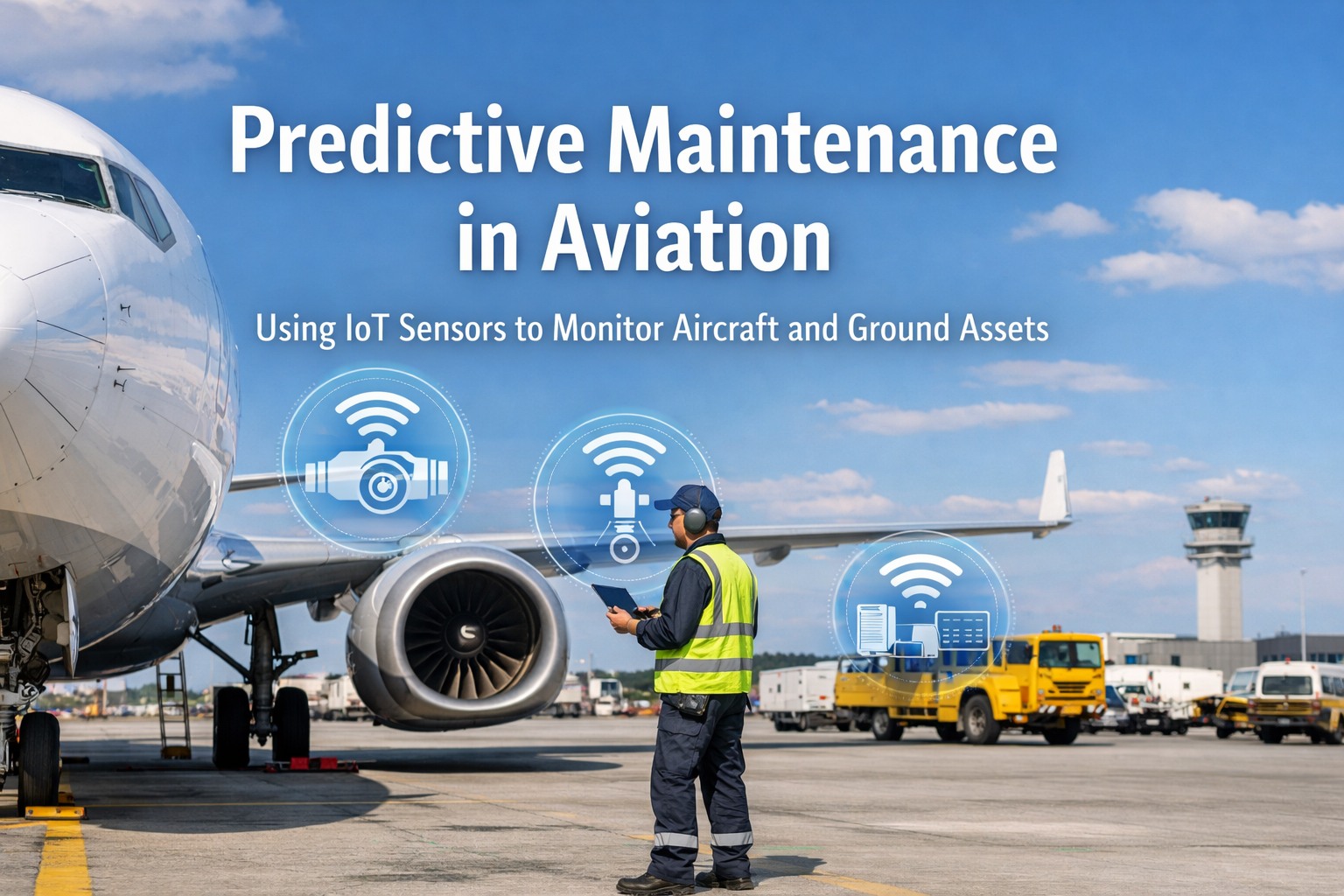
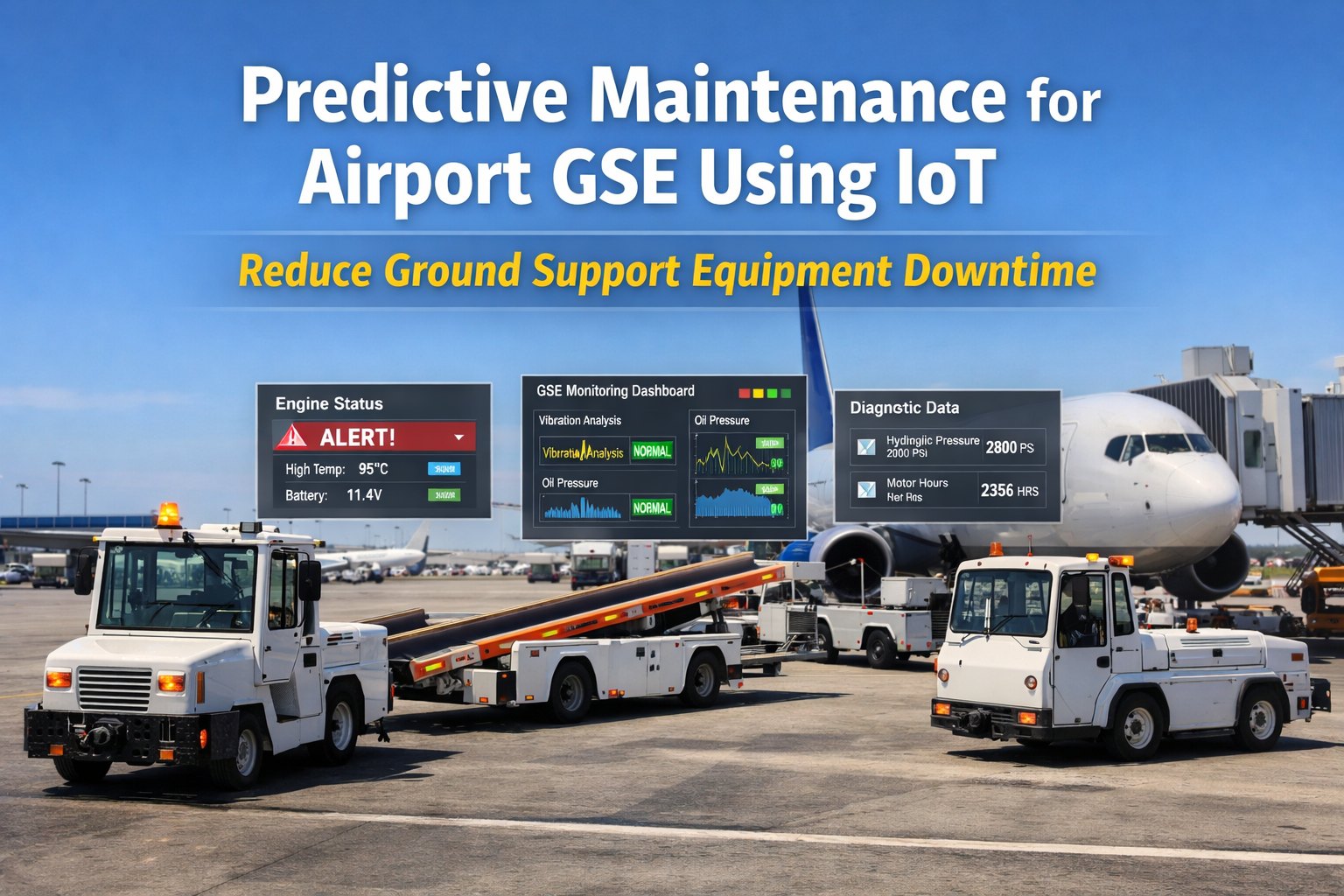
Every minute an aircraft sits at the gate costs airlines approximately $100 in delay expenses. With over 35,000 passenger boarding bridges operating worldwide, even minor jetway malfunctions cascade into flight delays, passenger frustration, and operational chaos. Yet most facilities still rely on reactive maintenance—waiting for failures before taking action. IoT-enabled PBB monitoring transforms gate operations from guesswork into precision intelligence, predicting failures before they disrupt your schedule. Schedule a consultation to discover how smart jetway analytics can optimize your turnaround times and eliminate unplanned gate closures.
The Gate Operations Challenge
Passenger boarding bridges are the critical link between terminal and aircraft—and when they fail, everything stops. Industry data reveals that ground handling issues contribute to nearly a third of all flight delays, with jetway malfunctions among the most disruptive equipment failures an airport can experience. The financial and operational consequences extend far beyond the immediate gate.
30%
Of flight delays tied to ground handling issues according to IATA studies
$100
Cost per minute when aircraft turnaround exceeds planned time
35%
Of new PBB contracts now specify IoT and automation features
A single jetway failure during peak operations creates a domino effect: passengers queue in terminals, connecting flights are missed, crews time out, and gate assignments scramble across the entire concourse. Modern IoT monitoring provides the visibility needed to anticipate problems and act before passengers ever notice.
What Smart PBB Monitoring Tracks
Comprehensive jetway monitoring captures data from dozens of sensors positioned throughout the boarding bridge system. This continuous intelligence stream reveals equipment health, operational patterns, and emerging issues long before they cause service interruptions.
Position & Movement
Encoders tracking elevation, extension, rotation angle in real-time
Docking Accuracy
Laser sensors measuring alignment precision to aircraft door
Door Status
Open/closed/sealed confirmation with safety interlock verification
Drive System Health
Motor current, torque load, vibration patterns for predictive alerts
Hydraulic Performance
Pressure levels, fluid temperature, cylinder response times
Environmental Conditions
Internal temperature, humidity, HVAC system performance
Want to see your gate equipment data in one view? Create a free OXmaint account and explore how centralized monitoring transforms terminal operations management.
Start Free Account
From Reactive to Predictive: The IoT Advantage
Traditional PBB maintenance operates in the dark—technicians respond after failures occur, often during the worst possible moments. IoT monitoring flips this model entirely, providing continuous visibility that enables proactive intervention before problems impact operations.
Reactive Maintenance
Failure Detection
After breakdown
Average Response
45-90 minutes
Gate Availability
85-90%
Parts Inventory
Overstocked or missing
Maintenance Cost
High emergency rates
VS
Predictive IoT Monitoring
Failure Detection
Days to weeks ahead
Average Response
Scheduled window
Gate Availability
98%+ uptime
Parts Inventory
Data-driven stocking
Maintenance Cost
20% reduction typical
Five Warning Signs IoT Sensors Detect Early
Passenger boarding bridges rarely fail without warning—the challenge is recognizing the signals before they disrupt operations. IoT sensors continuously monitor for the subtle changes that indicate developing problems, alerting maintenance teams while there's still time to act.
01
Movement Irregularities
Sensors detect unusual vibrations, slower docking cycles, or inconsistent extension speeds. These deviations from normal patterns indicate developing mechanical issues in drive systems, wheels, or telescopic sections before visible symptoms appear.
Early Alert: Motor torque trending 15% above baseline
02
Alignment Drift
Position encoders track docking accuracy over thousands of cycles. Gradual drift indicates structural settling, sensor calibration decay, or mechanical wear in the rotunda assembly—all correctable during scheduled maintenance windows.
Early Alert: Docking precision degraded 8mm from calibration
03
Hydraulic Pressure Anomalies
Continuous pressure monitoring reveals slow leaks, pump degradation, or cylinder seal wear long before they cause operational failures. Temperature correlation identifies whether issues are environmental or mechanical in origin.
Early Alert: Pressure recovery time increased 2.3 seconds
04
Safety System Degradation
Collision sensors, emergency stops, and interlock circuits are continuously verified. Any degradation in response time or signal integrity triggers immediate alerts—these systems must function perfectly every time.
Early Alert: Proximity sensor response delayed 0.4 seconds
05
Environmental Stress Patterns
Temperature extremes, humidity levels, and weather exposure data correlate with equipment performance. The system learns how your specific PBBs respond to environmental conditions and adjusts maintenance recommendations accordingly.
Early Alert: Seal performance degrading in cold weather cycles
Expert Review: Industry Perspectives on Smart Gate Operations
Terminal operations leaders across the aviation industry have implemented IoT monitoring for their passenger boarding bridges. Their experiences highlight both the operational improvements and the strategic value of moving to data-driven gate management.
"We manage over 80 gates across three concourses. Before IoT monitoring, a jetway failure during the morning bank was catastrophic—we'd scramble maintenance while dozens of flights rippled into delays. Now we see problems developing days ahead. Last month, the system flagged a drive motor drawing excess current on Gate 47. We replaced it during overnight maintenance. Zero operational impact, zero passenger delays."
Key Result:
Gate-related delays reduced 73% in first year of IoT deployment
"The data transformed how we approach maintenance planning. Instead of calendar-based inspections that might miss developing problems or waste effort on healthy equipment, we now maintain based on actual condition. Our bridges range from 5 to 22 years old—the system treats each one according to its real health status, not arbitrary schedules. We've extended equipment life while reducing total maintenance hours."
Key Result:
Maintenance labor reduced 25% while equipment uptime improved
"Turnaround time is everything in our operation—we target 25-minute turns on narrowbody aircraft. The docking analytics showed us that three of our gates consistently took 15-20 seconds longer to dock than the others. Investigation revealed minor calibration drift we'd never have noticed otherwise. After adjustment, those gates now match our fastest performers. Across hundreds of daily turns, that adds up."
Key Result:
Average docking time improved 12 seconds per operation
Ready to bring predictive intelligence to your gates? Book a demo to see how OXmaint's PBB monitoring platform delivers the visibility that leading terminals demand.
Book Demo
The Turnaround Time Impact
Aircraft turnaround is a precisely choreographed sequence where every component must perform flawlessly. The passenger boarding bridge is the gateway for the highest-priority activity: getting passengers on and off the aircraft. Delays at the jetway cascade through the entire turnaround process.
0:00
Aircraft Arrives at Gate
Wheels stop, chocks placed, PBB begins approach
0:45
PBB Docked & Doors Open
Automated systems achieve 45-second dock times
8:00
Deplaning Complete
Passengers exit, cleaning crew enters
15:00
Cabin Service Underway
Concurrent: fueling, catering, baggage
20:00
Boarding Begins
New passengers enter through PBB
35:00
Doors Close, PBB Retracts
Aircraft ready for pushback
Impact of PBB Delay:
Every minute of jetway delay extends total turnaround. Delays exceeding 6 minutes typically cannot be recovered in flight.
Key System Capabilities
Effective PBB monitoring requires purpose-built capabilities that address the unique demands of gate equipment operations. From real-time alerts to long-term trend analysis, the right platform delivers actionable intelligence at every level of your organization.
Live visibility into every PBB across your terminal: current position, operational state, active faults, and docking status. Operations teams see gate readiness at a glance; maintenance teams monitor equipment health continuously.
Machine learning algorithms analyze sensor patterns to identify developing issues. The system learns normal behavior for each PBB and alerts when deviations suggest impending failures—typically days to weeks before breakdown occurs.
Track docking times, accuracy, and operator performance across all gates. Identify which bridges dock fastest, which need calibration, and where additional training might improve turnaround efficiency.
Connect PBB data with visual docking guidance systems (VDGS), flight information displays, and apron management platforms. Create unified gate intelligence that supports Airport Collaborative Decision Making (A-CDM) initiatives.
When sensors detect issues requiring attention, the system automatically generates work orders with diagnostic data, affected components, and recommended actions. Technicians arrive prepared with the right parts and information.
Analyze equipment performance over months and years. Identify seasonal patterns, compare PBB reliability across manufacturers or age groups, and build data-driven business cases for capital equipment decisions.
Implementation Approach
Deploying IoT monitoring across passenger boarding bridges requires a structured approach that minimizes operational disruption while maximizing the value of your investment. Successful implementations follow a phased methodology that builds capability progressively.
01
Assessment & Planning
Survey existing PBB fleet to identify sensor installation requirements, communication infrastructure needs, and integration points with current systems. Prioritize gates based on traffic volume and historical reliability issues.
02
Pilot Deployment
Instrument 3-5 representative gates spanning different PBB types and ages. Establish baseline performance data, validate sensor accuracy, and refine alert thresholds based on actual operational patterns.
03
Scaled Rollout
Extend monitoring to remaining gates in phases, typically by concourse or terminal. Training for operations and maintenance teams accompanies each phase to ensure full adoption of new capabilities.
04
Optimization & Expansion
With full fleet data, refine predictive models, integrate with additional airport systems, and extend monitoring to bridge-mounted equipment (GPU, PCA). Continuous improvement becomes embedded in operations.
Frequently Asked Questions
What types of passenger boarding bridges can be monitored with IoT sensors?
IoT monitoring systems can be retrofitted to virtually any PBB type, including fixed bridges, apron-drive bridges, nose-loaders, T-bridges, and dual-bridge configurations for widebody aircraft. Both electro-mechanical and hydraulic elevation systems are supported. The sensor package is customized based on bridge configuration, age, and the specific data points most valuable for your operation. Bridges from all major manufacturers—including those 15-25 years into their service life—can benefit from retrofit monitoring.
How quickly does predictive monitoring provide ROI?
Most facilities see measurable returns within the first year of deployment. Primary value drivers include: avoided emergency repair costs (typically 3-5x higher than scheduled maintenance), reduced flight delays and associated airline penalties, extended equipment life through condition-based maintenance, and optimized spare parts inventory. Facilities with older PBB fleets or high gate utilization typically see faster payback. A single prevented peak-hour gate closure can offset months of monitoring system costs.
Does sensor installation require taking gates out of service?
Most sensor installation can be completed during overnight maintenance windows or scheduled service periods without impacting gate availability. Non-invasive sensors (vibration, temperature, current monitoring) typically install in 2-4 hours per bridge. More comprehensive instrumentation may require 1-2 overnight sessions. OXmaint works with your operations team to schedule installation during minimum-impact periods and can phase deployment to maintain full gate capacity throughout the project.
How does the system integrate with existing airport infrastructure?
Modern PBB monitoring platforms are designed for integration with airport operational systems. Standard connections include visual docking guidance systems (VDGS), airport operational databases (AODB), flight information display systems (FIDS), and existing CMMS/EAM platforms. API-based integration supports Airport Collaborative Decision Making (A-CDM) initiatives by sharing real-time gate equipment status with airlines, ground handlers, and air traffic management.
Start a free account to explore integration capabilities for your specific environment.
What happens when the monitoring system detects an issue?
Alert workflows are configurable based on issue severity and your operational procedures. Critical safety issues trigger immediate notifications to maintenance supervisors and operations control. Developing problems (predictive alerts) generate work orders with recommended maintenance windows and diagnostic information. All alerts include relevant sensor data, historical context, and suggested actions. Mobile notifications ensure the right people receive information regardless of location, and escalation paths ensure nothing falls through the cracks.
Transform Your Gate Operations
OXmaint's PBB monitoring platform delivers the real-time visibility and predictive intelligence that modern terminals demand. Join facilities worldwide that have eliminated surprise jetway failures, optimized turnaround times, and turned gate equipment data into operational advantage. Our aviation-focused team provides implementation support from initial assessment through full deployment.