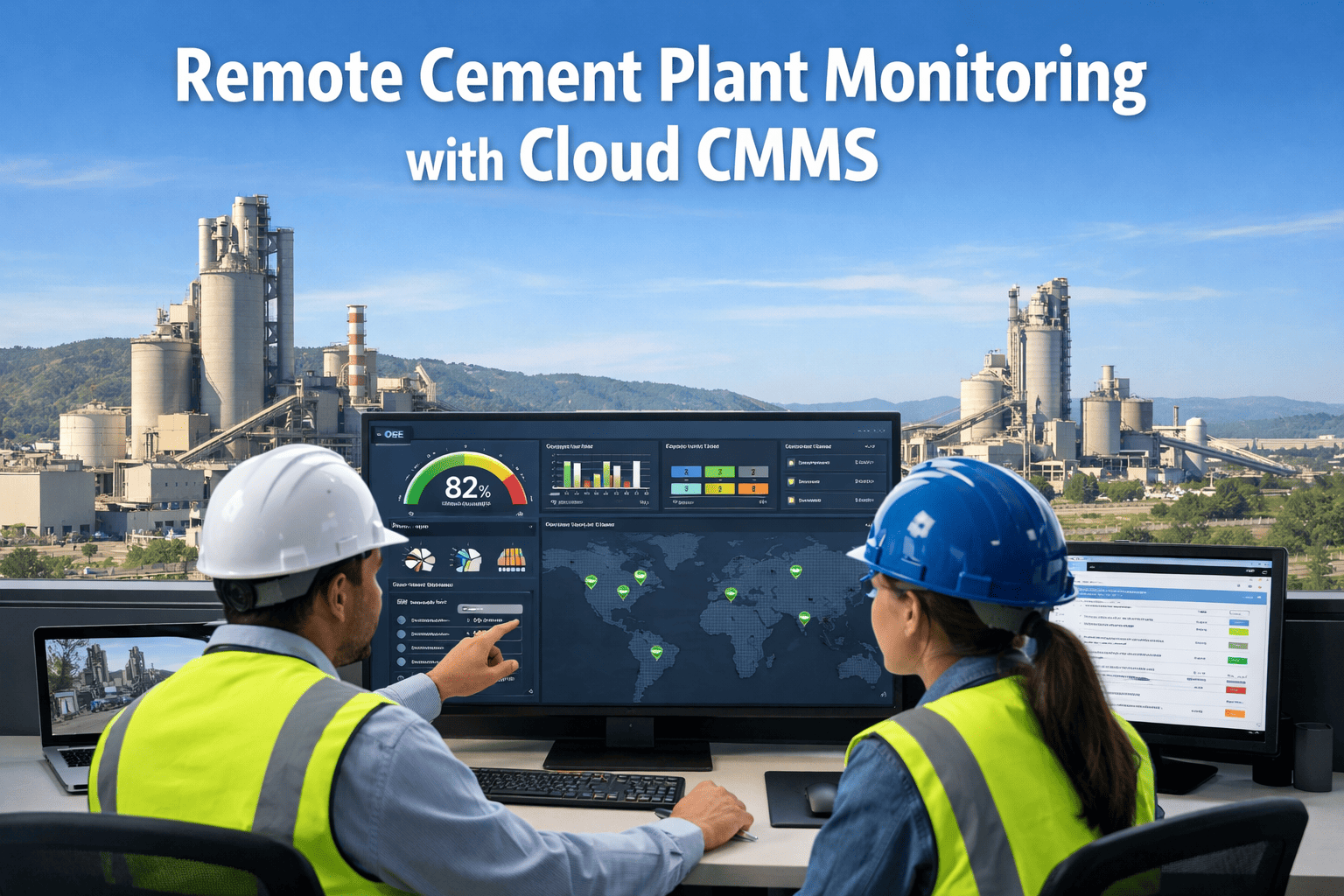
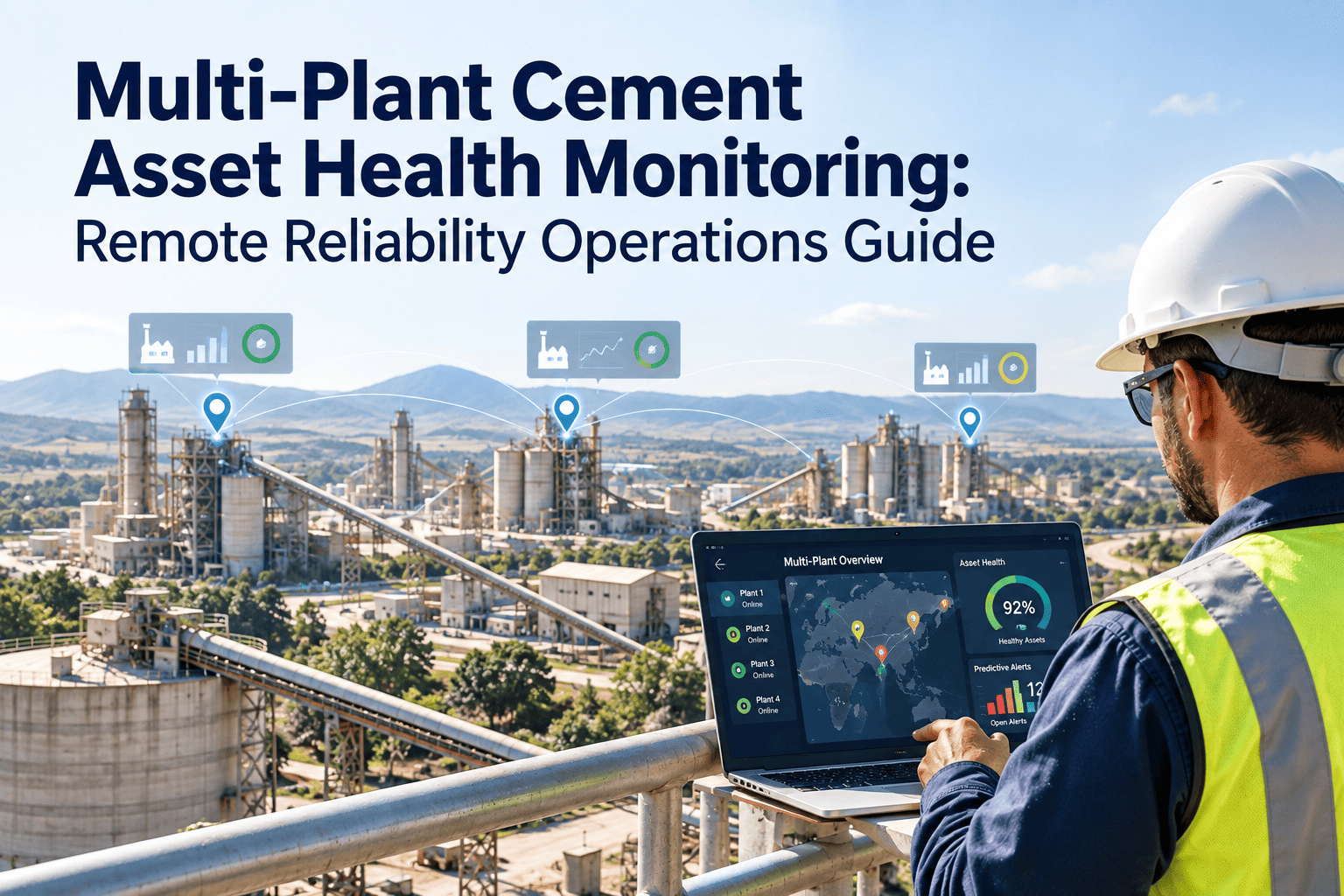
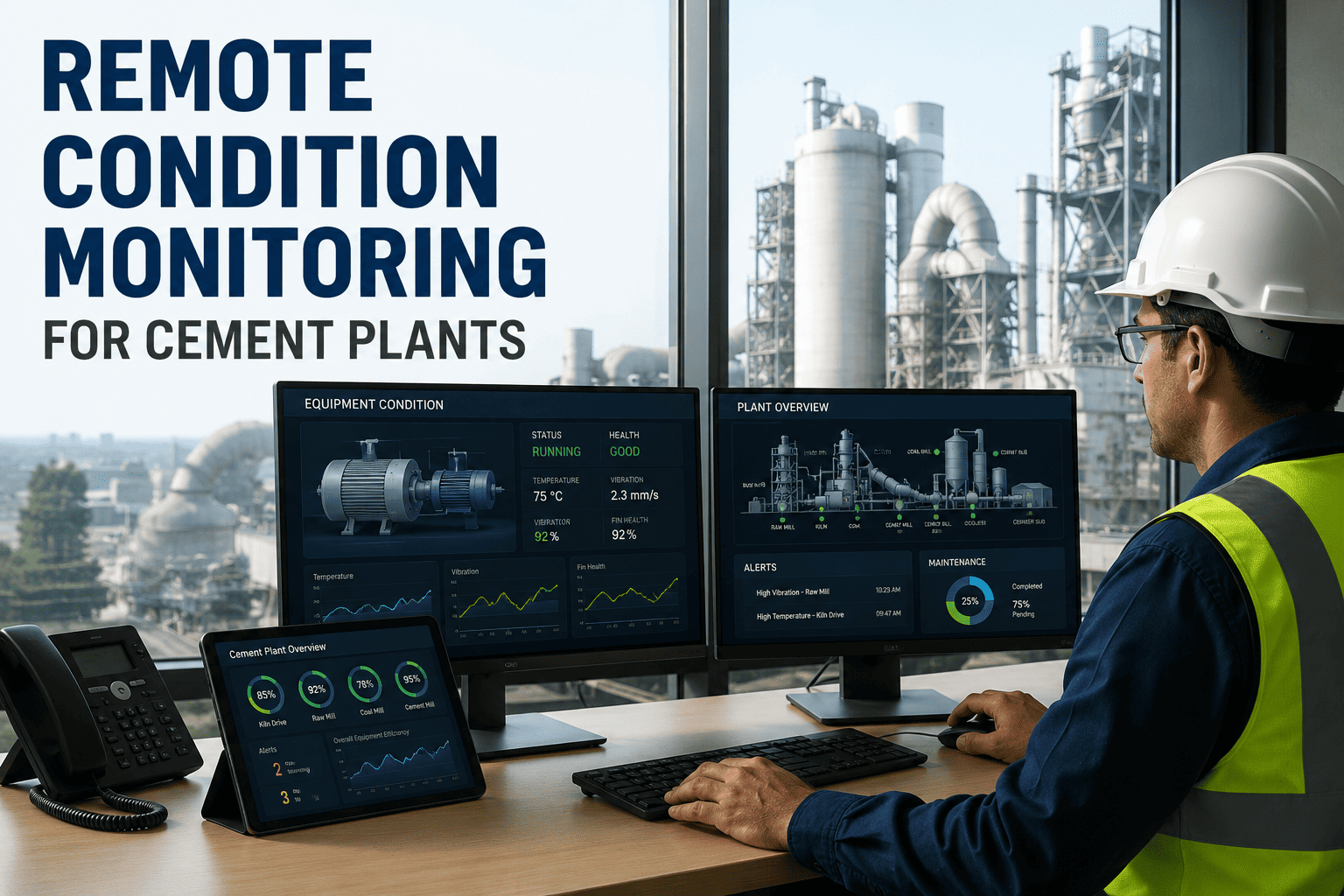
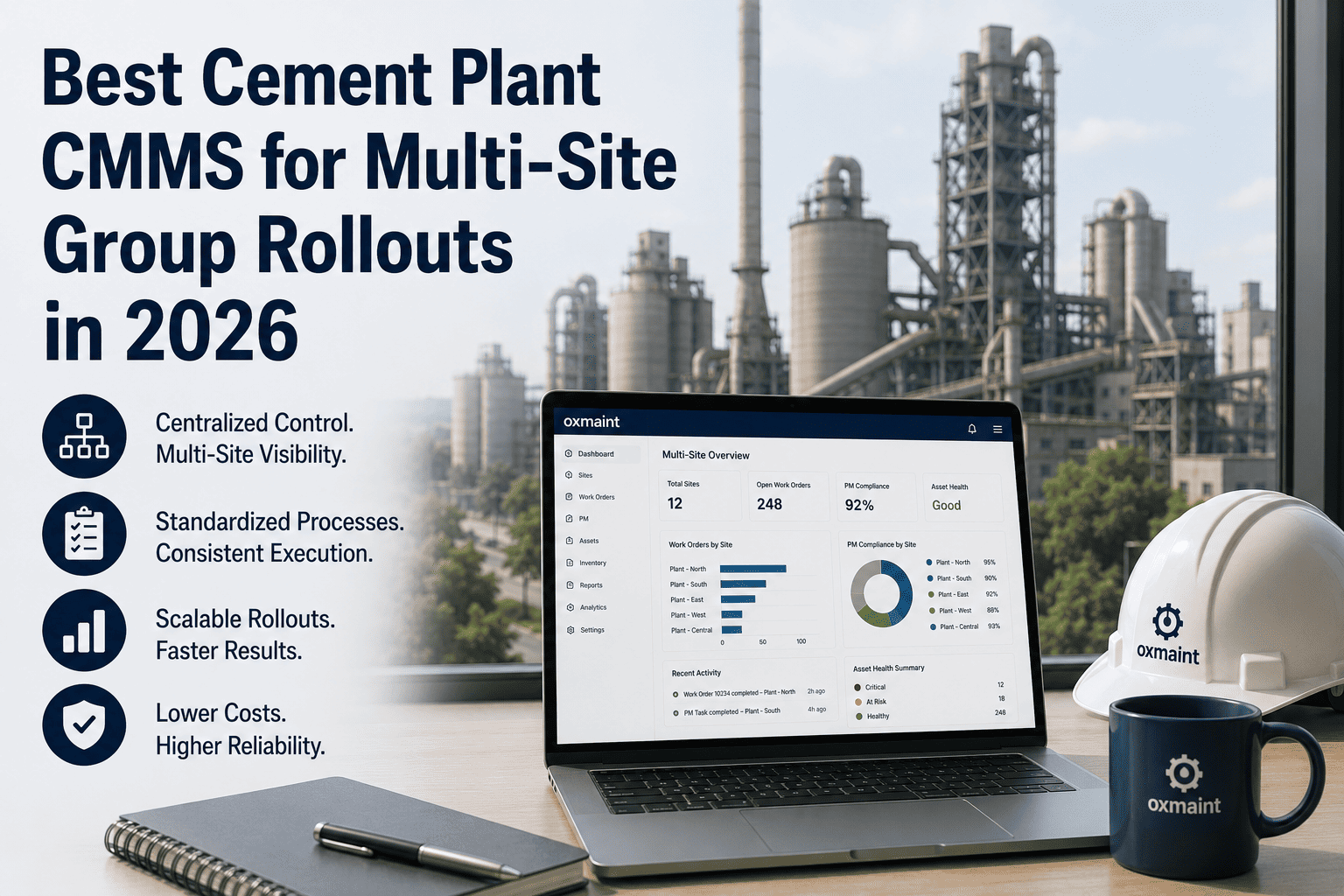
A reliability engineer managing four cement plants across three states cannot fly to each site to understand what broke, why the kiln tripped at 2:14 AM, or whether the raw mill in Plant B is running the same failure pattern that took Plant D offline last quarter. That is the exact problem OxMaint's cloud CMMS platform was built to solve — giving group-level reliability engineers a single live dashboard that pulls OEE, equipment health scores, work order status, and predictive alerts from every cement plant in the portfolio into one browser tab. Industry benchmarks show cement groups running centralized cloud monitoring reduce unplanned kiln stops by 60–80% and recover 10–15% throughput by catching failure signatures in one plant before they repeat across others — converting isolated site data into portfolio-wide reliability intelligence. This page walks through how remote cement plant monitoring actually works on a cloud CMMS, the exact dashboard views reliability engineers use to run multi-site operations, and the deployment architecture that makes it possible without replacing your existing DCS or SCADA layer.
Cloud CMMS · Multi-Plant Monitoring · Remote Reliability
Run Every Cement Plant From One Browser Tab
Live OEE, kiln health scores, work order status, and predictive alerts from every plant in your portfolio — surfaced in a single cloud dashboard built for reliability engineers managing multi-site cement operations.
Portfolio View · 4 Plants Live
Plant A · Karnataka
OEE 87%
Healthy
Plant B · Gujarat
OEE 72%
Watch · Raw Mill
Plant C · Rajasthan
OEE 84%
Healthy
Plant D · Tamil Nadu
OEE 58%
Kiln Alert · PM Due
The Problem With Running Multi-Plant Cement Operations Blind
A single cement plant generates data from 500 to 2,000 sensors across its DCS and SCADA layer — kiln shell temperature, mill power draw, baghouse differential pressure, separator efficiency, clinker cooler airflow. That data lives inside each plant's control room. The moment you have two plants, that data is siloed. Add four or six plants, and the group reliability team is flying blind — reading monthly PDF reports from site maintenance managers, calling plant managers to ask why a specific kiln tripped, and finding out weeks later that the same bearing failure happened at Plant A in March and Plant C in July.
The Four Gaps Cloud CMMS Closes
Gap 1
No Portfolio-Level View
Each plant has its own local HMI and paper-based work orders. Group reliability engineers cannot see live OEE, asset health, or work order backlog across the portfolio without asking each site individually.
Gap 2
Failure Patterns Repeat Across Sites
A preheater cyclone buildup issue resolved at Plant A never reaches the maintenance team at Plant C — who encounter the same failure six months later and spend the same three days solving it from scratch.
Gap 3
Delayed Failure Detection
Without centralized monitoring, bearing degradation on a vertical roller mill is discovered during routine inspection — two to four weeks after the vibration trend first deviated. By then, the repair is a replacement, not a correction.
Gap 4
Reactive, Not Predictive, CapEx
Capital planning runs on site-level anecdotes instead of cross-plant reliability data. A kiln refractory campaign is extended too long at one site while another site relines a zone with 18% brick life remaining — because no one has the data to compare.
What a Centralized Cloud CMMS Dashboard Actually Looks Like
A remote monitoring dashboard for a multi-plant cement group is not a single view — it is five connected layers the reliability engineer drills through. Each layer answers a different question, from "is the portfolio healthy right now" down to "what does the vibration trend on kiln main drive motor at Plant B look like this week." OxMaint ships these layers pre-built for cement operations, so the reliability engineer is not configuring a blank BI tool for six months before seeing useful data.
Layer 1
Portfolio Command View
Question answered
Is my group-level cement operation healthy right now, and which plant needs attention today?
What it shows
Live OEE for every plant, active critical alerts, PM compliance rate, open work order count, and a heatmap of asset health across all sites. One screen. No switching between plants.
Layer 2
Plant-Level Operations Dashboard
Question answered
For a specific plant, what is running, what is down, and what is the live production vs target?
What it shows
Shift production figures, kiln feed rate, mill tonnage, clinker cooler outlet temperature, baghouse pressure, and current WO status — all in one plant-scoped view.
Layer 3
Asset Health Scoring
Question answered
Which specific assets are degrading, and which of those are about to fail in the next 7 to 30 days?
What it shows
Each critical asset scored 0–100 based on vibration trend, temperature deviation, power consumption, and maintenance history. Assets below 60 surface as predictive alerts with a recommended action window.
Layer 4
Work Order & PM Compliance Tracker
Question answered
Is every plant completing its PM schedule, and where is maintenance backlog building up?
What it shows
PM compliance percentage per plant per zone, overdue WO count, average WO close time, and a backlog aging report. The reliability engineer sees which site is falling behind without waiting for month-end reporting.
Layer 5
Cross-Plant Failure Intelligence
Question answered
Has a failure that just happened at one plant ever happened before at another plant in my group?
What it shows
When a new WO is opened, the system surfaces every similar WO across the portfolio — the asset, fault code, resolution, parts used, and technician notes. Failure knowledge compounds instead of being trapped at each site.
Cloud CMMS for Cement Groups
Stop Calling Every Site. Start Seeing Every Site.
OxMaint gives reliability engineers a live dashboard of every cement plant in the portfolio — OEE, asset health, work orders, and predictive alerts — built for groups running two sites or twenty.
How Remote Monitoring Connects to Your Existing Plant Systems
Cement plants do not need to replace their DCS, SCADA, or process historian to run cloud CMMS monitoring. OxMaint wraps around the existing control infrastructure and pulls the data that matters for reliability decisions — without interfering with plant control logic. The integration architecture below is the same deployment pattern used at cement groups running 2 to 20 plants on a single cloud tenant.
01
Plant Floor — Sensors & Control Systems
Existing DCS (ABB, Siemens), SCADA (Wonderware, Ignition), PLCs, and 500 to 2,000 sensors per plant. No hardware replacement required. OxMaint reads from this layer — it never writes control commands to it.
↓
02
Edge Connector — Data Aggregation
Lightweight edge connector reads from OPC-UA, Modbus TCP, MQTT, and REST endpoints at each plant. Aggregates sensor streams, handles buffering during connectivity loss, and pushes data securely upstream.
↓
03
Cloud CMMS Core — OxMaint
All plant data lands in a single secure cloud tenant. Asset register, work orders, PM schedules, and sensor time-series data unified per plant and rolled up at portfolio level. Role-based access controls which engineers see which plants.
↓
04
AI Analytics & Alerts
Machine learning models run on the unified data — detecting vibration drift, thermal anomalies, and failure-signature patterns weeks before manual inspection would catch them. Alerts route to the right person at the right plant automatically.
↓
05
Dashboards & Mobile App
Reliability engineers see the portfolio view in a browser from anywhere. Plant supervisors use the mobile app on the shop floor. Technicians receive work orders and log findings offline — sync resumes when connectivity returns.
What Reliability Engineers Actually Do With Remote Monitoring
The dashboard is not the outcome. The decision is. Below are the five decisions a group reliability engineer makes every week when running a cement portfolio on cloud CMMS — and the specific data the platform surfaces to make each decision in minutes instead of days.
Monday Morning
Portfolio Triage
Which plant needs my attention this week?
Open portfolio view. Sort by OEE descending. Any plant below 75% and any plant with a critical alert older than 48 hours gets a direct call to the site reliability lead before lunch.
Tuesday
Predictive Alert Review
Which assets across all plants will fail in the next 30 days if I do nothing?
Filter alerts by severity = High and time-to-failure under 30 days. Each alert routes to a WO with recommended parts, technician assignment, and suggested shutdown window aligned to production schedule.
Wednesday
Cross-Plant Pattern Check
Is a failure at Plant B repeating a pattern we already solved at Plant A?
Open the new WO. Cross-plant failure search surfaces every matching WO across the portfolio — resolution, parts, time-to-fix. The Plant B technician inherits Plant A's solution instead of rediscovering it.
Thursday
PM Compliance Audit
Which plants are slipping on PM compliance, and in which zone?
PM compliance tracker shows percentage per plant per zone. Any zone under 85% compliance triggers a direct conversation with the site maintenance manager with specific overdue tasks and aging data.
Friday
CapEx Data Assembly
What capital requests should go into next quarter's plan, and where is the data?
Asset register report exports remaining-life projections, repair history cost, and condition scores for every critical asset across the group. CapEx requests are built from data, not from site-level anecdotes.
Before and After — What Multi-Site Reliability Looks Like on Cloud CMMS
| Reliability Workflow |
Before Cloud CMMS |
After OxMaint Cloud CMMS |
| Portfolio health check |
Call each plant manager. Wait for email reports. Takes 3–5 days to assemble. |
Open one browser tab. Live data across every plant. Under 2 minutes. |
| Failure detection lead time |
Discovered during routine inspection — 2 to 4 weeks after first trend deviation. |
Predictive alert fires when trend first deviates — 7 to 30 days before failure. |
| Cross-plant knowledge sharing |
Site-specific. A fix at Plant A never reaches Plant C. |
Failure intelligence searches portfolio-wide. Every plant inherits every solution. |
| Work order visibility |
Paper cards at each site. Group-level tracking impossible. |
Live WO status across all plants. Aging reports built in. |
| PM compliance measurement |
Monthly PDF from each site. Compliance self-reported. |
Live percentage per plant per zone. Auditable history. |
| CapEx planning data |
Anecdotal from site managers. Inconsistent justification. |
Exportable asset condition and cost history. Board-defensible. |
| Unplanned kiln stops |
Industry baseline at non-digital plants. |
60–80% reduction after full cloud CMMS deployment. |
| Throughput recovery |
No visibility into minor stoppage patterns. |
10–15% throughput gain via real-time loss tracking. |
Security, Access Control, and Multi-Site Data Governance
A cloud CMMS for a cement group holds the most operationally sensitive data the business has — kiln availability, failure history, maintenance spend per plant, and capital planning. Security and access control are not optional features. They are the foundation of whether the platform is trusted at group level. OxMaint's multi-site architecture is built around four governance controls.
Role-Based Access
Group reliability engineers see all plants. Site maintenance managers see only their plant. Contractors see only their assigned WOs. Permissions are enforced at the asset, WO, and report level — not just the user login level.
Plant-Level Data Isolation
Each plant's operational data is isolated at the database layer. Cross-plant views are generated through explicit portfolio-scope queries controlled by admin roles — not through shared tables.
Encrypted Transit & Rest
All data in transit from edge connector to cloud is TLS 1.3 encrypted. Data at rest in the cloud tenant is AES-256 encrypted. Audit logs track every access, export, and permission change.
Read-Only Integration
OxMaint reads from DCS and SCADA. It does not write control commands. Process safety and control logic remain entirely under the plant's existing control system — the CMMS never becomes a control vector.
Expected Impact — Documented Cement Industry Benchmarks
The numbers below reflect cement industry benchmarks reported by plants transitioning from reactive or site-siloed maintenance to centralized cloud CMMS with predictive monitoring. Results are typically measured 12 to 18 months after full deployment across the portfolio.
60-80%
Reduction in unplanned kiln and mill stops
10-15%
Throughput gain from loss elimination
15-25%
Energy cost reduction via maintenance-driven optimization
84%
PM schedule compliance rate across all equipment classes
52%
Reduction in emergency repair costs within 18 months
73%
Reduction in critical spare parts stockouts
Frequently Asked Questions
Does OxMaint require replacing our existing DCS or SCADA system?
No. OxMaint wraps around your existing control infrastructure using OPC-UA, Modbus TCP, MQTT, and REST APIs. It reads operational data for reliability decisions but never writes control commands. Your DCS and SCADA remain the authoritative control system.
Book a demo to see the integration architecture in detail.
How long does it take to deploy cloud CMMS across multiple cement plants?
A single plant typically reaches baseline operation in 4 to 6 weeks using the pre-built cement template. Multi-plant rollouts deploy plant-by-plant in parallel, with portfolio-level dashboards active within 8 to 12 weeks of the first site going live. Full AI predictive capability matures 3 to 6 months after data baselines are established.
Can the platform handle plants in different countries with different network reliability?
What cement plant equipment classes are supported in the asset register?
Rotary kilns, preheater cyclones, calciners, raw mills, ball mills, vertical roller mills, coal mills, crushers, clinker coolers, separators, baghouses, conveyors, packers, and ancillary systems — with PM schedules, refractory campaign tracking, and condition monitoring templates built in for each class.
Can group reliability engineers see every plant while site teams see only their own?
Yes. Role-based access is enforced at the asset and report level. Group reliability sees portfolio views. Site managers see their plant. Contractors see only assigned work orders. Permissions are audited end-to-end.
Book a demo to walk through the access control model.
How does predictive alerting actually work on cement plant equipment?
Machine learning models analyze vibration, temperature, power consumption, and historical failure data against asset-specific baselines. When a trend deviates from the baseline, a severity-scored alert fires with a time-to-failure estimate and recommended action — typically 7 to 30 days before manual inspection would catch it.
OxMaint · Cloud CMMS for Cement Groups
One Dashboard. Every Plant. Every Asset. Every Alert.
OxMaint gives reliability engineers the live, portfolio-wide view of every cement plant in the group — turning siloed site data into centralized reliability intelligence that prevents kiln stops, recovers throughput, and builds CapEx plans from data instead of anecdote.