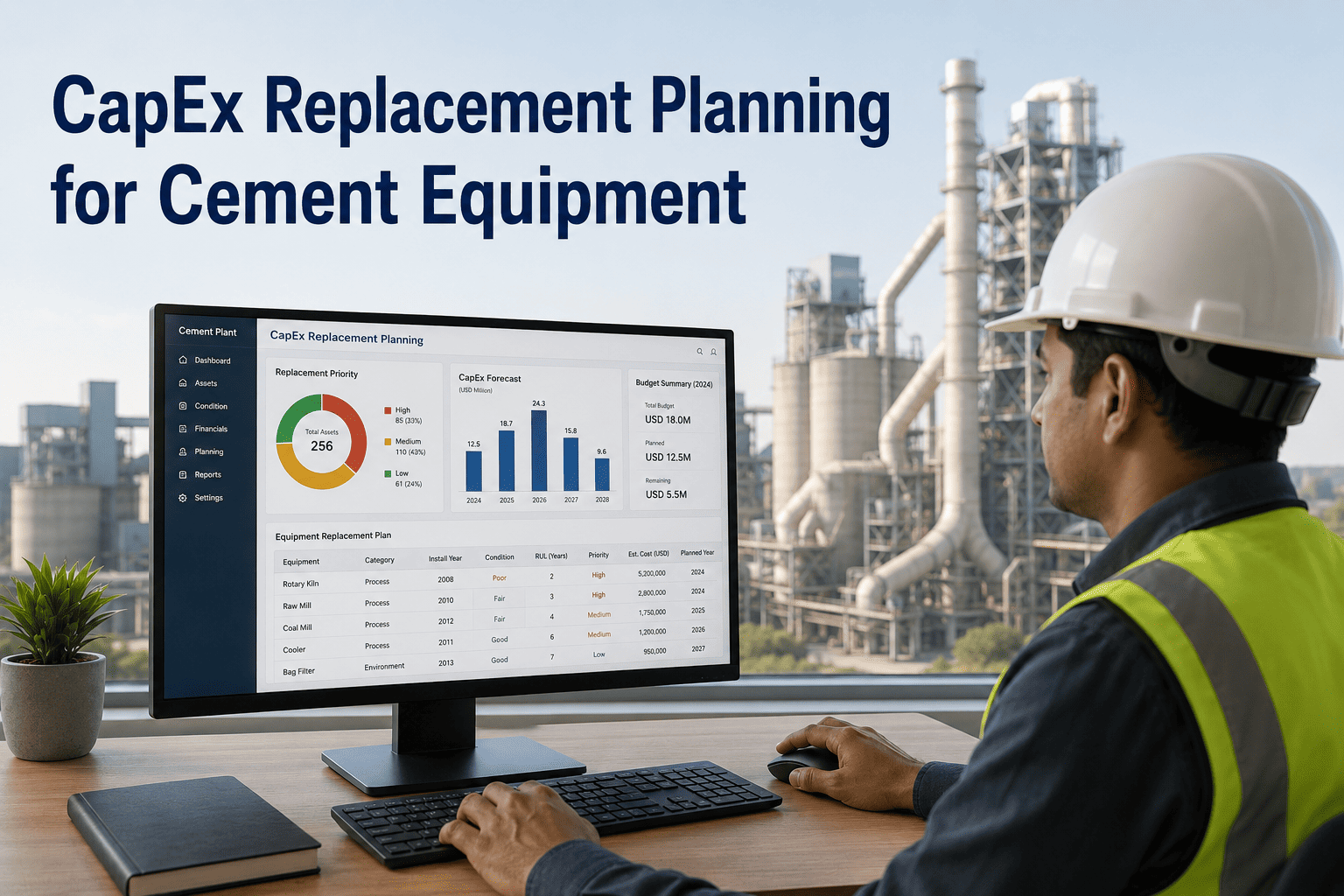
A cement plant's kiln shell was flagged for replacement during a five-year capital planning review. The original estimate: $18 million in replacement CapEx, scheduled for year three of the plan. What the asset replacement model did not account for was the actual condition of the asset — because there was no systematic way to measure it. When the plant activated Oxmaint's Remaining Useful Life tracking against 18 months of real maintenance data, the picture changed completely. The replacement was deferred by two full years, unlocking $18 million in capital that was redeployed elsewhere. This case study documents how that deferral was justified, approved, and safely executed. Start your plant's RUL tracking in Oxmaint free and find out which of your assets are being replaced before their time.
Case Study — CapEx Optimization
Cement Plant Defers $18M CapEx With 5-Year RUL Activation in Oxmaint
How one cement plant used Remaining Useful Life data from Oxmaint to prove an $18M asset replacement was premature — and safely defer it by two years without a single unplanned failure.
+2 yrs
Asset Life Extended
0
Unplanned Failures During Deferral
94.7%
Kiln Availability Maintained
The Problem With Standard CapEx Planning
Why Asset Replacement Schedules Are Based on Age, Not Condition
Most cement plant capital plans are built on OEM asset life recommendations — a kiln shell is expected to last 20 years, a girth gear 15 years, a major bearing assembly 8 years. These are population averages, not individual asset assessments. A kiln shell that has operated in a well-maintained, stable process may have significant remaining life beyond the OEM assumption. One that has experienced thermal cycling extremes may need replacement earlier. Without condition-based data, finance teams default to the conservative number — and over-capitalize as a result.
Traditional CapEx Planning
Age-based schedules
Replace at OEM-recommended interval regardless of actual condition
No condition data
Maintenance history not linked to asset life projection
Conservative default
Over-replacement is treated as safe; under-replacement is the risk
Inflexible
Once scheduled, replacement is locked into capital plan and contractor contracts
Oxmaint RUL-Based Planning
Condition-based
RUL score derived from actual maintenance events, inspection findings, and sensor history
Evidence-backed
Deferral justified with documented maintenance records and trend analysis
Defensible
Finance and board approval supported by condition data, not engineering opinion alone
Dynamic
RUL score updates with every maintenance event — deferral decision is continuously validated
How the Deferral Was Built
The Four-Stage RUL Activation Process
The plant did not arrive at an $18M deferral decision through instinct or optimism. The process ran over 18 months of data accumulation, with four distinct stages that produced the evidence package presented to the capital planning committee.
Stage 1 — Months 1 to 4
Asset Condition Baseline
Every maintenance event on the kiln shell, riding rings, and support rollers was logged in Oxmaint with condition observations, measurement data, and repair scope. Historical work orders were migrated and tagged to create a retrospective baseline. Shell thickness measurements from the previous 12 months were uploaded and linked to the asset record.
Stage 2 — Months 5 to 10
Trend Analysis and RUL Projection
Oxmaint's RUL module plotted wear rate trends against the accumulated condition data. Shell thickness decline rate was modelled against minimum operational tolerance. The projection showed the asset had 4.2 years of estimated remaining useful life at current degradation rates — against the 2-year replacement trigger in the original capital plan.
Stage 3 — Months 11 to 14
Deferral Justification Package
The plant's maintenance team compiled the deferral justification using Oxmaint's reporting tools: 18 months of condition trend data, shell thickness measurement history, maintenance event log, no critical fault events, and the RUL projection with confidence range. The package was submitted to the capital planning committee alongside the original OEM life expectancy documentation.
Stage 4 — Month 15 onward
Monitored Deferral Period
Deferral was approved. Oxmaint monitoring continued at increased inspection frequency — shell thickness measured every shutdown, RUL score reviewed monthly. Two years into the deferral period, no critical condition thresholds were exceeded. The replacement was rescheduled to year five of the capital plan, $18M redeployed to a grinding mill upgrade.
What RUL Tracking Covers
The Cement Plant Assets Most Likely to Yield CapEx Deferral Opportunities
Not every asset is a deferral candidate. RUL analysis yields the highest capital impact on high-value, long-life assets where OEM replacement intervals are conservative and actual condition data is rarely collected systematically. These are the categories most cement plants over-replace.
Kiln Shell Sections
OEM life assumption: 18–22 years
Typical deferral potential: 2–4 years with condition monitoring
Replacement cost: $6M – $20M per section
Girth Gear and Pinion
OEM life assumption: 12–18 years
Typical deferral potential: 18–36 months with documented wear tracking
Replacement cost: $1.5M – $4M
Riding Rings (Tyres)
OEM life assumption: 15–25 years
Typical deferral potential: 2–5 years with ovality and creep monitoring
Replacement cost: $800K – $2.5M each
Preheater Tower Structure
OEM life assumption: 25–30 years
Typical deferral potential: 3–6 years with structural inspection records
Refurbishment cost: $2M – $8M
Raw Mill Shell and Liners
OEM life assumption: 6–10 years (liners 12–18 months)
Typical deferral potential: 12–18 months on liners with wear tracking
Liner replacement cost: $400K – $1.2M per set
Clinker Cooler Grate Plates
OEM life assumption: 18–24 months
Typical deferral potential: 6–12 months with thermal imaging and wear logging
Replacement cost: $300K – $900K per set
Find out which of your plant's assets are being replaced ahead of their actual end-of-life
Oxmaint's RUL module builds condition-based life projections from your maintenance event history — turning your work order data into a defensible CapEx deferral case your finance team can approve.
FAQ
Questions on RUL-Based CapEx Deferral for Cement Plants
How does Oxmaint calculate Remaining Useful Life for cement plant assets?
Oxmaint derives RUL from the maintenance event history on each asset — wear measurements, inspection findings, failure events, and repair scope logged over time. It models the degradation trend against minimum operational thresholds and projects the date at which the asset reaches end-of-operational-life. The projection updates automatically as new maintenance data is logged.
Book a demo to see the RUL module.
How much maintenance history is needed before RUL projections are reliable?
Oxmaint recommends 12 to 18 months of consistent condition data for statistically stable RUL projections on major rotating equipment. However, retrospective data migration — uploading historical inspection reports and work orders from paper or legacy systems — can accelerate the baseline significantly, sometimes producing usable projections within the first 90 days of deployment.
How do we present a deferral case to the board or finance committee?
Oxmaint generates exportable condition trend reports showing wear rate history, RUL projection with confidence interval, maintenance event log, and comparison against OEM life assumption. This package is designed to support a formal capital committee presentation — giving finance the data they need to approve a deferral confidently rather than relying on maintenance team assertions.
Start building your case now.
What happens if condition deteriorates faster than the RUL projection during the deferral period?
Oxmaint's RUL score updates with every new maintenance event. If wear rate accelerates or a new deficiency is identified, the RUL projection revises automatically and generates an alert — giving the team early warning that the deferral may need to be reconsidered before the condition reaches a critical threshold. The deferral is never a fixed commitment; it is a continuously validated decision.
Is CapEx deferral a risk if it pushes replacement past OEM recommendations?
The risk of deferral is mitigated by the quality and frequency of condition monitoring during the extended period. OEM recommendations are conservative averages designed to protect manufacturers from liability, not precision end-of-life dates for individual assets. A deferral backed by continuous RUL monitoring and documented inspection records carries far less operational risk than an unmonitored asset running past its replacement date.
Turn your maintenance data into a defensible CapEx deferral — before the next budget cycle locks the replacement in
Oxmaint's RUL module builds condition-based asset life projections from every maintenance event your team records — converting your work order history into capital planning intelligence that recovers millions from premature replacement schedules.