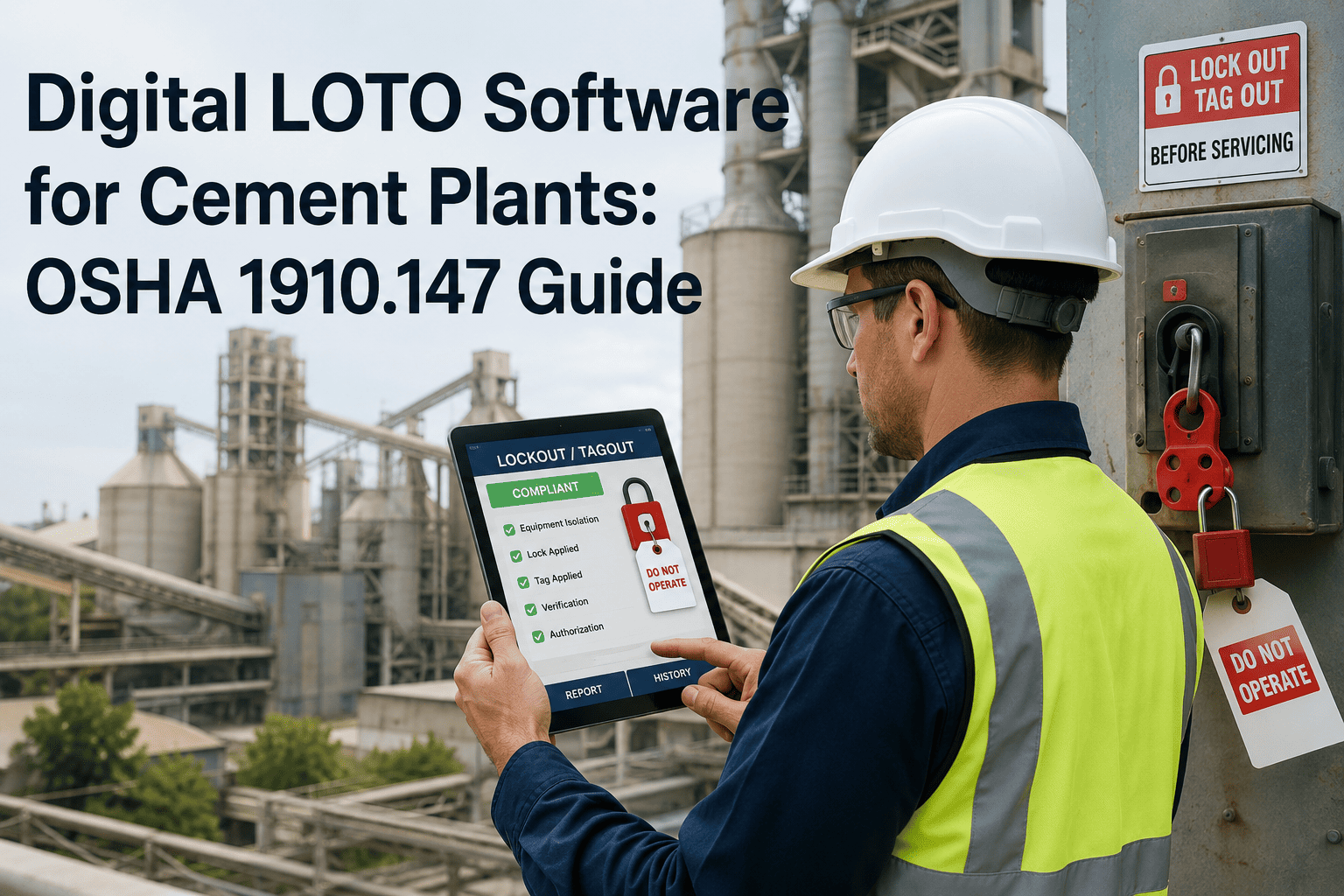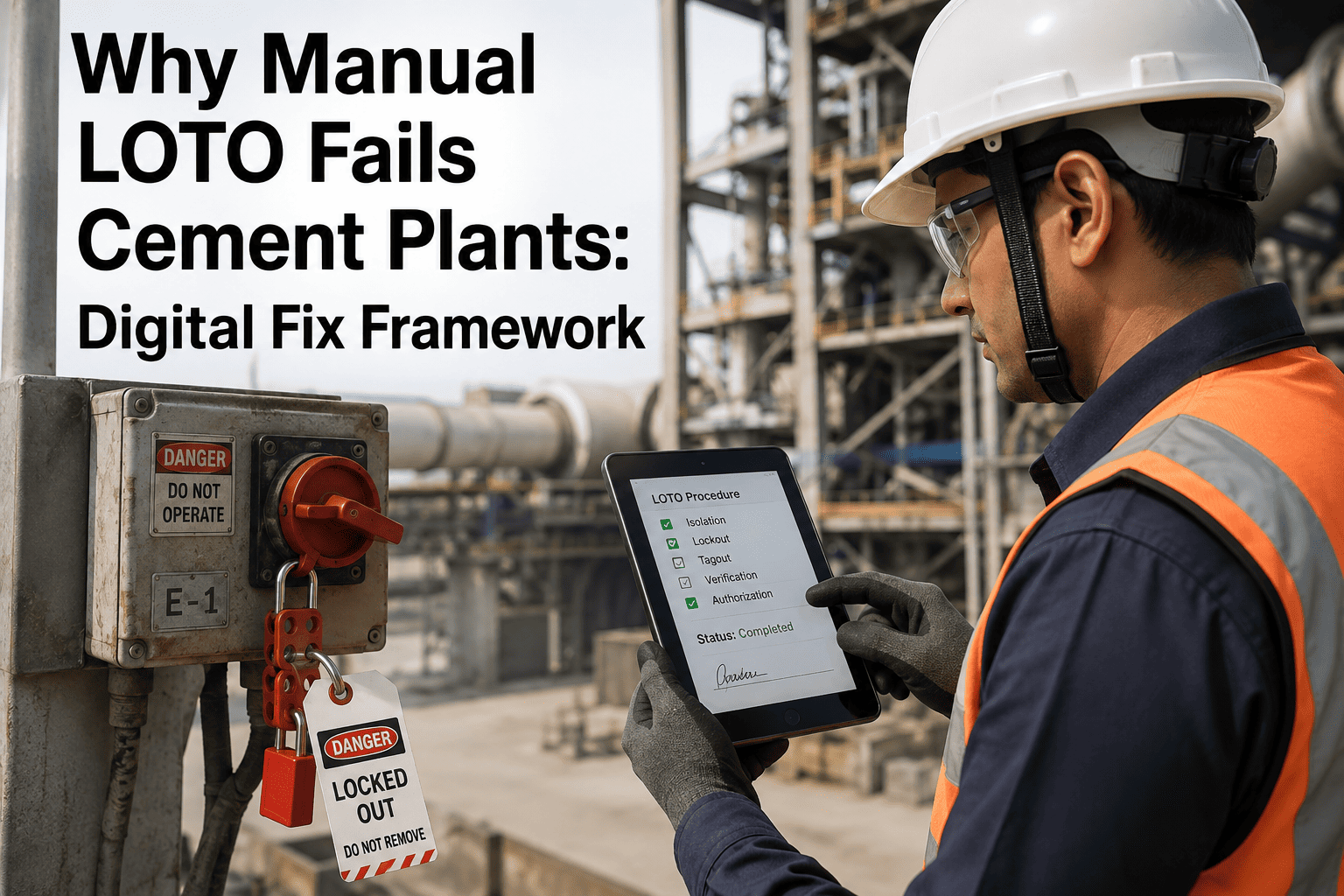
Every cement plant shutdown starts the same way — a stack of paper permits, a whiteboard tracking isolation points, and a supervisor hoping nobody forgets to pull a lock before the kiln re-energizes. That gap between paper and reality is where workers get hurt and turnarounds run over budget. Manual lock-out/tag-out was built for a plant with a handful of isolation points, not a modern cement facility with hundreds of energy sources spread across kilns, mills, crushers, and conveyors. A digital LOTO framework closes that gap by tying every isolation point to a live, auditable record inside your CMMS.
How many isolation points on your last shutdown were tracked on paper alone?
Paper LOTO boards can't tell you in real time which of 200+ energy sources are still isolated, who applied which lock, or whether a permit has quietly expired mid-shift. A digital LOTO system turns that blind spot into a live dashboard every supervisor can check before re-energization.
Where paper-based LOTO actually fails on a cement plant floor
Manual LOTO doesn't fail because crews are careless — it fails because paper cannot scale with the number of isolation points, shift handoffs, and contractor crews moving through a plant during a major stop. Four failure points show up again and again.
A kiln drive alone can carry a dozen energy sources — electrical, hydraulic, pneumatic, and stored mechanical. Paper checklists depend on one technician remembering every point across every visit, with no automatic flag when one is skipped.
When a permit changes hands between day and night crews, the paper board rarely captures why a lock is still on or which contractor placed it. The incoming shift either re-verifies everything from scratch or trusts a gap in the record.
Clearing a paper board after a multi-crew job means physically tracking down every lock holder before restart. On a large turnaround that reconciliation alone can add hours to the return-to-service window.
OSHA 1910.147 and MSHA inspections ask for proof of periodic inspection and permit history. A binder of signed sheets is searchable only by hand, which turns a routine audit into a multi-day scramble.
A four-layer framework that replaces the paper board
Digitizing LOTO isn't one big-bang project. Plants that succeed roll it out in layers, starting with a digital record of what already exists on paper and building toward live isolation tracking across the whole site.
Replace the LOTO board before your next turnaround
Digitize isolation points, permits, and re-energization checks in one CMMS-connected workflow — and walk into your next OSHA or MSHA audit with a searchable record instead of a binder.
Paper board versus digital LOTO, shutdown by shutdown
The difference shows up most clearly during the events that matter most — audits, shift changes, and multi-crew turnarounds.
| Shutdown Event | Paper LOTO Board | Digital LOTO |
|---|---|---|
| Isolation point verification | Manual walk-down, no flag on missed points | Digital checklist with mandatory photo confirmation |
| Shift handoff | Verbal handover plus paper notes | Live permit and lock status visible to incoming shift |
| Multi-crew lockbox | Physical group lockbox tracked by hand | Digital group lock record tied to each crew member |
| Re-energization clearance | Manual tracking down of every lock holder | Restart gated in the CMMS until all locks clear |
| Audit preparation | Manual binder search, often multi-day | Searchable digital history, minutes to produce |
A reliability manager's account of the switch
We used to spend the first two hours of every major turnaround just confirming which locks were actually on. Moving isolation records into the CMMS meant the incoming shift could see the full lock status the moment they walked in. Our last MSHA inspection took a fraction of the time it used to.
Digital LOTO for cement plants — common questions
No — it digitizes the same energy-control procedures your program already requires. The isolation steps, verification, and authorization stay the same; what changes is that each step is logged in the CMMS instead of on paper, which makes periodic inspection and audit records far easier to produce.
Most plants start with their highest-risk area — typically the kiln drive and mill circuit — and build the isolation register over four to six weeks before expanding site-wide. A phased rollout keeps crews trained without pausing production.
Yes. Contractor crews are issued temporary digital permits scoped to their specific isolation points, so their lock status appears on the same live dashboard as internal crews without extra paperwork on either side.
Field devices cache permit and lock data locally and sync once connectivity returns, so an isolation point already verified in the field is never lost from the record even in low-signal areas of the plant.
The clearest savings come from faster re-energization and shorter audit prep, both of which show up within the first turnaround. A Book a Demo session can walk through those numbers against your own shutdown schedule.
Give every shutdown a live, auditable LOTO record
Join cement plants replacing whiteboards and binders with a CMMS-connected LOTO workflow that's ready for OSHA, MSHA, and ISO 55000 review at any moment.
Free 14-day trial · No credit card