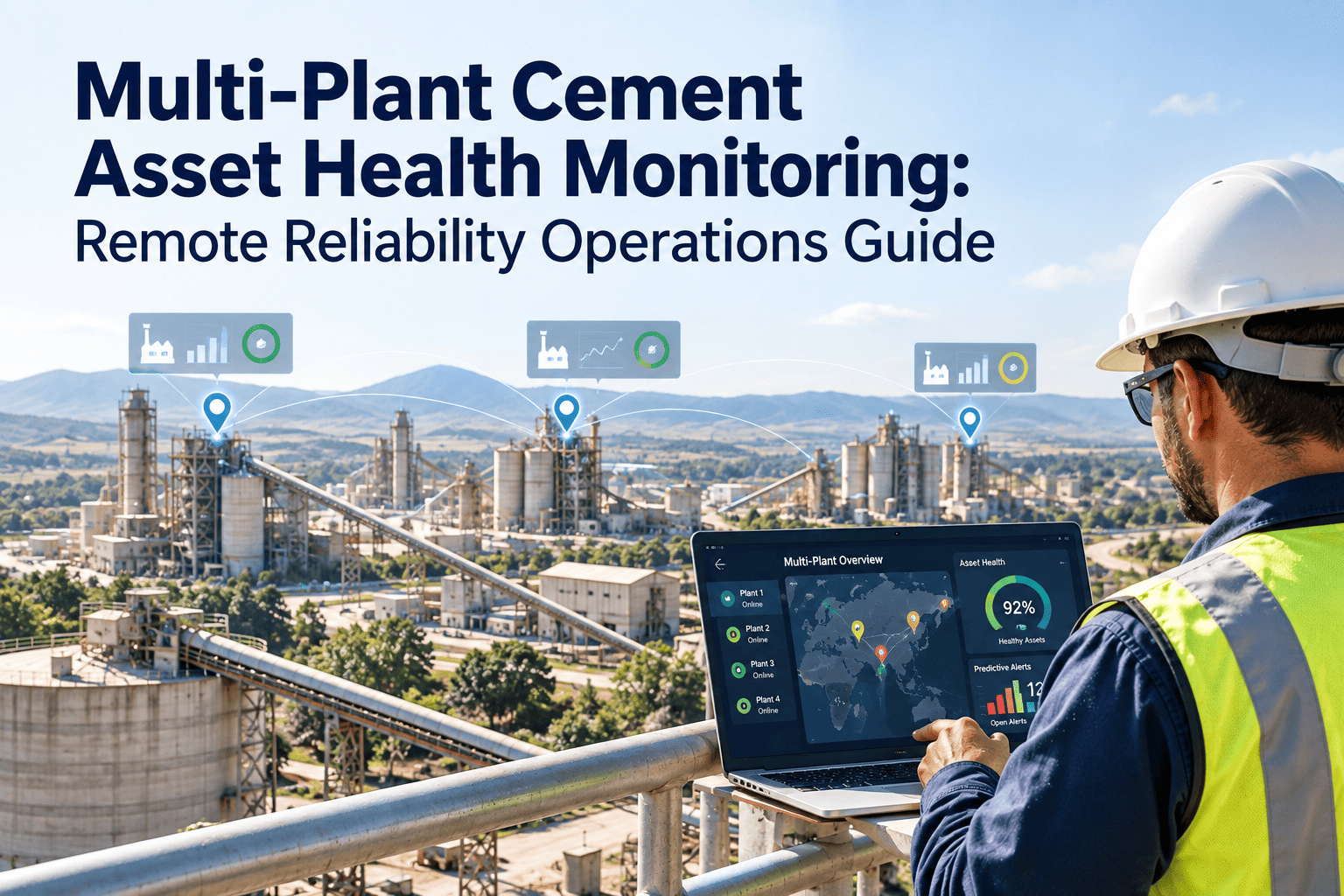
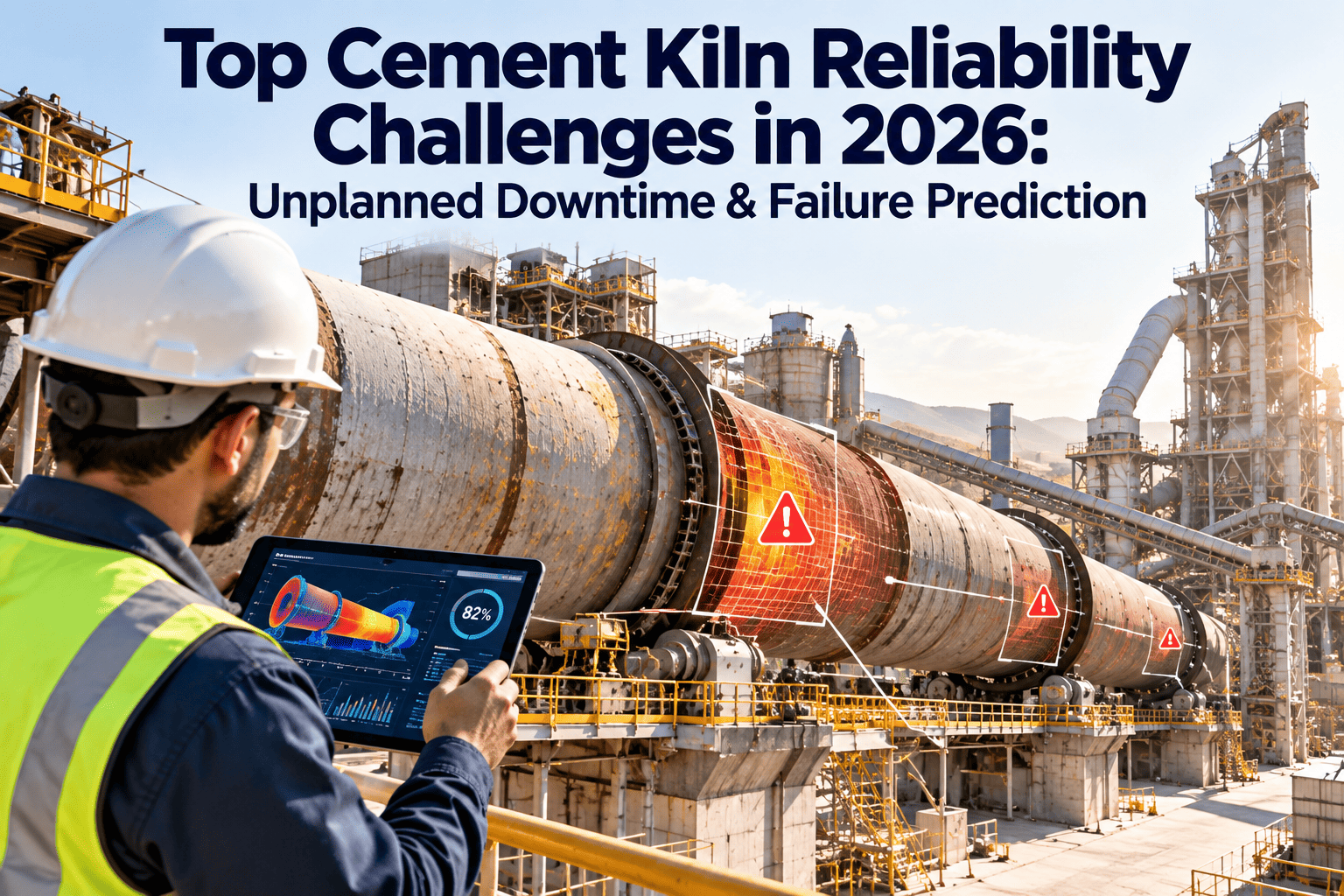
A single kiln failure can cost your cement plant $50,000 to $100,000 per hour in lost production. Traditional maintenance approaches force you to choose between expensive over-maintenance or risking catastrophic breakdowns. But what if you could predict failures weeks before they happen? AI-powered predictive maintenance analyzes vibration patterns, temperature trends, and power consumption to detect anomalies invisible to human operators. Leading cement manufacturers are already achieving 30-50% reductions in unplanned downtime—transforming maintenance from a cost center into a competitive advantage.
Maintenance Pain Points in Cement Operations
Cement plants operate some of the most demanding equipment in industrial manufacturing. The consequences of getting maintenance wrong are severe.
Kiln Failures
The rotary kiln is the heart of cement production. A major bearing failure or refractory collapse means 2-4 weeks of downtime and repair costs exceeding $500,000. Traditional time-based maintenance can't predict when components will actually fail.
Mill Breakdowns
Ball mills and vertical roller mills contain expensive gearboxes, bearings, and grinding elements. Unexpected failures halt production for days while spare parts ship from overseas. Over-maintenance wastes $200K+ annually in unnecessary replacements.
Fan & Motor Issues
ID fans, kiln drives, and conveyor motors operate under extreme conditions. Vibration-induced failures often cascade into secondary damage. A single motor failure can idle an entire production line while maintenance scrambles to respond.
Hidden Degradation
Equipment doesn't fail suddenly—it degrades gradually. But without continuous monitoring, maintenance teams only discover problems after visible symptoms appear. By then, the damage is done and emergency repairs are inevitable.
Predictive vs Preventive Maintenance
Understanding the fundamental shift from calendar-based to condition-based maintenance is key to capturing value.
- Replace parts on fixed schedules regardless of condition
- Components replaced too early waste money
- Components replaced too late cause failures
- No visibility into actual equipment health
- Maintenance windows based on calendar, not need
- Replace parts when data indicates degradation
- Maximize component lifespan safely
- Catch failures weeks before they occur
- Real-time visibility into asset health
- Maintenance planned around production needs
Ready to Predict Failures Before They Happen?
See how OxMaint's AI detects equipment anomalies weeks in advance—giving you time to plan repairs without disrupting production.
Sensors and Data That Power Predictions
Predictive maintenance relies on continuous data streams from your equipment. Here's what gets monitored and why it matters.
Vibration Monitoring
Accelerometers detect imbalance, misalignment, bearing wear, and looseness. Vibration analysis catches 80% of rotating equipment failures before they occur.
Temperature Sensing
Thermal sensors and infrared monitoring track bearing temperatures, motor windings, and process heat. Rising temperatures often precede failures by days or weeks.
Power Analysis
Current and power consumption patterns reveal motor degradation, load imbalances, and electrical faults. Abnormal power signatures indicate mechanical problems.
Acoustic Monitoring
Ultrasonic sensors detect air leaks, steam traps, and early-stage bearing defects inaudible to humans. Catches problems before vibration changes appear.
Oil Analysis
Lubricant sampling reveals wear particles, contamination, and degradation. Metal particles in oil indicate component wear months before failure.
SCADA Integration
Process data from existing control systems provides context: production rates, feed quality, and operating conditions that affect equipment stress and degradation patterns.
Failure Prediction for Key Equipment
Different equipment requires different monitoring approaches. Here's how predictive maintenance applies to your most critical assets.
Rotary Kiln
CriticalFailure Modes Detected
- Main bearing wear and misalignment
- Girth gear tooth damage
- Shell ovality and hot spots
- Drive motor degradation
- Refractory condition changes
Vertical Roller Mill
CriticalFailure Modes Detected
- Gearbox bearing degradation
- Roller and table wear patterns
- Hydraulic system issues
- Separator bearing faults
- Motor winding deterioration
Ball Mill
HighFailure Modes Detected
- Pinion and ring gear wear
- Trunnion bearing problems
- Mill shell cracks
- Diaphragm plate damage
- Liner bolt loosening
ID Fans
HighFailure Modes Detected
- Impeller imbalance and erosion
- Bearing wear and lubrication
- Shaft misalignment
- Foundation looseness
- Coupling degradation
Predictive Maintenance Success Stories
See how cement manufacturers are achieving measurable results with AI-powered maintenance.
Bearing Failure Prevented
Machine learning detected subtle vibration pattern changes in a kiln's main drive motor. The AI predicted bearing failure 18 days before it would have occurred catastrophically.
Mill Gearbox Saved
Oil analysis integration with vibration monitoring identified gear tooth pitting in a vertical roller mill gearbox. Early detection enabled targeted repair vs. full replacement.
ID Fan Imbalance Caught
Continuous vibration monitoring detected developing impeller erosion on a preheater ID fan. Gradual imbalance trend triggered maintenance before catastrophic blade separation.
ROI of Predictive Maintenance
Predictive maintenance delivers measurable returns across multiple dimensions of cement operations.
Downtime Reduction
Early warnings enable planned repairs during scheduled maintenance windows, eliminating emergency shutdowns.
Maintenance Savings
Condition-based replacement eliminates unnecessary maintenance while catching problems before costly damage.
Extended Asset Life
Running equipment to actual end-of-life rather than arbitrary schedules maximizes capital investment value.
Spare Parts Optimization
Predictable failures mean predictable parts needs. Reduce safety stock while ensuring availability when needed.
Typical Implementation ROI
ROI typically achieved from a single avoided major failure
Implementation Roadmap
A practical path to deploying predictive maintenance without disrupting operations.
Pilot Critical Assets
- Select 3-5 highest-impact assets (kiln drive, main mills)
- Deploy sensors on critical monitoring points
- Establish data connectivity to cloud platform
- Begin baseline data collection
AI Model Training
- AI learns normal operating patterns
- Historical failure data improves predictions
- Alert thresholds tuned to your equipment
- Integration with CMMS for work orders
Expand Coverage
- Roll out to additional critical assets
- Add secondary monitoring points
- Refine prediction models with local data
- Train maintenance team on system use
Optimize & Scale
- Continuous model improvement
- Extend to additional plants
- Integrate with production planning
- Advanced analytics and reporting
Frequently Asked Questions
How accurate are AI failure predictions?
Modern predictive maintenance systems achieve 85-95% accuracy in detecting developing failures. The key is not just detecting problems, but providing enough lead time to plan repairs. Most systems detect issues 1-4 weeks before failure, with some catching problems months in advance.
What if our equipment is old and doesn't have sensors?
Predictive maintenance works with any equipment age. Retrofit sensors are non-invasive and can be installed without modifying equipment. Wireless vibration sensors, clamp-on temperature monitors, and power meters connect to existing assets in hours, not weeks.
How long before we see results?
You'll have real-time visibility within weeks of deployment. AI models typically need 4-8 weeks of baseline data before generating reliable predictions. Most plants see their first prevented failure within 3-6 months, often recovering the entire investment.
Does this replace our maintenance team?
No—it empowers your maintenance team with better information. Technicians shift from reactive firefighting to planned, efficient repairs. The AI handles continuous monitoring that humans can't do; your team makes the decisions and performs the work.
How does this integrate with our existing CMMS?
OxMaint integrates with all major CMMS platforms via API. When AI detects an issue, it can automatically create work orders with diagnosis details, severity, and recommended actions. Your team works in familiar systems with better information.
Stop Reacting. Start Predicting.
Transform your cement plant maintenance from costly firefighting to strategic asset management. See how AI predicts failures weeks in advance—giving you time to plan repairs on your schedule.
Works with existing equipment - No production disruption - Results in weeks