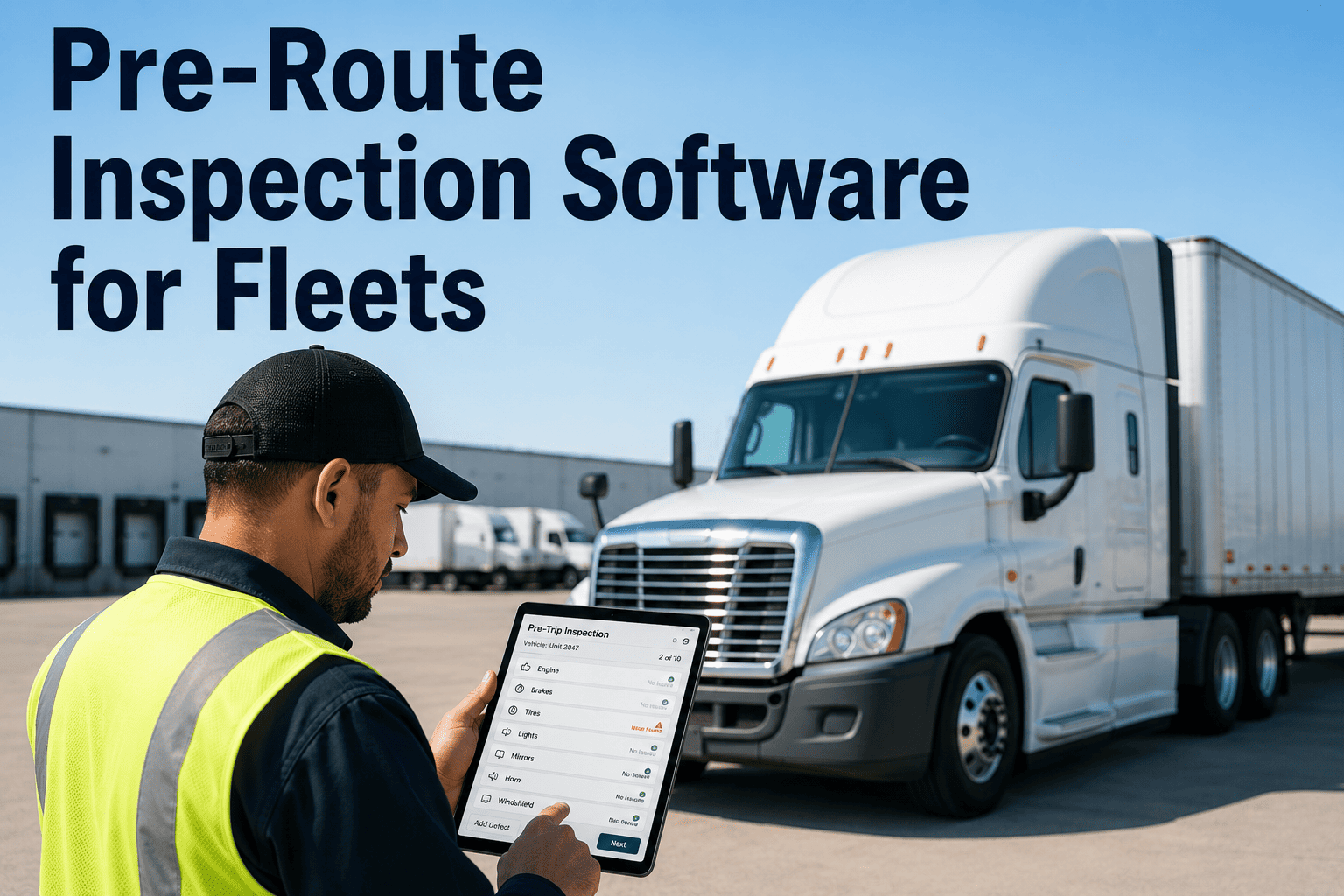
A single failed DOT roadside inspection can take a commercial vehicle out of service immediately — costing your operation thousands in missed deliveries, driver downtime, and emergency repairs. Multiply that risk across a fleet of 20, 50, or 200 vehicles, and the compliance gap becomes a business-threatening liability. Yet most delivery fleets still manage DOT compliance through paper DVIR forms, manual spreadsheet logs, and reactive scrambles before audits. The companies pulling ahead are running automated compliance platforms that handle inspections, violation tracking, and audit documentation without anyone printing a form.
Compliance + Buyer Intent · Delivery Operations Management
Delivery Fleet DOT Compliance Software: Inspection Automation Guide
How delivery companies eliminate violations, automate DVIR inspections, and stay audit-ready 365 days a year — without the paper trail.
$16,000
Maximum fine per DOT violation for serious commercial vehicle infractions
34%
Of roadside inspections result in at least one vehicle or driver violation
87%
Of compliance violations are preventable with a structured inspection program
3x
More likely to pass DOT audit with digitized, timestamped inspection records
What DOT Compliance Actually Requires of Delivery Fleets
Federal Motor Carrier Safety Administration (FMCSA) regulations under 49 CFR Parts 390–396 establish the compliance framework every commercial delivery fleet must meet. Non-compliance is not a paperwork technicality — it triggers out-of-service orders, SMS score impacts, audit exposure, and civil liability in accidents.
01
Driver Vehicle Inspection Reports (DVIR)
Mandatory pre- and post-trip inspections under 49 CFR 396.11. Must cover 10 specified parts, document any defects, and carry driver signature. Records must be retained for 90 days. Failure to complete or retain is a direct violation — regardless of vehicle condition.
Direct violation risk
02
Periodic Vehicle Inspections (Annual)
49 CFR 396.17 requires a full inspection at minimum once every 12 months by a qualified inspector. The inspection certificate must be carried in the vehicle. Expired inspection documentation is an immediate out-of-service condition at roadside.
Out-of-service trigger
03
Driver Qualification Files
49 CFR 391 requires maintained qualification files for every driver — CDL records, medical certificates, driving history, employment applications, and road test certifications. Gaps in driver files are among the most common audit deficiencies found during FMCSA compliance reviews.
Audit deficiency risk
04
Hours of Service (HOS) Records
49 CFR 395 mandates ELD compliance for most commercial operations, with accurate logging of on-duty, driving, off-duty, and sleeper time. HOS violations rank among the top SMS violation categories and trigger driver disqualification in serious repeat cases.
SMS score impact
05
Vehicle Maintenance Records
49 CFR 396.3 requires carriers to systematically inspect, repair, and maintain all vehicles. Maintenance records — including work orders, inspection results, and repair certifications — must be retained and producible on demand during audits. No records means no proof of compliance.
Retention requirement
06
Roadside Inspection Reports (RS&I)
Every roadside inspection result feeds directly into FMCSA's Safety Measurement System (SMS). Repeated violations in any BASIC category trigger Compliance Review. Carriers in the top 25% of SMS scores face prioritized enforcement — meaning more inspections, more violations, and more fines.
Enforcement escalation
Managing all of this on paper is a compliance liability
OxMaint centralizes DVIR completion, maintenance records, inspection schedules, and audit documentation in one platform — so your fleet is always ready for roadside or formal review.
Manual vs. Automated Fleet Compliance: What Actually Changes
| Compliance Task |
Manual / Paper Process |
Automated Software Platform |
| DVIR Completion |
Paper form, filed manually — easily lost |
Mobile app, timestamped, auto-archived |
| Defect Escalation |
Driver tells dispatcher — if remembered |
Instant work order auto-generated on defect flag |
| Inspection Due Alerts |
Manager tracks manually — gaps common |
Automated reminders 30, 14, 7 days before due |
| Audit Preparation |
Days of manual record retrieval |
One-click export of full compliance history |
| PM Schedule Tracking |
Spreadsheet updated inconsistently |
Auto-scheduled by mileage or calendar |
| Multi-Vehicle Visibility |
No central view — blind spots across fleet |
Real-time compliance dashboard, all vehicles |
| Record Retention |
Physical files — risk of loss, damage, gaps |
Cloud-stored, searchable, indefinitely retained |
The FMCSA SMS Scoring System: Why Your Compliance Data Follows You
The Safety Measurement System (SMS) scores every carrier on seven BASIC categories using data from roadside inspections, crash reports, and investigations. High SMS scores trigger increased roadside inspection frequency — creating a compounding cycle where poor compliance leads to more inspections, which reveals more violations, which raises scores further.
Unsafe Driving
Speed, reckless driving, improper lane changes
Speeding, seatbelt, mobile phone use
65% triggers alert
HOS Compliance
Log falsification, hours violations, ELD use
Exceeding drive time, log errors
65% triggers alert
Driver Fitness
CDL validity, medical cert, disqualifications
Expired CDL, missing medical cert
80% triggers alert
Vehicle Maintenance
Brake systems, lights, tires, coupling
Brake defects, inoperable lights, tire violations
80% triggers alert
Controlled Substances
Drug/alcohol testing program compliance
Positive tests, missing records
Any violation critical
Hazardous Materials
HazMat handling, placards, documentation
Improper placarding, missing shipping papers
60% triggers alert
Crash Indicator
History of reportable crashes
Frequency and severity of accidents
65% triggers alert
Why This Matters for Compliance Software
Every DVIR you complete and file, every PM you complete on schedule, every defect you resolve with a documented work order — these records are your defense against SMS score accumulation. A compliance software platform does not just save time. It builds the documented proof that keeps your scores low and your fleet off the priority enforcement list.
6 Core Features to Look for in Fleet DOT Compliance Software
01
Digital DVIR with Driver Mobile App
Drivers complete pre- and post-trip inspections from their phone. Each form is timestamped, geo-tagged, and driver-signed digitally. Defects auto-generate work orders instantly — no dispatcher relay needed. Records are stored and searchable for the full 90-day retention period and beyond.
02
Automated PM Scheduling and Alerts
Preventive maintenance is scheduled by mileage trigger or calendar date per vehicle. Fleet managers receive automated alerts when vehicles approach service due dates — 30, 14, and 7 days out. Overdue PM is flagged on the dashboard so nothing falls through cracks during busy dispatch periods.
03
Annual Inspection Tracking and Certification
49 CFR 396.17 annual inspections are tracked per vehicle with expiration dates visible on the fleet dashboard. The system flags vehicles approaching expiration and stores signed inspection certificates digitally. Expired annual inspections are among the most cited out-of-service conditions at roadside.
04
Defect-to-Resolution Tracking
Every defect reported on a DVIR must be certified as repaired or not requiring repair before the vehicle re-enters service. The platform tracks every open defect through to resolution — with technician certification and manager sign-off captured digitally. No vehicle enters service with an unresolved critical defect.
05
Audit-Ready Compliance Reports
When an FMCSA compliance review is initiated, the platform generates a complete audit package — all DVIRs, all PM records, all annual inspection certificates, all defect resolutions — for any vehicle over any time period. What used to take days of manual record retrieval is available in one export.
06
Fleet-Wide Compliance Dashboard
A real-time view of every vehicle's compliance status — DVIR completion rate, PM due dates, annual inspection expiry, open defects, and overdue work orders. Fleet managers see exactly which vehicles are compliant and which need immediate attention without calling drivers or searching spreadsheets.
DOT Audit Readiness: What Inspectors Actually Look For
Documentation Review
90 days of completed DVIR forms — pre and post-trip
Annual vehicle inspection certificates in each cab
Maintenance records for every vehicle in fleet
Defect-to-repair certification chain for flagged items
Driver qualification files — current and complete
Vehicle Inspection
Brake system condition and adjustment
Lighting — all required lights operational
Tire condition, tread depth, and pressure
Coupling devices and fifth wheel condition
Steering and suspension components
Driver Records
Current CDL matching vehicle class operated
Valid medical examiner's certificate
HOS logs — ELD records for previous 8 days
Drug and alcohol testing records
Road test certificate or equivalent waiver
What Non-Compliance Actually Costs
$16,000
Per violation — serious infractions
$1,000–$10,000
Per DVIR violation, per day
Out of Service
Vehicle pulled immediately for critical violations
Unsatisfactory
Safety rating — triggers further enforcement action
What Full Compliance Automation Looks Like in Practice
This is the day-to-day reality for a 45-vehicle regional delivery operation that has moved from paper DVIR to a digital compliance platform. The shift takes under 30 days to implement and compounds in value every month as the audit record builds.
6:00 AM
Driver completes pre-trip DVIR on mobile
Takes 4 minutes. Form is timestamped, signed, and stored automatically. Any defect flagged triggers an immediate work order and alerts the fleet manager before dispatch.
6:15 AM
Fleet manager reviews dashboard — 45 vehicles at a glance
All DVIR completions visible. Two vehicles flagged: one with a brake light defect, one with a tire pressure concern. Both are pulled from service pending tech review. The other 43 dispatch on schedule.
8:30 AM
Technician resolves defects, certifies repairs in platform
Both vehicles are cleared with documented repair work orders and tech certification. The system records defect-to-resolution chain with timestamps — exactly what an FMCSA auditor needs to see.
Weekly
PM due alerts surface vehicles approaching service
Four vehicles are within 500 miles of scheduled oil change. Two are 18 days from annual inspection expiry. Fleet manager schedules all six proactively — no surprises, no expired certifications.
Audit Day
FMCSA compliance review — documentation ready in 10 minutes
Full export of 90-day DVIR history, all maintenance records, annual inspection certificates, and defect resolution logs for every vehicle. No scrambling, no missing records, no violations from documentation gaps.
Key Takeaways: DOT Compliance Software for Delivery Fleets
→
DVIR automation is the single highest-impact compliance change: Digital pre- and post-trip inspections with automatic archiving eliminate the most common documentation violations and give auditors exactly what they need on demand.
→
Your SMS score follows your fleet permanently: Every violation at roadside accumulates in FMCSA's system and increases inspection frequency. A compliance platform that prevents violations and documents resolutions is your most effective SMS score management tool.
→
Defect-to-resolution documentation is often the audit gap: Most fleets track defects — far fewer can prove the repair chain. Software that captures technician certification on every defect resolution provides the audit documentation most paper systems cannot.
→
Compliance ROI compounds with fleet size: The cost of one out-of-service event — lost revenue, tow, emergency repair, and route reassignment — exceeds the annual cost of most compliance platforms for fleets under 25 vehicles.
Your Fleet Should Never Fail an Audit Over Missing Records
OxMaint automates digital DVIR completion, maintenance scheduling, defect tracking, and audit documentation for delivery fleets of any size. Every inspection logged, every repair certified, every record available on demand — so you are ready for roadside or formal compliance review at any time.
Digital DVIR on mobile — pre and post-trip
Automated PM alerts by mileage or date
Defect-to-resolution tracking and certification
One-click audit export — full history
Frequently Asked Questions
What is DOT compliance software for delivery fleets?
DOT compliance software is a fleet management platform that automates the inspection, documentation, and record-keeping requirements mandated by FMCSA regulations. For delivery fleets, this includes digital DVIR completion, automated preventive maintenance scheduling, annual inspection tracking, defect-to-repair documentation, and audit-ready record exports. The software replaces paper forms and manual spreadsheets with a centralized system that ensures every compliance requirement is met and provable on demand.
Are digital DVIRs accepted by FMCSA?
Yes. FMCSA accepts electronic DVIRs provided they capture all required fields under 49 CFR 396.11 — driver identification, vehicle unit number, date and time, odometer reading, inspection items covered, defects identified, driver certification signature, and repair certification where applicable. Digital platforms that meet these requirements and provide secure, unalterable records with timestamps are fully compliant and often provide stronger audit documentation than paper forms.
How long must DVIR records be retained?
FMCSA requires DVIR records to be retained for a minimum of 90 days. The original signed DVIR must be kept at the carrier's principal place of business or at the location where the vehicle is housed. Digital compliance platforms automatically retain records beyond the minimum requirement and make them searchable by vehicle, driver, date, or violation type — significantly reducing the time required to respond to audits or roadside requests.
What triggers an FMCSA compliance review?
FMCSA compliance reviews are triggered by a high Safety Measurement System (SMS) score in one or more BASIC categories, a complaint or whistleblower report, a serious crash, or random selection. Carriers identified in the top percentage of SMS scores in Vehicle Maintenance, Unsafe Driving, or HOS Compliance face the highest priority for review. Maintaining low SMS scores through documented compliance is the most effective way to reduce audit exposure.
How quickly can a fleet implement digital compliance software?
Most delivery fleets can complete implementation of a digital DVIR and compliance platform within 2–4 weeks. The process involves loading vehicle and driver records into the system, configuring inspection forms to match FMCSA requirements, and training drivers on mobile app completion. Cloud-based platforms require no hardware installation. Audit-ready documentation begins accumulating from the first completed digital inspection — providing compliance value from day one.