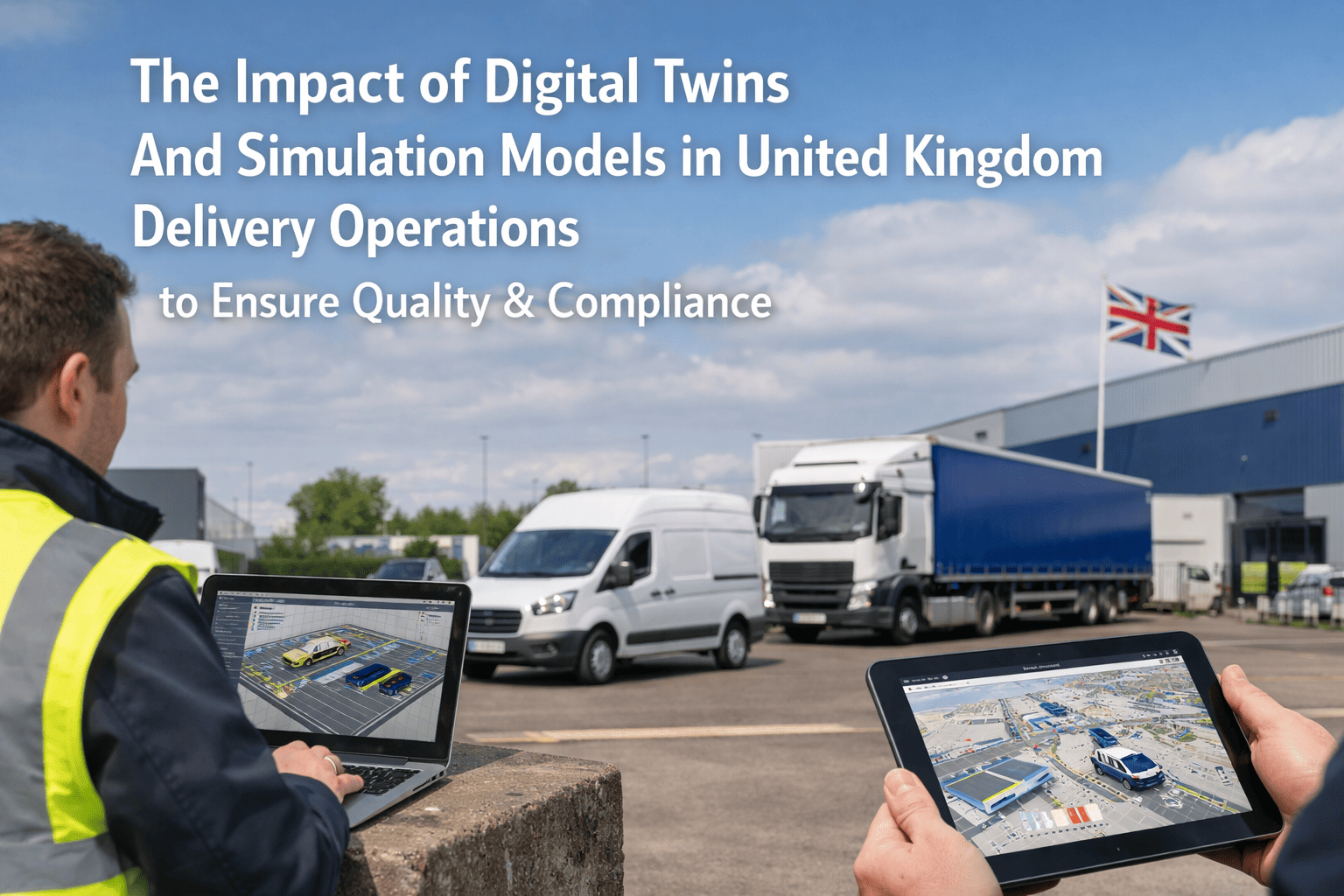
Every delivery fleet manager has faced it — a vehicle breaks down mid-route, a driver takes the wrong path, or a warehouse dispatch gets bottlenecked during peak hours. These are not random events. They are predictable patterns that most operations simply lack the tools to see. Digital twin technology changes that equation entirely, giving logistics teams a live, intelligent replica of their entire fleet that learns, simulates, and optimizes — before problems happen on the road.
Advanced Thought Leadership · Delivery Operations Management
Digital Twin for Delivery Fleet Operations: The Future of Smart Logistics
How leading fleets in 2026 are using virtual replicas of their operations to predict failures, optimize routes, and cut logistics costs — before a single driver leaves the depot.
$73.5B
Projected digital twin market size by 2027
30%
Average reduction in fleet maintenance costs with digital twin adoption
25%
Improvement in on-time delivery rates reported by early adopters
2x
Faster route optimization response vs. traditional dispatch systems
What Is a Digital Twin for Fleet Operations?
A digital twin is a real-time virtual model of a physical system — in this case, your entire delivery fleet. It mirrors every vehicle, driver, route, and maintenance status in a live simulation that runs alongside actual operations. Sensors feed data into the model continuously. The twin uses that data to simulate future states, predict failures, and recommend optimal decisions.
It is not a dashboard. It is not a GPS tracker. It is a dynamic, intelligent replica that thinks ahead — processing thousands of variables simultaneously to keep your fleet performing at its best.
Physical Fleet
Vehicle on road with sensors
Driver behavior in real time
Engine temperature, fuel, wear
Route conditions and traffic
Cargo weight and delivery stops
Digital Twin Engine
AI simulation + predictive modeling
Intelligence Output
Failure prediction 2–4 weeks ahead
Optimized route recommendations
Automated maintenance work orders
Driver coaching alerts
Fleet cost scenario simulations
The Five Core Capabilities of Fleet Digital Twins
01
Predictive Maintenance
The twin analyzes sensor data from each vehicle — vibration, temperature, oil pressure, brake wear — and predicts component failures before they happen. Maintenance is triggered by actual condition, not a calendar. Unplanned breakdowns drop by up to 50%.
02
AI Route Optimization
The simulation models traffic patterns, weather, delivery windows, and vehicle load in real time. It continuously recalculates the most efficient routes across the entire fleet — not just one driver at a time — cutting fuel costs and improving on-time performance simultaneously.
03
Scenario Simulation
Before you add a new depot, change a delivery zone, or expand your fleet, the digital twin simulates the outcome. Operations teams can test dozens of "what if" scenarios without risk — choosing the strategy that delivers the best result before committing resources.
04
Driver Performance Modeling
The twin builds a performance profile for every driver based on fuel efficiency, braking behavior, idle time, and delivery accuracy. Coaching insights are generated automatically — identifying training needs and recognizing top performers with real data, not guesswork.
05
Fleet Lifecycle Intelligence
Using historical wear patterns and usage intensity, the twin models the remaining useful life of every vehicle in the fleet. Replacement decisions are made based on total cost of ownership projections — not gut feel or manufacturer defaults.
Build your digital foundation before the twin
Digital twins need clean, centralized fleet data to function. OxMaint gives you the CMMS backbone — work orders, asset records, and maintenance history — that powers intelligent fleet modeling.
Traditional Fleet Management vs. Digital Twin Operations
| Capability |
Traditional Fleet Management |
Digital Twin Operations |
| Maintenance Trigger |
Calendar schedule or breakdown |
Condition-based, AI-predicted |
| Route Planning |
Static daily dispatch plan |
Real-time dynamic optimization |
| Failure Visibility |
Zero — reactive only |
2–4 weeks advance prediction |
| Fleet Expansion Decisions |
Based on experience and estimates |
Simulated outcome modeling |
| Driver Coaching |
Periodic manager review |
Automated real-time behavioral insights |
| Vehicle Replacement |
Age or reactive breakdown |
Total cost of ownership projection |
| Fuel Cost Control |
Monitored after the fact |
Actively optimized per route and driver |
How Digital Twins Work in a Real Delivery Operation
The concept becomes clearer through a real-world scenario. A regional last-mile delivery company runs 80 vehicles across three depots. Here is what changes when they deploy a digital twin.
1
Data Collection
Telematics, IoT sensors, and CMMS maintenance records feed continuous data into the twin — vehicle health, GPS position, driver inputs, fuel consumption, and cargo load at every moment.
2
Live Simulation
The twin builds a virtual model of all 80 vehicles simultaneously. It runs millions of micro-simulations per day — modeling wear rates, traffic impact, delivery timing, and energy consumption for every route.
3
Anomaly Detection
The AI identifies Vehicle #47 showing vibration patterns consistent with a failing wheel bearing — 18 days before a projected failure. A work order is automatically generated and parts are flagged for pre-order.
4
Decision Automation
The twin reschedules Vehicle #47 for service during its lowest-revenue window, routes its assigned deliveries to two nearby vehicles with available capacity, and notifies the fleet manager — no manual coordination required.
5
Continuous Learning
After the repair, the outcome is logged back into the twin. The model improves its bearing failure prediction for all similar vehicles in the fleet, getting more accurate with every service event.
The Data Foundation: What Your Fleet Twin Actually Needs
Required Data Inputs
Real-time vehicle telematics (GPS, speed, idle time)
IoT sensor feeds (engine, brakes, tires, temperature)
Historical maintenance records and work orders
Driver behavior data (acceleration, braking, cornering)
Route and delivery completion records
Fuel consumption logs per vehicle and route
Intelligence Generated
Component failure predictions with timeline estimates
Dynamic route and load optimization recommendations
Automated maintenance scheduling and dispatch
Fleet cost scenario modeling for expansion planning
Driver performance scorecards and coaching triggers
Vehicle replacement timing recommendations
Why Most Fleets Are Not Ready
Maintenance records on paper — not digitized or searchable
No CMMS — work orders managed by phone or email
Disconnected systems with no shared data layer
Inconsistent inspection logs — gaps in asset history
No baseline asset condition data to train models on
Single-depot visibility — no cross-fleet intelligence
The Digital Twin Readiness Gap
A digital twin is only as intelligent as the data it learns from. Fleets without a centralized maintenance management system — digitized work orders, asset records, and inspection history — cannot deploy a meaningful twin. The single most impactful first step is not buying a simulation platform. It is digitizing your existing fleet data into a CMMS that creates the clean, consistent records a twin model can actually learn from.
ROI: What Fleets Gain at Each Stage
Stage 1
Digitized Fleet CMMS
20–30% fewer emergency breakdowns
Full maintenance history per vehicle
Automated PM scheduling
200–400% ROI in 2 years
→
Stage 2
IoT + Predictive Analytics
Up to 50% reduction in unplanned downtime
Condition-based maintenance precision
Failure alerts 2–4 weeks in advance
25–35% lower maintenance costs
→
Stage 3
Full Digital Twin
Fleet-wide optimization in real time
Scenario simulation before decisions
Autonomous dispatch and scheduling
35–45% total logistics cost reduction
Key Takeaways: Digital Twin for Delivery Fleets
→
A digital twin is not a product you buy — it is a capability you build: It requires clean, continuous data from telematics, sensors, and a CMMS. Without that foundation, no simulation platform delivers real value.
→
The ROI starts before the full twin is deployed: Digitizing maintenance and building a predictive maintenance program — Stage 1 and 2 — delivers measurable cost reduction while creating the data layer the twin needs.
→
Route optimization and predictive maintenance compound each other: A fleet that never has unplanned breakdowns and always runs the optimal route is not a future concept. It is what digital twin operations deliver today for fleets that have built the right data foundation.
→
Start with fleet data digitization — now: The fleets investing in digital twin infrastructure in 2026 will have a 12–18 month intelligence advantage over competitors who delay. The gap widens with every month of clean data collected.
Your Fleet's Digital Twin Journey Starts with Clean Data
OxMaint provides the fleet CMMS foundation that every digital twin deployment needs — digitized work orders, centralized asset records, automated PM scheduling, and cross-fleet maintenance analytics. Build the data layer that powers intelligent fleet operations.
Digital work orders and DVIR logs
Asset history and condition tracking
Automated PM by mileage or date
Cross-fleet maintenance analytics
Frequently Asked Questions
What is a digital twin in fleet management?
A digital twin in fleet management is a real-time virtual replica of your physical fleet — vehicles, routes, drivers, and maintenance status — that runs as a live simulation. It continuously ingests data from telematics and IoT sensors, uses AI to model future states, and generates predictions and recommendations to optimize operations before problems occur on the road.
How does digital twin technology reduce fleet maintenance costs?
Digital twins shift maintenance from reactive and schedule-based to condition-based and predictive. By detecting component wear patterns weeks before failure, they eliminate expensive emergency breakdowns, reduce unnecessary preventive services, and optimize parts ordering. Early adopters report 25–35% reductions in total fleet maintenance costs within the first two years of deployment.
What data does a delivery fleet need to deploy a digital twin?
A functional fleet digital twin requires: real-time telematics data, IoT sensor feeds from vehicle systems, a complete maintenance history from a CMMS, driver behavior records, route and delivery logs, and fuel consumption data. The most critical prerequisite is a digitized maintenance management system — without clean historical records, the AI model has no baseline to learn from.
Can small and mid-size delivery fleets use digital twin technology?
Yes. While early digital twin deployments were enterprise-only, the technology has become accessible to fleets of 10–50 vehicles through cloud-based platforms. The practical starting point for any fleet size is the same: digitize your maintenance operations first. This creates the data foundation that scales into predictive analytics and eventually full twin simulation as your operation grows.
How is AI fleet simulation different from standard fleet GPS tracking?
GPS tracking shows you where your fleet is right now. AI fleet simulation — the core of digital twin operations — models where your fleet is going, what will break, which route is truly optimal given 50 variables, and what your fleet will cost to operate over the next quarter. It is the difference between a rearview mirror and a predictive windshield.