Your warehouse has a conveyor motor that has been running for 14,000 hours. It is consuming 6% more energy than baseline, its bearing temperature is trending 4 degrees above normal, and vibration amplitude at the drive end has increased 18% over the past three weeks. Will it fail this month? Next quarter? In an hour? Without a digital twin, you are guessing. With one, you already know — because a virtual replica of that motor has been running the same 14,000 hours in simulation, processing the same sensor data, and the degradation model has already calculated a remaining useful life of 22 days with 91% confidence. Digital twin technology gives warehouse operations teams the ability to simulate equipment breakdowns before they happen, test maintenance interventions without touching a physical asset, and optimise schedules based on predicted — not assumed — failure timelines. Start free on OxMaint or book a live demo to see how digital twin simulation integrates with CMMS-driven maintenance workflows for warehouse logistics.
Article · Warehouse Operations · Digital Twin · Predictive Simulation
Digital Twin Warehouse Maintenance Simulation: Predict Failures, Test Fixes, Optimise Schedules — Before Touching a Single Asset
How digital twin technology creates real-time virtual replicas of warehouse equipment — enabling operations teams to simulate breakdowns, validate maintenance decisions, and reduce failure costs with predictive confidence that manual planning cannot match.
$33.97B
global digital twin market in 2026 — growing at 35.4% CAGR toward $384B by 2034
88-97%
accuracy in predicting remaining useful life when digital twins process sensor data through degradation models
30-40%
reduction in maintenance costs reported by facilities using digital twin predictive simulation
What a Digital Twin Actually Is — and What It Is Not
A digital twin is not a 3D model. It is not a dashboard. It is not a static blueprint of your warehouse. A digital twin is a living, continuously updated virtual replica of a physical system — fed by real-time sensor data, governed by physics-based degradation models, and capable of simulating future behaviour with quantified confidence. It mirrors your equipment's actual condition, predicts how that condition will evolve, and lets you test maintenance interventions virtually before committing resources to the physical asset.
Physical World
Conveyor motor runs 18 hours per day under variable load
Bearing temperature: 72 degrees C and rising 0.3 per week
Vibration RMS: 4.2 mm/s — up from 3.1 baseline
Energy draw: 6% above rated specification
Last maintenance: 4,200 operating hours ago
Digital Twin
Virtual motor simulates same 18-hour cycle with identical load profile
Thermal model predicts bearing reaches critical threshold in 22 days
FFT analysis classifies inner race bearing defect at 91% confidence
Energy model flags insulation degradation as probable root cause
Simulation recommends intervention within 14-day window — CMMS work order triggered
See how digital twin simulation connects to automated maintenance workflows
OxMaint receives predictive alerts from digital twin platforms and converts them into prioritised, scheduled work orders — with technician assignment, parts reservation, and mobile notification built in.
Five Simulation Capabilities That Change Warehouse Maintenance
Digital twins do not just monitor — they simulate. This is the fundamental difference from threshold-based condition monitoring. A digital twin can answer questions that no sensor dashboard can: What happens if we delay this repair by two weeks? What is the cascade effect if this conveyor fails during peak shift? How much life can we extract by reducing load by 15%?
01
Remaining Useful Life Prediction
The twin processes vibration, thermal, and electrical data through physics-based degradation models to calculate how many operating hours remain before functional failure — with a confidence interval, not a guess. Maintenance teams schedule interventions at the optimal point: late enough to extract maximum asset life, early enough to prevent breakdown.
Output: "Bearing RUL: 22 days at current load (91% confidence)" — auto-triggers CMMS work order
02
What-If Scenario Testing
Test maintenance decisions virtually before committing. What happens if we replace just the bearing versus the full motor assembly? What if we reduce conveyor speed by 10% instead of stopping for repair? The twin simulates each scenario and calculates the cost, downtime, and risk tradeoff.
Output: "Speed reduction extends RUL by 31 days — saves $8,400 vs. emergency replacement"
03
Failure Cascade Simulation
A single conveyor failure does not just stop one line — it backs up upstream, starves downstream, and disrupts dispatch schedules. The digital twin models these cascading effects across the entire warehouse system, showing the true cost of inaction versus the cost of planned intervention.
Output: "Drive motor failure on Line 3 causes 4.2-hour throughput loss across 3 connected lines"
04
Maintenance Schedule Optimisation
Instead of calendar-based PM schedules, the twin calculates optimal maintenance windows based on actual equipment condition, production demand, and technician availability. It replaces fixed schedules with condition-driven timing — aligning service windows with operational reality.
Output: "Optimal window: Tuesday 02:00-06:00 — lowest throughput impact, parts in stock"
05
Root Cause Replay
When a failure occurs, the twin replays equipment behaviour in simulation — stepping back through the data to pinpoint exactly when the degradation began, what caused it, and what intervention would have prevented it. This transforms every failure into a learning event that improves future prediction accuracy.
Output: "Failure root cause: lubrication degradation began 47 days prior — flagged but deferred"
Digital Twin Architecture for Warehouse Maintenance
Understanding how a digital twin connects to your warehouse operation — from sensor to simulation to work order — is essential for evaluating whether the technology fits your infrastructure and maintenance workflow.
Layer 1
Data Collection
IoT sensors on critical assets capture vibration, temperature, current, and pressure data. Edge gateways process raw signals locally — extracting features like RMS, FFT spectra, and fault frequencies — and transmit only diagnostic-grade data to the twin platform.
Layer 2
Digital Twin Engine
Physics-based models and machine learning algorithms create a virtual replica of each monitored asset. The twin continuously synchronises with real-time data, compares actual behaviour to predicted behaviour, and flags deviations that indicate developing faults or accelerating degradation.
Layer 3
Simulation and Prediction
The twin runs what-if scenarios, calculates remaining useful life, models failure cascades, and optimises maintenance timing. Predictions carry confidence scores — giving maintenance teams quantified risk data, not just alerts.
Layer 4
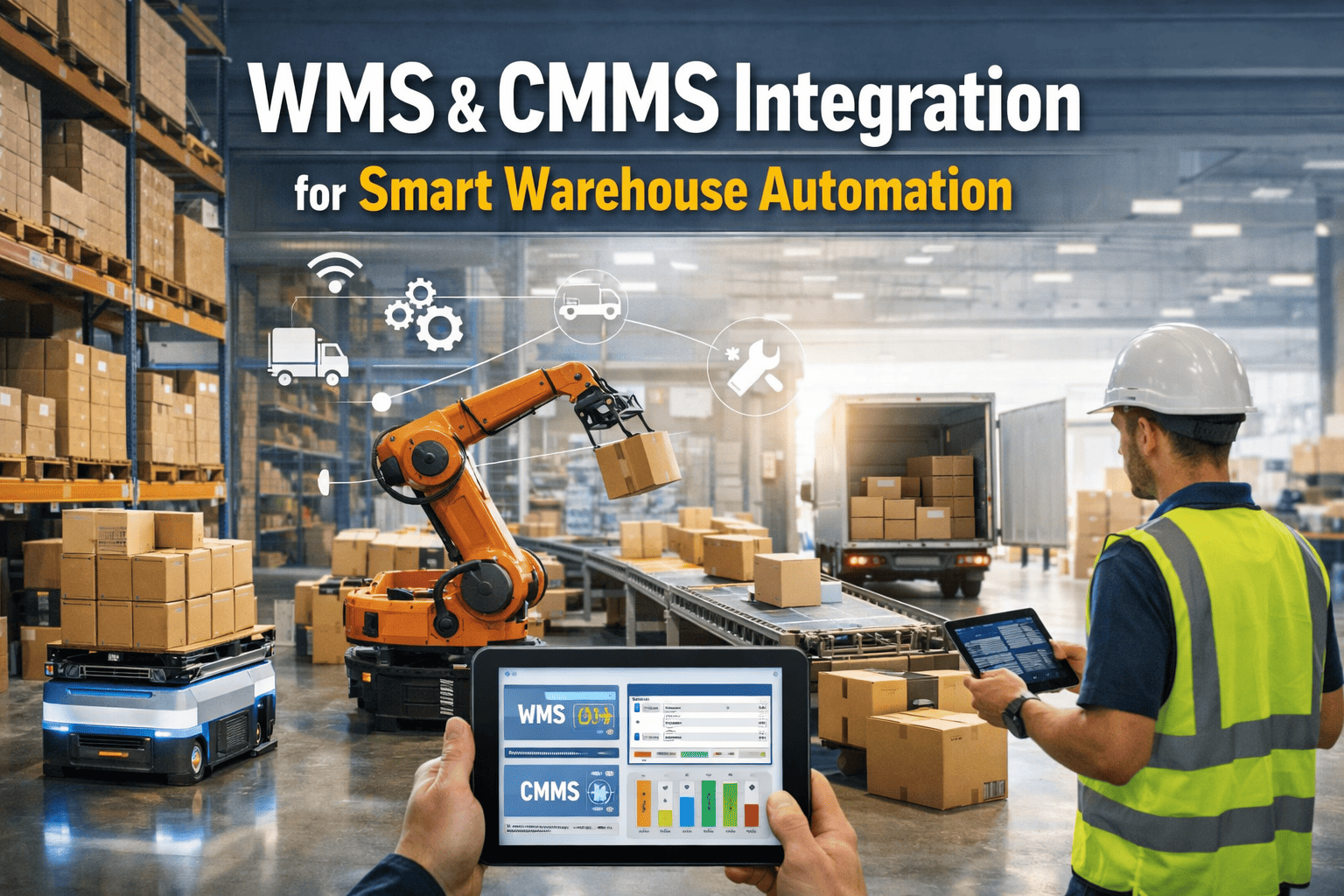
CMMS Integration
Simulation outputs route to OxMaint via API — generating prioritised work orders with asset ID, fault type, severity, recommended intervention, and optimal scheduling window. Technicians receive mobile alerts with full repair context. Completed work feeds data back into the twin for model refinement.
Where Digital Twins Deliver the Highest ROI in Warehouse Logistics
Not every warehouse asset justifies a digital twin. The technology delivers highest return on equipment where failure consequence is severe, replacement lead time is long, and degradation patterns are complex enough to benefit from simulation-based prediction over simple threshold alerts.
| Warehouse Asset |
Digital Twin Value |
Simulation Use Case |
ROI Driver |
| Conveyor Drive Systems |
RUL prediction for motor bearings, gearboxes, and belt tension mechanisms |
Simulate load reduction vs. full replacement tradeoff |
Highest — line stoppage impact |
| Sortation Equipment |
Cascade failure modelling across interconnected divert mechanisms |
Model throughput loss from single-point failures |
Highest — order fulfilment dependency |
| Dock Leveller Hydraulics |
Pump degradation and valve cavitation prediction |
Test seal replacement timing vs. full rebuild |
High — loading bay availability |
| Packaging Line Gearboxes |
Gear mesh frequency trending and tooth wear simulation |
Optimise lubrication schedule based on simulated wear rates |
High — packing throughput |
| Automated Storage/Retrieval |
Multi-axis motion system degradation modelling |
Simulate component replacement sequencing to minimise total downtime |
Highest — inventory access dependency |
| HVAC and Refrigeration |
Compressor and fan motor thermal modelling |
Energy optimisation scenarios under varying ambient conditions |
Medium — climate compliance |
Ready to simulate before you schedule?
OxMaint connects to digital twin platforms and converts predictive outputs into structured maintenance workflows — so every simulation insight becomes a scheduled, tracked, and completed repair.
Traditional Monitoring vs. Digital Twin Simulation
Threshold-Based Monitoring
Triggers alert when a single parameter exceeds a fixed limit
No simulation — cannot model what happens next
No remaining useful life estimate — alert is binary (pass/fail)
Cannot test intervention scenarios before execution
Misses complex multi-parameter failure patterns
Digital Twin Predictive Simulation
Processes multiple sensor streams through physics-based models simultaneously
Simulates future behaviour with confidence-scored predictions
Calculates remaining useful life in days/hours with accuracy above 88%
Runs what-if scenarios to validate intervention decisions before execution
Detects subtle cross-parameter degradation patterns invisible to threshold alerts
85-90%
of catastrophic equipment failures preventable when digital twins model degradation continuously
20-40%
extension in equipment lifespan when maintenance timing is driven by simulation instead of fixed schedules
50%
reduction in development and testing time for maintenance process changes using virtual commissioning
Frequently Asked Questions
What is a digital twin in warehouse maintenance?
A digital twin is a continuously updated virtual replica of physical warehouse equipment — fed by real-time sensor data and physics-based models. It simulates equipment behaviour, predicts remaining useful life, and enables what-if scenario testing so maintenance teams can plan interventions with quantified confidence.
Start free on OxMaint to see how twin outputs integrate with work orders.
How does a digital twin differ from regular condition monitoring?
Condition monitoring triggers alerts when a single parameter exceeds a threshold. A digital twin processes multiple data streams through simulation models — predicting when failure will occur, modelling cascade effects, and testing intervention scenarios before execution.
Book a demo to see the difference in practice.
Which warehouse equipment benefits most from digital twin simulation?
Conveyor drive systems, sortation equipment, and automated storage/retrieval systems deliver the highest ROI — any asset where failure stops throughput, replacement lead time is long, and degradation patterns benefit from physics-based modelling.
Try OxMaint free to build your asset priority list.
How accurate are digital twin failure predictions?
Facilities using digital twin predictive maintenance report 88-97% accuracy in remaining useful life predictions — but the twin typically needs 6-12 months of baseline data to train models effectively. Accuracy improves continuously as the model learns.
Book a demo to discuss implementation timelines.
How does a digital twin connect to a CMMS like OxMaint?
The twin platform sends prediction outputs via API to OxMaint — generating work orders with asset ID, fault classification, severity, recommended timing, and confidence score. Technicians get mobile alerts with full context. Completed repairs feed data back into the twin.
Start your free trial.
Simulate It Before It Breaks. Fix It Before It Costs.
OxMaint integrates with digital twin platforms to convert predictive simulation outputs into structured, scheduled, and tracked maintenance workflows. Every prediction becomes a work order. Every work order becomes a completed repair. Every completed repair feeds data back into a smarter model. That is how digital twins and CMMS work together to eliminate unplanned downtime.