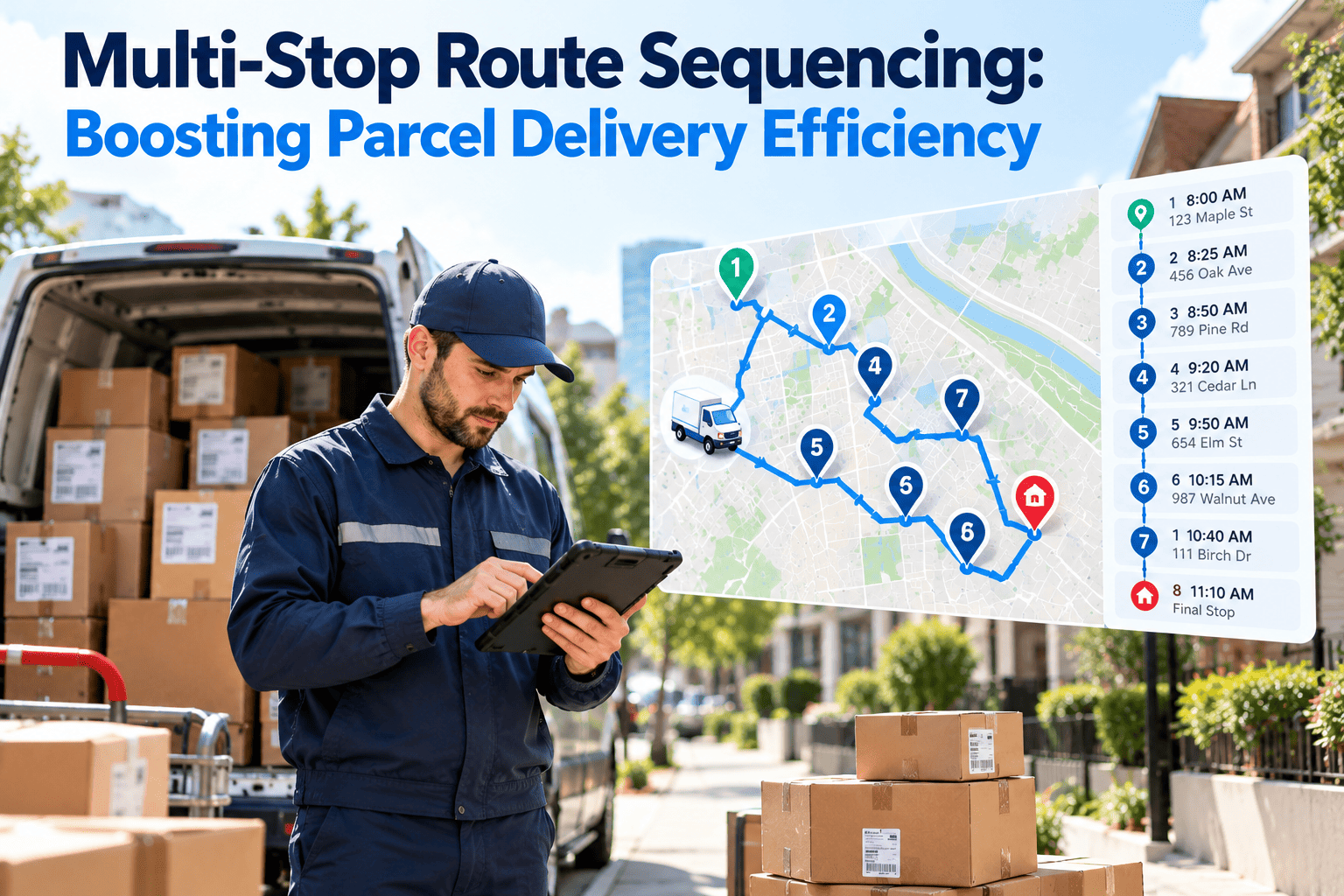
Two routes can serve exactly the same stops and still differ sharply in miles, hours, and fuel. The difference is sequence. In multi-stop parcel delivery, the order of stops decides how much backtracking, idling, and driver fatigue a route carries before the first package is even scanned. This guide explains how multi-stop route sequencing works, which heuristics and constraints matter, how to re-sequence live on the road, and why vehicle reliability, tracked through preventive maintenance software, protects the sequence you planned.
Multi-Stop Route Sequencing: Boosting Parcel Delivery Efficiency
Sequence stops so drivers cover less ground, wait less, and finish on time, with a method that holds up against real-world constraints.
Why Stop Order Matters More Than Most Teams Expect
Assigning stops to a route is one decision. Ordering them is another. Many operations spend effort on the first and leave the second to driver habit or address sorting.
- Backtracking adds miles without adding deliveries.
- Poor order creates waiting when drivers arrive before a window opens.
- Crossing the same corridor twice increases exposure to congestion.
- Heavy or fragile items loaded in the wrong order slow every stop.
- Late stops are often a sequencing problem disguised as a capacity problem.
The cost of a bad sequence shows up in four places
Sequencing Methods Compared
No single method wins everywhere. The right choice depends on stop count, constraint density, and how often plans change.
| Method | How it works | Strength | Limitation |
|---|---|---|---|
| Nearest neighbor | Always go to the closest unvisited stop. | Simple and fast. | Can leave isolated stops stranded at the end. |
| Sweep | Order stops by angle around the depot. | Good for compact, radial territories. | Weak with windows and uneven geography. |
| Insertion | Add each stop where it increases cost the least. | Handles constraints more naturally. | Result depends on insertion order. |
| Local improvement | Swap or reverse segments to shorten the route. | Improves any starting sequence. | May settle on a good, not best, result. |
| Metaheuristic search | Explore many sequences using guided search. | Strong with complex constraints. | Needs tuning and computing time. |
Practical guidance
Start with a fast constructive method, then apply improvement steps. Compare outcomes on total cost, not only distance, because a shorter route that misses windows is not better.
Real-World Constraints That Reshape the Sequence
- WindowsDelivery commitments force some stops earlier than geography suggests.
- Load orderVehicle layout determines which parcels are reachable at each stop.
- Access limitsOne-way streets, turning limits, and building hours change feasible paths.
- Service timeApartment blocks, signatures, and large items alter how long each stop takes.
- Driver breaksMandatory rest periods must fall at sensible places along the route.
- PriorityExpress, high-value, or time-sensitive parcels may move to the front.
Reduce Miles Without Adding Breakdown Risk
Efficient routes still depend on healthy vehicles. Manage inspections, work orders, and preventive schedules in one place.
Optimized Versus Truly Efficient Routes
A route can be mathematically optimal and still fail the driver. The model only knows what it was given.
Optimized on paper
- Minimum modeled distance
- Assumes constant travel speed
- Ignores parking and access effort
- Treats every stop as equal effort
- Cannot react to a blocked road
Efficient in practice
- Lowest total cost including time
- Uses time-of-day travel data
- Includes realistic stop effort
- Respects loading and handling order
- Adjusts as conditions change
Live Re-Sequencing on the Road
The morning plan is a forecast. Orders change, vehicles slow down, and customers are absent. Re-sequencing is how a plan adapts.
Guardrails for dynamic changes
- Limit how often the sequence can change so drivers are not whipsawed.
- Do not move stops the driver has already prepared or loaded for.
- Show the driver why the order changed.
- Record every change so planners can learn from recurring triggers.
What to Measure
How Maintenance Protects the Sequence
A well-sequenced route assumes the vehicle runs the whole day. Oxmaint does not sequence stops; it supports the maintenance workflow behind the vehicles.
- Preventive maintenance by mileage reflects the real distance each vehicle covers, so efficient routing and service intervals stay aligned.
- Pre-trip inspections on mobile capture defects before they strand a route.
- Work orders assign and track repairs so dispatch knows availability.
- Asset records keep service history, documents, and warranty details together.
- Inventory control helps keep tires, filters, and brake parts available.
- Dashboards and reports reveal repeat failures and cost per vehicle.
Linking route data to maintenance planning
When sequencing reduces mileage, service intervals stretch. When routes get longer, wear accelerates. Review maintenance schedules whenever routing changes significantly.
Sequencing Readiness Checklist
- Stop locations geocoded and validated
- Service times modeled by stop type
- Time windows and priorities defined
- Load order matched to stop order
- Travel times reflect time of day
- Re-sequencing rules and limits documented
- Planned versus actual order reviewed weekly
- Vehicle readiness confirmed before dispatch
Frequently Asked Questions
What is multi-stop route sequencing?
It is deciding the order in which a vehicle visits its assigned stops to reduce distance and time while meeting constraints.
Is the nearest-neighbor method good enough?
It is a fast starting point, but improvement steps usually yield better results, especially with windows.
How often should routes be re-sequenced during the day?
Only when a trigger materially affects remaining stops, with limits so drivers are not constantly reordered.
Does vehicle maintenance affect route efficiency?
Yes, because breakdowns and poorly maintained vehicles disrupt plans. You can start with Oxmaint to organize maintenance.
Can I see how Oxmaint handles fleet work orders?
A short session covers inspections, schedules, and repairs. You can book a demo to see it.
Data Required for Reliable Sequencing
Sequencing quality depends on inputs more than algorithms. Weak data produces confident but wrong sequences.
Location and road data
- Validated geocodes with entrance, gate, or loading-bay detail where it matters.
- Road attributes such as one-way streets, vehicle restrictions, and turning limits.
- Time-of-day travel speeds for the corridors your drivers use most.
- Known access problems recorded by drivers and fed back to planning.
Stop and parcel data
- Parcel counts, dimensions, and weights for load planning.
- Service time by stop type, building type, and parcel handling needs.
- Time windows, priority levels, and special instructions.
- Delivery outcome history to identify stops that regularly fail or run long.
Sequencing in Dense Urban and Rural Areas
The same method behaves differently depending on geography. Match your approach to the territory.
Dense urban routes
- Walking time between nearby addresses may matter more than driving time.
- Parking search and access delay should be built into service time.
- Park-and-walk clusters can reduce vehicle movement when stops are close together.
- Congestion makes time-of-day travel data especially important.
Rural and spread-out routes
- Long distances between stops make drive time the dominant cost.
- A missed stop is expensive to revisit, so reliable timing and contact matter.
- Fuel stops, signal gaps, and limited roads affect feasible sequences.
- Combining routes across days can reduce empty return distance.
Mixed territories
- Divide routes into zones with different service-time and travel assumptions.
- Avoid forcing one rule set across very different areas.
- Review zone results separately so one area does not hide problems in another.
Handling Priority, Returns, and Pickups in the Same Route
Delivery routes increasingly carry returns, pickups, and exchanges. These change what a good sequence looks like.
Mixed delivery and pickup
- Check vehicle space, since pickups consume capacity as deliveries release it.
- Sequence deliveries first where load order and space require it.
- Keep returns away from fragile or high-value parcels when practical.
- Record pickup windows separately from delivery windows.
Priority parcels
- Define what qualifies as priority and keep the list short.
- Estimate the cost of moving priority stops forward before accepting the change.
- Notify affected customers when priority insertions shift their arrival.
Common Sequencing Mistakes
Many sequence problems are repeatable. Review this list before blaming the algorithm.
Mistakes worth correcting
- Optimizing distance while ignoring windows and service time.
- Letting drivers reorder routes with no record of why.
- Using one flat travel speed across the whole day.
- Ignoring how parcels are physically loaded in the vehicle.
- Re-sequencing so often that drivers lose confidence in the plan.
- Reviewing only completed routes and never comparing against the plan.
Evaluating Sequencing Quality in Practice
A route that looks smooth on a map is not automatically efficient. Test sequence quality against measurable results.
Practical tests
- Compare planned and actual total time for the same set of stops over several weeks.
- Check how many routes cross their own path or double back through the same corridor.
- Look at idle time spent waiting for windows to open.
- Review the last few stops of each route, where sequencing weaknesses often show up.
- Ask drivers which routes feel wrong and examine those first.
Benchmarking approach
- Keep a baseline from before any sequencing change.
- Change one factor at a time, such as service-time settings or window handling.
- Measure total cost including time, not distance alone.
- Repeat the comparison across different days and weather conditions.
Scaling Sequencing Across Depots and Peak Seasons
Methods that work for a single depot on a normal day can strain under peak volume or multi-depot networks.
Peak season considerations
- Test planning speed with peak order volumes before the season starts.
- Prepare temporary drivers with simpler routes and clearer instructions.
- Add review checkpoints so planners can catch problems early in the day.
- Protect maintenance windows so vehicle availability does not collapse at peak.
Multi-depot networks
- Assign stops to depots using the same constraints used for sequencing.
- Avoid sequencing in isolation from depot loading capacity.
- Compare depots on consistent measures to find best practice worth copying.
Driver Experience and Sequence Acceptance
Drivers accept sequences they understand. Resistance often points to missing information rather than stubbornness.
Improving acceptance
- Show stop notes, access details, and window information beside the sequence.
- Explain unusual ordering choices, such as a distant stop placed early because of a window.
- Allow a simple way to flag a bad sequence from the road.
- Review flagged routes weekly and fix the underlying data.
A Practical Sequencing Improvement Plan
Improving sequence quality works best as a short series of controlled steps instead of a single large change.
Four steps
- Baseline: record planned and actual distance, time, and stop order for a representative set of routes.
- Clean: fix addresses, service times, and access notes that distort the plan.
- Tune: adjust constraint settings and test results against the baseline.
- Sustain: review sequence quality weekly and feed driver feedback into planning.
Signs the plan is working
- Fewer manual re-orders by dispatchers.
- Lower idle and waiting time before windows.
- Smaller gap between planned and actual finish times.
- Drivers describing routes as sensible rather than random.
Common Questions From Operations Teams
Teams new to sequencing optimization ask similar questions. These answers help set expectations.
Frequent concerns
- Will optimized sequences always beat an experienced driver? Not always, which is why feedback from drivers should improve the model.
- Should sequence be locked at dispatch? Lock stops the driver has prepared for, but allow controlled changes for the rest.
- How much improvement should we expect? It depends on your starting point, so measure your own baseline first.
- Does shorter distance always mean lower cost? No, because time, windows, and vehicle wear also count.
Sequencing and Vehicle Wear
Sequence quality changes how hard each vehicle works, which links routing to maintenance planning.
Where sequence affects the vehicle
- Stop-and-go driving in dense areas increases brake, clutch, and tire wear.
- Extra backtracking adds mileage that shortens service intervals.
- Long idle periods while waiting for windows add engine hours without distance.
- Heavily loaded early stops can raise stress on suspension and tires.
Maintenance responses
- Base preventive schedules on actual mileage and engine hours, not calendar time alone.
- Review inspection findings by route type to spot wear patterns.
- Reassess service intervals after any major change to route design.
Closing Thoughts on Efficient Sequencing
The best sequencing programs combine solid data, sensible constraints, driver input, and reliable vehicles. Treat the sequence as a living plan that improves with every week of results.
Keep these priorities in view
- Measure total cost, not only distance.
- Keep constraints realistic and documented.
- Let driver feedback improve the model.
- Protect vehicle availability with disciplined maintenance.
Practical Tips for Planners
Planners can improve sequences without waiting for a system change.
Habits that help
- Review the longest and most backtracked routes first.
- Keep service-time settings current by checking them against recent stop data.
- Compare similar routes on different days to separate sequencing from traffic effects.
- Document manual changes and the reason for each.
- Confirm vehicle availability before finalizing the day's sequence.
Keep Efficient Routes Running All Day
Give every vehicle a maintenance plan that matches how it is actually used, with inspections and repairs tracked in one system.