A Tier-1 parcel carrier operating a 47,000-parcel-per-hour cross-belt sorter experienced a gradual drift in camera-based barcode reads — accuracy fell from 99.7% to 94.2% over eleven weeks. The downstream impact was not the 5.5-percentage-point miss rate in isolation. It was the 2,585 parcels per hour flowing to recirculation, the induction queue backing up, the divert-to-manual-sort chute saturating at 3x design capacity, and the 14-minute average dwell increase per parcel cascading into missed carrier cutoffs. The root cause was lens contamination and ambient lighting drift that no one had scheduled to inspect. Modern robotic sorters do not fail the way belt conveyors fail — they fail quietly, in the vision layer, and the throughput damage is exponential rather than linear. Sign in to OxMaint to schedule vision-system inspections, calibration cycles, and AI-model drift checks across your sortation fleet — or book a demo to see the robotic sorter maintenance workflow configured for your warehouse.
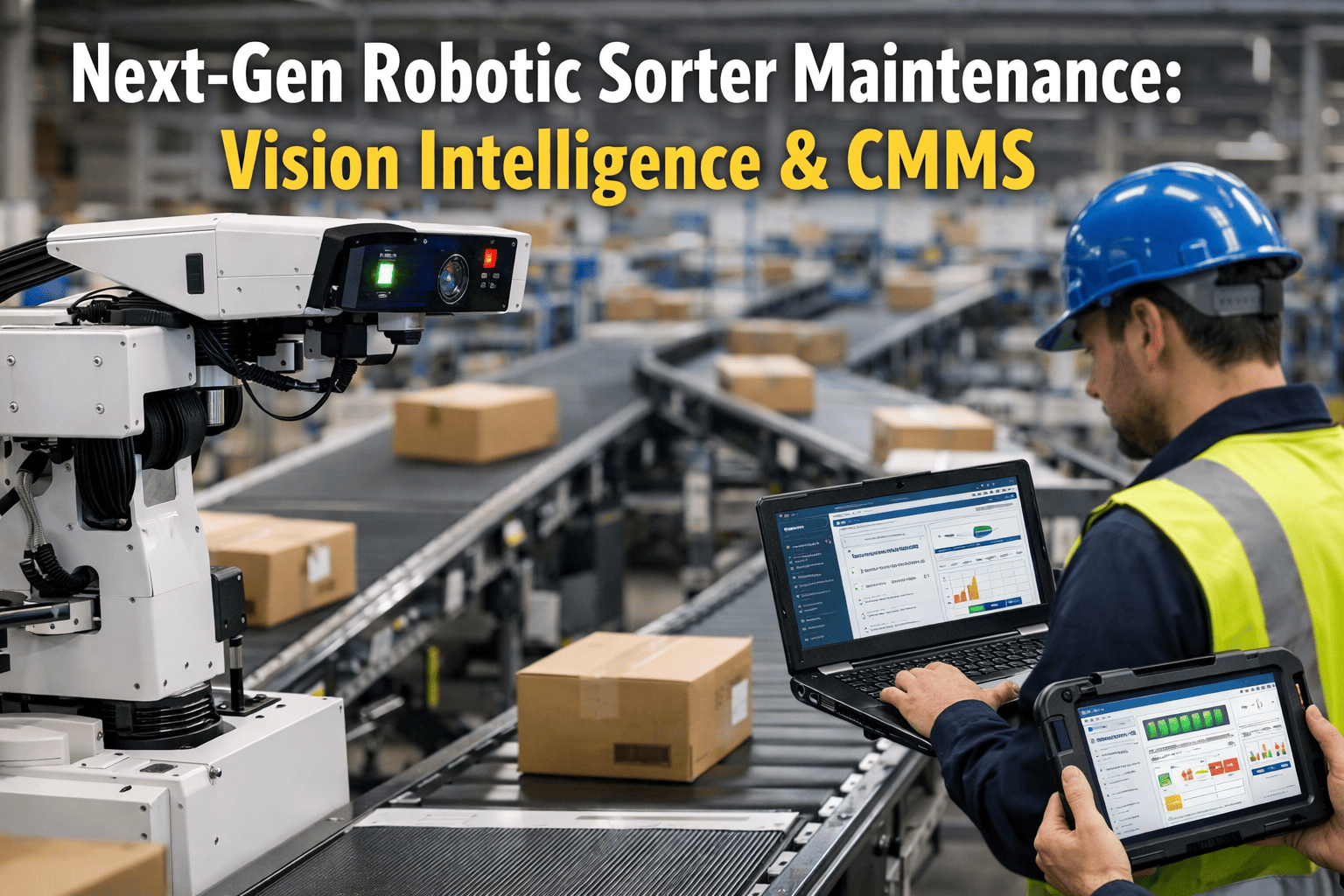
Next-Gen Robotic Sorter Maintenance: Vision Intelligence & CMMS
Modern robotic sorters combine neural-network vision with adaptive routing. When vision drifts, sort accuracy collapses across the entire outbound pipeline. CMMS-scheduled vision maintenance prevents this entirely — here is how the maintenance model has to change.
Why Vision Intelligence Changed Sorter Maintenance Forever
The sorter your grandparents would recognise — chain-driven tilt tray, photo-eye barcode read, PLC-routed divert — was a mechanical machine with an electronic controller. Its failure modes were mechanical: worn tilt mechanisms, stretched chains, failing photo-eyes. Preventive maintenance was a grease schedule and a chain tension check. The sorter installed in a modern fulfilment centre is a fundamentally different machine. It reads packages with a 6-to-12-camera array feeding a convolutional neural network that classifies barcodes, 2D matrices, handwritten labels, damaged labels, and increasingly label-less packages via SKU-level visual recognition. It routes via continuous adaptive algorithms that balance chute fill-rate, downstream loader readiness, and carrier cutoff windows. The hardware is still mechanical — but the failure surface has moved.
Vision-layer failures do not announce themselves. A photo-eye that fails triggers a fault, stops the sorter, and generates a work order. A camera whose lens is 30% contaminated keeps running, keeps reading — but its confidence scores drop, its read rate falls, and marginal packages start routing to the no-read chute. Throughput degrades silently for days or weeks before anyone correlates the recirculation spike to the camera. Sign in to OxMaint to configure vision-system PM schedules that catch drift before it cascades.
The Vision Drift Cascade — How a 2% Read-Rate Drop Becomes a Shift-Ending Incident
The compounding nature of vision-layer failures is what separates modern sorter maintenance from its mechanical ancestor. A 2% read-rate drop on a 40,000 PPH sorter sounds recoverable — 800 extra parcels per hour going to no-read. In isolation, it is. In the context of a full operation, it is the start of a cascade that operations managers have watched unfold in real time across hundreds of distribution centres.
This cascade is not a worst-case scenario. It is the predictable consequence of vision-layer drift on any high-throughput sorter that runs continuously without scheduled vision maintenance. Book a demo to see how OxMaint configures vision-layer PM schedules that break this cascade at Stage 1.
Vision-Layer PM Scheduling Built Into OxMaint
Camera inspection, lens cleaning, lighting verification, and AI confidence-score drift checks — scheduled, executed, and audited alongside your mechanical PM programme. One platform for the whole sorter.
The Vision Intelligence Maintenance Matrix — What to Check, How Often, Why
Building a vision-layer PM programme from scratch is overwhelming if the maintenance team has only ever worked with mechanical assets. The matrix below is the condensed version of what high-throughput warehouse operations have learned — often painfully — about what each vision-system component requires and how often. Sign in to import this matrix as a PM template library in OxMaint.
| Component | Check Interval | Inspection Task | Failure Signature | Criticality |
|---|---|---|---|---|
| Camera lenses | Daily | Visual inspection, microfibre clean, IPA wipe if dust/grease present | Declining confidence scores, rising no-read rate on specific lanes | High |
| LED lighting rings | Weekly | Lux measurement vs baseline, uniformity check, LED temperature scan | Shadow bands, inconsistent read rate across belt width, thermal hotspots | High |
| Camera mounting rigidity | Monthly | Torque check on mount bolts, vibration baseline comparison | Motion blur, misaligned field-of-view, intermittent read failures | Medium |
| Calibration targets | Weekly | Run calibration target packages through induction, verify read confidence | Absolute performance baseline — catches drift before production impact | High |
| AI model confidence drift | Weekly | Review 7-day confidence-score histogram, investigate left-shift | Population of reads shifting toward lower confidence — leading indicator | High |
| No-read chute volume | Daily | Log parcel count diverted to no-read, trend vs 30-day baseline | Rising no-read volume is the earliest operational signal of vision issues | High |
| Package-type distribution | Monthly | Sample failing reads for package type — identify new SKUs or packaging changes | Model blind spots on new packaging require retraining, not mechanical fix | Medium |
| Ambient lighting | Seasonal | Measure ambient lux at induction, check for skylight / bay-door interference | Seasonal daylight changes affect contrast — common autumn/spring issue | Low-Med |
| Chute-full sensors | Monthly | Functional test with trigger object, verify WMS signal propagation | Silent failure creates chute overfill and recirculation even with 100% read | High |
| Divert actuator cycle count | Monthly | Log cycle count vs OEM service interval, schedule replacement proactively | Divert miss at EOL causes wrong-chute routing — not a read failure | Medium |
From Reactive to Predictive — The CMMS-Driven Vision Maintenance Model
The maintenance philosophy that fits a modern robotic sorter is not the one that fit the mechanical ancestor. The failure signatures are different, the inspection cadence is different, and the data sources are different. The shift is from reactive mechanical repair to predictive vision-layer intervention — and the CMMS is the connective tissue that holds it together.
Most warehouse operations running robotic sortation today sit somewhere between the transitional and predictive models. The gap is almost always the CMMS — legacy CMMS platforms configured for forklift and conveyor PM schedules were never architected to handle vision-telemetry triggers or AI-model drift alerts. Book a demo to see how OxMaint handles vision-telemetry-triggered work orders for robotic sortation assets.
The Seven KPIs That Matter for Vision-Driven Sorter Reliability
Measuring sorter performance with the old KPIs — uptime, PLC fault count, belt speed — misses the entire vision-layer story. The KPI set below is what leading-edge warehouse operations now use to run sortation reliability. Every one of them can be configured as a tracked metric in OxMaint against its corresponding asset. Sign in to configure the KPI dashboard for your sortation fleet.