K–12 districts average 55–65% PM compliance because manual scheduling cannot manage 7 compliance domains, 12,000+ assets, and an academic calendar simultaneously. The result: 45% emergency work ratio at 3–5× planned cost, compliance gaps discovered during audits, and HVAC failures during state testing weeks. AI-driven PM scheduling treats every deadline, every technician skill, every building access window, and every asset risk score as variables in a single optimization — moving PM compliance to 95%+ and emergency ratio below 15% within two semesters, without adding staff. Schedule a demo to see AI preventive maintenance scheduling configured for K–12 operations.
55–65%
average PM compliance in K–12 districts using manual scheduling
95%+
PM compliance achievable with AI-driven scheduling within two semesters
45% → <15%
emergency work ratio reduction as PM compliance prevents the failures that generate emergencies
$800K–$2M
annual savings from emergency prevention, energy correction, and compliance penalty avoidance
Why Manual PM Scheduling Fails in K–12 Districts
School districts face a scheduling problem that is structurally different from single-facility operations. The assets are distributed across dozens of buildings separated by miles. The academic calendar creates hard constraints that change weekly. Compliance domains overlap with different frequencies and different documentation requirements. And the maintenance team is too small to absorb any disruption without cascading deferrals.
Manual PM Scheduling
PM schedules built from manufacturer intervals — not actual asset condition or campus context
Calendar-based triggers ignore academic events — PM scheduled during finals, assemblies, testing
Every emergency defers 2–4 PM tasks — with no automatic rescheduling within compliance windows
No geographic clustering — technicians drive between schools randomly, wasting 60–90 min/day
Compliance deadlines buried in spreadsheets — discovered when the inspector arrives
No visibility into which deferrals create the highest failure risk
Result: 55–65% PM compliance. 45% emergency ratio. Compliance gaps discovered during audits. Growing backlog.
AI-Driven PM Scheduling
PM intervals adjusted by actual asset condition, failure history, and risk score
Academic calendar integrated — disruptive PM auto-scheduled for breaks and off-hours
Emergency deferrals auto-rescheduled within compliance windows — zero tasks lost
Geographic routing clusters PM by building — 2–4 additional tasks completed per tech per day
Compliance deadlines are hard constraints — scheduled first, remaining capacity fills around them
Risk-scored deferrals surface the PM tasks most likely to cause emergencies if skipped
Result: 95%+ PM compliance. Under 15% emergency ratio. 100% audit-ready. Stable backlog.
The Seven Compliance Domains AI Schedules Simultaneously
K–12 facilities face seven distinct compliance domains, each with different inspection frequencies, different documentation requirements, and different penalty structures. Manual scheduling tracks these in separate spreadsheets or calendars. AI scheduling treats all seven as a unified constraint set — ensuring no deadline is missed regardless of which emergency consumed this week’s capacity.
Scope:
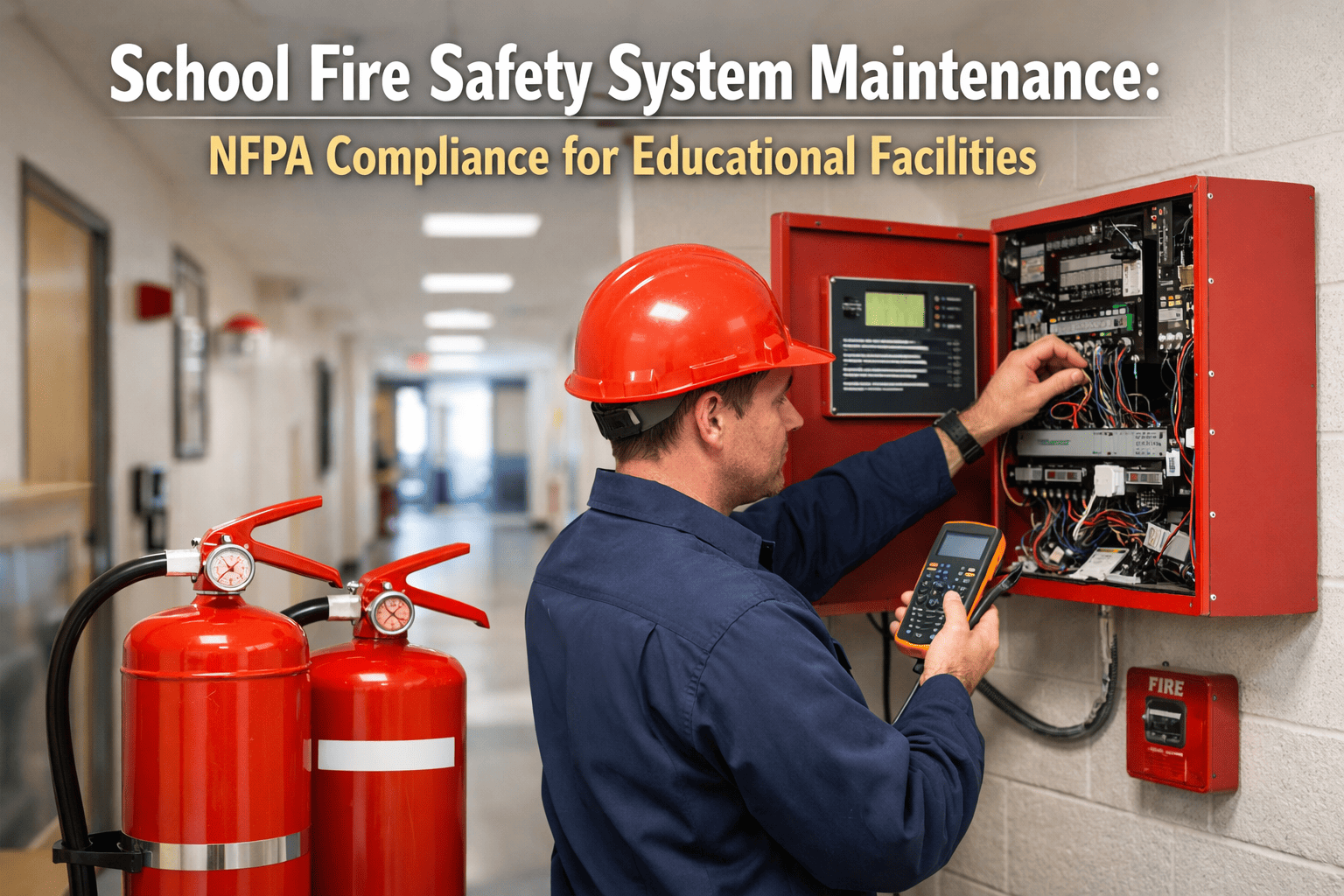
Fire alarm testing, sprinkler inspections (NFPA 25), fire extinguisher checks, fire door inspections, emergency lighting, kitchen hood suppression, fire pump testing
Frequency:
Monthly visual inspections, quarterly flow tests, annual comprehensive inspections, 5-year internal sprinkler exams
Penalty:
Building occupancy holds ($5K–$50K remediation), fire marshal closure orders, insurance premium increases
AI scheduling:
Auto-generates every inspection at the correct frequency for every building. Digital checklists match NFPA standards. Deficiency findings auto-create corrective work orders with deadline tracking.
40–60 inspection tasks per school per year. Across a 35-school district: 1,400–2,100 fire safety tasks annually.
Scope:
Boiler inspections, lockout/tagout verification, chemical storage compliance, fall protection, electrical safety, confined space, and the 2026 Heat Illness Prevention rule for outdoor maintenance staff and athletics facilities
Penalty:
$16,131 per serious violation, $161,323 per willful violation (2026 rates)
AI scheduling:
Compliance tasks scheduled as immovable deadlines. Heat illness monitoring auto-activates when forecast temperatures exceed OSHA thresholds. Boiler inspections scheduled during breaks to avoid occupied-building shutdowns.
OSHA citations in education are increasing 12% annually. 68% of citations are for documentation gaps, not actual hazards.
Scope:
AHERA asbestos management plans (mandatory for all K–12), lead and copper water testing (EPA Lead and Copper Rule), stormwater management, refrigerant tracking, underground storage tanks
Penalty:
$25,000–$75,000 per EPA violation. AHERA violations: $44,539 per day of noncompliance
AI scheduling:
AHERA 6-month periodic surveillance and 3-year re-inspections auto-scheduled with certified inspector requirements flagged. Lead/copper testing scheduled at the correct frequency per building age and piping material.
AHERA applies to every K–12 school in the US. Compliance requires documented management plans and periodic re-inspection — not just initial assessment.
Scope:
Elevator maintenance and inspection, accessible door operator function, ramp condition, accessible restroom fixture maintenance, wayfinding signage, parking lot striping and access
Penalty:
$150,000–$500,000 per ADA lawsuit. Average settlement: $250,000. Plus remediation costs.
AI scheduling:
Elevator inspections scheduled per state code. Accessible door operators tested monthly. Ramp and pathway condition inspections scheduled quarterly with photo documentation. Deficiencies auto-escalate to priority repair.
Elevator and accessible door failures are the two most frequent ADA triggers in K–12. Both are preventable with consistent PM.
Scope:
HVAC filter replacement schedules, outdoor air damper verification, CO₂ monitoring calibration, humidity control, ventilation rate verification per classroom occupancy
Standard:
ASHRAE 241 (2023) establishes equivalent clean air delivery requirements for infection risk mitigation — adopted or referenced by increasing numbers of state and local jurisdictions
AI scheduling:
Filter PM frequencies adjusted by actual pressure differential readings rather than calendar intervals. Damper verification scheduled before heating and cooling season transitions. CO₂ sensor calibration at manufacturer-specified intervals across all classrooms.
IAQ is a top-3 parent concern in 2026. Districts with documented ventilation maintenance programs report 15–25% fewer student sick days.
Scope:
Playground equipment inspections (CPSC guidelines, ASTM F1487), surfacing depth verification, athletic field condition, bleacher structural inspections, gymnasium equipment safety checks
Liability:
Playground injury lawsuits average $200,000–$1.5M in education settings. Documented inspection programs are the primary defense.
AI scheduling:
Weekly visual inspections, monthly detailed inspections, and annual comprehensive audits auto-scheduled per CPSC frequency guidance. Surfacing depth measurements logged with GPS-tagged photos. Deficiencies generate immediate corrective work orders.
Playground inspection documentation is the single most effective liability defense in student injury claims. Consistent scheduling is the foundation.
Scope:
Elevator and wheelchair lift inspections, emergency phone testing, door operator function checks, hoist machine maintenance, controller diagnostics, annual full-load testing
Frequency:
Monthly phone tests, quarterly maintenance checks, annual state-certified inspection, 5-year full-load testing
AI scheduling:
Contractor service visits scheduled at required frequencies with automated certificate tracking. Deficiency follow-ups generated as priority work orders. Out-of-service duration tracked per unit for ADA compliance reporting.
Districts with 15–60 elevators spend $120K–$500K annually on elevator maintenance. Centralized scheduling saves 15–25% through contract consolidation.
Seven Compliance Domains. Thousands of Tasks. One Scheduling Engine.
Oxmaint schedules every fire, OSHA, EPA, ADA, IAQ, playground, and elevator inspection across every school in your district — treating compliance deadlines as immovable constraints that are never deferred, regardless of what emergencies consume this week’s capacity.
How AI Scheduling Optimizes PM Across a Multi-School District
AI scheduling is not a digital calendar that auto-generates reminders. It is a constrained optimization engine that evaluates six variables simultaneously to produce the PM schedule that maximizes completed inspections, protects every compliance deadline, and minimizes technician travel — all within the real-world constraints of a school district’s staffing, calendar, and budget.
01
Compliance Deadlines Scheduled First
The AI loads every regulatory deadline as an immovable constraint: NFPA quarterly sprinkler tests, AHERA 6-month surveillance, annual boiler inspections, monthly elevator phone tests, weekly playground inspections. These tasks are placed into the schedule first. Remaining technician capacity fills around them with corrective work, energy maintenance, and lower-priority PM. Compliance is never deferred because reactive work consumed the day.
02
Academic Calendar Integration
The scheduler knows when finals are happening, when state testing occupies classrooms, when assemblies fill the gymnasium, and when admissions tours bring visitors through the building. Disruptive PM — boiler shutdowns, fire alarm testing, HVAC maintenance that requires room access — is auto-scheduled for breaks, weekends, and off-hours. Non-disruptive PM (exterior inspections, mechanical room work, roof checks) can proceed during occupied hours without restriction.
03
Geographic Clustering Across Schools
A district with 35 schools spread across 120 square miles cannot afford random dispatch. The AI clusters PM tasks by school and by geographic zone: a technician visiting Lincoln Elementary for a quarterly sprinkler test also completes the fire extinguisher inspection, the playground check, and the AHU filter replacement at that building before driving to the next school. Travel time between tasks drops from 20–30 minutes to zero. Each technician completes 2–4 additional PM tasks per day from routing efficiency alone.
04
Skill-Matched Assignment
A boiler inspection requires a licensed boiler operator. An AHERA surveillance requires a certified asbestos inspector. A fire alarm test requires familiarity with the specific panel model. The scheduler matches every PM task to technicians who hold the required certifications — and flags upcoming certification expirations that would disqualify a technician from performing scheduled work. No PM is assigned to someone unqualified to perform it.
05
Emergency Deferral Recovery
When a pipe burst at Washington Middle School consumes two technicians for a full day, the 8 PM tasks they were scheduled to perform do not disappear. The AI reschedules them within their compliance windows — redistributing across the remaining team over the next 3–5 days, maintaining geographic clustering, and protecting any tasks approaching their deadlines. No deferred PM falls through the cracks because the planner was too busy managing the emergency to remember what was displaced.
06
Risk-Scored PM Prioritization
When capacity is constrained (understaffing, illness, seasonal overload), the AI determines which PM tasks to prioritize and which can safely shift by one cycle. A chiller PM on a unit scoring 78/100 risk is prioritized over a filter change on a unit scoring 22/100 — even if the filter change was scheduled first. The risk score ensures that limited capacity is directed to the PM tasks most likely to prevent expensive failures, not simply the tasks that appeared first in the calendar.
Start your free trial and see risk-scored PM scheduling applied to your district’s asset data within the first week.
The PM Calendar: What a Scheduled Year Looks Like
A properly configured AI schedule distributes 4,000–12,000 PM tasks across the academic year, concentrating disruptive work during breaks while maintaining continuous compliance coverage during occupied periods.
Summer
Summer Break: Maximum PM Capacity (June–August)
HVAC overhauls
Boiler annual service
Roof inspections
Floor refinishing
Elevator annual tests
Fire system annuals
35–45% of annual PM volume
is concentrated here. Full building access. No student disruption. Extended work windows. This is when chiller teardowns, boiler tube inspections, major filter replacements, and disruptive system shutdowns are scheduled. The AI front-loads the highest-disruption work into the longest access window.
↓ transition to ↓
Academic
Academic Year: Continuous Compliance (September–May)
Monthly fire checks
Weekly playground
Filter changes
Quarterly sprinkler
AHERA surveillance
Elevator monthly
55–65% of annual PM volume
distributed across the academic year. Non-disruptive PM (mechanical rooms, exterior, roof) proceeds during school hours. Disruptive PM (classroom HVAC, fire alarm testing, noisy repairs) is scheduled for after hours, weekends, and mid-year breaks (fall break, winter break, spring break). The scheduler knows the district calendar and adjusts automatically.
↓ critical periods ↓
Critical
High-Stakes Windows: Protected Periods
State testing weeks
First week of school
Graduation events
Open house nights
Board meetings
Zero disruptive PM scheduled
during state testing, first/last week of school, graduation, and board-designated events. Only emergency response and non-disruptive monitoring proceed. The AI identifies these windows from the academic calendar and treats them as blackout periods for any work that could create noise, require room access, or trigger fire alarm evacuations.
→
The summer trap:
Many districts try to do all PM during summer break. This fails because summer capacity covers only 35–45% of annual PM volume. The remaining 55–65% must be distributed across the academic year — which requires the AI scheduling intelligence to route around occupied classrooms, testing windows, and events that manual scheduling cannot manage at scale.
Financial Impact for K–12 Districts
$800K–$2M
Annual emergency failure prevention as PM compliance rises from 55% to 95%+ and prevents the breakdowns that generate 3–5× cost multiplier repairs
$150K–$500K
Annual energy savings from timely HVAC PM — filter changes, coil cleaning, damper verification — preventing the 15–25% energy waste from degraded systems
$118K–$413K
Compliance penalty avoidance across OSHA ($161K/willful), NFPA (occupancy holds), ADA ($150K–$500K/lawsuit), and EPA ($25K–$75K/violation)
$180K–$350K
Labor productivity recovery from geographic routing (60–90 min/tech/day) and schedule optimization (45-min morning meeting eliminated)
Implementation: 30–60 Days to Full AI Scheduling
Foundation: Assets, Compliance, and Calendar
✓ Import building and asset registry across all schools in the district
✓ Configure all 7 compliance domains with inspection frequencies per building
✓ Load district academic calendar including testing windows, breaks, and events
✓ Set up technician profiles with skills, certifications, and zone assignments
Activation: AI Scheduling and Mobile Deployment
✓ Activate AI schedule generation with compliance-first, calendar-aware logic
✓ Deploy mobile app to field technicians with GPS-tracked inspection routes
✓ Enable digital checklists matching each compliance standard (NFPA 25, CPSC, etc.)
✓ Activate auto-rescheduling for emergency deferrals within compliance windows
Intelligence: Risk Scoring and Continuous Optimization
✓ Activate asset risk scoring to prioritize PM on highest-risk equipment
✓ Enable condition-based PM interval adjustment for assets with sensor data
✓ Deploy compliance dashboards showing district-wide audit readiness
✓ Establish KPI tracking: PM compliance rate, emergency ratio, response time
By day 30, every compliance inspection across every school is scheduled, tracked, and documented digitally. By day 60, the AI is optimizing PM intervals based on asset condition, routing technicians by geographic cluster, and recovering deferred tasks automatically after emergencies. PM compliance is measurably improving from the first week.
Sign up free and have compliance-driven PM schedules generating across your district within the first two weeks.
Your District Has 12,000 PM Tasks Per Year. Your Team Cannot Schedule Them Manually.
Oxmaint’s AI scheduling engine treats compliance deadlines as immovable, routes technicians by school cluster, adjusts PM for the academic calendar, recovers emergency deferrals automatically, and prioritizes by asset risk — moving PM compliance from 55% to 95%+ within two semesters without adding staff. Start free. Deploy in 30 days.
Frequently Asked Questions
Can the AI schedule PM differently for elementary schools vs. high schools?
Yes. Each school in the district is configured with its own asset inventory, academic calendar, occupancy schedule, and building-specific constraints. An elementary school with younger students may have stricter noise restrictions during class hours than a high school with open periods. A school with a pool has additional water chemistry PM that other schools lack. A school with elevators has ADA-critical PM that single-story schools do not. The AI applies building-specific rules while maintaining district-wide compliance coverage and geographic routing efficiency across all sites.
How does the system handle PM during summer when many staff are on reduced schedules?
Summer scheduling is configured separately from academic-year scheduling. The AI knows which technicians are available during summer (full-time 12-month staff vs. 10-month staff on break), adjusts daily capacity accordingly, and prioritizes the disruptive PM tasks that can only be performed during unoccupied periods. If summer capacity is insufficient to complete all planned work, the AI identifies which tasks can safely shift to the early fall academic period and which must be completed before school opens — based on compliance deadlines and asset risk scores.
Book a demo to see how summer PM planning integrates with the academic-year schedule across your specific district calendar.
What happens when an emergency disrupts the PM schedule?
When a technician is pulled from PM for an emergency, the AI reschedules their displaced PM tasks within compliance windows — distributing them across the remaining team over the next 3–5 days while maintaining geographic clustering. Tasks approaching compliance deadlines are rescheduled first. Tasks with high asset risk scores are prioritized over routine items. The facilities coordinator receives a summary showing what was displaced, when it will be rescheduled, and whether any compliance deadline is at risk. No manual re-planning required. No tasks forgotten.
Does the system generate the documentation that auditors and inspectors need?
Yes — every completed PM task produces a digital record with timestamp, technician identification, GPS-confirmed location, completed checklist with pass/fail on each item, photos, meter readings, and any deficiency findings with auto-generated corrective work orders. These records are stored permanently and exportable in audit-ready format: by building, by compliance domain, by date range, or by specific regulatory standard. When an OSHA inspector, fire marshal, or AHERA auditor requests documentation, the report generates in minutes rather than the 2–4 weeks typical of paper-based record assembly.
Start free and see the audit-ready compliance documentation generated from your first completed inspection.
What is the realistic cost and ROI for a K–12 district?
A 30-building district typically invests $20K–$50K annually for the full platform against $1.25M–$3.3M in documented annual savings — a 25:1 to 66:1 return. The ROI begins immediately: the first prevented emergency ($28K–$340K avoided), the first compliance citation averted ($15K–$161K), the energy savings from timely HVAC PM ($150K–$500K annually), and the staff time recovered from manual scheduling elimination (0.5–1.0 FTE) typically cover the annual platform cost multiple times over within the first quarter. Districts starting mid-year see measurable PM compliance improvement within 30 days.