Education facilities face 7 overlapping compliance domains — NFPA fire safety, OSHA occupational safety, EPA/AHERA environmental, ADA accessibility, ASHRAE indoor air quality, CPSC playground safety, and state elevator codes — generating 4,000–12,000 inspections per year across a typical 30-building district. Most institutions manage this volume with paper checklists, spreadsheet calendars, and filing cabinets that take 2–4 weeks to assemble when an auditor requests documentation. The gap between “inspections performed” and “inspections documented, stored, and retrievable” is where citations happen: 68% of OSHA education citations are for documentation failures, not actual hazards. Digital inspection software closes this gap by replacing paper with mobile checklists matched to each regulatory standard, auto-generating compliance records with timestamps, GPS confirmation, photo evidence, and pass/fail scoring — then routing deficiency findings directly into the CMMS as prioritized corrective work orders. Every completed inspection instantly becomes an audit-ready record. Every deficiency instantly becomes a tracked repair. Schedule a demo to see digital inspection workflows configured for education compliance.
Compliance Reality
68%
of OSHA education citations are for documentation gaps — not actual safety hazards. The inspection happened. The record did not.
4,000–12K
annual inspections required across a 30-building K–12 district or mid-size university campus
2–4 wks
to assemble paper-based inspection records when an auditor requests documentation
<30 sec
to export any compliance record from a digital inspection system — by building, domain, or date
Why Paper Inspections Fail
The Inspection Was Done. The Record Wasn’t.
Paper-based inspection programs fail at documentation, not at inspection. Technicians perform fire extinguisher checks, playground walkthroughs, and boiler inspections — but the records are inconsistent, incomplete, or unfindable when needed. A handwritten checkmark on a clipboard does not prove to OSHA that the inspection was performed at the correct frequency, by a qualified person, on the correct equipment, with the correct criteria evaluated. Digital inspection software produces the record that withstands audit scrutiny: timestamped, GPS-located, photo-documented, checklist-specific, and permanently stored.
$161K
OSHA willful violation penalty (2026 rate) — a single undocumented boiler inspection can trigger this
$44.5K
EPA AHERA penalty per day of noncompliance for missing asbestos management documentation
$250K
average ADA settlement in education — documented inspection programs are the primary legal defense
Seven Compliance Domains, One Inspection Platform
Each domain has different inspection types, different frequencies, different checklists, and different documentation requirements. Digital inspection software manages all seven from a single mobile interface — ensuring every technician uses the correct checklist for the correct asset at the correct frequency.
NFPA
Fire and Life Safety
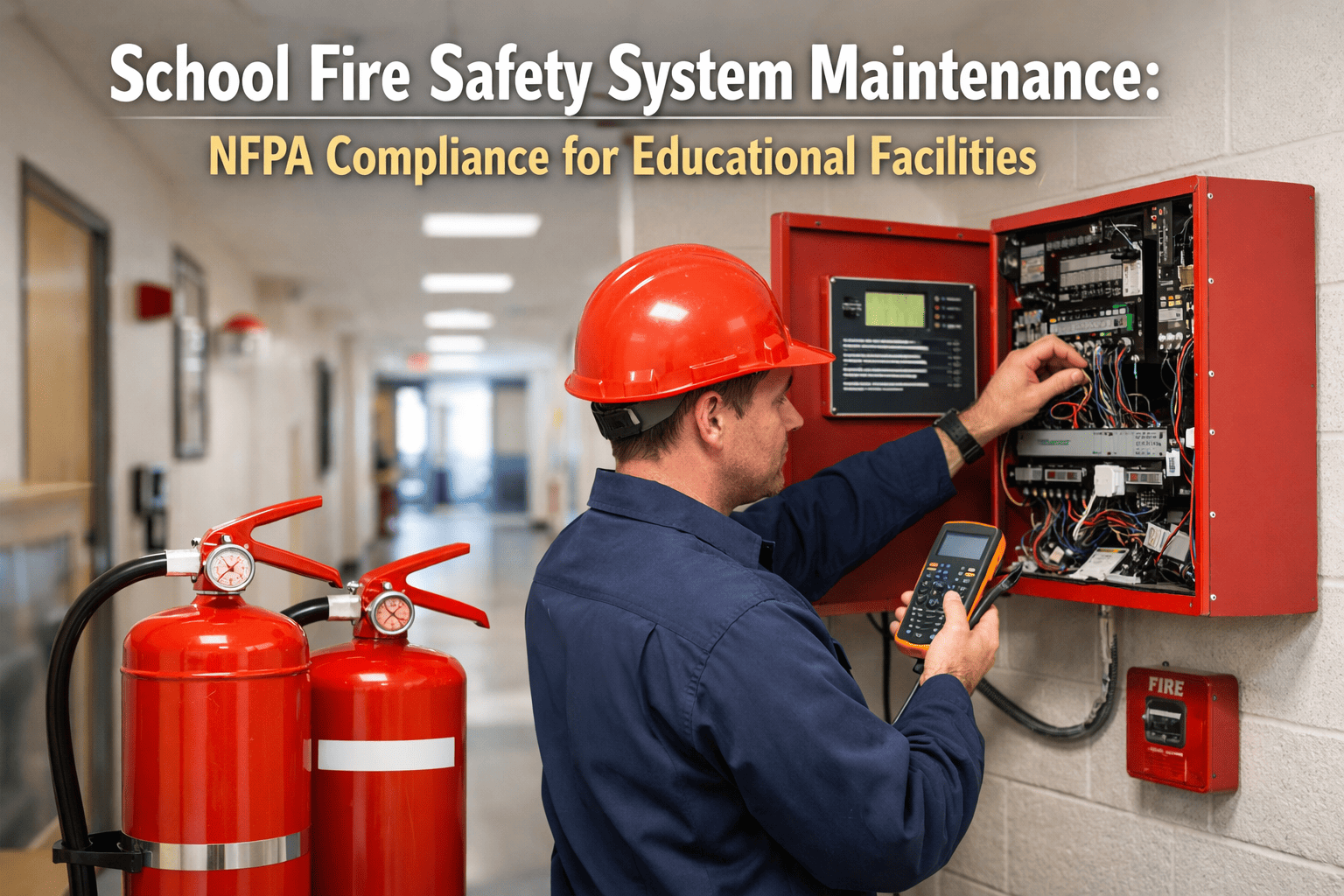
Fire alarm testing (monthly), sprinkler inspections per NFPA 25 (quarterly flow, annual comprehensive, 5-year internal), fire extinguisher checks (monthly visual, annual certification), fire door inspections (annual per NFPA 80), emergency lighting (monthly/annual), and kitchen hood suppression (semi-annual). Digital checklists match each NFPA standard exactly. Deficiency findings auto-create corrective work orders with fire marshal deadline tracking.
Penalty: Building occupancy holds · Fire marshal closure orders · Insurance premium increases
OSHA
Occupational Safety
Boiler inspections, lockout/tagout verification, chemical storage (SDS compliance), fall protection equipment, electrical safety, confined space, and the 2026 Heat Illness Prevention rule for outdoor maintenance staff and athletics. Each inspection type has a regulation-specific digital checklist. Heat illness monitoring auto-activates when forecast temperatures exceed OSHA action thresholds. Every inspection produces the documentation format that OSHA auditors expect.
Penalty: $16,131/serious · $161,323/willful · Citations increasing 12% annually in education
EPA / AHERA
Environmental Compliance
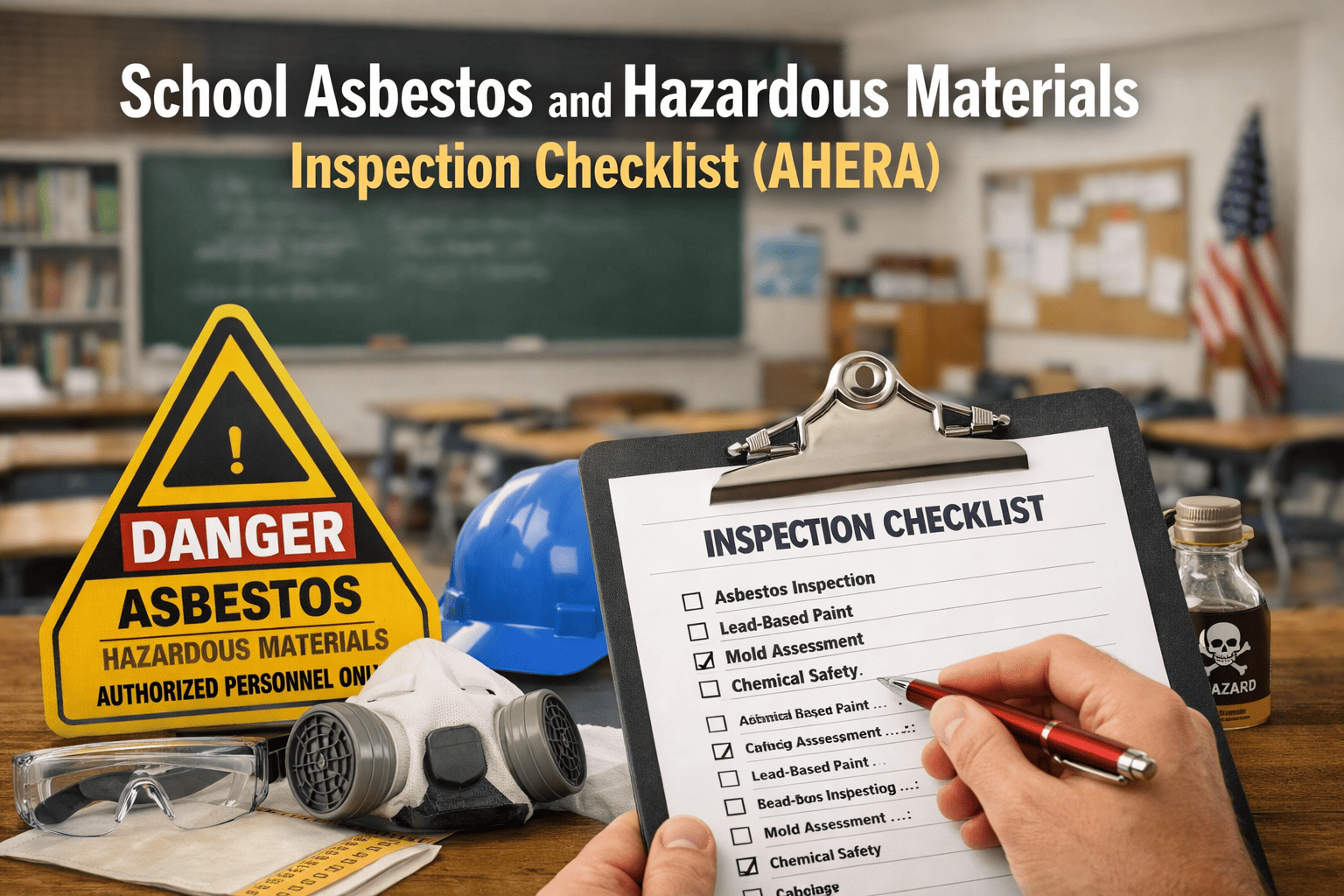
AHERA asbestos management plans (mandatory for every K–12 school), 6-month periodic surveillance, 3-year re-inspections by certified inspectors, lead and copper water testing per EPA Lead and Copper Rule, refrigerant tracking, stormwater management, and underground storage tank compliance. The platform tracks certified inspector requirements and auto-schedules at AHERA-mandated frequencies per building age and material inventory.
Penalty: $25K–$75K/violation · $44,539/day AHERA noncompliance · Applies to every K–12 school
ADA + Elevator
Accessibility and Vertical Transport
Elevator maintenance checks (monthly phone tests, quarterly service, annual state-certified inspections, 5-year full-load testing), accessible door operator function (monthly), ramp and pathway condition (quarterly with photo documentation), accessible restroom fixture maintenance, wayfinding signage, and parking lot striping. Elevator out-of-service duration is tracked per unit for ADA compliance reporting. Deficiencies auto-escalate to priority repair.
Penalty: $150K–$500K/ADA lawsuit · $5K–$15K/day elevator downtime cost · 15–25% contract savings from centralization
How Digital Inspections Work: From Mobile Checklist to Audit-Ready Record
The workflow replaces paper at every step — from the technician opening the checklist on their phone to the compliance officer exporting documentation for an auditor. Every handoff is automated. Every record is permanent.
1
Inspection Assigned
AI scheduler generates the inspection at the correct frequency, assigns it to a qualified technician based on certification and location, and pushes it to their mobile device with the regulation-matched checklist.
2
Mobile Execution
Technician opens the checklist on their phone at the asset location. GPS confirms they are at the correct building. Each checklist item maps to the specific regulatory standard (NFPA 25 for sprinklers, CPSC for playgrounds, etc.). Pass/fail per item. Photos required for deficiencies.
3
Deficiency → Work Order
Any failed checklist item auto-generates a corrective work order in the CMMS with the deficiency photo, location, regulatory reference, and deadline. Priority is set by compliance severity — fire safety deficiencies escalate above routine repairs automatically.
4
Audit-Ready Record
The completed inspection becomes a permanently stored digital record: timestamp, technician ID, GPS location, checklist results, photos, deficiency work orders, and repair confirmation. Exportable by building, domain, date range, or specific standard in under 30 seconds.
Every Inspection Instant. Every Record Permanent. Every Deficiency Tracked.
Oxmaint replaces paper checklists with regulation-matched digital inspections that produce audit-ready records automatically — routing deficiency findings into prioritized corrective work orders without manual data entry.
Paper Inspections vs. Digital: Side by Side
Paper-Based Inspections
Fire extinguisher check recorded as a checkmark on a hanging tag. No photo. No timestamp. No proof the technician actually inspected the gauge, pin, and tamper seal — or just initialed from memory.
Playground inspection documented in a binder that lives in the principal’s office. When a parent files an injury claim 8 months later, the binder has pages missing and no photos of the equipment condition at the time of inspection.
Boiler inspection deficiency noted on the technician’s clipboard but never transferred to a work order. The repair is forgotten. OSHA finds the deficiency unchanged 6 months later during a complaint investigation.
AHERA 6-month surveillance completed by the custodian but not by a certified inspector as AHERA requires. The form exists but is invalid. The school is technically noncompliant and has been for 18 months.
VS
Digital Inspections + Oxmaint
Fire extinguisher checklist requires pass/fail on gauge, pin, tamper seal, mount height, and obstruction — each item individually. Photo required. GPS confirms location. Timestamp proves when. Record stored permanently.
Playground inspection with CPSC-matched checklist, GPS-tagged photos of every equipment piece and surfacing depth measurement, and deficiency photos with auto-generated corrective work orders. The record is the defense.
Boiler deficiency auto-generates a corrective work order the moment the technician marks it “fail” on the checklist. Priority escalated. Deadline tracked. Repair confirmation required before the inspection record closes.
AHERA surveillance is only assignable to technicians whose certified inspector credential is current in the system. If certification has expired, the inspection cannot be assigned to that person. Compliance is enforced by the platform, not by memory.
What the Compliance Dashboard Shows in Real Time
The facilities director and compliance officer see district-wide or campus-wide inspection status updated continuously — not assembled monthly. Every metric draws from live inspection completion data.
Inspections by Status
Current · Approaching Deadline · Overdue · Completed
Color-coded status for every inspection across every building and every compliance domain. Overdue items surface to the top with days-past-due count and escalation notification to the responsible manager.
Deficiency Tracking
Open · In Progress · Repair Confirmed · Re-inspection Scheduled
Every failed inspection item is tracked from deficiency identification through corrective work order, repair completion, and re-inspection confirmation. No deficiency falls through the cracks between inspection and repair.
Certification Tracking
Technician · Contractor · Expiration Date · Inspection Eligibility
Tracks every certification required for compliance inspections: AHERA certified inspector, boiler operator license, fire alarm technician, elevator inspector. Flags expirations 90 days in advance. Blocks assignment of expired personnel.
Audit Export
By Building · By Domain · By Date Range · By Standard
Any auditor request — “show me all fire inspections for Building 7 from the last 12 months” — generates a formatted report with every checklist, every photo, every deficiency, and every repair confirmation in under 30 seconds.
Financial Impact: What Digital Inspections Save
Compliance penalty avoidance
$118K–$413K/yr
Liability defense (playground, ADA)
$200K–$1.5M/claim
Report assembly labor eliminated
0.5–1.0 FTE saved
Deficiency-to-repair cycle time
Weeks → Same day
Insurance premium reduction
5–15% documented
Frequently Asked Questions
Can we customize checklists for our specific state and local requirements?
Yes. The platform ships with standard checklists aligned to federal regulations (NFPA 25, NFPA 80, OSHA 1910, AHERA, CPSC, ADA), and each checklist is fully customizable to add state-specific requirements, local fire marshal additions, district policies, and institution-specific items. A Texas school district can add state fire marshal requirements alongside NFPA standards. A California university can add Title 24 energy compliance checks alongside ASHRAE 241 ventilation items. Checklists are versioned — when a regulation changes, the platform updates the checklist and logs the revision for audit traceability.
Start free and configure your first custom inspection checklist within the first week.
How does the system ensure the right person performs each inspection?
Every technician profile includes their certifications with expiration dates. When the AI scheduler generates an AHERA surveillance, it checks which technicians hold current certified inspector credentials and assigns only to qualified personnel. If no qualified person is available, the system flags the gap and escalates to the facilities director — before the inspection deadline passes, not after. Boiler inspections route only to licensed boiler operators. Fire alarm testing routes only to technicians trained on the specific panel model. The platform enforces qualification requirements that paper systems rely on memory to maintain.
What happens when an inspection reveals a deficiency?
The moment a technician marks any checklist item as “fail,” the system auto-generates a corrective work order with the deficiency photo, asset location, regulatory reference, and repair deadline. Fire safety deficiencies auto-escalate above routine maintenance priority. The original inspection record remains open until the corrective work order is completed and a re-inspection confirms the deficiency is resolved. This creates a closed-loop audit trail from deficiency discovery through repair verification — exactly the documentation chain that auditors evaluate.
Book a demo to see the deficiency-to-repair closed-loop workflow in action.
Does this work for both K–12 districts and universities?
Yes. K–12 districts configure the platform per school with district-wide dashboards showing compliance status across all buildings. Universities configure per building or per zone with campus-wide analytics for the facilities director and CBO. Multi-campus systems (university systems, state college networks) see compliance status across all campuses from a single dashboard. The compliance domains are the same — NFPA, OSHA, EPA, ADA, ASHRAE, playground, elevator — but the asset mix and building count differ. The platform scales from a 5-building elementary district to a 400-building university system without architectural changes.
What is the implementation timeline and cost?
A 30-building district deploys in 14–30 days: days 1–7 import assets and configure checklists for all 7 compliance domains, days 8–14 deploy mobile to field technicians and run first inspections, days 15–30 activate AI scheduling, deficiency tracking, and compliance dashboards. Annual platform cost for a 30-building district: $20K–$50K against $118K–$413K in compliance penalty avoidance alone — before counting labor savings, insurance reduction, and liability defense value. Universities with 50–200 buildings deploy in 30–60 days with phased rollout by building group.
100% Audit-Ready. Always.
Every Inspection Documented. Every Deficiency Tracked. Every Audit Answered in 30 Seconds.
Oxmaint replaces paper checklists with regulation-matched digital inspections across all 7 compliance domains — producing permanent, audit-ready records with timestamps, GPS confirmation, photos, and automatic deficiency-to-repair tracking. Deploy in 14–30 days.



.png)


