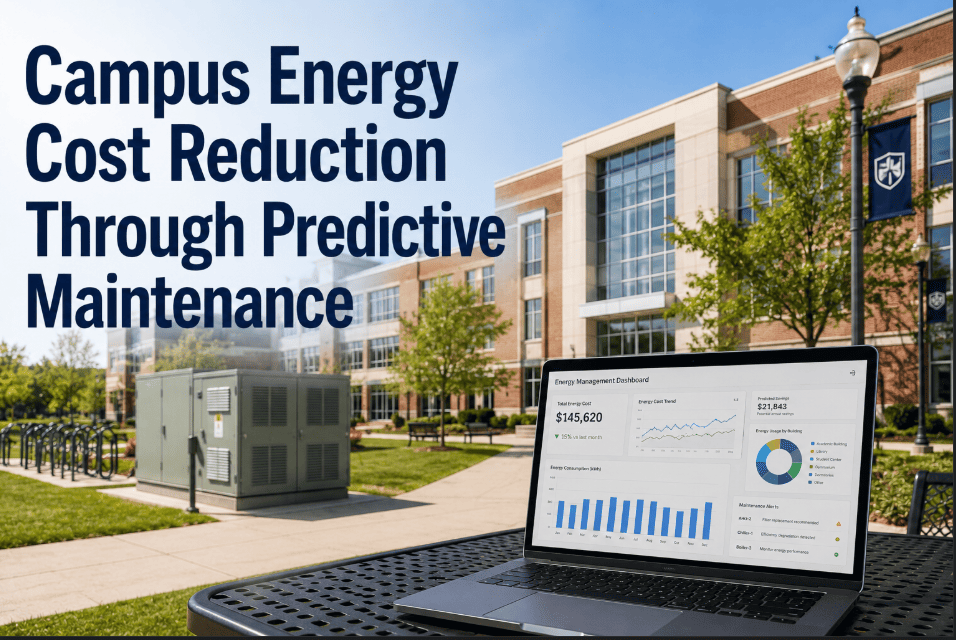
In February 2026, the chief business officer of a 1.4 million-square-foot state university reviewed the annual utility reconciliation and discovered that the institution had spent $7.2 million on energy during a fiscal year when total enrollment had declined 6%. The math was inescapable: fewer students occupying fewer buildings, yet energy costs had increased 11% year over year. Rate increases accounted for roughly half the spike. The other half — approximately $380,000 — was attributable to equipment degradation and operational waste that had been invisible to every existing campus system. Three buildings were running HVAC 24/7 because BAS overrides set during a 2023 COVID ventilation protocol had never been cleared. Two chillers were consuming 31% more electricity than rated capacity because condenser tubes hadn't been cleaned since 2021. Fourteen rooftop units had failed economizer dampers, forcing mechanical cooling during 2,200 hours per year when outdoor air could have cooled the buildings for free. And nobody knew — because no system on campus connected energy consumption data, maintenance work order patterns, and building automation status into a unified analytical view. AI-powered energy intelligence would have detected every one of these waste sources within the first 60 days of deployment, generated maintenance work orders to resolve them, and recovered $380,000 in annual energy spend through maintenance actions alone — no capital equipment purchases required. This is the campus energy crisis of 2026: not that energy costs are rising, but that 25–40% of what institutions spend on energy is waste attributable to deferred maintenance and degraded equipment — waste that is invisible without AI analytics and recoverable through maintenance optimization. Start your free trial today and begin detecting the energy waste hiding in your campus buildings.
Traditional Energy Management
Waste Detection Method
Quarterly Utility Bill Review (After Money Spent)
BAS Override Visibility
None — Overrides Invisible Until Manual Audit
Chiller Efficiency Tracking
Annual PM Check — Degradation Undetected Between Visits
Economizer Function Verification
Not Monitored — Failed Dampers Run Years Undetected
Energy-Maintenance Correlation
None — Energy and Maintenance Are Separate Silos
Board Reporting Capability
Total Spend Only — No Per-Building or Per-System Insight
AI-Powered Energy Intelligence
Waste Detection Method
Real-Time Anomaly Alerts Per Building (Before Waste Accumulates)
BAS Override Visibility
AI Flags Overrides >72 Hours — Auto-Generates Clearing Work Orders
Chiller Efficiency Tracking
Continuous kW/Ton Monitoring — Alerts at 5% Degradation
Economizer Function Verification
AI Correlates Compressor Runtime with Outdoor Temp — Detects in Days
Energy-Maintenance Correlation
Every Work Order Linked to Measurable Energy Impact ($$/Action)
Board Reporting Capability
Per-Building Cost, Per-Action Recovery, Weather-Normalized Baselines
Average Campus Energy Cost Recovery Within 18 Months: 15–25% ($450K–$1.4M on $3M–$5.5M Spend)
The Six Sources of Campus Energy Waste — And Why Maintenance Recovers Them
Campus energy waste is not caused by old equipment. It is caused by undetected maintenance failures in equipment of any age. A brand-new chiller with fouled condenser tubes wastes the same energy as a 20-year-old unit — the age of the equipment is irrelevant when the maintenance is deferred. This distinction is critical because it means recovery does not require capital expenditure. The six waste sources below are recoverable through maintenance actions at 4–18× ROI, detectable only through AI-powered analytics that correlate energy performance with equipment condition, and documentable in CMMS work orders that link every maintenance action to a measurable energy dollar impact. Understanding these six sources is the foundation for building a maintenance-driven energy optimization program that recovers 15–25% of campus energy costs without purchasing new equipment.
BAS Override Accumulation
$18K–$85K/yr
78% of campuses affected — HVAC running 24/7 on fixed schedules instead of optimized programs
Chiller Efficiency Degradation
$38K–$95K/yr
Per unit — degraded from 0.55 to 0.72 kW/ton wastes 31% more electricity on 40–50% of cooling load
Economizer Failures
$8K–$32K/yr
55% of campuses — failed dampers force mechanical cooling during 30–50% of hours when free cooling is available
Steam Trap Failures
$8–$35/day each
15–25% failure rate campus-wide — failed-open traps dump live steam directly to condensate return
Simultaneous Heating & Cooling
$12K–$45K/yr
30% of buildings — stuck reheat valves fighting cooling systems, consuming energy on both sides simultaneously
Lighting & Schedule Drift
$4K–$18K/yr
45% of buildings lit at 100% evenings, weekends, and breaks — schedules drifted or overridden and never restored
The Big Three: Maintenance Actions That Recover 70% of Energy Waste
While all six waste sources are addressable, three maintenance actions alone recover approximately 70% of total campus energy waste — and each delivers ROI that makes the investment case self-evident. These are not technology projects. They are maintenance actions — executed by existing staff, using existing tools, documented in CMMS work orders that link every dollar of maintenance labor to a measurable dollar of energy recovery. The AI platform detects the waste. The CMMS organizes the work. The maintenance team executes the recovery. The CFO sees the results on the next utility bill.
01
BAS Override Audit & Clearing
Identify all control points in manual mode
Clear non-essential overrides — restore optimized schedules
AI monitors for new overrides >72 hours, auto-alerts
Schedule quarterly audit as recurring CMMS work order
Recovery: 8–15% of Building Energy — Near-Zero Cost
02
Chiller Plant Optimization
Annual condenser tube brushing ($2.5K–$5K per unit)
Refrigerant charge verification ($500–$1K per unit)
Quarterly vibration analysis ($1.2K–$2.4K per unit)
AI monitors kW/ton trending — alerts at 5% degradation
Recovery: $38K–$95K/yr Per Unit — ROI 7–15×
03
Economizer Repair & Verification
Damper actuator replacement ($200–$800 per unit)
Outdoor air temperature sensor verification ($50–$150)
Functional test: confirm free cooling activation at setpoint
AI correlates compressor runtime with OAT — detects failure in days
Recovery: $8K–$32K/yr Per Campus — ROI 10–40×
Three Maintenance Actions. $64K–$212K Annual Recovery. Maintenance Investment: $8K–$15K.
Oxmaint detects BAS overrides, monitors chiller efficiency, correlates compressor runtime with outdoor temperature, and generates the prioritized work orders that turn energy waste detection into energy cost recovery — all documented with dollar-per-action tracking that makes board reporting effortless.
The AI Energy Detection Pipeline: How It Works
AI-powered energy intelligence follows a four-stage pipeline that converts raw operational data into prioritized maintenance actions with documented dollar recovery. The system does not replace maintenance staff — it tells them exactly where to look, what to fix, and how much the institution saves when they do. Every detection generates a CMMS work order. Every completed work order is linked to a measured energy impact. Every board report shows documented recovery, not estimates.
01
Monitor
BAS integration: setpoints, runtimes, overrides
Utility meters: per-building energy consumption
IoT sensors: kW/ton, approach temps, vibration
Data: All Campus Systems — Real Time
02
Detect
AI identifies buildings consuming above weather-normalized baseline
Anomaly scoring quantifies deviation in dollars per day
Pattern recognition detects equipment-specific signatures
Speed: Anomalies Detected in Hours, Not Months
03
Diagnose
AI correlates energy anomaly with specific equipment failure
Identifies root cause: override, degradation, or component failure
Estimates recovery value if maintenance action is completed
Precision: Equipment-Level Root Cause
04
Recover
Auto-generates CMMS work order with estimated $ recovery
Maintenance team executes — documents completion
AI verifies recovery on next utility cycle — closes the loop
Outcome: Documented $$/Action Recovery
The Financial Model: ROI of AI Energy Intelligence for Campus Facilities
The financial case for AI-powered energy intelligence is not theoretical — it is measurable from utility bills, documented in CMMS work orders, and verifiable through weather-normalized before-and-after comparison. For a mid-size university with $3 million in annual energy spend (1.2M GSF, 150 buildings), the following model projects conservative first-year returns based on documented results at comparable institutions. Every line item is traceable to a specific maintenance action category, making board reporting straightforward: "We spent $70K on platform and labor. We recovered $680K in energy costs. Here are the utility bills."
BAS Override Clearing
15–30% of control points in manual mode × campus-wide clearing
$85,000
Chiller Plant Optimization
Restore 0.55 kW/ton from 0.72 degraded × 3 central plant chillers
$190,000
Economizer Repair
Restore free cooling to 14 failed RTUs × 2,200 available hours/yr
$95,000
Steam Trap Survey & Repair
Identify and replace 45 failed traps × $12–$35/day recovered
$120,000
Simultaneous Heat/Cool & Lighting
Reheat valve calibration + schedule correction across 22 buildings
$190,000
Total Annual Energy Recovery
$680,000
Platform investment: $30K CMMS + $25K IoT sensors + $15K labor = $70K total. Net recovery: $610,000/year. ROI: 9.7×. Validated by utility bill comparison, weather-normalized, building-specific.
These numbers are conservative. Campuses with larger energy budgets, older equipment, or higher utility rates typically recover at the upper end of each range. The critical distinction from traditional energy audits: AI-powered detection is continuous, not a one-time snapshot. The system finds new waste sources as they emerge — a new override set this week, a condenser beginning to foul this month, an economizer damper that seized last Tuesday — generating maintenance work orders that prevent waste from accumulating between annual reviews. Schedule a consultation to model projected energy recovery for your specific campus portfolio.
Implementation Roadmap: Energy Recovery in 12 Months
Energy cost recovery does not require waiting 12 months for AI to "learn" your campus. The phased approach below delivers measurable savings from Day 1, with each phase building on the data foundation of the previous one. Phase 1 is pure maintenance — no technology required beyond CMMS. Phase 2 adds sensor intelligence. Phase 3 activates AI optimization. Most campuses recover enough in Phase 1 to fund the entire annual platform cost before Phase 2 begins.
01
Quick Wins (Month 1–2)
Deploy CMMS — register all HVAC assets across campus
Conduct BAS override audit — clear all non-essential overrides
Test all economizer dampers — repair or replace failed units
Execute PM: filter changes, belt inspections, coil cleaning
Result: 8–12% Energy Reduction (Maintenance Only)
02
Systematic PM + IoT (Month 3–6)
Deploy IoT on central plant — kW/ton, approach temp, flow rate
Activate automated PM: filters, coils, belts, condensers, traps
Complete chiller optimization: condenser brushing + refrigerant
Execute campus-wide steam trap survey (ultrasonic + thermal)
Cumulative: 12–20% Total Reduction From Baseline
03
AI Optimization (Month 7–12)
Activate AI: dynamic setpoints based on occupancy + weather
Per-building energy dashboards for CFO and board monthly
Generate first annual energy-maintenance report (documented ROI)
Feed capital planning: efficiency curves justify replacements
Sustained: 15–25% Total — $450K–$750K/yr on $3M
The Decarbonization Connection: Why Maintenance Comes Before Electrification
State and federal decarbonization mandates are accelerating — with 24 states now requiring documented carbon reduction plans for public institutions. The conventional approach jumps directly to electrification: replace gas boilers with heat pumps, install solar panels, convert campus fleets. But the institutions achieving the fastest carbon reduction are following a maintenance-first strategy. The logic is straightforward: there is no point electrifying a campus where 25–40% of energy is being wasted due to deferred maintenance. Optimizing existing equipment first delivers three compounding advantages. The immediate reduction (15–25%) counts toward mandate compliance now — not 3–5 years from now when construction projects complete. The reduced baseline means replacement equipment can be sized 15–25% smaller, reducing both capital cost and grid capacity requirements. And the CMMS documentation provides the auditable evidence that decarbonization mandates require — not estimates, but measured reductions linked to specific maintenance actions. Maintenance-first is not anti-electrification. It is the prerequisite that makes electrification affordable, correctly sized, and immediately credible.
$14 Billion in Annual Campus Energy Spend. 25–40% Is Waste. AI Finds It. Maintenance Recovers It.
Oxmaint connects building automation, maintenance work orders, and energy metering into the AI-powered intelligence layer that detects BAS overrides, monitors chiller efficiency, correlates equipment performance with energy consumption, and generates the prioritized work orders that turn detection into documented dollar recovery. Start recovering energy costs this quarter.
Frequently Asked Questions
How much energy waste is actually recoverable through maintenance alone — without new equipment?
Documented results across comparable campus deployments show 15–25% of total energy spend is recoverable through maintenance-driven optimization — no capital equipment purchases required. The six primary sources are BAS override clearing (8–15% of building energy at near-zero cost), chiller efficiency restoration (recovering 31% excess consumption per degraded unit at 7–15× ROI), economizer repair (restoring free cooling during 30–50% of annual hours at 10–40× ROI), steam trap replacement (eliminating $8–$35/day waste per failed trap), simultaneous heating/cooling correction (reheat valve calibration), and lighting schedule restoration. On a $3 million annual energy budget, this translates to $450,000–$750,000 in annual recovery against $50,000–$100,000 in platform and maintenance investment. The key distinction: this is maintenance, not technology. AI detects the waste. Maintenance teams recover it. Utility bills verify it.
Sign up free to begin detecting the waste hiding in your campus buildings.
What is a BAS override audit and why does it produce the fastest energy recovery?
A BAS override audit is a systematic review of every control point in your building automation system to identify equipment running in manual mode instead of optimized automatic schedules. Overrides are set during troubleshooting, seasonal transitions, comfort complaints, or special events — and are almost never cleared afterward. The average campus has 15–30% of BAS control points in manual mode, meaning HVAC equipment is running on fixed 24/7 schedules instead of optimized programs that respond to occupancy, weather, and time-of-day. Clearing these overrides restores the original optimized schedules and reduces building energy consumption 8–15% at essentially zero cost — the maintenance action is simply restoring settings that were changed but never restored. This is the fastest energy recovery available because it requires no parts, no equipment, and no capital — just a systematic audit of BAS status and the discipline to clear overrides that are no longer needed. AI makes this sustainable by detecting any control point that remains in manual mode for more than 72 hours and generating an automatic clearing work order.
How quickly does AI energy intelligence detect waste compared to traditional methods?
Traditional energy management relies on quarterly utility bill review — meaning a waste source that begins in January is not detected until the March bill arrives in April, by which time 3–4 months of waste have accumulated. The chiller example in this report ran at 63% efficiency for 11 months undetected, costing $74,000 in excess energy before catastrophic failure added another $507,000 in emergency costs. AI-powered energy intelligence detects anomalies within hours to days: BAS overrides flagged within 72 hours, chiller efficiency degradation detected within 1–2 weeks (5% threshold), economizer failures identified within days by correlating compressor runtime with outdoor temperature, and simultaneous heating/cooling detected on the first occurrence. Phase 1 (BAS override audit and economizer testing) delivers 8–12% energy reduction within the first 60 days — maintenance actions, not technology. By Month 6, systematic PM and IoT deployment brings cumulative reduction to 12–20%. By Month 12, full AI optimization sustains 15–25% recovery.
How does AI energy intelligence support decarbonization mandates?
Maintenance-driven energy optimization is the immediate first step that should precede electrification and renewable energy investment. Three reasons: (1) The 15–25% reduction achieved through maintenance counts toward mandate compliance immediately — no 3–5 year construction timeline required. (2) The optimized baseline means replacement equipment (heat pumps, electric boilers, high-efficiency chillers) can be sized 15–25% smaller — reducing capital cost and grid capacity requirements for electrification projects. (3) CMMS data provides the auditable documentation that mandates require — measured reductions linked to specific maintenance actions, not estimates or projections. The practical sequence: optimize first (maintenance), document the optimized baseline (CMMS), then electrify against the true load (capital planning) — not against the inflated, waste-inclusive consumption that makes electrification projects 15–25% more expensive than necessary.
How do we present energy recovery results to our board or administration?
Three numbers transform the board conversation. First: current energy cost per GSF per building compared to APPA benchmarks ($2.80/GSF top quartile). If your campus averages $4.50/GSF across 1.2M GSF, the gap represents $2.04 million in addressable waste — 30–50% of which is maintenance-recoverable ($612K–$1.02M). Second: documented recovery per maintenance action after 90 days of CMMS data — actual utility bill reductions correlated with specific maintenance work orders (BAS clearing, chiller optimization, economizer repair). This is measured money, not projected savings. Third: net ROI — total energy dollars recovered divided by total platform and maintenance investment. Boards fund math. "We invested $70,000 in platform and labor. We recovered $480,000 in energy costs. Here are the building-by-building utility bills." That presentation funds every subsequent year without debate.
Schedule a consultation to build the energy recovery model for your specific campus.