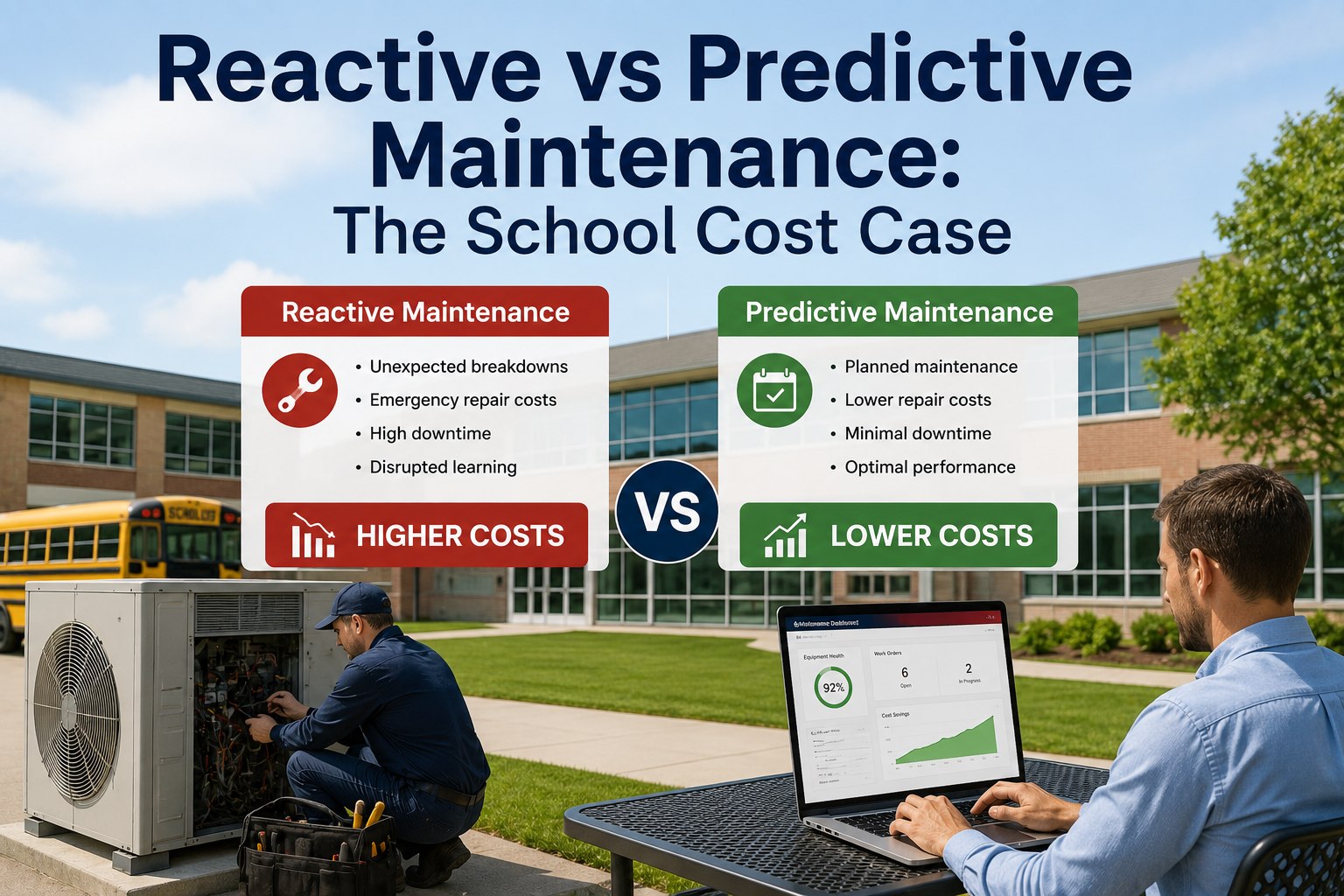
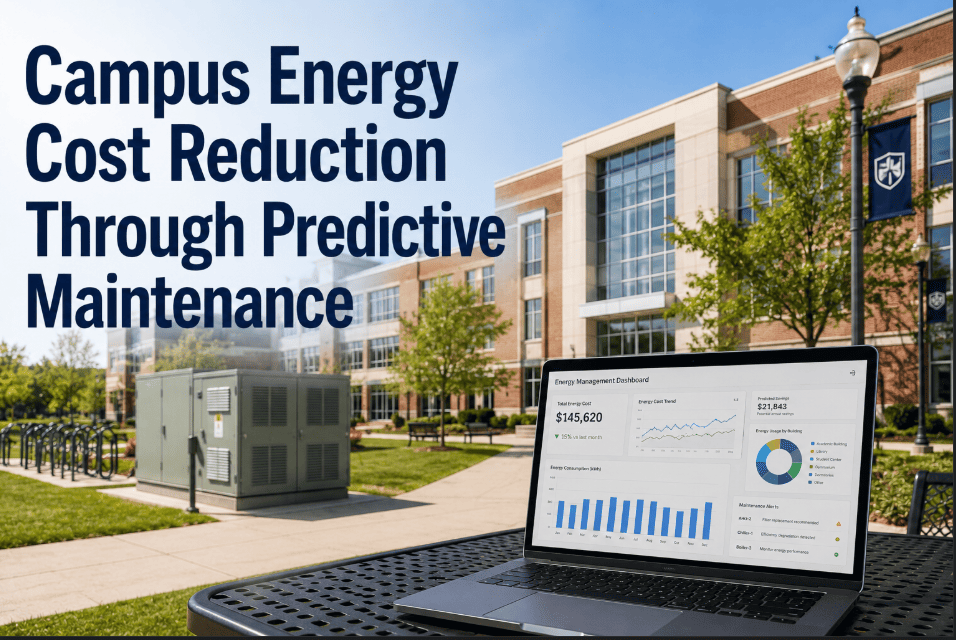
A 35,000-student state university in Ohio spent $4.7 million on emergency facility repairs in a single fiscal year — more than its entire planned capital maintenance budget. Across the hall, its peer institution in Michigan with comparable square footage spent $1.9 million on the same category. The difference was not funding levels, not building age, and not staffing. The Michigan campus had deployed IoT-connected building systems, AI-driven maintenance scheduling, and real-time energy optimization across 68 buildings three years earlier. The Ohio campus was still running on legacy BAS controllers, paper work orders, and calendar-based PM schedules designed in the 1990s. The $2.8 million annual gap between these two institutions is not an anomaly — it is the structural cost difference between a smart campus and a traditional one, and it compounds every year. This comparison maps every operational cost category where smart campus infrastructure outperforms traditional operations, quantifies the gap with production data from real university deployments, and shows CFOs and CBOs exactly where the ROI accumulates. Book a Demo — see the cost comparison for your campus. Sign Up — start building your smart campus foundation.
38%
Lower Maintenance Cost
Smart campus total maintenance spend vs. traditional campus average (per GSF)
$2.4M
Avg. Annual Savings
For a mid-size university (3–5M GSF) after smart campus transition
14–22 Mo
Full Payback Period
Platform + IoT sensor deployment ROI timeline across 50+ deployments
4.2×
Budget Accuracy Gain
Predictive analytics vs. historical averaging for maintenance forecasting
This is not a technology comparison — it is a financial comparison. Every section maps a specific cost category, quantifies the gap between smart and traditional operations, and identifies where the savings originate. The goal is to give university CFOs, CBOs, and VPs of Facilities the data they need to build the business case for their board. Sign Up — digitize your campus operations baseline.
$4.7M in emergency repairs vs. $1.9M. Same building age. Same climate. Different infrastructure. The gap is the operating system, not the buildings. Book a Demo.
Six Cost Categories Where Smart Campuses Win
The operational cost advantage of a smart campus is not concentrated in one line item — it compounds across six interconnected categories that collectively represent 60–75% of a university's non-personnel facilities budget. Traditional campuses overspend in every category because they lack the data infrastructure to optimize any of them.
Reactive Maintenance
Traditional: $8.50–$14/GSF
Smart campuses reduce reactive maintenance 55–70% by detecting failures before they occur. Predictive alerts convert emergency repairs into planned work orders at 1/3 to 1/5 the cost — eliminating overtime, expedited parts, and consequential damage.
Energy & Utilities
Traditional: 30% waste on aging systems
AI-optimized HVAC scheduling, occupancy-based lighting, and equipment efficiency monitoring reduce energy consumption 15–25%. Smart campuses correlate maintenance condition with energy output — identifying the exact equipment driving waste.
Labor Productivity
Traditional: 35% wrench time
Mobile work orders, GPS-optimized routing, and predictive parts staging increase technician wrench time from 35% to 55–65%. Smart campuses complete 40% more work orders per FTE without adding headcount — critical during the skilled trades shortage.
Capital Planning
Traditional: ±25% budget variance
Asset condition data and remaining useful life projections replace guesswork. Smart campuses forecast capital needs with ±5–8% accuracy vs. ±20–30% on traditional campuses — eliminating mid-year emergency capital requests that erode board confidence.
Compliance & Risk
Traditional: $180K–$500K/yr exposure
Automated OSHA, NFPA, EPA, and ADA compliance tracking with audit-ready documentation. Smart campuses eliminate the manual inspection logs, missed deadlines, and undocumented corrections that create regulatory exposure and insurance premium increases.
Asset Lifecycle
Traditional: 15–20yr avg. replacement
Condition-based maintenance extends equipment life 25–40% beyond calendar-based replacement schedules. A chiller that traditional campuses replace at year 20 often runs to year 28 on a smart campus — deferring $200K–$500K capital expenditures per major system.
The compound effect across all six categories is what makes the business case compelling. No single line item justifies the investment alone — but when a CFO models reduced emergency spend plus energy savings plus labor productivity plus extended asset life plus compliance cost avoidance plus capital accuracy, the combined ROI becomes impossible to ignore. Sign Up — model the compound savings for your campus.
How the Smart Campus Cost Advantage Builds Over Time
Smart campus ROI is not a one-time event — it is a compounding advantage that widens every year as the platform accumulates more data, the AI models improve their predictions, and the institution shifts further from reactive to predictive operations. Here is how the advantage builds across a typical five-year deployment.
Y1
Foundation Year: $400K–$800K Savings
Asset registry established, PM scheduling automated, mobile work orders deployed. Immediate gains from eliminating paper-based inefficiency, reducing duplicate work orders, and capturing baseline data. Emergency spend begins declining as first predictive alerts prevent failures. Energy savings from automated scheduling optimization.
Primary driver: Labor productivity + emergency avoidance
Y2
Acceleration Year: $1.2M–$2.0M Cumulative
AI models trained on 12 months of operational data begin predicting failures with increasing accuracy. Emergency-to-planned work order ratio shifts from 65:35 to 30:70. Energy optimization algorithms calibrate to building-specific occupancy patterns. First capital expenditure deferrals documented as condition-based maintenance extends equipment life beyond calendar replacement dates.
Primary driver: Predictive maintenance + energy optimization
Y3
Optimization Year: $2.5M–$4.2M Cumulative
Full predictive operations across the portfolio. Budget variance drops below ±5%. Board receives AI-generated capital prioritization ranked by risk-adjusted ROI. Insurance premiums renegotiated based on documented risk reduction. FCI trending demonstrates continuous improvement to rating agencies. Compliance documentation fully automated.
Primary driver: Capital accuracy + compliance + insurance
Y4
Maturity Year: $4.0M–$6.8M Cumulative
Second-generation AI models incorporate weather, enrollment, and event data for campus-wide resource optimization. Deferred maintenance backlog declining for the first time in institutional history. Technician retention improves as skilled staff use mobile tools and data-driven workflows instead of reactive firefighting. Bond issuance supported by documented asset stewardship.
Primary driver: Backlog reduction + workforce retention + credit
Y5
Strategic Year: $6.0M–$10.5M Cumulative
Smart campus infrastructure becomes a competitive enrollment advantage as prospective students and parents evaluate facility quality. Cross-campus benchmarking optimizes resource allocation across the entire portfolio. The institution operates at 25–40% lower facilities TCO than peer institutions still running traditional operations — a structural financial advantage that compounds indefinitely.
Primary driver: Enrollment competitiveness + portfolio optimization
∞
The Widening Gap
Traditional campuses that delay the transition fall further behind every year. Their buildings age, their data deficits grow, their emergency costs accelerate, and their competitive position erodes. The cost of transitioning to a smart campus is fixed. The cost of not transitioning compounds. Every year of delay adds 12–18 months to the payback period because the baseline deteriorates while the transition cost remains constant.
Every year of delay increases the eventual transition cost
Year 1 pays for the platform. Year 3 funds a capital project. Year 5 changes the institution's financial trajectory.
See Your Campus on the Smart vs. Traditional Cost Curve
Oxmaint models your specific building portfolio, current maintenance spend, energy costs, and staffing levels against the smart campus benchmark — showing exactly where your institution sits on the cost curve and how quickly the transition pays for itself. No estimates. No generic benchmarks. Your buildings. Your data. Your ROI.
Head-to-Head: Smart Campus vs. Traditional Campus Operations
The following comparison maps four critical operational scenarios that every university faces — and shows how smart and traditional campuses handle each one differently, with dramatically different cost and risk outcomes. These are not hypothetical scenarios. They are composites drawn from real university operations data. Book a Demo — see how your campus compares.
Traditional Campus Response
Failure discovered when building occupants call to report heat. Emergency service call placed — 4–8 hour response for commercial HVAC. Temporary portable cooling rented. Classes relocated. Total cost: $85K–$180K including emergency labor, parts, rental, and lost productivity. Timeline: 3–7 days to restore.
Smart Campus Response
AI detected refrigerant pressure anomaly 6 weeks prior. CMMS generated predictive work order. Planned repair scheduled during summer break. Parts pre-ordered at standard pricing. Total cost: $12K–$28K for planned compressor service. Timeline: 4 hours, zero disruption.
Cost Differential
Traditional: $85K–$180K + disruption. Smart: $12K–$28K, no disruption. Savings per event: $73K–$152K. A mid-size campus averages 3–5 major HVAC emergencies per year.
Traditional Campus Response
Burst discovered by RA at 2 AM when water reaches hallway. Facilities called, response time 35–50 minutes. Three floors of water damage. 40 students displaced to hotel. Remediation contractor mobilized. Total cost: $220K–$450K including remediation, housing, insurance claim. Timeline: 2–4 weeks.
Smart Campus Response
IoT water flow sensor detected pressure anomaly at 1:47 AM. Automated shutoff valve closed in 8 seconds. CMMS dispatched on-call plumber with exact location. Damage contained to one room. Total cost: $8K–$15K for pipe repair and limited remediation. Timeline: 6 hours.
Cost Differential
Traditional: $220K–$450K + 40 students displaced. Smart: $8K–$15K, 0 students displaced. Savings per event: $212K–$435K. Insurance premium impact avoided entirely.
Traditional Campus Response
Audit notice received. Facilities team spends 3–4 weeks assembling paper records, chasing missing inspection logs, and conducting overdue inspections. Multiple findings issued for incomplete documentation. Corrective action plan required. Total cost: $60K–$180K in staff time, fines, and remediation.
Smart Campus Response
Audit notice received. Compliance dashboard exports inspection history, PM records, environmental monitoring data, and corrective action logs in 2 hours. All inspections current. Documentation complete. Zero findings. Total cost: 4 staff-hours for escort and review.
Cost Differential
Traditional: $60K–$180K + reputational risk. Smart: ~$500 in staff time. Savings per audit: $59K–$179K. Universities face 2–4 regulatory audits annually across OSHA, NFPA, EPA, and state agencies.
Traditional Campus Response
VP Facilities assembles capital request from department wish lists, consultant FCA reports (3–5 years old), and best guesses. Board questions data quality. Projects compete on political urgency. Budget approved at 60–70% of request. Mid-year emergency request erodes trust. Cycle repeats.
Smart Campus Response
AI-generated capital prioritization ranks every project by failure probability × consequence cost × energy ROI × enrollment impact. Board sees real-time FCI by building, remaining useful life projections, and TCO comparisons. Budget approved at 85–95% of request. Zero mid-year emergencies. Credibility compounds.
Cost Differential
Traditional: 30–40% capital under-approval + mid-year surprises. Smart: Near-full approval + predictable execution. Annual impact: $1M–$5M in optimized capital allocation and avoided emergency requests.
Smart Campus Technology Stack: What You Actually Need
The "smart campus" label can mean anything from a single building automation upgrade to a full IoT mesh network. This schedule maps the actual technology components required for each stage of smart campus maturity — and the maintenance infrastructure each stage demands to remain operational. Sign Up — build your smart campus technology roadmap.
Stage 1: Digitized
Cloud CMMS with mobile work orders
Eliminate paper
Digital asset registry with hierarchy
Know what you own
Automated PM scheduling
Nothing gets missed
Spare parts inventory tracking
Right part, right time
Stage 2: Connected
IoT sensors on critical systems
Real-time visibility
BAS integration (HVAC, lighting)
Energy optimization
Automated fault detection
Catch failures early
Energy metering by building
Pinpoint waste
Stage 3: Predictive
AI failure prediction models
Know before it breaks
Remaining useful life analytics
Capital planning data
Occupancy-based scheduling
Match supply to demand
Compliance auto-documentation
Audit-ready always
Stage 4: Autonomous
Cross-system AI optimization
Campus-wide intelligence
Automated work order generation
Zero human triage
Portfolio capital prioritization
Board-ready ROI ranking
Predictive budget forecasting
±2–4% accuracy
The Complete ROI: Smart Campus vs. Traditional Campus
The financial case for smart campus infrastructure is built on six quantifiable savings categories. The following analysis uses mid-range figures from universities operating 3–5 million gross square feet — the typical range for a 15,000–35,000 student public institution.
Emergency Cost Avoidance
55–70% reduction in reactive maintenance spend through predictive alerts
$850,000
Energy Optimization
15–25% utility reduction from AI scheduling + equipment efficiency monitoring
$620,000
Labor Productivity
40% more work orders per FTE — equivalent to 3–5 additional technicians
$380,000
Asset Life Extension
25–40% longer equipment life = deferred capital expenditure value per year
$340,000
Compliance & Insurance
Audit cost avoidance + documented risk reduction for premium negotiation
$210,000
Total Annual Smart Campus Advantage:
$2,400,000+
Platform: starts free • IoT sensors: $150–$500/point • Full deployment payback: 14–22 months • Year 5 cumulative: $6M–$10.5M
What Traditional Campuses Are Actually Spending More On
The hidden cost of traditional campus operations is not what appears in the facilities budget — it is the spending that lands in other departmental budgets, contingency reserves, insurance premiums, and mid-year emergency appropriations that the board never connects to infrastructure management. Book a Demo — see hidden cost modeling for your campus.
CONTINGENCY
Over-Reserved Emergency Funds
Traditional campuses hold 8–12% contingency reserves for unpredictable facility failures. Smart campuses operate at 3–5% because predictive analytics eliminates most surprises. The 5–7% difference on a $50M operating budget = $2.5M–$3.5M sitting idle instead of funding strategic priorities.
INSURANCE
Premium Penalties for Reactive Ops
Insurers charge 10–20% higher property premiums for campuses without documented preventive maintenance programs and IoT monitoring. For a campus paying $800K–$2M annually in property insurance, that is $80K–$400K in avoidable premium — compounding every renewal cycle.
CREDIT
Higher Bond Borrowing Costs
Moody's evaluates deferred maintenance ratios as a credit factor. A 25–75 basis point increase on bond issuance from poor infrastructure documentation adds $250K–$750K annually on a $100M issuance — and that cost compounds over the 20–30 year bond life.
ENROLLMENT
Facility-Driven Student Attrition
Facility quality is a top-3 factor in student enrollment and retention decisions. Campuses with visible deferred maintenance — stained ceilings, broken HVAC, outdated labs — lose 2–5% more students annually. At $15K–$35K net revenue per student, that is $450K–$5.2M in enrollment margin erosion.
The real cost of running a traditional campus is not in your facilities budget. It is in your contingency reserve, your insurance premium, your bond rate, and your enrollment yield. Sign Up — calculate your total cost of traditional operations.
Frequently Asked Questions
How long does it take to transition from traditional to smart campus operations?
The transition is staged, not all-at-once. Stage 1 (digitized operations with cloud CMMS, mobile work orders, and automated PM scheduling) deploys in 4–8 weeks and begins generating savings immediately. Stage 2 (connected systems with IoT sensors and BAS integration) adds 2–4 months for priority buildings. Most universities reach Stage 3 (predictive analytics) within 12–18 months. You do not need to wait for full deployment to see ROI — the savings begin accumulating from the first week of digitized operations.
Sign up free to start Stage 1 immediately.
What does the initial investment look like compared to the savings?
Oxmaint offers a free tier that lets your team pilot digitized operations on priority buildings with no upfront cost. For full campus deployment with IoT sensors, hardware costs run $150–$500 per monitored point depending on sensor type, with platform software at $2–$5 per sensor per month. A 50-building campus with 500–1,000 monitored points typically invests $150K–$350K in Year 1 hardware and $15K–$50K annually in software. Against $2.4M+ in annual savings, the payback period is 14–22 months — and the savings compound every year thereafter.
Does this require replacing our existing building automation system?
No. Oxmaint integrates with existing BAS platforms (Siemens, Johnson Controls, Honeywell, Tridium) through BACnet, Modbus, and API connections. The platform adds an AI analytics and CMMS layer on top of your existing building controls — it does not replace them. IoT sensors supplement your BAS by monitoring systems and spaces that your existing automation does not reach. Most campuses have BAS coverage in 30–50% of buildings. IoT extends monitoring to 100% of the portfolio at a fraction of the cost of expanding BAS.
How do we get buy-in from our board for this investment?
The business case is built on three numbers your board already cares about: emergency maintenance spend (reduction of 55–70%), energy costs (reduction of 15–25%), and budget variance (improvement from ±20% to ±5%). Oxmaint's free campus assessment produces these projections specific to your institution using your actual building data and current spend. The assessment is designed to be board-presentation-ready — not a sales deck, but a financial analysis your CFO can defend.
Book a demo to get your campus-specific business case.
What about the enrollment cliff — how does smart campus infrastructure help?
The 2026 enrollment cliff compresses revenue while infrastructure costs accelerate. Smart campus infrastructure addresses both sides simultaneously: it reduces operating costs 25–40% (protecting margins as enrollment declines), and it improves facility quality (which is a top-3 factor in student enrollment decisions). Institutions competing for a shrinking student population cannot afford buildings with visible deferred maintenance, unreliable HVAC, or outdated labs. The smart campuses that deliver superior student experience at lower operating cost will be the survivors.
Sign up to see how smart campus infrastructure protects your enrollment margins.
Free Smart Campus Cost Comparison for Your Institution
Your campus is spending more than it should on emergency repairs, wasted energy, manual compliance, and over-reserved contingency funds — and the gap widens every year you delay the transition. Oxmaint's Smart Campus Assessment analyzes your building portfolio, models your current spend against the smart campus benchmark, and delivers a 5-year ROI projection your CFO can present to the board. No commitment. No cost. Just the financial clarity to make the decision.