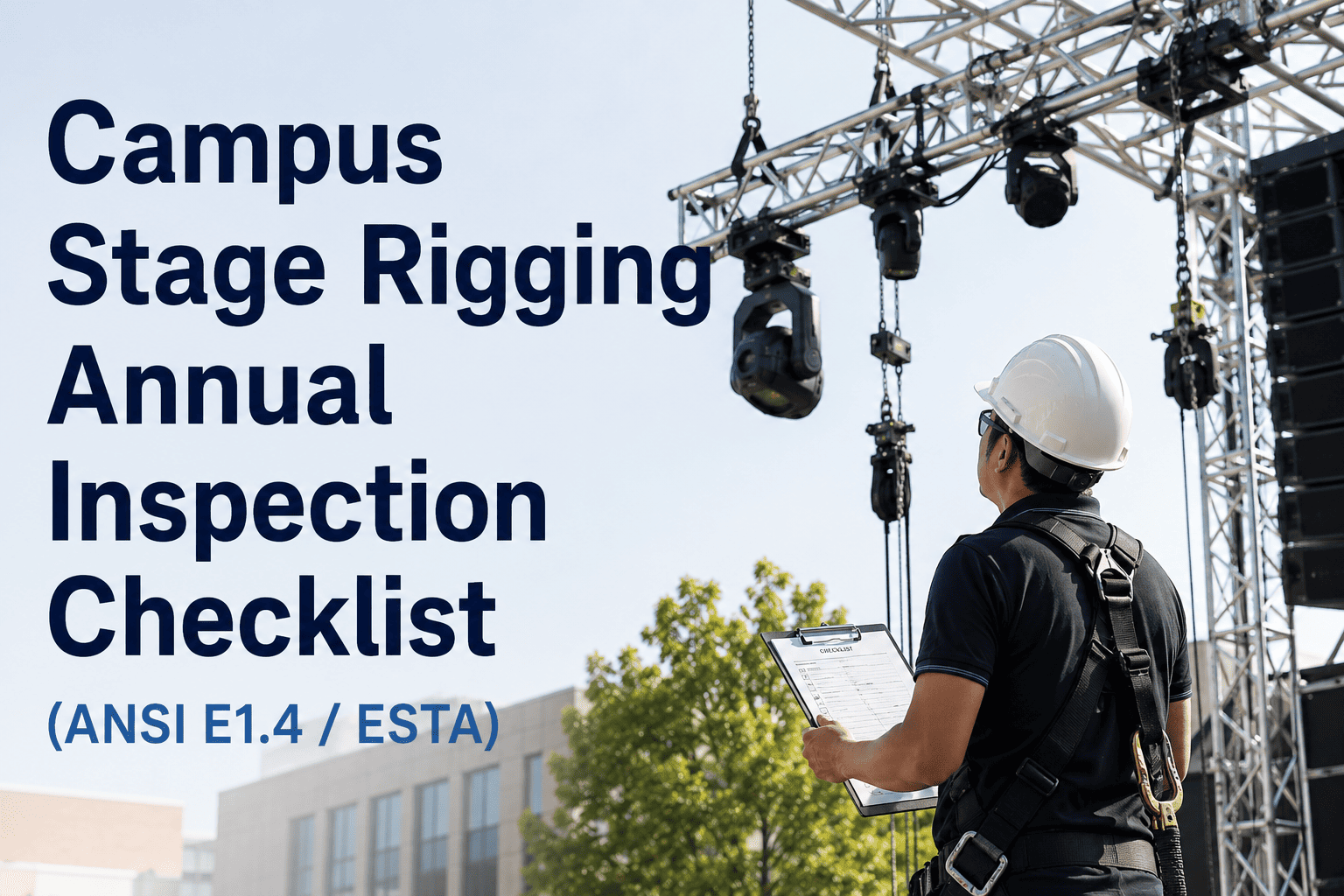
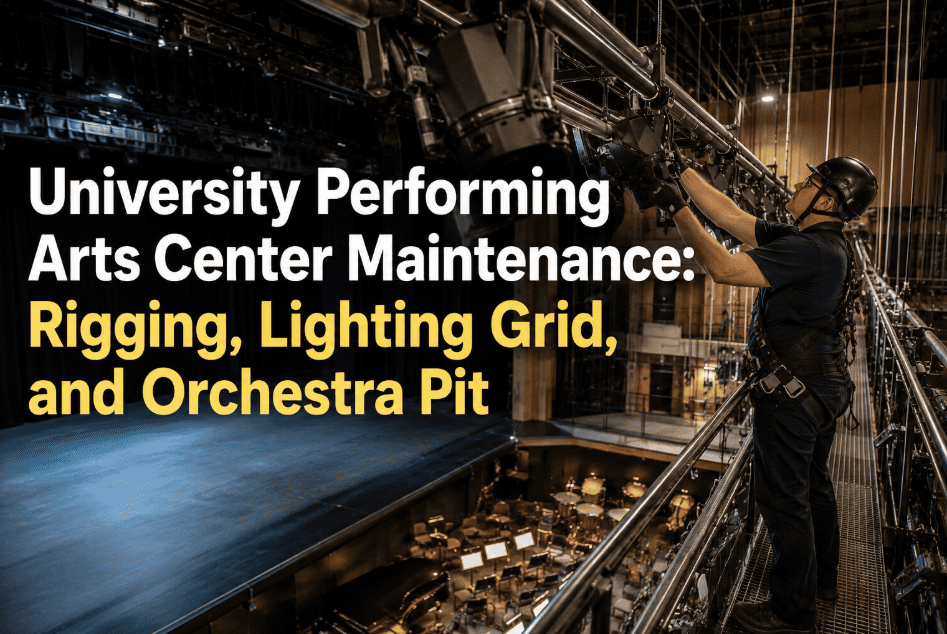
In February 2023, a counterweight rigging system in a university performing arts center dropped an arbor mid-performance because a single hemp line had degraded unnoticed over two summers of humidity cycling in an unconditioned fly loft. Nobody was injured only because the lead rigger happened to be standing two feet outside the kill zone. The insurance investigator asked a simple question: when was the last documented inspection? The answer was "three years ago, maybe four." Under OSHA 1926.1501(a)(6) and ANSI E1.4, that gap is indefensible — and if the court goes to negligence, the institution pays. Campus theater maintenance is not a facilities luxury. It is a safety, compliance, and liability issue with a clear standard of care. Start a free trial of OxMaint to set up a documented inspection schedule across every rigging line, fixture, and curtain, or book a demo to see how peer campuses run annual, pre-use, and third-party inspections from one dashboard.
Campus Theater · Stage Rigging · OSHA / ANSI
Campus Theater & Auditorium Stage Equipment Maintenance: Keeping a Performing Arts Facility Show-Ready and Compliant
OSHA 1926.1501(a)(6) mandates annual inspection of hoisting machinery. ANSI E1.4 and IBC Section 20.9.1 require annual rigging inspection. ESTA's E1.47 guidelines push even further for installed systems. CMMS turns all of this from calendar chaos into an auditable, permit-ready program — so no stage crew, student, or audience member is ever exposed to an unreviewed hazard.
Annual
Rigging inspection cadence required under OSHA 1926.1501(a)(6)
3–5 yr
Outside-contractor rigging inspection frequency per UCOP standard
400A
Typical auditorium dimmer power — driving routine electrical inspections
2–5 yr
Stage curtain flame-retardant retreatment cycle
One missed inspection can shift an injury from accident to negligence.
Rigging, lighting, fire curtains, fall protection — every item has a standard cadence. CMMS makes sure none of them slip between productions, semesters, or staff turnover.
What Makes Campus Theater Maintenance Uniquely Risky
A campus auditorium is not a commercial venue running the same repertoire every night. It is a shared space hosting four to eight departments, a student-run theater club, external renters, convocations, commencements, touring productions, and occasional film screenings. That churn means different operators, different load patterns, and different rigging configurations — sometimes in the same week. Counterweight arbors get loaded and unloaded more than a road house. Fire curtains get tested infrequently because nobody assumes authority over them. Lighting rigs get focused by undergraduates who have not yet completed certification. The regulatory framework exists because these risks are not theoretical. OSHA 1926.1501(a)(6), ANSI E1.4-2014 section 5.2.2.1, IBC Section 20.9.1, and ESTA/ANSI E1.47 all require a documented inspection program. Book a demo to see a model campus theater PM library.
Inspection Cadence Matrix: Every Stage System on a Schedule
| Equipment |
Pre-Use |
Weekly |
Monthly |
Semi-Annual |
Annual |
3–5 Year |
| Counterweight rigging |
Shift check |
— |
Line check |
Arbor audit |
In-house full |
Outside contractor |
| Motorized rigging / hoists |
Shift check |
Function test |
— |
— |
Certified inspection |
— |
| Lighting fixtures & dimmers |
— |
— |
Clean & test |
— |
Electrical cert |
— |
| Stage curtains |
After each show |
— |
— |
Vacuum clean |
— |
Flame retardant |
| Fire safety curtain |
— |
— |
Drop test |
— |
Fire marshal |
— |
| Aerial lifts & scissor lifts |
Start of shift |
— |
— |
— |
Manufacturer PM |
— |
| Fall protection (harness, anchors) |
Before each use |
— |
— |
Visual survey |
Recertification |
— |
| Fire extinguishers |
— |
— |
Visual & seal |
— |
Certified service |
— |
| Catwalks, grid, fly floors |
— |
— |
Housekeeping |
Structural visual |
Load rating review |
— |
Required by OSHA / ANSI / IBC
Recommended best practice
Not applicable at this cadence
The Stage Hazard Matrix: Severity Meets Probability
Stage rigging contains a relatively low probability of component failure paired with an extremely high severity when it does happen — the exact quadrant where a structured inspection program pays the highest dividend. Mapping each system to its hazard quadrant tells the facility team where to spend inspection effort first and where to accept lower cadence. Start a free trial and build your own campus-specific hazard map.
High severity
Low severity
Rigging failure
Low probability · life-threatening severity — annual third-party inspection mandatory
Lighting fall
Fixtures > 50 lbs overhead — dual safety cables, regular load checks
Fire curtain failure
Rare activation, but consequences severe — quarterly drop test
Aerial lift tip
Medium probability with misuse — pre-use and annual PM checks
Electrical shock
400A dimmer systems, high wattage fixtures — annual electrical cert
Scaffold collapse
Mid probability, mid severity — 4:1 ratio rule, guardrails above 8 ft
Curtain tear
Higher probability, low severity — immediate repair, never use tape
Slip / trip backstage
Higher probability, low severity — housekeeping and pathway discipline
Lamp burnout
Expected, not dangerous — inventory spares, replace on schedule
Low probability
Medium probability
High probability
How OxMaint Handles Stage Equipment Specifically
Rigging line-by-line registry
Every batten, arbor, lockrail, and loft block gets its own asset record. Inspection findings attach to the specific line, not the overall system — so historical patterns surface.
Multi-tier inspection templates
Pre-use, weekly, monthly, semi-annual, annual, and 3–5 year checklists generated automatically. Each template references the specific OSHA, ANSI, or IBC clause it satisfies.
Photo and signature capture
Mobile technicians photograph each inspected component and sign off with a timestamp. When insurance or fire marshal asks for documentation, the answer is one export click away.
Outside contractor workflow
Third-party rigging inspectors receive a guest link to record findings directly. No emails, no PDFs lost in inboxes. Their report lives on the asset timeline forever.
Production-blocking alerts
If a rigging line is flagged during inspection, the system blocks that batten from being scheduled on any upcoming production until the repair work order closes.
Compliance audit packets
Generate annual compliance packets for Cal-OSHA, fire marshal, insurance carrier, or accreditation review in minutes — including photos, signatures, and inspector credentials.
The Numbers That Make Theater Maintenance Pay For Itself
100%
Documentation rate
Every inspection has date, inspector, findings, photos
80%
Fewer missed PMs
Automated scheduling replaces whiteboard and memory
60%
Faster audit prep
Compliance packets exported in minutes, not days
Zero
Rigging finds lost
Outside contractor findings tracked through closure
Frequently Asked Questions
Does CMMS replace the need for an outside rigging inspector?
No. OSHA and ANSI both require a competent or qualified outside inspection at documented intervals — typically annually in-house plus every 3–5 years by a third-party contractor. OxMaint holds the schedule, stores the findings, and makes the handoff clean. The inspector is still the inspector.
Book a demo to see the contractor workflow.
Can we track student-operator certifications in the CMMS?
Yes. Student workers, grad assistants, and faculty operators all have individual profiles with certification status, expiration dates, and permitted equipment lists. The system blocks work order assignment if the operator's certification has lapsed — which is exactly the control auditors want to see.
How do we handle the summer maintenance push when everyone is off?
Summer is the best window for annual deep inspections precisely because the space is quiet. OxMaint front-loads the annual PM calendar into May–August by default, so the fall semester opens with every system fresh and documented.
Start a free trial and preview the summer template.
What happens when a rigging line fails inspection mid-production week?
OxMaint flags the line as out of service, generates a repair work order, notifies the production manager, and blocks that batten from future schedules until the work order closes. The production team sees the status on the stage dashboard and reroutes the cue or hang within the same shift.
Safety, Compliance, and Show-Ready — All From One Dashboard
OxMaint turns campus performing arts facility maintenance into an auditable, automated program. Every rigging line, lighting fixture, fire curtain, and harness on a schedule. Every inspection photographed, signed, archived. Audit packets generated in minutes instead of weeks.