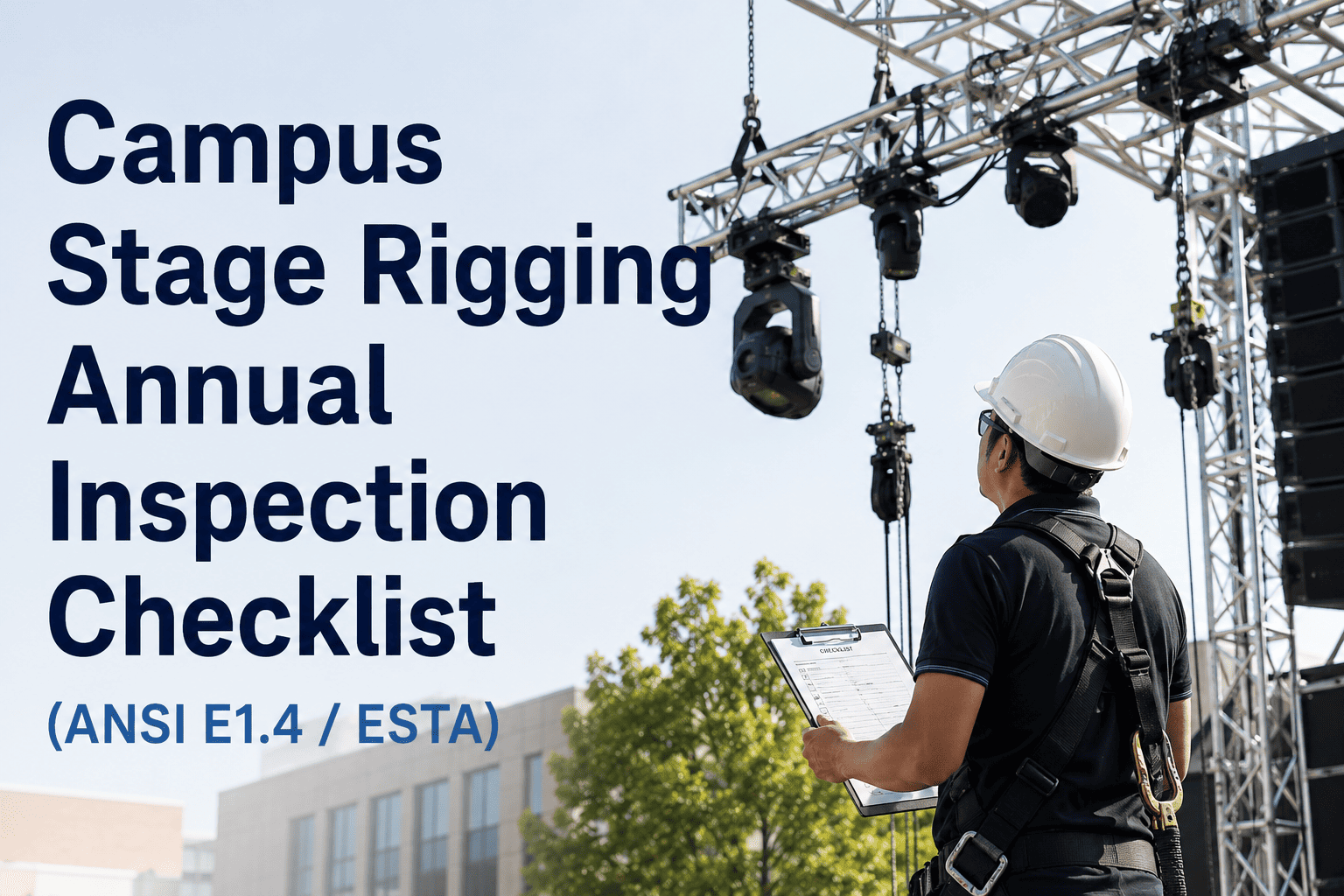
College and university theaters operating fly systems, battens, and counterweight arbors without a documented annual rigging inspection are not managing a performing arts facility — they are managing a liability. Campus stage rigging operates under ANSI E1.4 (Entertainment Technology — Manual Counterweight Rigging Systems) and ESTA standards that require annual inspections by qualified riggers, documented rope lock and arbor assessments, and traceable sign-off records that hold up to institutional safety audits. Whether your performing arts center tracks rigging compliance in paper binders or a digital CMMS like Oxmaint, every facilities and theater operations team needs a structured annual framework covering every critical rigging system — from fly lines and battens to fire curtain mechanisms and loading gallery access to replace paper rigging logs with mobile inspection workflows that timestamp every check, flag overdue annual inspections, and generate audit-ready reports for your campus risk management office. Theater operations managers who with Oxmaint can map every fly system component to a recurring annual work order — so no rigging inspection is missed between production seasons. This checklist follows ANSI E1.4 and ESTA guidance across every rigging subsystem, structured so each check is traceable and ready for your next institutional safety review. Facilities teams that Sign Up Free today give their campus theater a compliance record that satisfies both internal risk audits and third-party rigging inspector requirements.
Campus Theater · ANSI E1.4 · Annual Compliance
Campus Stage Rigging Annual Inspection Checklist (ANSI E1.4 / ESTA)
A system-by-system annual inspection framework for college and university stage rigging — covering fly systems, battens, rope locks, counterweight arbors, wire rope, and CMMS-tracked sign-off records built for performing arts facilities where a missed annual inspection is a safety citation or a production shutdown.
8System Categories
50+Check Points
ANSIE1.4 Aligned
P1Life Safety Priority
High-Risk Zones in a Campus Stage Rigging System
Counterweight ArborsOverloading, guide rail wear, arbor rod corrosion, runaway risk
Wire Rope & Lift LinesBroken wires, kinks, corrosion, improper termination
Rope Locks & Line SetsLock slip, handle wear, improper sequencing under load
Battens & Pipe GridBend, corrosion, clamp loosening, capacity exceedance
Head Block & Loft BlocksSheave wear, bearing failure, mounting bolt torque loss
Loading Gallery AccessGuardrail compliance, fall protection anchors, load path clearance
DDaily
WWeekly
MMonthly
QQuarterly
AAnnual
Oxmaint converts your campus rigging inspection schedule into mobile CMMS workflows — timestamped annual checks, qualified inspector sign-off, and one-click audit reports for your institutional risk office.
System 01
Wire Rope & Lift Line Inspection
Wire rope failure is the highest-consequence failure mode in a manual counterweight fly system. ANSI E1.4 requires annual inspection of all lift lines, purchase lines, and tension lines by a qualified rigger — not a visual check from the stage deck, but a hands-on inspection of every accessible foot of wire rope in the system.
Lift lines inspected for broken wires — each lift line examined for broken wire strands across the full accessible length; any section with more than two broken wires in one lay length, or more than one broken wire at a termination point, taken out of service immediately pending replacement
AQualified Rigger · Wire rope inspection log
Wire rope diameter measured for reduction — any lift line showing diameter reduction greater than 1/3 of original wire diameter from wear or corrosion flagged for immediate replacement; diameter recorded at multiple points along run
AQualified Rigger · Diameter measurement log
Wire rope terminations and end fittings inspected — swaged sleeves, wedge sockets, and thimbles at arbor and batten connections inspected for cracking, slippage indicators, and corrosion; any termination showing deformation removed from service
AQualified Rigger · Termination inspection log
Kinks, bird-caging, and crushing assessed — any kinked, bird-caged, or crushed section of wire rope treated as immediate replacement regardless of visible wire breakage; rope deformation compromises load distribution capacity permanently
AQualified Rigger · Condition assessment log
Purchase line (operating line) condition verified — hemp or synthetic hand-purchase lines inspected for wear, fraying, and UV degradation; lines showing core exposure, flat spots, or splice failure replaced before next production season
AQualified Rigger · Purchase line log
System 02
Counterweight Arbor & Guide Rail Assessment
A counterweight arbor running out-of-balance or on worn guide rails is a runaway hazard during a live production. ANSI E1.4 requires arbor loading records, guide rail condition checks, and arbor rod integrity verification as part of every annual inspection cycle.
Arbor rod condition inspected — all arbor rods examined for bending, corrosion, and thread integrity at top and bottom plate connections; bent rods that prevent smooth arbor travel in guide rails replaced before return to service
AQualified Rigger · Arbor rod inspection log
Guide rail wear and alignment verified — T-bar or channel guide rails inspected for wear pattern, deformation, and mounting hardware torque; guide rail sections showing lateral play greater than manufacturer tolerance flagged for realignment or replacement
AQualified Rigger · Guide rail condition log
Counterweight loading records verified — weight loaded on each arbor documented and confirmed against batten capacity rating; undocumented or unmarked counterweights investigated and weighed before re-approval for use in any line set
ATheater Operations Manager · Arbor loading record
Arbor travel limits and stop hardware confirmed — hard stops at top and bottom of arbor travel present and functional; any missing or damaged stop hardware prevents that line set from returning to service until corrected
AQualified Rigger · Stop hardware log
System 03
Rope Lock & Operating Line Inspection
A rope lock that slips under load during a performance is not an inconvenience — it is a dropped load event. Every rope lock in the fly system must be tested annually for grip retention under load and inspected for worn contact surfaces, damaged handles, and missing safety pins.
Rope lock grip tested under load — each rope lock engaged and tested for slip with a simulated operating load; any lock that allows purchase line movement under load taken out of service and tagged for repair or replacement before use
AQualified Rigger · Rope lock test log
Rope lock contact surfaces and jaws inspected — jaw faces checked for wear, grooving, and contamination that reduces gripping effectiveness; worn jaw sets replaced per manufacturer specification before annual sign-off
AQualified Rigger · Lock condition log
Safety pins and secondary retention hardware verified — locking safety pins on rope lock handles present on all locks; missing safety hardware sourced and installed before return to service; no lock operated without secondary retention in a production environment
AQualified Rigger · Hardware verification log
Operating line sequencing procedures reviewed with fly crew — annual review of correct fly rail operating sequence with all personnel authorized to operate the fly system; any crew member unable to demonstrate correct line set operation procedure removed from authorized list pending retraining
ATheater Operations Manager · Crew competency log
System 04
Head Block, Loft Blocks & Sheave Inspection
Sheave wear and bearing failure in loft and head blocks are silent hazards — wire rope that tracks off a worn sheave groove generates lateral loading that accelerates rope failure. Annual block and sheave inspection is required under ANSI E1.4 because visual checks from the stage deck cannot assess the condition of grooves, bearings, or mounting hardware at height.
Head block sheave grooves inspected for wear — groove depth and profile measured or assessed against wire rope diameter; grooves worn to the point where wire rope contacts the sheave cheeks rather than the groove bottom replaced before annual sign-off
AQualified Rigger · Head block inspection log
Loft block mounting hardware torqued and verified — all loft block mounting bolts checked for torque and lock-nut integrity; any block showing movement or rotation at its mounting point taken out of service until remounted to structural capacity requirements
AQualified Rigger · Block mounting log
Sheave bearing condition assessed — all accessible sheaves rotated by hand to detect bearing roughness, binding, or lateral play; seized or excessively loose bearings replaced to prevent uneven wire rope wear and tracking failure
AQualified Rigger · Bearing condition log
System 05
Batten & Pipe Grid Structural Inspection
Battens loaded beyond their capacity rating or showing structural deformation are not safe to use regardless of how recently the fly system was last inspected. Annual batten inspection requires a physical assessment of every pipe in the system — not just the ones showing visible sag from the stage deck.
Batten straightness and deformation inspected — each batten raised to working height and assessed for lateral bow, permanent set, and out-of-level condition; battens with visible permanent deformation from overloading taken out of service pending engineering assessment
AQualified Rigger · Batten condition log
Batten capacity ratings documented and posted — safe working load for each batten posted at the fly rail; any batten without a documented load rating assigned a rating by a qualified rigger before return to production use
ATheater Operations Manager · Load rating log
Clamp and drop hardware on battens inspected — C-clamps, drop rods, and safety cables on all battens inspected for deformation, thread damage, and missing safety locking collars; any clamp hardware not meeting manufacturer load rating removed from service
QTheater Operations Manager · Hardware inspection log
Lighting bar and electrics batten electrical connections verified — all electrical connectors on electrics battens (1E, 2E, 3E, etc.) inspected for damage, secure mounting, and cable strain relief; any connector showing arcing marks or heat damage taken offline and referred to campus electrician
ACampus Electrician · Electrical batten log
System 06
Fire Curtain (Brail Curtain) & Safety Systems
A fire curtain that fails to deploy during a stage fire is not a maintenance oversight — it is a building code failure with direct life-safety consequences. NFPA 101 and local fire codes require annual operational testing of fire curtains and smoke pocket systems in addition to the ANSI E1.4 rigging inspection cycle.
Fire curtain full-travel deployment test completed — fire curtain released from stored position and allowed to travel fully to the stage floor under its own weight; any hesitation, binding, or failure to reach full close position requires immediate corrective maintenance before approval for next production period
AQualified Rigger · Fire curtain deployment log
Fusible link and automatic release mechanism inspected — fusible links on fire curtain release mechanism present and undamaged; links replaced if any show corrosion, mechanical damage, or have been exposed to heat; automatic release function verified with local fire marshal if required by jurisdiction
AFacilities Manager · Fire safety compliance log
Smoke pocket and proscenium sealing assessed — smoke pockets at proscenium sides and top inspected for seal integrity; gaps or damage that would allow smoke bypass of the fire curtain system documented and submitted as a facilities work order to campus facilities management
AFacilities Manager · Smoke pocket condition log
System 07
Loading Gallery, Fly Rail & Fall Protection
The loading gallery and fly rail are elevated work platforms that fall under OSHA General Industry standards in addition to ANSI E1.4 rigging requirements. Annual inspection must address guardrail integrity, fall protection anchor points, and access ladder condition — not just the rigging hardware at height.
Loading gallery guardrail structural integrity verified — all guardrail sections, top rails, mid-rails, and toe boards inspected for secure attachment, corrosion, and impact damage; any guardrail section that moves or deflects under 200-lb point load test replaced before next loading gallery access
AFacilities Manager · Fall protection inspection log
Fall protection anchor points load-rated and certified — all permanent fall arrest anchor points on loading gallery and above-stage catwalks verified as rated and certified to 5,000 lbs per anchor or 2x maximum arrest force per OSHA 1926.502; uncertified anchors removed from use until structural engineering review
AFacilities Manager · Anchor certification log
Access ladders and stair towers to fly rail inspected — all permanent access ladders to fly rail and loading gallery inspected for rung integrity, side rail condition, and secure mounting; cage guards on fixed ladders above 20 feet verified in place and undamaged
AFacilities Manager · Access ladder inspection log
Fly rail deck surface and lighting conditions assessed — fly rail deck checked for trip hazards, damaged non-slip surface, and adequate lighting for operating personnel; any lighting fixture out on the fly rail or loading gallery submitted as a facilities work order before the next production period
QTheater Operations Manager · Fly rail condition log
System 08
Annual Inspection Sign-Off & CMMS Documentation
An annual rigging inspection without a signed, dated, qualified-rigger report is not a completed inspection — it is an informal walkthrough with no institutional value during an incident investigation. ANSI E1.4 requires that annual inspection results be documented, retained, and accessible to facility management and qualified personnel reviewing the system's status.
Qualified rigger credentials verified and recorded — inspector's name, qualification basis (ETCP certification, employer qualification, or equivalent), and inspection date recorded in CMMS before inspection commences; uninspected systems not approved for production use
ATheater Operations Manager · Inspector credential log
All deficiencies logged as open CMMS work orders — every deficiency identified during the annual inspection entered as a separate work order in Oxmaint with priority, assigned owner, and required completion date; no line set with an open deficiency approved for production loading until work order is closed
AFacilities Manager · CMMS deficiency log
Annual inspection report signed and filed — completed inspection report signed by the qualified rigger and the theater operations manager; report retained for a minimum of five years or two inspection cycles, whichever is longer; digital copy stored in CMMS asset record for the rigging system
ATheater Operations Manager · Annual report log
Next annual inspection date scheduled in CMMS — Oxmaint recurring work order created for following year's annual inspection with 60-day advance notification to theater operations manager and facilities; inspection scheduling not left to memory or academic calendar planning alone
AFacilities Manager · CMMS inspection scheduler
Campus risk management office notified of inspection completion — annual rigging inspection completion report shared with campus risk management and environmental health and safety office; any line sets placed out of service or capacity-reduced documented in the notification
AFacilities Manager · Risk management notification log
Compliance KPIs
Six Metrics That Prove Your Campus Rigging System Is Inspection-Ready
| Metric | How to Measure | Target | Frequency |
| Annual Inspection Completion Rate |
Line sets inspected / Total line sets in system |
100% |
Annual |
| Deficiency Closure Rate |
Closed work orders / Deficiencies identified at inspection |
100% before production |
Post-inspection |
| Wire Rope Replacement Compliance |
Lines replaced per criteria / Lines meeting replacement criteria |
100% |
Annual |
| Rope Lock Pass Rate |
Locks passing grip test / Total rope locks tested |
100% |
Annual |
| Fire Curtain Deployment Test |
Successful full-travel deployments / Tests conducted |
100% |
Annual |
| Inspection Report Retention |
Signed reports on file / Required retention period |
Minimum 5 years |
Ongoing |
Oxmaint tracks every campus rigging inspection interval, assigns qualified rigger work orders, captures deficiency records as structured CMMS data, and schedules your next annual inspection automatically — so no production season begins without a completed rigging sign-off on record.
FAQs
Frequently Asked Questions
How often does ANSI E1.4 require stage rigging inspection in a college theater?
ANSI E1.4 requires a comprehensive inspection of manual counterweight rigging systems at least annually by a qualified rigger. Higher-use facilities or systems with known wear history may require more frequent intervals. Inspection records must be retained and accessible to facility management.
Who qualifies as a qualified rigger for a campus ANSI E1.4 annual inspection?
A qualified rigger under ANSI E1.4 is someone with recognized degree, certificate, or professional standing, plus extensive knowledge and experience in stage rigging systems. ETCP (Entertainment Technician Certification Program) Certified Rigger — Theatre is the most widely recognized credential. Campus facilities managers should document inspector credentials in their CMMS before each annual inspection cycle.
Can a campus theater operate a fly system while annual inspection deficiencies are open?
No. Any line set or rigging component with an open safety deficiency should be taken out of service until the deficiency is corrected and the component is re-approved by a qualified rigger. Operating a deficient line set exposes the institution to both safety risk and liability. Oxmaint can lock out deficient assets in the CMMS until work orders are closed.
How does Oxmaint support ANSI E1.4 annual rigging inspection compliance?
Oxmaint digitizes annual rigging inspection workflows into mobile CMMS checklists with timestamped inspector sign-off, structured deficiency logging, and recurring scheduling for next-cycle inspections. Every inspection record is stored against the rigging system's asset profile and accessible for audit review. Book a Demo to see how campus performing arts facilities use Oxmaint for rigging compliance tracking.
What records should a college theater retain from each annual rigging inspection?
Retain the signed inspection report, inspector credential documentation, a list of all deficiencies identified with corrective action records, and any component replacement records. A minimum five-year retention or two full inspection cycles is a recognized best practice. Oxmaint stores all inspection records centrally with export capability for institutional audits.
ANSI E1.4 · Campus Theater Rigging Compliance
Every Lift Line Logged. Every Deficiency Tracked. Every Annual Inspection Signed Off.
Oxmaint converts your campus stage rigging annual inspection into a structured CMMS workflow — qualified rigger sign-off, deficiency work orders, wire rope replacement records, and next-cycle scheduling in one platform — so your performing arts facility never enters a production season without a completed ANSI E1.4 inspection on record.